Hubbry Logo
Benjamin MilamBenjamin MilamMain
Open search
Benjamin Milam
Community hub
Benjamin Milam
logo
8 pages, 0 posts
0 subscribers
Be the first to start a discussion here.
Benjamin Milam
Benjamin Milam
from Wikipedia

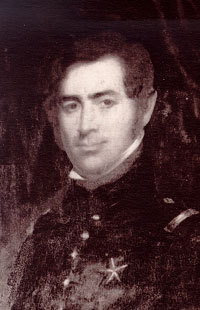
Benjamin Rush Milam (October 20, 1788 – December 7, 1835) was an American colonist of Mexican Texas and a military leader and hero of the Texas Revolution. A native of what is now Kentucky, Milam fought beside American interests during the Mexican War of Independence and later joined the Texians in their own fight for independence, for which he assumed a leadership role. Persuading the weary Texians not to back down during the Siege of Béxar, Milam was killed in action while leading an assault into the city that eventually resulted in the Mexican Army's surrender. Milam County, Texas and the town of Milam are named in his honor, as are many other placenames and civic works throughout Texas.

Key Information

Early life

[edit]

Ben Milam was born in Frankfort, Kentucky on October 20, 1788, when Kentucky was still considered part of Virginia.[1] He was the fifth of six children born to Moses Milam and his wife, Elizabeth Pattie Boyd. Raised in the remote western frontier of the early United States, Milam had little formal schooling. As a young man, he enlisted as a private in the 8th Regiment of the Kentucky Militia and eventually was commissioned a lieutenant. He served in the War of 1812.[2]

Early years in Texas

[edit]

In 1818, after learning of the trading opportunities with the Native Americans living along the upper Red River, Milam traveled from Kentucky to Spanish Texas to trade with the Comanche.[1][2] While there, he met David G. Burnet, who at the time was living with the Indians in an attempt to recover from a case of tuberculosis.[2]

In New Orleans in 1819, Milam met José Félix Trespalacios and James Long, who intended to lead a filibustering expedition to Texas to help Mexican revolutionaries in their ongoing fight for independence from Spain.[2] Milam decided to join the pair on what became known as the Long Expedition.[1][2]

The expedition captured Nacogdoches in the summer of 1819 but fell apart when confronted by a Spanish army. With help from Milam, Long regrouped his forces near Galveston the following year. By 1821, Milam had broken with Long's new expedition. While Long marched to Presidio La Bahía, Milam and Trespalacios traveled to Veracruz and Mexico City; both parties met a hostile reception and were quickly imprisoned.[2] While in prison, Long was mysteriously shot and killed by a guard, and Milam came to believe that the murder had been arranged by Trespalacios. This incident drove Milam and some of his friends to plot to kill Trespalacios, and when that plot was discovered, Milam was again imprisoned.[2]

Milam and his friends were sent to Mexico City, where they were held until the fall of 1822, when Joel R. Poinsett, U.S. Commissioner of Observation to Mexico, secured their freedom. With the exception of Milam, all were returned to the United States on the sloop-of-war USS John Adams.[2]

By the spring of 1824, Milam had returned to Mexico, which was adopting the new republican form of government established by the 1824 Constitution of Mexico. Trespalacios and Milam reconciled, and Milam was granted Mexican citizenship and commissioned as a colonel in the Mexican Army.[1][2]

Texas Revolution

[edit]
Milam joins the Texian soldiers

In 1825, Milam and Arthur G. Wavell, an English general in the Mexican Army, became partners in a silver mine operation in Nuevo León. The two also obtained empresario grants in Texas. In 1829, Milam sought to organize a new mining company in partnership with David G. Burnet, but their efforts failed due to a lack of funds. Milam and Wavell's empresarial efforts also failed when their contract was canceled by the Mexican government for an insufficient supply of new citizens for their colony in Texas, following a new law passed in 1830.[2]

In 1835, Milam went to Monclova, the capital of Coahuila y Texas, to urge the new governor, Agustín Viesca, to send a land commissioner to Texas to provide settlers there with land titles. However, before Milam could leave the city, word arrived that Mexican President Antonio López de Santa Anna had overthrown the representative federal government and established a dictatorship.[1] Governor Viesca fled with Milam, but both were captured and imprisoned at Monterrey. Milam eventually escaped thanks to sympathetic jailers, who also supplied him with a horse.[2]

By chance, Milam encountered a company of Texian soldiers commanded by George Collinsworth, from whom he learned of the movement for independence in Texas. Milam joined them, helping to capture Goliad on October 10, 1835.[2] He wrote: "I assisted Texas to gain her independence. I have endured heat and cold, hunger and thirst; I have borne losses and suffered persecutions; I have been a tenant of every prison between this and Mexico. But the events of this night have compensated me for all my losses and all my sufferings."

Siege of Béxar

[edit]

He then joined the main Texian Army in its attempt to expel all Mexican forces from Texas by capturing San Antonio in the ongoing Siege of Béxar. While returning from a scouting mission in the southwest on December 4, 1835, Milam learned that a majority of the army was considering retreating into winter quarters instead of continuing on with the planned attack on San Antonio.[2]

Commander Edward Burleson and his council of officers were reluctant to attack, and the next day at 3 PM, Milam went to Burleson's tent to ask permission to call for volunteers to storm the city. Burleson had little choice but to go along with Milam's plan. Milam was convinced that putting off the final assault on San Antonio would be a disaster for the cause of independence.[2] He then made his famous impassioned plea: "Who will go with old Ben Milam into San Antonio?" Three hundred men cheered their support for Milam and volunteered to attack at dawn on December 5.[1][2]

Plans were quickly made for a two-column surprise attack. The volunteers would form at an abandoned mill, Molino Blanco or Zambrano's mill, at 3 AM, while Burleson would hold the rest of the army in reserve. At the same time, Captain James C. Neill would open fire on the Alamo, the center of the Mexican Army's defensive position, with two cannons to distract the Mexican soldiers. Early on December 5, Colonel Milam and Colonel Frank W. Johnson each led a column of attackers into the heavily fortified city, where they eventually seized a foothold and entrenched their position overnight.[citation needed]

On December 7, 1835, the Texians renewed the attack and progressed further into the city, capturing another foothold, but Milam was killed while leading the attack. Standing with Johnson and Henry Karnes near the Veramendi house, Milam had been trying to observe the San Fernando church tower with a field telescope given to him by Stephen F. Austin when he was shot in the head by a Mexican rifleman and killed instantly.[1][2] He fell into the arms of Samuel Maverick. Robert Morris was chosen to take over Milam's command of the first division.[citation needed]

The Mexican Army lost more than 400 killed, deserted, or wounded in the ensuing battle. Texian losses were only 20 to 30 killed. The siege ended on December 9, 1835, when General Martín Perfecto de Cos sent a subordinate to negotiate a truce with the Texians. Morris gave Cos and his troops six days to leave the Alamo. Burleson provided the Mexican Army with as many supplies as he could spare, and the Mexican wounded were allowed to remain behind to be treated by Texian doctors.

Memorials

[edit]
A monument to Benjamin Milam located in modern-day Downtown San Antonio
  • In 1897, the Daughters of the Republic of Texas placed a marker on Milam's grave site at Milam Park, San Antonio; the marker was moved in 1976 and the location of the grave was forgotten until it was found again in 1993.[2] The statue facing the grave is by Bonnie MacLeary.[3]
  • On July 17, 1938, a statue of Milam was unveiled at the Milam County Courthouse in Cameron, Texas.
  • Many places in Texas are named for Milam, including the Ben Milam Hotel and Milam Street in Houston and the Milam Building in San Antonio.

References

[edit]

Further reading

[edit]
[edit]
Revisions and contributorsEdit on WikipediaRead on Wikipedia
from Grokipedia
Benjamin Rush Milam (October 20, 1788 – December 7, 1835) was an American frontiersman, colonizer, and military commander who advanced Anglo-American settlement in Mexican Texas through empresario contracts and led a pivotal volunteer force during the Texas Revolution. In 1826, Milam secured an empresario grant to introduce 300 families between the Guadalupe and Colorado rivers north of the San Antonio Road, resulting in the issuance of 53 land titles to settlers by 1835. During the Siege of Béxar in December 1835, he rallied approximately 300 volunteers with the challenge "Who will go with old Ben Milam into San Antonio?" and directed the storming of the Mexican-held city, only to be fatally shot in the head by a sniper on the second day of the assault. Born in , to Moses and Elizabeth Pattie (Boyd) Milam as the fifth of six children, he received minimal formal education and served in the Kentucky militia during the before venturing westward. Milam engaged in trade with Indians along the in 1818 and later partnered with Arthur G. Wavell from 1825 to 1829 on colonization grants and silver mining ventures, while also clearing the Red River raft to facilitate navigation via the vessel . His leadership in the successful capture of temporarily secured Texian control over the region, marking a key early victory in the push for independence from , though his remains were not rediscovered until 1993.

Early Life and Frontier Beginnings

Birth and Family in Kentucky

Benjamin Rush Milam was born on October 20, 1788, in , to Moses Milam and Elizabeth Pattie (Boyd) Milam. He was named after , the prominent physician and signer of the Declaration of Independence. As the fifth of six children in the Milam family, Benjamin grew up in a frontier environment typical of late 18th-century , where his parents had settled after origins tracing back to . Moses Milam, born around 1751, had migrated westward with his family, engaging in farming and militia service amid the region's conflicts with Native American tribes and British forces during the Revolutionary War era. Elizabeth Pattie Boyd Milam, his wife, came from a similarly pioneering lineage, with roots in . The family's circumstances provided limited opportunities for formal education, leaving young Benjamin with scant schooling before he entered military service in the Kentucky militia as a teenager. This upbringing instilled an early independence that characterized his later ventures.

Migration to Louisiana and Initial Frontier Activities

Following his brief enlistment in the Kentucky militia and service during the early months of the , Benjamin Milam relocated from , to , sometime after 1815, seeking opportunities in the expanding economy. In , he pursued mercantile endeavors, partnering in a venture to transport and sell flour abroad; the expedition sailed to , , but encountered severe setbacks, including a among the crew and a tropical storm that wrecked the ship, forcing the survivors to return destitute. By 1818, Milam had shifted his focus to the southwestern borderlands, conducting trade expeditions into Spanish-controlled territory from bases in and adjacent areas. He exchanged goods such as ammunition, cloth, and ironware with Indians near the headwaters of the , navigating hostile terrain and indigenous networks to establish commercial contacts amid ongoing Anglo-Spanish tensions. These overland forays, often launching from frontier outposts like Natchitoches, exposed him to the risks of , skirmishes with Spanish patrols, and alliances with local tribes, laying the groundwork for his later involvements. Milam's Louisiana-based operations reflected the broader pattern of early 19th-century American expansionism, where private traders blurred lines between commerce and incursion into Spanish domains, driven by profit and anti-colonial sentiments rather than formal government sanction. His adaptability in these volatile environments—managing logistics across rivers like the Red and Sabine—demonstrated the self-reliant of entrepreneurs, though such activities frequently invited legal repercussions from Spanish authorities.

Filibustering Expeditions Against Spanish Rule

Gutiérrez-Magee Expedition (1812–1813)

The Gutiérrez-Magee Expedition, also known as the Magee-Gutiérrez Expedition, was an early filibustering incursion into launched in 1812 amid the broader against Spain. Organized primarily in , it sought to exploit revolutionary fervor by overthrowing Spanish authority in the province and establishing a republican government. José Bernardo Maximiliano Gutiérrez de Lara, a Mexican revolutionary exiled after failed uprisings, collaborated with Augustus William Magee, a U.S. Army lieutenant who resigned his commission to lead the military effort. On August 8, 1812, approximately 130 men—mostly Anglo-American volunteers supplemented by Mexican exiles—crossed the Sabine River into , raising a green flag symbolizing independence. The expedition advanced rapidly with minimal resistance, capturing Nacogdoches on August 12, 1812, after a brief skirmish with Spanish forces. Recruiting locals and deserters along the way, the filibusters grew to around 300 men by late 1812. They bypassed Trinidad de Salcedo, the Spanish provincial capital, and marched on La Bahía (Presidio La Bahía at Goliad), which fell on November 7, 1812, yielding valuable supplies and . Magee established a there, issuing the first Texas republican constitution on November 15, 1812, which promised land grants and protections to participants. However, internal tensions arose over Gutiérrez's radical proposals, including executing Spanish officials, leading to a temporary split where some forces under Samuel Kemper retreated to . Magee died of illness on February 6, 1813, prompting Kemper's resignation and Henry Perry's assumption of command, later joined by the more authoritarian José Álvarez de Toledo y Dubois. Reinforced to about 800 men, including and additional Anglo recruits, the expedition resumed operations in early 1813. On March 29, 1813, they decisively defeated a Spanish force of 1,200 at the Battle of Rosillo Creek near , killing or capturing most royalists with fewer than 100 casualties. This victory prompted the surrender of on April 1, 1813, where Governor Manuel María de Salcedo and other officials were executed under Toledo's orders, an act that alienated potential allies and drew condemnation from U.S. observers like diplomat William Shaler for its brutality. Further success came on June 20, 1813, at the Battle of Alazán, routing 900 royalists. Yet overextension and Spanish reinforcements under General Joaquín de Arredondo led to disaster at the on August 18, 1813—the bloodiest engagement in history up to that point—where filibusters suffered near-total annihilation, with estimates of 300–400 killed and survivors hunted down in reprisals that executed 327 prisoners. The expedition's failure stemmed from logistical strains, leadership disputes, and underestimation of Spanish resilience, but it demonstrated Texas's vulnerability to external incursions and inspired subsequent filibustering attempts by fostering anti-Spanish sentiment among Anglo settlers. While it briefly controlled much of East and , the harsh royalist response, including property confiscations and executions, suppressed unrest temporarily but sowed seeds for future independence movements. No direct participation by Benjamin Milam is recorded in contemporary accounts, though exemplified the era's opportunistic ventures that later drew figures like him into similar anti-Spanish activities.

Subsequent Ventures, Capture, and Imprisonment

Following the collapse of the Gutiérrez-Magee Expedition in 1813, Milam engaged in trading activities along the Texas frontier before joining a subsequent filibustering effort led by James Long in 1819. In New Orleans that year, Milam allied with Long and José Félix Trespalacios, who aimed to invade Texas, capture key presidios, and support Mexican independence from Spain by establishing a provisional government. Commissioned as a colonel by this insurgent council, Milam participated in efforts to reorganize filibuster forces, including revitalizing the Supreme Council of Texas at Point Bolivar in April 1820. While Long advanced overland with a small force and briefly captured La Bahía (Presidio Goliad) on October 4, 1821, only to surrender four days later to superior Spanish troops under Colonel Ignacio Pérez, Milam accompanied Trespalacios by sea to . Upon arrival amid ongoing royalist control, they encountered fierce opposition; the pair was seized by Spanish authorities and transported to for imprisonment, where they joined other captured filibusters including Long, who was later executed by a guard in April 1822 under suspicious circumstances. Milam's confinement in stemmed directly from the expedition's failure and perceived threats to Spanish sovereignty, lasting until November 1822, when U.S. President James Monroe's special envoy to Mexico, Joel R. Poinsett, intervened diplomatically to secure his release along with Trespalacios. Suspecting Trespalacios's complicity in Long's death, Milam briefly plotted his assassination post-release, but the scheme was uncovered, resulting in a short additional in during 1822; Poinsett again facilitated his liberation, allowing Milam to depart for the by early 1823. These events marked the end of his overt filibustering phase, as Spanish vigilance and personal reversals deterred further armed incursions until Mexican independence stabilized.

Settlement and Activities in Mexican Texas

Arrival and Initial Land Claims

Benjamin Milam made his initial incursion into Texas in 1818, traveling to the headwaters of the to conduct trade with Indians. During this expedition, he encountered , a fellow frontiersman who would later become a key figure in Texas independence efforts. This venture highlighted Milam's familiarity with the region's indigenous networks and its potential for commerce, though it did not result in permanent settlement at the time. In 1820, Milam joined James Long's filibustering expedition against Spanish control, landing at Bolivar Point on with the intent to establish a base for revolutionary activities. The effort collapsed amid internal discord and Spanish countermeasures, but it reinforced Milam's interest in as a domain for economic and political opportunity. Following his release from Mexican imprisonment in 1824, Milam secured Mexican citizenship on June 24 of that year, a prerequisite for legal land ownership under Mexican law. This status enabled his subsequent pursuits in , though records indicate no formalized personal land grants prior to 1826; instead, his early efforts centered on reconnaissance and alliance-building to support future colonization. One reported claim from this period was later invalidated when U.S. engineers determined in 1827 that surveyed lands attributed to him fell within , outside jurisdiction.

Empresario Role and Colonization Efforts

In 1826, Benjamin Rush Milam secured an empresario contract from the Mexican government authorizing him to settle 300 families in an area between the Guadalupe and rivers, north of the Road. He partnered with Arthur G. Wavell, another , and served as agent for Wavell's proposed while overseeing recruitment for his own grant; Robert M. Williamson acted as agent for Milam's colony. Milam focused on soliciting settlers from the , including efforts to clear navigational obstacles by removing a from the Red River and acquiring the steamboat to facilitate transport. These initiatives faced significant barriers, particularly the Mexican , which banned immigration from the and other Anglo-American sources, drastically reducing the pool of potential colonists. By 1832, Milam and Wavell's contracts lapsed without fulfilling the required settler quotas, leading to their cancellation by Mexican authorities. Despite the overall shortfall, land commissioner Talbot Chambers issued 53 titles within Milam's designated territory in 1835, indicating limited but incomplete settlement activity. Milam later advocated for validating existing claims and issuing titles to preempt further disputes amid rising tensions. The failure of these ventures stemmed primarily from external policy constraints rather than lack of initiative, though Milam's financial strains and the remote, frontier nature of the lands compounded recruitment challenges; no large-scale colony materialized under his auspices.

Trading, Mining, and Financial Struggles

Upon arriving in in the early , Milam engaged in trading activities, including commerce with Indians along the in 1818, where he first encountered future partner . These efforts supplemented his income amid unstable frontier conditions but yielded limited long-term gains. Milam's mining pursuits began in earnest through a partnership with British colonel Arthur G. Wavell, securing a silver mine concession in , , around 1825–1826; the operation was leased to an English mining company, which defaulted on its contract by 1828, resulting in financial loss. In 1829, he attempted to launch another mining enterprise with Burnet, proposing investments in Mexican prospects, but the venture collapsed due to insufficient capital raised. These failures, compounded by a brief, unsuccessful timber operation along the Trinity River, eroded his resources without recoverable returns. As an , Milam received a contract on January 12, 1826, to introduce 300 families between the Guadalupe and rivers north of the San Antonio Road, obligating him to front settlement costs in exchange for premium lands. He also acted as agent for Wavell's Red River contract to settle 500 families. To facilitate access, Milam organized the partial removal of the obstruction on the Red River in 1831 and acquired the steamboat for navigation, incurring further expenses. However, Mexico's , banned further Anglo-American immigration, preventing quota fulfillment; both contracts expired unrenewed in 1832, leaving Milam with unrecouped investments and mounting debts from promotional travels and outlays. These setbacks, absent successful colonization premiums or mining yields, plunged him into chronic financial distress by the mid-1830s, prompting desperate measures to reclaim fortunes in .

Role in the Texas Revolution

Buildup to Armed Conflict

In early 1835, as Mexican President Antonio López de Santa Anna consolidated centralist power by dissolving the federalist Congress of Coahuila y Texas and arresting officials, Benjamin Milam traveled to Monclova to address unresolved land title disputes for Texas colonists. There, he petitioned the newly elected federalist governor, Agustín Viesca, to dispatch a land commissioner to validate settler claims under earlier empresario contracts, reflecting Milam's ongoing financial interests tied to his 1825 colonization contract with the state. Viesca consented to the request on May 25, 1835, but Santa Anna's forces soon intervened, arresting Viesca on June 3 and nullifying the federalist administration, which thwarted the commission and escalated grievances among Anglo settlers over property rights and autonomy. Milam, entangled in the deteriorating political climate, faced detention in Monterrey under Mexican authorities amid the crackdown on federalist sympathizers, but he escaped and reentered by early October 1835, coinciding with the outbreak of open hostilities following the on October 2. Upon his return, he aligned with pro-independence volunteers, joining Captain George M. Collinsworth's company of approximately 125 men advancing on the Mexican garrison at in Goliad. On October 9, Milam encountered the group en route and participated in the assault, contributing to the fort's capture on October 10 after brief resistance from its 44 Mexican defenders, marking an initial Texian success that secured supplies and boosted revolutionary momentum. After Goliad, Milam integrated into the provisional Texian army under , marching northwest toward de Béxar with combined forces exceeding 300 men to confront General Martín Perfecto de Cos's approximately 1,000 troops entrenched there. During the ensuing from October 12, Milam served as a scout, conducting reconnaissance missions to assess Mexican positions and supply lines, while the army established a loose that strained Cos's resources amid internal Texian debates over and enlistments. These efforts, amid broader unrest from events like the , positioned Milam to advocate for decisive action when volunteer morale waned in late , setting the stage for intensified urban combat.

Rallying Volunteers for the Siege of Béxar

By early December 1835, the Texian besieging de Béxar had stalled in its efforts against Mexican forces under General , with morale waning and discussions of withdrawal to Goliad emerging among leaders like . Benjamin R. Milam, serving as co-commander alongside Francis W. Johnson, intervened decisively on to rally troops for a direct assault on the city. Standing before the assembled volunteers, Milam issued his famous challenge: "Who will go with old Ben Milam into ?" This impassioned call succeeded in recruiting more than 300 men, who volunteered to divide into two columns under Milam and William Gordon Cooke for the attack, while Burleson maintained lines with approximately 400 others. The volunteers' commitment stemmed from Milam's reputation as a seasoned fighter and his prior experiences in expeditions against Spanish and rule, which lent credibility to his leadership despite the risks of urban combat against entrenched defenders. The assault commenced at dawn on December 5, 1835, with Milam's division advancing house-to-house through Béxar, employing axes to breach walls and facing sniper fire from Mexican troops. This volunteer-led push culminated in Cos's surrender on December 9, securing Texian control of the city and averting a potential retreat that could have undermined the revolutionary momentum. Milam's rally thus proved pivotal in transforming a protracted siege into a , though it came at the cost of his life during the fighting.

Death in Combat and Tactical Impact

On December 5, 1835, during the Siege of Béxar, Milam volunteered to lead an assault on the Mexican-held town of de Béxar, rallying over 300 Texian fighters with the call, "Who will go with old Ben Milam into the city of Bexar?" He divided the force into two columns—one under his command and the other under Colonel —to advance house-to-house against General Martín Perfecto de Cos's garrison of approximately 1,200 Mexican troops entrenched in the city. By , after two days of intense that resulted in Texian captures of key positions like the Veramendi Palace, Milam was directing operations from the Veramendi house when a Mexican 's bullet struck him in the forehead, killing him instantly. The , positioned in a nearby tree or building, targeted Milam as he moved between command points amid ongoing skirmishes that had already cost the Texans two killed and 26 wounded. Milam's death did not halt the assault; Colonel Francis W. Johnson assumed command and pressed night attacks, leading to Cos's surrender on after Mexican losses of about 50 killed and the evacuation of under terms allowing Cos's forces to retreat to the . Tactically, Milam's initiative overcame Texian hesitancy to storm the fortified city—despite ammunition shortages and a prolonged since October—securing a key early victory that expelled a major Centralist from territory, boosted volunteer recruitment, and temporarily neutralized as a base for Santa Anna's later advance. This success, however, dispersed Texian forces across captured Mexican supplies and prisoners, contributing to defensive vulnerabilities at the Alamo in subsequent months.

Personal Traits and Contemporaneous Views

Lifestyle, Relationships, and Unmarried Status

Benjamin Rush Milam, born on October 20, 1788, in , to Moses Milam and Elizabeth Pattie Boyd, grew up in a environment with little to no formal education, reflecting the limited schooling opportunities of early American settlers. His lifestyle was marked by constant mobility and rugged self-reliance, involving extensive travel across , , , and for trading, mining, and exploratory ventures, often in partnership with figures like and Arthur G. Wavell. Years of horseback riding left him bow-legged and occasionally reliant on a cane in later life, underscoring the physical demands of his peripatetic existence as a trader with Indians and filibusterer. Milam's personal relationships centered on familial ties and professional alliances rather than domestic partnerships; he maintained friendships forged through shared hardships, such as his 1818 acquaintance with Burnet during Comanche trade expeditions and a reconciled association with José Félix Trespalacios after earlier tensions. Accounts suggest a romantic engagement to Annie McKinney, which dissolved after his three-year absence without communication, leading her to marry another; Milam reportedly redirected gifts intended for her to her sister Elizabeth, who wed his nephew Jefferson Milam. Milam remained unmarried throughout his life, a status attributed in some historical narratives to his unwavering devotion to Texas colonization efforts, and he had no known children or direct descendants. This childless and single state aligned with his prioritization of entrepreneurial and revolutionary pursuits over settled family life, consistent with biographical records lacking any record of matrimony.

Character Assessments: Boldness Versus Recklessness

Benjamin Rush Milam exhibited boldness through his decisive leadership during the Siege of Béxar in December 1835, when he challenged younger officers' reluctance to assault by rallying approximately 300 volunteers with , "Who will go with old Ben Milam into ?" This initiative, undertaken at age 47, overcame strategic hesitation and led to the successful capture of garrison on December 9, 1835, demonstrating calculated risk in pursuit of revolutionary objectives. Earlier, Milam's participation in filibustering expeditions, such as the 1819 venture with James Long to support Mexican independence from , underscored his willingness to engage in high-stakes actions against entrenched powers, earning him a commission as a in the Mexican army by 1824. Aspects of Milam's conduct, however, invited assessments of recklessness, particularly his 1822 plot to assassinate José Félix Trespalacios, whom he suspected of orchestrating James Long's execution; this vendetta resulted in Milam's arrest and two years' imprisonment in until his release in 1824. His entrepreneurial pursuits similarly reflected imprudent overextension, as evidenced by failed mining partnerships, such as the 1829 collaboration with , and his inability to fulfill colonization contracts granting 100 leagues of land for failing to deliver the required 800 families by the deadlines imposed by the Law of April 6, 1830. These ventures, while ambitious, contributed to chronic financial distress, suggesting a pattern of pursuing opportunities without adequate contingency planning. Historians generally portray Milam as an intrepid figure whose boldness catalyzed key victories, as in contemporary accounts crediting his "daring" assault for shifting momentum in the , yet acknowledge imprudence in personal and financial domains that amplified risks without proportional safeguards. This duality—strategic audacity in combat versus impulsive vendettas and speculative failures—distinguishes Milam's character as embodying frontier-era resolve tempered by occasional lapses in foresight, with his death by sniper fire on December 7, 1835, during the Bexar operation encapsulating both heroism and exposure to unnecessary peril.

Legacy and Memorials

Place Names, Monuments, and Recent Preservation Efforts

, established in 1837, was named in honor of Benjamin Rush Milam shortly after his death in the . Other locations bearing his name include Milam Park in , originally a burial ground established in 1884 where Milam's remains were reinterred. Streets such as Milam Street in and , along with the historic Milam Building in , also commemorate him. Monuments dedicated to Milam feature prominently in Texas. In Milam Park, a monument erected by the Daughters of the in 1897 marks his gravesite, with his remains interred beneath it following exhumation from an earlier location. A bronze of Milam stands at 500 West Houston Street in , depicting him in a dynamic pose and installed as part of the Texas Centennial celebrations in 1936 to symbolize Anglo settlement achievements. Another resides on the grounds of the Milam County Courthouse in Cameron, . Recent preservation efforts have focused on maintaining these sites. The Ben Milam Statue in was listed on the on August 27, 2020, recognizing its cultural significance. Archaeological monitoring accompanied stabilization work at Milam's grave in Milam Park, ensuring the integrity of the burial site during maintenance. In Milam County, the Historical Commission's Preservation Trust Fund supports broader heritage initiatives, including those related to Milam's legacy.

Historical Evaluations: Heroism in Expansion Versus Invader Perspectives

In Texan , Benjamin Milam is portrayed as a paragon of heroism, embodying the settler drive for and territorial expansion against perceived Mexican tyranny. His leadership during the Siege of Béxar, where he rallied approximately 300 volunteers on December 4, 1835, with the call "Who will go with old Ben Milam into ?", culminated in the expulsion of General Martín Perfecto de Cos's forces by December 10, securing a vital early victory for Texian independence. Milam's death from a wound on December 7, 1835, during the house-to-house fighting amplified his mythic status, symbolizing sacrificial boldness in advancing Anglo-American settlement, republican governance, and economic opportunities in fertile lands previously under sparse Mexican control. This narrative privileges the causal role of grievances—such as the 1830 immigration ban and abolition of in 1829—as triggers for rebellion, framing expansion as a natural extension of pioneer enterprise rather than unprovoked aggression. Mexican historical perspectives, by contrast, evaluate Milam as a and invader whose career exemplified Anglo-American encroachment on sovereign territory. His participation in expeditions like James Long's 1819–1821 incursion against Spanish (later ) holdings in marked him as an early disruptor, motivated by land speculation and anti-centralist intrigue rather than loyalty to under which he briefly operated as an from 1825 until contract revocation in 1826 for non-performance. These views, rooted in accounts of repeated U.S.-backed , depict the as a culmination of illegal settlement, violation of colonization pacts requiring and bans, and covert plots, with Milam's 1835 assault on Béxar seen as treasonous rebellion by granted colonists who prioritized U.S. ties and chattel labor over law. Empirical data on settler demographics—over 20,000 Anglos by 1835 versus fewer than 5,000 —underscore the demographic imbalance fueling fears of disloyalty, though sometimes overlooks internal fractures under Santa Anna's 1834 coup as contributory causes. Indigenous evaluations, though sparsely documented for Milam specifically, align with broader critiques of expansionist heroism as invasive dispossession, as advances displaced tribes like the and Karankawa through land grants and militia actions that prioritized settler security over native treaties. Milam's pre-revolutionary trading with and warnings of Mexican alliances with them reflect pragmatic frontier realism, yet his role in securing [San Antonio](/page/San Antonio) facilitated subsequent U.S.-style settlement that eroded indigenous autonomy via attrition and conflict, with Indian population declining sharply post-1836 amid raids and reservations failures. Modern reassessments, often from academia emphasizing decolonial lenses, critique the hero-invader binary by highlighting causal drivers like slavery's economic imperative—Milam's own speculative ventures tied to lands—but such analyses warrant scrutiny for potential overemphasis on ideological narratives at the expense of primary accounts of mutual hostilities between Mexican forces and Texian volunteers.

References

Add your contribution
Related Hubs
User Avatar
No comments yet.