
Recent from talks
Berlin Blockade
Knowledge base stats:
Talk channels stats:
Members stats:
Berlin Blockade
The Berlin Blockade (24 June 1948 – 12 May 1949) was one of the first major international crises of the Cold War. During the multinational occupation of post–World War II Germany, the Soviet Union blocked the Western Allies' railway, road, and canal access to the sectors of Berlin under Western control. The Soviets offered to drop the blockade if the Western Allies withdrew the newly introduced Deutsche Mark from West Berlin.
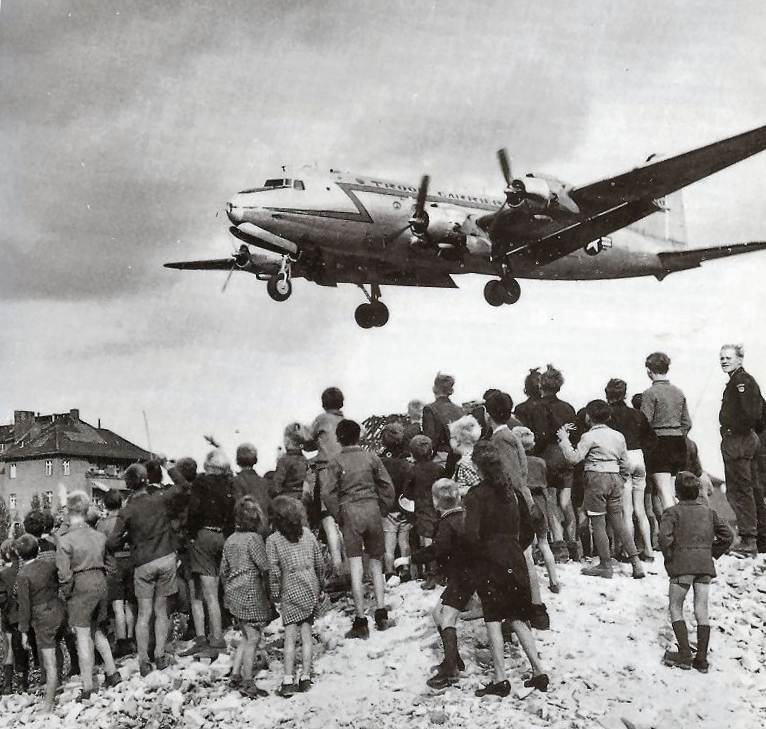
The Western Allies organised the Berlin Airlift (German: Berliner Luftbrücke, lit. "Berlin Air Bridge") from 26 June 1948 to 30 September 1949 to carry supplies to the people of West Berlin, a difficult feat given the size of the city and the population. American and British air forces flew over Berlin more than 250,000 times, dropping necessities such as fuel and food, with the original plan being to lift 3,475 tons[clarification needed] of supplies daily.[citation needed] By the spring of 1949, that number was often met twofold, with the peak daily delivery totalling 12,941 tons. Among these was the work of the later concurrent Operation Little Vittles in which candy-dropping aircraft dubbed "raisin bombers" generated much goodwill among German children.
Having initially concluded there was no way the airlift could work, the Soviets found its continued success an increasing embarrassment.[citation needed] On 12 May 1949, the USSR lifted the blockade of West Berlin, due to economic issues in East Berlin, although for a time the Americans and British continued to supply the city by air as they were worried that the Soviets would resume the blockade and were only trying to disrupt Western supply lines. The Berlin Airlift officially ended on 30 September 1949 after fifteen months. The US Air Force had delivered 1,783,573 tons (76.4% of total) and the RAF 541,937 tons (23.3% of total), totalling 2,334,374 tons, nearly two-thirds of which was coal, on 278,228 flights to Berlin. In addition Canadian, Australian, New Zealand and South African air crews assisted the RAF during the blockade. The French also conducted flights, but only to provide supplies for their military garrison.
American C-47 and C-54 transport airplanes, together, flew over 92,000,000 miles (148,000,000 km) in the process, almost the distance from Earth to the Sun. British transports, including Handley Page Haltons and Short Sunderlands, flew as well. At the height of the airlift, one plane reached West Berlin every thirty seconds.
Seventeen American and eight British aircraft crashed during the operation. A total of 101 fatalities were recorded as a result of the operation, including 40 Britons and 31 Americans, mostly due to non-flying accidents.
The Berlin Blockade served to highlight the competing ideological and economic visions for postwar Europe. It played a major role in aligning West Berlin with the United States and Britain as the major protecting powers, and in drawing West Germany into the NATO orbit several years later in 1955.
From 17 July to 2 August 1945, the victorious Allies reached the Potsdam Agreement on the fate of postwar Europe, calling for the division of defeated Germany, west of the Oder-Neisse line, into four temporary occupation zones each one controlled by one of the four occupying Allied powers: the United States, the United Kingdom, France and the Soviet Union (thus re-affirming principles laid out earlier by the Yalta Conference). These zones were located roughly around the then-current locations of the allied armies. All four zones would be treated as single economic unit through the Allied Control Council (consisting of the military governors of each zone) located in Berlin. Berlin was also divided into four occupation zones, despite the city's location, 100 miles (160 km) inside Soviet-controlled eastern Germany. The United States, United Kingdom, and France controlled western portions of the city, while Soviet troops controlled the eastern sector.
Each military governor had ultimate authority in his zone which meant the Allied Control Council had to have unanimous agreement. The Allied Western powers never explicitly agreed with the Soviet Union that they had right of access to Berlin. There was only a verbal agreement between Marshal Georgi K. Zhukov, the Soviet commander in Germany, General Lucius D. Clay, Commander in Chief, United States Forces in Europe, and Sir Robert Weeks, representative of the British government. On 30 November 1945, the Allied Control Council in Berlin approved the only written agreement regarding transportation to Berlin from the West. This gave allowance for three 20-mile-wide air corridors between the city and West Germany for French, British and American planes. Also stipulated in the agreement was for Berlin airspace to be controlled by a four-power Air Safety Centre.
Hub AI
Berlin Blockade AI simulator
(@Berlin Blockade_simulator)
Berlin Blockade
The Berlin Blockade (24 June 1948 – 12 May 1949) was one of the first major international crises of the Cold War. During the multinational occupation of post–World War II Germany, the Soviet Union blocked the Western Allies' railway, road, and canal access to the sectors of Berlin under Western control. The Soviets offered to drop the blockade if the Western Allies withdrew the newly introduced Deutsche Mark from West Berlin.
The Western Allies organised the Berlin Airlift (German: Berliner Luftbrücke, lit. "Berlin Air Bridge") from 26 June 1948 to 30 September 1949 to carry supplies to the people of West Berlin, a difficult feat given the size of the city and the population. American and British air forces flew over Berlin more than 250,000 times, dropping necessities such as fuel and food, with the original plan being to lift 3,475 tons[clarification needed] of supplies daily.[citation needed] By the spring of 1949, that number was often met twofold, with the peak daily delivery totalling 12,941 tons. Among these was the work of the later concurrent Operation Little Vittles in which candy-dropping aircraft dubbed "raisin bombers" generated much goodwill among German children.
Having initially concluded there was no way the airlift could work, the Soviets found its continued success an increasing embarrassment.[citation needed] On 12 May 1949, the USSR lifted the blockade of West Berlin, due to economic issues in East Berlin, although for a time the Americans and British continued to supply the city by air as they were worried that the Soviets would resume the blockade and were only trying to disrupt Western supply lines. The Berlin Airlift officially ended on 30 September 1949 after fifteen months. The US Air Force had delivered 1,783,573 tons (76.4% of total) and the RAF 541,937 tons (23.3% of total), totalling 2,334,374 tons, nearly two-thirds of which was coal, on 278,228 flights to Berlin. In addition Canadian, Australian, New Zealand and South African air crews assisted the RAF during the blockade. The French also conducted flights, but only to provide supplies for their military garrison.
American C-47 and C-54 transport airplanes, together, flew over 92,000,000 miles (148,000,000 km) in the process, almost the distance from Earth to the Sun. British transports, including Handley Page Haltons and Short Sunderlands, flew as well. At the height of the airlift, one plane reached West Berlin every thirty seconds.
Seventeen American and eight British aircraft crashed during the operation. A total of 101 fatalities were recorded as a result of the operation, including 40 Britons and 31 Americans, mostly due to non-flying accidents.
The Berlin Blockade served to highlight the competing ideological and economic visions for postwar Europe. It played a major role in aligning West Berlin with the United States and Britain as the major protecting powers, and in drawing West Germany into the NATO orbit several years later in 1955.
From 17 July to 2 August 1945, the victorious Allies reached the Potsdam Agreement on the fate of postwar Europe, calling for the division of defeated Germany, west of the Oder-Neisse line, into four temporary occupation zones each one controlled by one of the four occupying Allied powers: the United States, the United Kingdom, France and the Soviet Union (thus re-affirming principles laid out earlier by the Yalta Conference). These zones were located roughly around the then-current locations of the allied armies. All four zones would be treated as single economic unit through the Allied Control Council (consisting of the military governors of each zone) located in Berlin. Berlin was also divided into four occupation zones, despite the city's location, 100 miles (160 km) inside Soviet-controlled eastern Germany. The United States, United Kingdom, and France controlled western portions of the city, while Soviet troops controlled the eastern sector.
Each military governor had ultimate authority in his zone which meant the Allied Control Council had to have unanimous agreement. The Allied Western powers never explicitly agreed with the Soviet Union that they had right of access to Berlin. There was only a verbal agreement between Marshal Georgi K. Zhukov, the Soviet commander in Germany, General Lucius D. Clay, Commander in Chief, United States Forces in Europe, and Sir Robert Weeks, representative of the British government. On 30 November 1945, the Allied Control Council in Berlin approved the only written agreement regarding transportation to Berlin from the West. This gave allowance for three 20-mile-wide air corridors between the city and West Germany for French, British and American planes. Also stipulated in the agreement was for Berlin airspace to be controlled by a four-power Air Safety Centre.
Recent media