
Recent from talks
Short Sunderland
Knowledge base stats:
Talk channels stats:
Members stats:
Short Sunderland
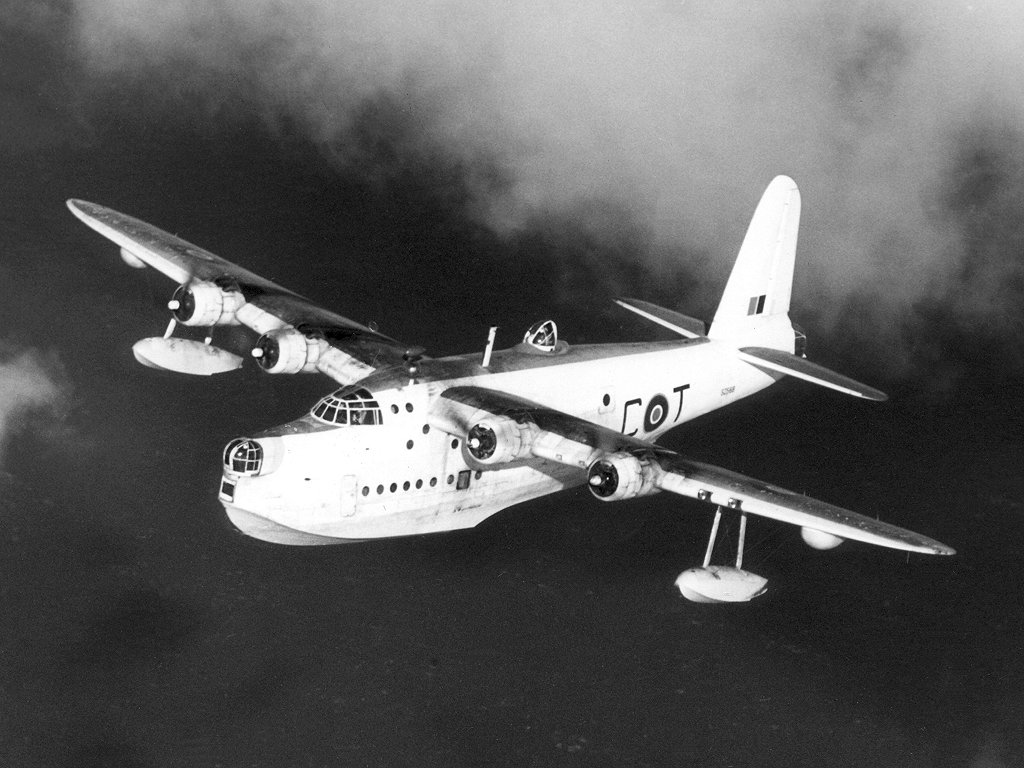
The Short S.25 Sunderland is a British flying boat patrol bomber, developed and constructed by Short Brothers for the Royal Air Force (RAF). The aircraft took its service name from the town (latterly, city) and port of Sunderland in North East England.
Developed in parallel with the civilian S.23 Empire flying boat, the flagship of Imperial Airways, the Sunderland was developed specifically to conform to the requirements of British Air Ministry Specification R.2/33 for a long-range patrol/reconnaissance flying boat to serve with the Royal Air Force. Sharing several similarities with the S.23, it had a more advanced aerodynamic hull and was fitted with various offensive and defensive armaments, including machine gun turrets, bombs, aerial mines, and depth charges. The Sunderland was powered by four Bristol Pegasus XVIII radial engines and was fitted with various detection equipment to aid combat operations, including the Leigh searchlight, the ASV Mark II and ASV Mark III radar units, and an astrodome.
The Sunderland was one of the most powerful and widely used flying boats throughout the Second World War. In addition to the RAF, the type was operated by other Allied military air wings, including the Royal Australian Air Force (RAAF), Royal Canadian Air Force (RCAF), South African Air Force (SAAF), Royal New Zealand Air Force (RNZAF), French Navy, Norwegian Air Force, and the Portuguese Navy. During the conflict, the type was heavily involved in Allied efforts to counter the threat posed by German U-boats in the Battle of the Atlantic. On 17 July 1940, an RAAF Sunderland (of No. 10 Squadron) performed the type's first unassisted U-boat kill. Sunderlands also played a major role in the Mediterranean theatre, performing maritime reconnaissance flights and logistical support missions. During the evacuation of Crete, shortly after the German invasion of the island, several aircraft were used to transport troops. Numerous unarmed Sunderlands were also flown by civil operator British Overseas Airways Corporation (BOAC), traversing routes as far afield as the Pacific Ocean.
During the post-war era, use of the Sunderland throughout Europe rapidly declined, while greater numbers remained in service in the Far East, where large developed runways were less prevalent. Between mid-1950 and September 1954, several squadrons of RAF Sunderlands saw combat action during the Korean War. Around a dozen aircraft also participated in the Berlin airlift, delivering supplies to the blockaded German city. The RAF continued to use the Sunderland in a military capacity up to 1959. In December 1960, the French Navy retired its aircraft, which were the last remaining examples in military use in the Northern Hemisphere. The type also remained in service with the RNZAF up to 1967, when they were replaced by the land-based Lockheed P-3 Orion. A number of Sunderlands were converted for use within the civil sector, where they were known as the Hythe and the Sandringham; in this configuration, the type continued in airline operation until 1974 – despite being originally made for military use, the Sunderland had a far longer commercial lifespan than its civilian Empire sibling and was one of the last large WWII-era flying boats in airline service. Several examples have been preserved, including a single airworthy Sunderland which has been placed on display in Florida at Fantasy of Flight.
During the early 1930s there was intense international competition to develop suitable aircraft to operate new long-range intercontinental passenger service between the United Kingdom, the United States, France and Germany. It was recognised that the United Kingdom had no existing equivalent to the new American Sikorsky S-42 flying boats or the German Dornier Do X. Accordingly, in 1934, the British Postmaster General declared that all first-class Royal Mail sent overseas was to travel by air, establishing a subsidy for the development of intercontinental air transport in a fashion similar to the U.S. domestic programme a decade earlier. In response, Imperial Airways announced a competition to design and manufacture a fleet of 28 large flying boats, each weighing 18 long tons (18 tonnes) and having a range of 700 mi (1,100 km) with a capacity for 24 passengers. A corresponding contract was issued to Short Brothers of Rochester for their design, which became the S.23 Empire.
While the Empire flying boat has often been credited as a predecessor of the Sunderland this impression is not strictly true. During November 1933 the British Air Ministry released Specification R.2/33, which called for the development of a next-generation long-range general purpose flying boat, intended to perform ocean reconnaissance missions. The specification called for an aircraft, either a monoplane or biplane, which would have a performance equal to the recently constructed Short Sarafand flying boat, but powered by a maximum of four engines and much more compact than the Sarafand. Specification R.2/33 was released before the publication of the commercial Imperial Airways requirement; by the time that Short received Imperial Airways' request the company had already started planning the design of the prospective military flying boat. After reviewing both sets of requirements, Short decided to prioritise the development of the civil S.23 design but also to work on a response to specification R.2/33.
Chief designer Arthur Gouge had originally intended for a COW 37 mm gun to be mounted in the bow of the craft to accompany the single Lewis gun installed in its tail. As with the S.23, he aimed to produce a fuselage which generated the lowest amount of drag possible, while a much longer nose than had been used for the S.23 was ultimately adopted.
During October 1934, Shorts settled upon the general configuration and geometry of the design, opting for a four-engine shoulder-wing monoplane configuration, similar to the Short Empire which had been ordered at the same time. The military flying boat design received the internal designation of S.25. While the S.25 design bore a strong resemblance to the civil S.23, it had an improved aerodynamic form, and sheet metal with curvature in more than one direction. This compound curve was more complex to manufacture but gave a superior shape.
Hub AI
Short Sunderland AI simulator
(@Short Sunderland_simulator)
Short Sunderland
The Short S.25 Sunderland is a British flying boat patrol bomber, developed and constructed by Short Brothers for the Royal Air Force (RAF). The aircraft took its service name from the town (latterly, city) and port of Sunderland in North East England.
Developed in parallel with the civilian S.23 Empire flying boat, the flagship of Imperial Airways, the Sunderland was developed specifically to conform to the requirements of British Air Ministry Specification R.2/33 for a long-range patrol/reconnaissance flying boat to serve with the Royal Air Force. Sharing several similarities with the S.23, it had a more advanced aerodynamic hull and was fitted with various offensive and defensive armaments, including machine gun turrets, bombs, aerial mines, and depth charges. The Sunderland was powered by four Bristol Pegasus XVIII radial engines and was fitted with various detection equipment to aid combat operations, including the Leigh searchlight, the ASV Mark II and ASV Mark III radar units, and an astrodome.
The Sunderland was one of the most powerful and widely used flying boats throughout the Second World War. In addition to the RAF, the type was operated by other Allied military air wings, including the Royal Australian Air Force (RAAF), Royal Canadian Air Force (RCAF), South African Air Force (SAAF), Royal New Zealand Air Force (RNZAF), French Navy, Norwegian Air Force, and the Portuguese Navy. During the conflict, the type was heavily involved in Allied efforts to counter the threat posed by German U-boats in the Battle of the Atlantic. On 17 July 1940, an RAAF Sunderland (of No. 10 Squadron) performed the type's first unassisted U-boat kill. Sunderlands also played a major role in the Mediterranean theatre, performing maritime reconnaissance flights and logistical support missions. During the evacuation of Crete, shortly after the German invasion of the island, several aircraft were used to transport troops. Numerous unarmed Sunderlands were also flown by civil operator British Overseas Airways Corporation (BOAC), traversing routes as far afield as the Pacific Ocean.
During the post-war era, use of the Sunderland throughout Europe rapidly declined, while greater numbers remained in service in the Far East, where large developed runways were less prevalent. Between mid-1950 and September 1954, several squadrons of RAF Sunderlands saw combat action during the Korean War. Around a dozen aircraft also participated in the Berlin airlift, delivering supplies to the blockaded German city. The RAF continued to use the Sunderland in a military capacity up to 1959. In December 1960, the French Navy retired its aircraft, which were the last remaining examples in military use in the Northern Hemisphere. The type also remained in service with the RNZAF up to 1967, when they were replaced by the land-based Lockheed P-3 Orion. A number of Sunderlands were converted for use within the civil sector, where they were known as the Hythe and the Sandringham; in this configuration, the type continued in airline operation until 1974 – despite being originally made for military use, the Sunderland had a far longer commercial lifespan than its civilian Empire sibling and was one of the last large WWII-era flying boats in airline service. Several examples have been preserved, including a single airworthy Sunderland which has been placed on display in Florida at Fantasy of Flight.
During the early 1930s there was intense international competition to develop suitable aircraft to operate new long-range intercontinental passenger service between the United Kingdom, the United States, France and Germany. It was recognised that the United Kingdom had no existing equivalent to the new American Sikorsky S-42 flying boats or the German Dornier Do X. Accordingly, in 1934, the British Postmaster General declared that all first-class Royal Mail sent overseas was to travel by air, establishing a subsidy for the development of intercontinental air transport in a fashion similar to the U.S. domestic programme a decade earlier. In response, Imperial Airways announced a competition to design and manufacture a fleet of 28 large flying boats, each weighing 18 long tons (18 tonnes) and having a range of 700 mi (1,100 km) with a capacity for 24 passengers. A corresponding contract was issued to Short Brothers of Rochester for their design, which became the S.23 Empire.
While the Empire flying boat has often been credited as a predecessor of the Sunderland this impression is not strictly true. During November 1933 the British Air Ministry released Specification R.2/33, which called for the development of a next-generation long-range general purpose flying boat, intended to perform ocean reconnaissance missions. The specification called for an aircraft, either a monoplane or biplane, which would have a performance equal to the recently constructed Short Sarafand flying boat, but powered by a maximum of four engines and much more compact than the Sarafand. Specification R.2/33 was released before the publication of the commercial Imperial Airways requirement; by the time that Short received Imperial Airways' request the company had already started planning the design of the prospective military flying boat. After reviewing both sets of requirements, Short decided to prioritise the development of the civil S.23 design but also to work on a response to specification R.2/33.
Chief designer Arthur Gouge had originally intended for a COW 37 mm gun to be mounted in the bow of the craft to accompany the single Lewis gun installed in its tail. As with the S.23, he aimed to produce a fuselage which generated the lowest amount of drag possible, while a much longer nose than had been used for the S.23 was ultimately adopted.
During October 1934, Shorts settled upon the general configuration and geometry of the design, opting for a four-engine shoulder-wing monoplane configuration, similar to the Short Empire which had been ordered at the same time. The military flying boat design received the internal designation of S.25. While the S.25 design bore a strong resemblance to the civil S.23, it had an improved aerodynamic form, and sheet metal with curvature in more than one direction. This compound curve was more complex to manufacture but gave a superior shape.
Recent media