


Community hub
Recent from talks
Contribute something
Nothing was collected or created yet.
Beta Lupi
View on Wikipedia  | |
| Observation data Epoch J2000 Equinox J2000 | |
|---|---|
| Constellation | Lupus |
| Right ascension | 14h 58m 31.92536s[1] |
| Declination | −43° 08′ 02.2699″[1] |
| Apparent magnitude (V) | 2.68[2] |
| Characteristics | |
| Spectral type | B2 III[3] |
| U−B color index | −0.902[4] |
| B−V color index | −0.226[4] |
| Variable type | β Cep[5] |
| Astrometry | |
| Radial velocity (Rv) | +0.1±1.0[3] km/s |
| Proper motion (μ) | RA: −35.78[1] mas/yr Dec.: −39.83[1] mas/yr |
| Parallax (π) | 8.52±0.18 mas[1] |
| Distance | 383 ± 8 ly (117 ± 2 pc) |
| Absolute magnitude (MV) | −3.3[6] |
| Details | |
| Mass | 8.8±0.2[7] M☉ |
| Radius | 6.6[8] R☉ |
| Luminosity | 10,000[6] L☉ |
| Surface gravity (log g) | 3.76[6] cgs |
| Temperature | 24,090[9] K |
| Metallicity [Fe/H] | −0.35±0.11[5] dex |
| Rotational velocity (v sin i) | 92[3] km/s |
| Age | 24.6±2.7[7] Myr |
| Other designations | |
| β Lup, CD−42°9853, FK5 552, HD 132058, HIP 73273, HR 5571, SAO 225335[10] | |
| Database references | |
| SIMBAD | data |
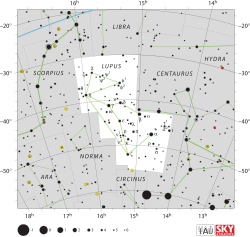
Beta Lupi (Latinized from β Lupi) is a star in the southern constellation of Lupus. It has an apparent visual magnitude of 2.7,[2] making it readily visible to the naked eye. Based upon parallax measurements, this star is located at a distance of about 383 light-years (117 parsecs) from Earth.[2]
Properties
[edit]The stellar classification of B2 III indicates this is a giant star.[3] The effective temperature of the star's outer envelope is 24,090 K,[9] giving it the blue-white hue of a B-type star.[11] With an age of around 25 million years,[7] it is near the end of its hydrogen phase, where hydrogen is fused into the element helium, and transferring into a red supergiant star. At about 8.8[7] solar masses, it may have enough mass to end its life as a Type II supernova, but there is the possibility of Beta Lupi becoming a white dwarf.[12]
This is a multi-period Beta Cephei variable with a dominant oscillation period of 0.232 days.[5] It is a proper motion member of the Upper Centaurus–Lupus sub-group in the Scorpius–Centaurus OB association, the nearest such co-moving association of massive stars to the Sun.[6] Beta Lupi has a high proper motion of more than 50 mas per year, suggesting a significant transverse velocity.[13]
It is positioned about 1.3° SSW of the supernova remnant SN 1006.[14]
Name
[edit]In Chinese, 騎官 (Qí Guān), meaning Imperial Guards, refers to an asterism consisting of β Lupi, γ Lupi, δ Lupi, κ Centauri, λ Lupi, ε Lupi, μ Lup, π Lupi, ο Lupi and α Lupi.[15] Consequently, the Chinese name for β Lupi itself is 騎官四 (Qí Guān sì, English: the Fourth Star of Imperial Guards.).[16] From the French rendering of this Chinese name derives the traditional European name Ke Kwan[17] or Kekouan (/ˈkɛkwɑːn/).[citation needed]
See also
[edit]References
[edit]- ^ a b c d e van Leeuwen, F. (November 2007), "Validation of the new Hipparcos reduction", Astronomy and Astrophysics, 474 (2): 653–664, arXiv:0708.1752, Bibcode:2007A&A...474..653V, doi:10.1051/0004-6361:20078357, S2CID 18759600
- ^ a b c Wielen, R.; et al. (1999), "Sixth Catalogue of Fundamental Stars (FK6). Part I. Basic fundamental stars with direct solutions", Veroeffentlichungen des Astronomischen Rechen-Instituts Heidelberg, 35 (35), Astronomisches Rechen-Institut Heidelberg: 1, Bibcode:1999VeARI..35....1W
- ^ a b c d Jilinski, E.; et al. (March 2006), "Radial velocity measurements of B stars in the Scorpius–Centaurus association", Astronomy and Astrophysics, 448 (3): 1001–1006, arXiv:astro-ph/0601643, Bibcode:2006A&A...448.1001J, doi:10.1051/0004-6361:20041614, S2CID 17818058
- ^ a b Gutierrez-Moreno, Adelina; Moreno, Hugo (June 1968), "A photometric investigation of the Scorpio-Centaurus association", Astrophysical Journal Supplement, 15: 459, Bibcode:1968ApJS...15..459G, doi:10.1086/190168
- ^ a b c Daszyńska-Daszkiewicz, J.; Niemczura, E. (April 2005), "Metallicity of mono- and multiperiodic β Cephei stars", Astronomy and Astrophysics, 433 (3): 1031–1035, arXiv:astro-ph/0410442, Bibcode:2005A&A...433.1031D, doi:10.1051/0004-6361:20040397, S2CID 119340011
- ^ a b c d de Geus, E. J.; de Zeeuw, P. T.; Lub, J. (June 1989), "Physical parameters of stars in the Scorpio-Centaurus OB association", Astronomy and Astrophysics, 216 (1–2): 44–61, Bibcode:1989A&A...216...44D
- ^ a b c d Tetzlaff, N.; Neuhäuser, R.; Hohle, M. M. (January 2011), "A catalogue of young runaway Hipparcos stars within 3 kpc from the Sun", Monthly Notices of the Royal Astronomical Society, 410 (1): 190–200, arXiv:1007.4883, Bibcode:2011MNRAS.410..190T, doi:10.1111/j.1365-2966.2010.17434.x, S2CID 118629873
- ^ Underhill, A. B.; et al. (November 1979), "Effective temperatures, angular diameters, distances and linear radii for 160 O and B stars", Monthly Notices of the Royal Astronomical Society, 189 (3): 601–605, Bibcode:1979MNRAS.189..601U, doi:10.1093/mnras/189.3.601
- ^ a b Zorec, J.; et al. (July 2009), "Fundamental parameters of B supergiants from the BCD system. I. Calibration of the (λ_1, D) parameters into Teff", Astronomy and Astrophysics, 501 (1): 297–320, arXiv:0903.5134, Bibcode:2009A&A...501..297Z, doi:10.1051/0004-6361/200811147, S2CID 14969137
- ^ "bet Lup -- Variable Star", SIMBAD, Centre de Données astronomiques de Strasbourg, retrieved 2012-01-16
- ^ "The Colour of Stars", Australia Telescope, Outreach and Education, Commonwealth Scientific and Industrial Research Organisation, December 21, 2004, archived from the original on 2012-03-18, retrieved 2012-01-16
- ^ Kaler, James B. (2007), "Beta Lupi", Stars, University of Illinois, archived from the original on 2011-07-16, retrieved 2009-07-03
- ^ Jiménez-Esteban, F. M.; Caballero, J. A.; Solano, E. (January 2011), "Identification of blue high proper motion objects in the Tycho-2 and 2MASS catalogues using Virtual Observatory tools", Astronomy and Astrophysics, 525: A29, arXiv:1009.3466, Bibcode:2011A&A...525A..29J, doi:10.1051/0004-6361/201015223, S2CID 55172549
- ^ Sinnott, Roger W.; Perryman, Michael A. C. (1997), Millennium Star Atlas, vol. 2, Sky Publishing Corporation and the European Space Agency, p. 929, ISBN 0-933346-83-2.
- ^ (in Chinese) 中國星座神話, written by 陳久金. Published by 台灣書房出版有限公司, 2005, ISBN 978-986-7332-25-7.
- ^ (in Chinese) 香港太空館 - 研究資源 - 亮星中英對照表 Archived 2011-01-29 at the Wayback Machine, Hong Kong Space Museum. Accessed on line November 23, 2010.]
- ^ Richard Hinckley Allen: Star Names — Their Lore and Meaning: Lupus
