



Community hub
Recent from talks
Knowledge base stats:
Talk channels stats:
Members stats:
Betawi cuisine
Betawi cuisine draws from a range of culinary traditions. This comes from the Betawi people being composed of regional immigrants from areas in the Indonesian archipelago, as well as Chinese, Indian, Arab, and European traders, visitors and immigrants that were attracted to the port city of Batavia (today modern Jakarta).
Betawi cuisine developed and evolved with influences from various cuisine traditions brought by waves of newcomers to the port city on the north coast of Western Java. From the small port of Sunda Kalapa, it grew into an active hub of international trade, primarily involving Indonesian, Chinese, Indian and Arab traders. By the early 16th century, drawn by the spice trade, the Portuguese were the first Europeans to arrive, followed by the Dutch later in the same century. During colonial VOC era, foreign communities were kept in enclaves under Dutch colonial rule; as the result the culinary concentration grew in each area: Tanah Abang for Arab cuisine, the Glodok and Kuningan area for Chinese food, and Tugu in North Jakarta for Portuguese.
Betawi cuisine is similar to Peranakan cuisine, another hybrid cuisines heavily influenced by Chinese and Malay, as well as Arab and European, cuisines, to neighboring Sundanese and Javanese cuisine. Nasi uduk, for example, a savory rice cooked in coconut milk and served with several side dishes, may be a local version of the Malay dish nasi lemak. Asinan, cured and brined pickled vegetables, and rujak juhi, vegetables served with shredded dried squid and peanut sauce, demonstrate Chinese influences. Because of this common heritage, some of Betawi cuisines, such as asinan and lontong cap go meh, are shared with Chinese Indonesian. Betawi cuisine also shares some recipes and dishes with neighboring Sundanese, such as both of them are familiar with sayur asem, gado-gado (lotek) and semur jengkol. Another examples are nasi kebuli and soto betawi that uses minyak samin (ghee), which indicates Arab or Muslim Indian influences.
Some dishes were created due to price constraints. For example, kerak telor was created due to the low quality of local glutinous rice, with the egg and other toppings added for flavor and satisfaction. Soto tangkar, which today is a meat soup, was mostly made from the broth of goat rib-cage bones in the past because meat was expensive, or the common population of Batavia were too poor to afford some meat back then.
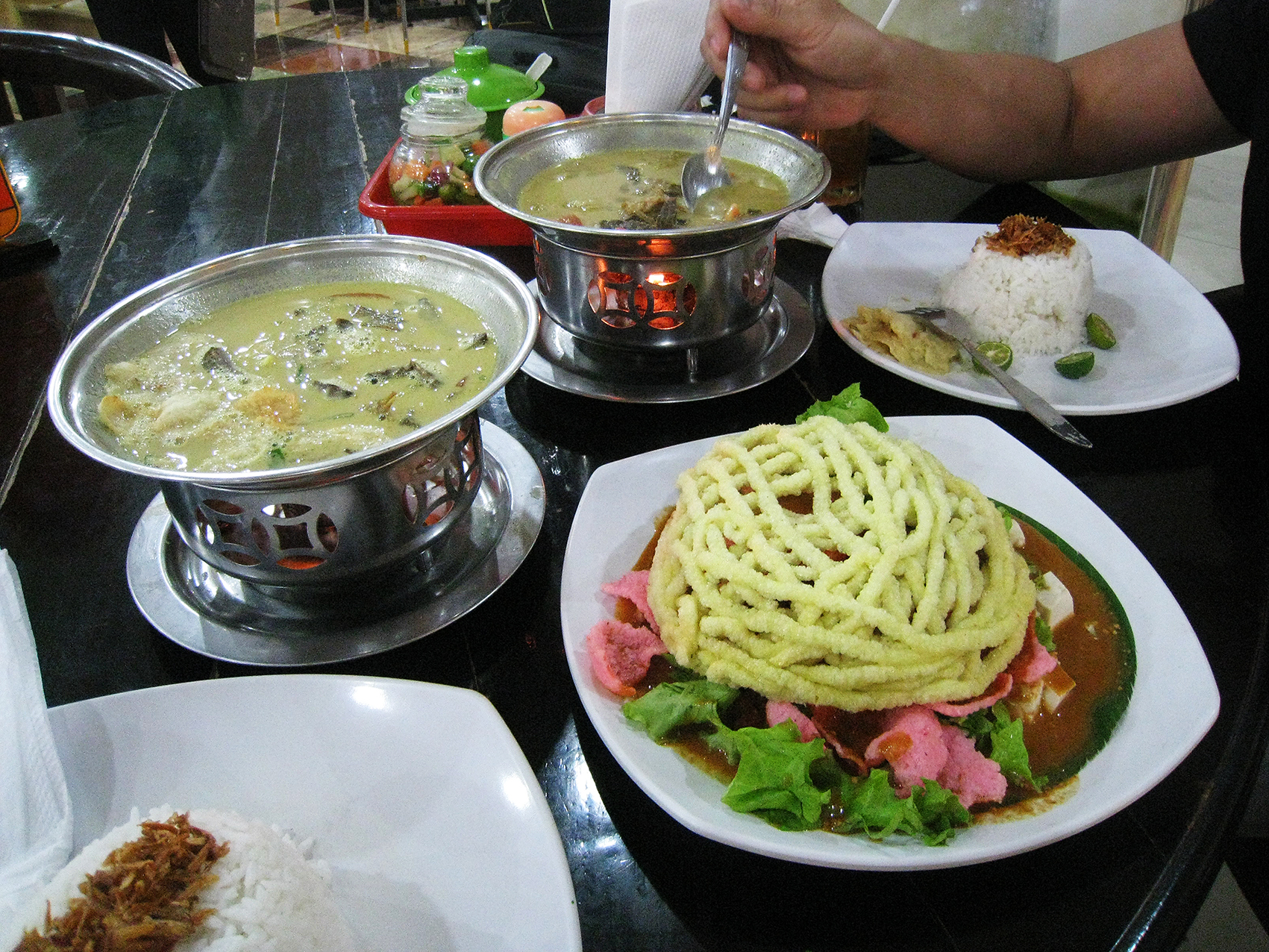
Today, many older Betawi dishes are hard to find even in the region. This is partly because as a cosmopolitan city, Jakarta also features dishes from across Indonesia, as well as international cuisines, and in part because the during the development of Jakarta, the Betawi community were moved to the marginal suburbs in and around Greater Jakarta in the wave of development. Some restaurants continue to make older dishes, viewing such efforts as heritage cuisine preservation. These dishes include rare gabus pucung, and pecak gabus, snakehead fish (Channa striata) in pecak sauce.
Betawi cuisine uses rice as staples, numbers of its dishes are revolved around rice, either steamed, cooked in coconut milk as nasi uduk (coconut rice), or compressed as ketupat sayur or lontong sayur rice cakes in vegetables soup. As a Muslim-majority community, Betawi people favour beef, mutton and goat meat, as they adhere to Islamic halal dietary-law which forbid pork consumption. Fishes are consumed too. Unusual for a coastal city, there are hardly any seafood dishes in Betawi cuisine. But there are plenty of freshwater fish dishes, using local varieties of snakehead fish and carp.
Popular Betawi dishes include soto betawi (beef offals in milky broth), sayur asem (sweet and sour vegetable soup), sop iga sapi (beef rib soup) and kerak telor (spiced coconut omelette). Most of Betawi dishes are cooked in deep-fried, stir-fried, barbecued or braised methods, and feature a delicate balance of sweet, sour and salty flavours.
Hub AI
Betawi cuisine AI simulator
(@Betawi cuisine_simulator)
Betawi cuisine
Betawi cuisine draws from a range of culinary traditions. This comes from the Betawi people being composed of regional immigrants from areas in the Indonesian archipelago, as well as Chinese, Indian, Arab, and European traders, visitors and immigrants that were attracted to the port city of Batavia (today modern Jakarta).
Betawi cuisine developed and evolved with influences from various cuisine traditions brought by waves of newcomers to the port city on the north coast of Western Java. From the small port of Sunda Kalapa, it grew into an active hub of international trade, primarily involving Indonesian, Chinese, Indian and Arab traders. By the early 16th century, drawn by the spice trade, the Portuguese were the first Europeans to arrive, followed by the Dutch later in the same century. During colonial VOC era, foreign communities were kept in enclaves under Dutch colonial rule; as the result the culinary concentration grew in each area: Tanah Abang for Arab cuisine, the Glodok and Kuningan area for Chinese food, and Tugu in North Jakarta for Portuguese.
Betawi cuisine is similar to Peranakan cuisine, another hybrid cuisines heavily influenced by Chinese and Malay, as well as Arab and European, cuisines, to neighboring Sundanese and Javanese cuisine. Nasi uduk, for example, a savory rice cooked in coconut milk and served with several side dishes, may be a local version of the Malay dish nasi lemak. Asinan, cured and brined pickled vegetables, and rujak juhi, vegetables served with shredded dried squid and peanut sauce, demonstrate Chinese influences. Because of this common heritage, some of Betawi cuisines, such as asinan and lontong cap go meh, are shared with Chinese Indonesian. Betawi cuisine also shares some recipes and dishes with neighboring Sundanese, such as both of them are familiar with sayur asem, gado-gado (lotek) and semur jengkol. Another examples are nasi kebuli and soto betawi that uses minyak samin (ghee), which indicates Arab or Muslim Indian influences.
Some dishes were created due to price constraints. For example, kerak telor was created due to the low quality of local glutinous rice, with the egg and other toppings added for flavor and satisfaction. Soto tangkar, which today is a meat soup, was mostly made from the broth of goat rib-cage bones in the past because meat was expensive, or the common population of Batavia were too poor to afford some meat back then.
Today, many older Betawi dishes are hard to find even in the region. This is partly because as a cosmopolitan city, Jakarta also features dishes from across Indonesia, as well as international cuisines, and in part because the during the development of Jakarta, the Betawi community were moved to the marginal suburbs in and around Greater Jakarta in the wave of development. Some restaurants continue to make older dishes, viewing such efforts as heritage cuisine preservation. These dishes include rare gabus pucung, and pecak gabus, snakehead fish (Channa striata) in pecak sauce.
Betawi cuisine uses rice as staples, numbers of its dishes are revolved around rice, either steamed, cooked in coconut milk as nasi uduk (coconut rice), or compressed as ketupat sayur or lontong sayur rice cakes in vegetables soup. As a Muslim-majority community, Betawi people favour beef, mutton and goat meat, as they adhere to Islamic halal dietary-law which forbid pork consumption. Fishes are consumed too. Unusual for a coastal city, there are hardly any seafood dishes in Betawi cuisine. But there are plenty of freshwater fish dishes, using local varieties of snakehead fish and carp.
Popular Betawi dishes include soto betawi (beef offals in milky broth), sayur asem (sweet and sour vegetable soup), sop iga sapi (beef rib soup) and kerak telor (spiced coconut omelette). Most of Betawi dishes are cooked in deep-fried, stir-fried, barbecued or braised methods, and feature a delicate balance of sweet, sour and salty flavours.