


Community hub
Recent from talks
Contribute something
Nothing was collected or created yet.
Asinan
View on Wikipedia | This article needs additional citations for verification. (October 2015) |
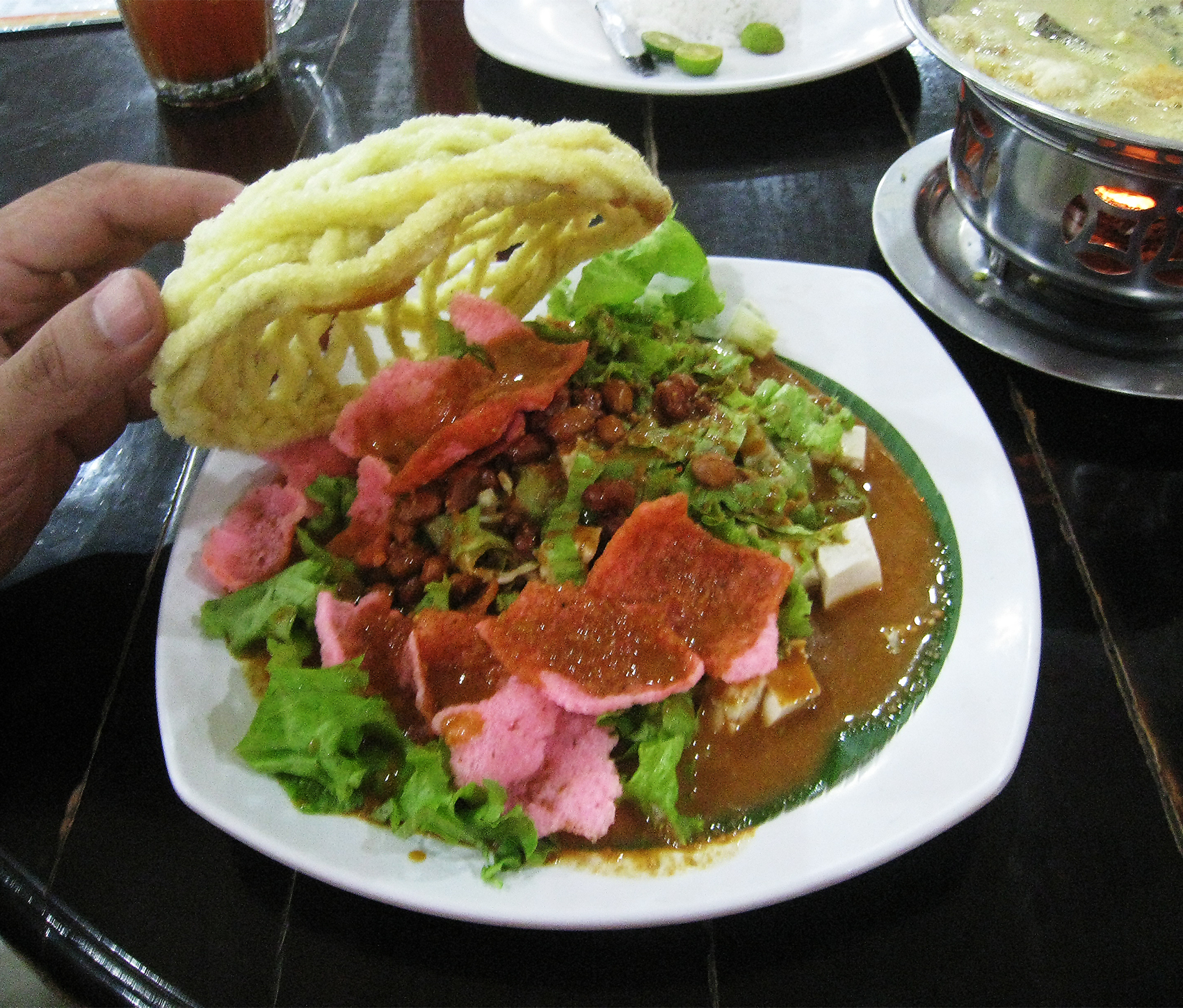
 Asinan Betawi topped with yellow kerupuk mie | |
| Course | Snack |
|---|---|
| Place of origin | Indonesia |
| Region or state | Jakarta and West Java |
| Serving temperature | Room temperature |
| Main ingredients | Various vegetables or fruits in hot, sour and sweet sauce |


Asinan is a pickled (either brined or vinegared) vegetable or fruit dish, commonly found in Indonesia. Asin, Indonesian for "salty", is the process of preserving the ingredients by soaking them in a solution of salty water. Asinan is similar to rujak, which is usually served fresh, while asinan is preserved vegetables or fruits. Of the many types and variations of asinan in Indonesia, the most popular are asinan Betawi and asinan Bogor. Asinan can be found in restaurants and warung, and from travelling street vendors.[1]

- Asinan Betawi: The vegetable asinan of the Betawi people from Jakarta is preserved Chinese cabbage, cabbage, bean sprouts, tofu, and lettuce served in a thin, hot, peanut sauce with vinegar, topped with peanuts and krupuk (especially krupuk mie).[1]
- Asinan Bogor: The fruit asinan of Bogor city, West Java is preserved tropical fruits, such as raw mango, water apple, papaya, ambarella, jicama, nutmeg, and pineapple served in sweet, hot, and sour vinegar and chili sauce, sprinkled with peanuts.[1]
Name
[edit]Asinan means salty food; in this context is vegetables or fruits. In Surabaya, this dish is called sayur asin (salty vegetable).[2]
Ingredients
[edit]Ingredients of asinan sayur have in common with kimchi. Their main ingredients are cabbage, cucumber, and salt. They both have the cabbage salted, but in kimchi the salting process takes longer than the process in asinan.[2] Other ingredients include bean sprouts, chili, and terasi.[3]
Variants
[edit]There are two main variants: asinan sayur and asinan buah (salted vegetable and salted fruit).[2] Asinan sayur is also called asinan Jakarta or asinan Betawi.[1] However, according to Indonesian food expert William Wongso, it doesn't guarantee the dish is originally from Jakarta. It might be influenced by Indian, Chinese, Arab, Portuguese, or Dutch cuisine.[4]
See also
[edit]

References
[edit]- ^ a b c d Will Meyrick. "Asinan the Indonesian Pickle". Street Food Chef. Archived from the original on 2016-10-11. Retrieved 2016-07-12.
- ^ a b c Junaidi, A. (27 April 2005). "'Asinan' vs. 'Kimchi': Variety is the spice of life". The Jakarta Post. Retrieved 15 September 2015.
- ^ Ilyas, Hamzah Puadi (1 February 2011). "'Imlek' and Idul Fitri share much in common". The Jakarta Post. Retrieved 15 September 2015.
- ^ Hulupi, Maria Endah (22 June 2003). "Betawi cuisine, culinary journey through history". The Jakarta Post. Archived from the original on 14 September 2015. Retrieved 15 September 2015.
Indonesian pickles and salads | |
|---|---|
| Pickles | |
| Salads | |

| Foods |
|  |
|---|---|---|
| By location | ||
| Mobile catering | ||
| Lists |
| |
| Salads |
|
|---|---|
| Bread salads | |
| Dessert salads | |
| Fish salads | |
| Fruit salads | |
| Noodle salads | |
| Related articles | |
Asinan
View on GrokipediaEtymology
Origin of the Term
The term "asinan" derives from the Indonesian word asin, which means "salty" or "salted," reflecting the dish's salty flavor from preservation methods involving salt, often through brining or vinegaring.[4][1] In Indonesian culinary language, "asinan" has historically denoted foods preserved via salting, brining, or vinegaring, with the suffix "-an" indicating the result of the action. It differs from acar, which refers to typically vinegar-based pickles influenced by Indian achar traditions .[5] Etymologically, asin traces back to Proto-Austronesian qasiN, denoting saltiness or a salty taste, underscoring the longstanding role of salt-based preservation in Southeast Asian Austronesian-speaking cultures.[6]Related Terminology
In regional Indonesian contexts, particularly in Surabaya and East Java, asinan is commonly referred to as sayur asin, a term emphasizing its vegetable base and salty preservation method.[7] This synonym highlights the dish's core characteristic as a brined or vinegared vegetable preparation, aligning with local Javanese-influenced dialects where "sayur" denotes vegetables.[1] Asinan shares superficial similarities with other preserved vegetable dishes like Korean kimchi, both involving brining for tangy flavors, but differs fundamentally in process—asinan typically uses solutions that may include vinegar and mild spicing without the extensive fermentation typical of kimchi.[8] It is also distinct from rujak, a fresh fruit and vegetable salad dressed in sweet-spicy peanut sauce, as asinan prioritizes pickling for longer shelf life rather than immediate consumption.[9] Linguistic variations of the term reflect Indonesia's Austronesian language influences, with "asinan" derived directly from "asin" (salty) in standardized Indonesian, which draws from Malay roots adapted across trade networks.[10] Regional adaptations, such as asinan Betawi in Jakarta or asinan Bogor in West Java, incorporate local dialectal nuances while retaining the base meaning of salty preservation.[1]History and Origins
Traditional Development
Asinan emerged during the 17th century among the Betawi people in Jakarta, then known as Batavia, as part of the region's evolving creole culinary traditions during early Dutch colonial times. This development coincided with the formation of the Betawi ethnic group, whose ancestors included a mix of local Javanese, Sundanese, and other indigenous peoples interacting in the port city. The dish's creation reflected the need for accessible food preservation amid the tropical environment's challenges, such as high humidity and abundant seasonal harvests.[2] Central to asinan's traditional role was its function as a simple brining technique to preserve perishable vegetables and fruits without modern refrigeration, allowing them to remain edible for days or weeks in the heat. This method, involving soaking in saltwater solutions, was well-suited to Indonesia's climate and became a staple for extending the usability of market-fresh produce among working-class communities. In West Java, particularly around Bogor, similar preservation practices took hold concurrently, adapting to local fruits and contributing to the dish's dual vegetable and fruit forms.[3] Early accounts position asinan as an everyday food of peasants and market vendors, integral to the modest diets of urban and rural Betawi and Sundanese-influenced groups.[11]Culinary Influences
Betawi cuisine, including preserved dishes like asinan from Jakarta and West Java, was shaped by external culinary traditions introduced via the spice trade and European colonization spanning the 16th to 19th centuries. These interactions reflect acculturation in Jakarta as a major trading port, where immigrant communities blended their techniques with indigenous ones.[12] Chilies, native to the Americas and introduced to Indonesia by Portuguese traders in the 16th century, became a key ingredient in local condiments and pickles, adding heat to dishes like asinan.[13] This evolution incorporated elements like vinegar for acidity, reflecting broader multicultural layering in Indonesian street foods. Historical documentation for specific influences on asinan remains limited, primarily drawn from general studies of Betawi culinary fusion.Ingredients
Vegetables in Asinan Sayur
Asinan sayur, the vegetable-based variant of the Indonesian pickled salad, primarily features a selection of fresh, crisp vegetables that are brined to achieve a tangy, refreshing flavor profile. The core ingredients include cabbage, cucumber, bean sprouts, carrots, and lettuce, with variations occasionally incorporating tofu for added protein.[9][14][15] Cabbage, often referred to as kol or green cabbage in Indonesian contexts, serves as the foundational vegetable, providing bulk and structure to the dish. It is typically shredded finely to ensure even absorption of the brine, allowing the leaves to soften slightly while retaining their crunch. This preparation method maximizes surface area for pickling, resulting in a tender yet firm texture that balances the salad's overall composition. In traditional recipes, cabbage constitutes a significant proportion, often around half of the vegetable mix, such as 2 cups shredded for a standard serving.[14][15][16] Cucumber contributes a cooling, hydrating element, sliced thinly to release subtle moisture during brining without becoming overly watery. Bean sprouts add a delicate crunch and nutty undertone, usually left whole or lightly trimmed to preserve their tenderness. Carrots, julienned into thin strips, introduce a slight sweetness and vibrant color, enhancing the visual appeal and nutritional diversity. Lettuce provides additional crispness and volume, often shredded or torn into pieces. Tofu, when included, is typically fried and adds a chewy texture and protein.[9][17] Nutritionally, these vegetables enrich asinan sayur with essential vitamins and fiber, supporting its role as a healthful side dish. Cabbage, in particular, is a rich source of vitamin C, with raw portions providing approximately 33 mg per 100 grams, which acts as an antioxidant to help preserve the dish by inhibiting oxidation and microbial growth during brining.[18] This vitamin content remains relatively stable in lightly pickled preparations, contributing to the salad's probiotic potential and immune-boosting qualities. Bean sprouts and cucumber further supply hydration and folate, while carrots add beta-carotene for eye health. These vegetables are complemented by shared seasonings like tamarind and chili, which unify the flavors across asinan variants without dominating the vegetable base.[9]Fruits and Seasonings in Asinan Buah
Asinan Buah, the fruit-based variant of this Indonesian pickled dish, centers on a selection of crisp, fresh fruits that provide contrasting textures and flavors when brined. Primary fruits include cucumber, pineapple, young or unripe mango, rose apple (known locally as jambu bol), jicama (bengkuang), and kedondong (ambarella), adding a subtle sweetness and rosy hue. These choices emphasize tropical produce common in Indonesian markets, with cucumber often overlapping from vegetable preparations but highlighted here for its role in balancing the ensemble.[8][19] Variations may incorporate starfruit (belimbing) for its sharp acidity or water apple (jambu air) to enhance the refreshing quality, depending on regional availability and vendor preferences in areas like Bogor, where the dish originated as a street food staple. Fruit selection prioritizes ripeness stages that preserve structural integrity during brining—unripe mangoes and firm pineapples are ideal to avoid sogginess, ensuring the final product retains a satisfying snap akin to fresh salad components. This focus on underripe or semi-ripe specimens distinguishes Asinan Buah from sweeter fruit salads, maintaining its pickled character.[8][19] The seasonings form a versatile brine solution shared across Asinan variants, blending preservation elements with bold flavors typical of Indonesian cuisine. Key components are salt for salinity, vinegar for acidity and pickling action, sugar to counterbalance sharpness, bird's eye chili (cabe rawit) for heat, terasi (roasted shrimp paste) for umami depth, and lime juice to brighten the mix. The brine is typically made by dissolving sugar, salt, and vinegar in water, blended with chilies and terasi, and adjusted for a balanced tangy, spicy-sweet taste. This combination yields a tangy, spicy-sweet liquid that permeates the fruits without overpowering their natural profiles, with terasi adding a fermented note optional in some recipes but essential for authenticity in others.[8][19]Preparation
Brining and Pickling Process
The brining and pickling process for asinan primarily applies to fruit-based variants like asinan buah, where fresh fruits are preserved through immersion in a saline or vinegared solution, imparting salty, sweet, and tangy notes while retaining a crisp texture. This quick-pickling method, derived from the Indonesian term asin meaning "salty," relies on osmosis from salt or acidity from vinegar to draw out excess moisture and inhibit spoilage.[8] In contrast, vegetable-based asinan sayur, such as the Betawi style, is typically prepared fresh without extended brining, using raw or lightly blanched vegetables dressed with sauce for immediate serving.[9][1] For asinan buah, preparation begins with washing the ingredients thoroughly under running water to remove dirt and impurities. Fruits, including unripe mango, pineapple, and jicama, are peeled and sliced into wedges or matchsticks, selecting firm specimens to preserve crunch.[8][20] The brine is next prepared by combining water, salt, sugar, and vinegar in a saucepan and bringing it to a boil to dissolve the solids and sterilize the mixture. Proportions vary by recipe, but a common approach uses about 1 liter of water, ½ teaspoon to 2 tablespoons of salt, 2 tablespoons to 200 grams of palm sugar (or granulated sugar), and 3-5 tablespoons of white vinegar, often enhanced with blended chilies, garlic, or shrimp paste for subtle heat during infusion.[8][20] The boiling typically lasts 10-15 minutes until fully integrated, after which the brine is strained if spices were used and allowed to cool slightly to lukewarm temperature.[8] Fruits undergo vinegaring with an acidic solution, which halts enzymatic browning and maintains juiciness. Soaking durations vary: some recipes marinate for 2 hours, while others up to 24 hours to fully infuse flavors without becoming mushy.[8][20] The cut ingredients are layered into a clean jar or bowl, and the prepared brine is poured over them to fully submerge, often weighed down with a plate if needed to ensure even coverage. The container is then sealed and refrigerated immediately to develop flavors.[8] For storage, asinan buah is kept refrigerated at 4-8°C (39-46°F) and consumed within 3-5 days to preserve texture and safety.[8] Over-soaking risks sogginess, so portions are often prepared fresh to maintain crispness.[20]Sauce Preparation and Serving
The sauce accompanying asinan, particularly for Betawi-style asinan sayur, is a vibrant, umami-rich peanut dressing (bumbu kacang) that balances heat, sourness, and sweetness, typically made by roasting and grinding peanuts with fresh red chilies, terasi (fermented shrimp paste), garlic, and sometimes tamarind or lime into a coarse paste.[3][9] This base is then combined with dissolved palm sugar in heated water, simmered briefly to meld the flavors, cooled, and finished with fresh lime juice for acidity, resulting in a diluted, pourable consistency suitable for drizzling.[16] To prepare the sauce, common proportions include 1 cup roasted peanuts, 2-5 red chilies, 2 cloves of garlic, and 1 teaspoon of toasted terasi ground together, while 100 grams of palm sugar is melted in 200 milliliters of boiling water; the paste is stirred in, the mixture simmers for 5-10 minutes until slightly thickened, then it cools before incorporating the juice of 1 lime and salt to taste.[16] This process yields a hot-sour-sweet profile that complements the elements without overpowering them, with adjustments made for spice level based on chili quantity.[9] Asinan is traditionally served at room temperature or chilled, with the vegetables or fruits (for buah, drained briefly to remove excess liquid) arranged and topped generously with the sauce and garnished with crisp fried shallots for added texture and aroma.[16] It functions primarily as a refreshing side dish or standalone snack in Indonesian meals, providing a tangy contrast to richer flavors.[1] Common pairings include steamed rice for a simple accompaniment, fried tempeh to enhance protein elements, or as a palate cleanser alongside heavier entrees like curries or stews.[9]Variants
Regional Styles
Asinan Betawi, originating from Jakarta, features a medley of fresh vegetables prominently including shredded cabbage and sliced cucumber, alongside bean sprouts, carrots, lettuce, and semi-fried tofu, all lightly brined in a saltwater-vinegar solution for crispness.[21][22] The dish's signature peanut sauce incorporates heavy terasi (shrimp paste) influence, blended with roasted peanuts, shallots, garlic, dried shrimp, red chilies, and tamarind for a bold umami depth balanced by sweetness from palm sugar, creating a tangy, spicy dressing that coats the vegetables.[21] This style is typically served cold with yellow noodles and pink rice crackers for added texture, emphasizing the Betawi culinary tradition of vibrant, layered flavors in everyday salads.[23] In West Java, particularly around Bogor, the vegetable-based asinan adopts a lighter profile with milder spice levels, using a sauce simmered from blended red chilies, sugar, salt, and vinegar without the intensity of peanut or heavy paste elements.[24] Key vegetables include thinly sliced cabbage, julienned carrots, cucumber slices, bean sprouts, and lettuce leaves, alongside boiled tofu and occasional pineapple chunks for subtle sweetness.[24][25] The preparation involves chilling the vegetables in ice water to enhance crunch before pouring the cooled sauce, resulting in a refreshing, soup-like consistency ideal for hot weather, with the overall heat tempered to appeal to broader palates.[24] East Java's Surabaya variant, known locally as "sayur asin," simplifies the process with a focus on straightforward salting of mustard greens (sawi) as the primary vegetable, often scalded briefly in hot water, squeezed to remove excess moisture, and cut into pieces without the addition of vinegar or complex brines.[7] This approach yields a shorter preparation time, typically just minutes for ready-to-use pickled greens from markets, relying on salt's natural preservation to achieve a crisp, tangy profile that highlights the inherent bitterness of the greens.[7] The dish is commonly paired with fried tofu and cucumber pickles in rujak-style presentations, underscoring East Javanese preferences for unadorned, quick vegetable preserves in daily meals.Fruit-Based Adaptations
Traditional Asinan Buah from Bogor features a selection of firm, tangy fruits such as jambu bol (a type of guava, Syzygium jambos) and pineapple as dominant ingredients, often combined with unripe mango, cucumber, and jicama for texture contrast. These fruits are sliced into bite-sized pieces and immersed in a brine made from boiled water, sugar, salt, vinegar, chilies, and sometimes lemon juice or optional shrimp paste to enhance umami. The resulting tanginess comes from the acidic vinegar and citrus elements, creating a sweet-sour-spicy profile that balances the natural sweetness of the fruits without requiring extended fermentation.[8][26] In modern urban adaptations, particularly in cities like Jakarta and Bogor, Asinan Buah incorporates exotic fruits such as apples to appeal to diverse tastes and availability, diverging from strictly tropical selections while maintaining the core brining technique. These variations often appear in street food stalls and home recipes, blending local traditions with global influences for broader accessibility.[26] A key distinction in fruit-based Asinan Buah compared to its vegetable counterpart (Asinan Sayur) lies in the brining duration, typically limited to 4-6 hours in refrigeration to infuse flavors while preserving the fruits' inherent sweetness and crispness, as opposed to longer marination that might soften vegetables more substantially. This shorter process ensures the dish remains a light, vibrant snack rather than a heavily preserved one.[20][8]Cultural Significance
Role in Indonesian Cuisine
Asinan serves as both a lauk (side dish) and camilan (snack) in Indonesian cuisine, providing a tangy, refreshing contrast to richer, spicier mains such as rendang by balancing heat with its sour and mildly sweet brine.[27] This quick-pickled dish, featuring vegetables or fruits preserved in a short brining process, offers a crunchy texture and vibrant flavors that enhance everyday meals centered around steamed rice (nasi). In Betawi cuisine of Jakarta, asinan is integrated into daily diets as a popular breakfast or snack option, often enjoyed for its fresh preparation and accessibility in home cooking or markets.[11] Similarly, in Javanese culinary traditions, particularly in West Java regions like Bogor, fruit-based variants such as asinan buah complement communal meals, adding a zesty element to vegetable-heavy sides. These integrations highlight the archipelago's ethnic diversity, where asinan adapts to local ingredients and preferences across Java and beyond. Distinct from acar, which relies on vinegar for longer preservation, or sambal, a chili-based condiment, asinan stands out for its brief salting in a spiced brine that yields a lighter, more immediate pickled profile without overpowering fermentation. This uniqueness makes it a versatile accompaniment, occasionally featured in street vending to provide quick relief from tropical heat.[27]Street Food and Social Context
Asinan is widely available as a street food in Jakarta and surrounding areas, particularly through Betawi-style vendors operating from warungs, pushcarts, and markets such as those in Kebayoran Lama and Taman Ismail Marzuki. In Bogor, it features prominently at local warungs like Asinan Gedung Dalam and Sedap Gedung Dalam, where it is sold alongside other regional specialties, contributing to the city's vibrant food scene. Mobile vendors in both cities traverse neighborhoods daily, offering portions to passersby and integrating asinan into the everyday rhythm of urban life.[28][29][30] Socially, asinan plays a key role as an accessible and communal snack, often enjoyed by working-class individuals during breaks due to its low cost and portability as a street offering. It gains heightened prominence during cultural festivals, such as the annual Lebaran Betawi event at Monas Park in Jakarta, where it is served to strengthen community ties and celebrate Betawi heritage among participants from various districts. This positioning underscores its function in fostering social interactions and shared traditions within diverse urban populations.[29] In contemporary settings, asinan has transitioned beyond street carts to home-cooked preparations in Betawi households, as seen in family-run catering operations that preserve recipes across generations. It also appears on restaurant menus under brands like Njonjah Menteng, adapting to modern palates while maintaining cultural authenticity. In 2024, asinan Betawi was recognized as communal intellectual property, alongside other Betawi dishes, to preserve its cultural heritage.[28][31] As of 2025, it continues to be celebrated in Jakarta's culinary festivals as a living heritage food.[3]References
- https://en.wiktionary.org/wiki/asin