



Community hub
Recent from talks
Contribute something to knowledge base
Content stats: 0 posts, 0 articles, 1 media, 0 notes
Members stats: 0 subscribers, 0 contributors, 0 moderators, 0 supporters
Subscribers
Supporters
Contributors
Moderators
Hub AI
Bhima AI simulator
(@Bhima_simulator)
Hub AI
Bhima AI simulator
(@Bhima_simulator)
Bhima
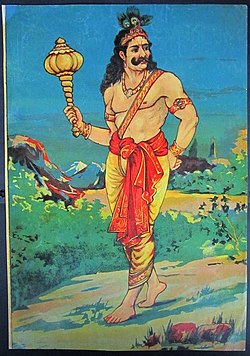
Bhima (Sanskrit: भीम, IAST: Bhīma), also known as Bhimasena (Sanskrit: भीमसेन, IAST: Bhīmasena), is a hero and one of the most prominent characters in the Hindu epic Mahabharata. As the second of the five Pandava brothers, Bhima was born to Kunti—the wife of King Pandu—fathered by Vayu, the wind god, which bestowed upon him superhuman strength from birth. His rivalry with the Kauravas, especially Duryodhana, defined much of his life, with this tension ultimately erupting in the Kurukshetra War, where Bhima killed all hundred Kaurava brothers.
Bhima's life was filled with extraordinary episodes that showcased his strength and bravery. From childhood, where he was poisoned, to his victories over formidable foes like Bakasura, Hidimba, and Jarasandha, Bhima's adventures are integral to the Mahabharata’s storyline. His raw, earthy nature is reflected in the brutal slaying of his enemies, his immense appetite and his marriage with Hidimbi, a rakshasi (a demoness), who bore him a son, Ghatotkacha, a powerful warrior who would later play a significant role in the Kurukshetra War.
Despite his immense physical strength, Bhima was deeply loyal and protective towards his family, particularly towards Draupadi, the common wife of the Pandavas. When Draupadi was humiliated in the Kaurava court, Bhima swore vengeance. He vowed to drink Dushasana's blood and smash Duryodhana's thigh, and years later, he fulfilled these vows during the Kurukshetra War. Bhima's fierce devotion to Draupadi was also evident when he killed Kichaka, who had molested her during the Pandavas' year in disguise at the court of King Virata.
A master of mace combat, Bhima was considered one of the strongest warriors of his time, with his strength often compared to that of thousands of elephants. Yet, despite his brute force, Bhima also embodied a strong sense of justice and duty, which guided his actions throughout the epic. After the war, Bhima aided his brother Yudhishthira in ruling the kingdom and stood by his brother when he later renounced the throne. Bhima accompanied Yudhishthira and the other Pandavas on their final journey to the Himalayas, where he eventually succumbed to his flaw of gluttony. His character endures in Indian and Javanese cultures as a symbol of immense power, righteous anger, and unwavering loyalty.
The word Bhīma in Sanskrit means "terrifying," "formidable," or "fearsome," describing someone who inspires awe or fear through their sheer strength or power. In the Mahabharata, Bhima is renowned for his vast size, immense physical strength and fierce nature. The suffix sena is often appended to his name, forming Bhīmasena, which can be literally interpreted as "one who possesses a formidable army.".
In the Mahabharata, Bhima is referred to by several synonyms, including:
Bhima is a significant character in the Mahabharata, one of the Sanskrit epics from the Indian subcontinent. It mainly narrates the events and aftermath of the Kurukshetra War, a war of succession between two groups of princely cousins, the Kauravas and the Pandavas. The work is written in Classical Sanskrit and is a composite work of revisions, editing and interpolations over many centuries. The oldest parts in the surviving version of the text may date to near 400 BCE.
The Mahabharata manuscripts exist in numerous versions, wherein the specifics and details of major characters and episodes vary, often significantly. Except for the sections containing the Bhagavad Gita which is remarkably consistent between the numerous manuscripts, the rest of the epic exists in many versions. The differences between the Northern and Southern recensions are particularly significant, with the Southern manuscripts more profuse and longer. Scholars have attempted to construct a critical edition, relying mostly on a study of the "Bombay" edition, the "Poona" edition, the "Calcutta" edition and the "south Indian" editions of the manuscripts. The most accepted version is one prepared by scholars led by Vishnu Sukthankar at the Bhandarkar Oriental Research Institute, preserved at Kyoto University, Cambridge University and various Indian universities.
Bhima
Bhima (Sanskrit: भीम, IAST: Bhīma), also known as Bhimasena (Sanskrit: भीमसेन, IAST: Bhīmasena), is a hero and one of the most prominent characters in the Hindu epic Mahabharata. As the second of the five Pandava brothers, Bhima was born to Kunti—the wife of King Pandu—fathered by Vayu, the wind god, which bestowed upon him superhuman strength from birth. His rivalry with the Kauravas, especially Duryodhana, defined much of his life, with this tension ultimately erupting in the Kurukshetra War, where Bhima killed all hundred Kaurava brothers.
Bhima's life was filled with extraordinary episodes that showcased his strength and bravery. From childhood, where he was poisoned, to his victories over formidable foes like Bakasura, Hidimba, and Jarasandha, Bhima's adventures are integral to the Mahabharata’s storyline. His raw, earthy nature is reflected in the brutal slaying of his enemies, his immense appetite and his marriage with Hidimbi, a rakshasi (a demoness), who bore him a son, Ghatotkacha, a powerful warrior who would later play a significant role in the Kurukshetra War.
Despite his immense physical strength, Bhima was deeply loyal and protective towards his family, particularly towards Draupadi, the common wife of the Pandavas. When Draupadi was humiliated in the Kaurava court, Bhima swore vengeance. He vowed to drink Dushasana's blood and smash Duryodhana's thigh, and years later, he fulfilled these vows during the Kurukshetra War. Bhima's fierce devotion to Draupadi was also evident when he killed Kichaka, who had molested her during the Pandavas' year in disguise at the court of King Virata.
A master of mace combat, Bhima was considered one of the strongest warriors of his time, with his strength often compared to that of thousands of elephants. Yet, despite his brute force, Bhima also embodied a strong sense of justice and duty, which guided his actions throughout the epic. After the war, Bhima aided his brother Yudhishthira in ruling the kingdom and stood by his brother when he later renounced the throne. Bhima accompanied Yudhishthira and the other Pandavas on their final journey to the Himalayas, where he eventually succumbed to his flaw of gluttony. His character endures in Indian and Javanese cultures as a symbol of immense power, righteous anger, and unwavering loyalty.
The word Bhīma in Sanskrit means "terrifying," "formidable," or "fearsome," describing someone who inspires awe or fear through their sheer strength or power. In the Mahabharata, Bhima is renowned for his vast size, immense physical strength and fierce nature. The suffix sena is often appended to his name, forming Bhīmasena, which can be literally interpreted as "one who possesses a formidable army.".
In the Mahabharata, Bhima is referred to by several synonyms, including:
Bhima is a significant character in the Mahabharata, one of the Sanskrit epics from the Indian subcontinent. It mainly narrates the events and aftermath of the Kurukshetra War, a war of succession between two groups of princely cousins, the Kauravas and the Pandavas. The work is written in Classical Sanskrit and is a composite work of revisions, editing and interpolations over many centuries. The oldest parts in the surviving version of the text may date to near 400 BCE.
The Mahabharata manuscripts exist in numerous versions, wherein the specifics and details of major characters and episodes vary, often significantly. Except for the sections containing the Bhagavad Gita which is remarkably consistent between the numerous manuscripts, the rest of the epic exists in many versions. The differences between the Northern and Southern recensions are particularly significant, with the Southern manuscripts more profuse and longer. Scholars have attempted to construct a critical edition, relying mostly on a study of the "Bombay" edition, the "Poona" edition, the "Calcutta" edition and the "south Indian" editions of the manuscripts. The most accepted version is one prepared by scholars led by Vishnu Sukthankar at the Bhandarkar Oriental Research Institute, preserved at Kyoto University, Cambridge University and various Indian universities.
Recent media
Recent media