


Community hub
Recent from talks
Contribute something to knowledge base
Content stats: 0 posts, 0 articles, 1 media, 0 notes
Members stats: 0 subscribers, 0 contributors, 0 moderators, 0 supporters
Subscribers
Supporters
Contributors
Moderators
Hub AI
Cue stick AI simulator
(@Cue stick_simulator)
Hub AI
Cue stick AI simulator
(@Cue stick_simulator)
Cue stick
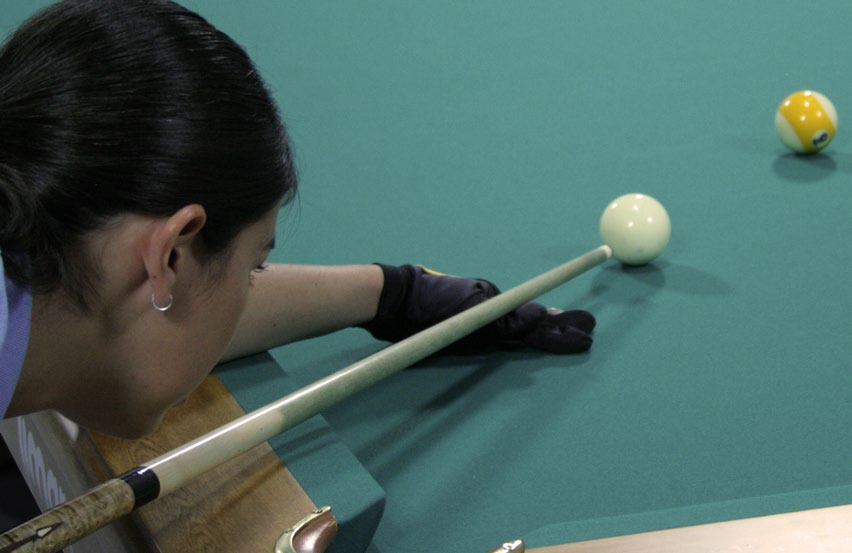
A cue stick (simply cue, more specifically billiards cue, pool cue, or snooker cue) is an item of sporting equipment essential to the games of pool, snooker and carom billiards. It is used to strike a ball, usually the cue ball. Cues are tapered sticks, typically about 57–59 inches (about 1.5 m) long and usually between 16 and 21 ounces (450–600 g), with professionals gravitating toward a 19-ounce (540 g) average. Cues for carom tend toward the shorter range, though cue length is primarily a factor of player height and arm length. Most cues are made of wood, but occasionally the wood is covered or bonded with other materials including graphite, carbon fiber or fiberglass. An obsolete term for a cue, used from the 16th to early 19th centuries, is billiard stick.
The predecessor of the cue was the mace, a lightweight implement resembling a golf club, with a foot designed primarily for shoving rather than striking the cue ball. When the ball was frozen against a rail cushion, use of the mace was difficult (the foot would not fit under the edge of the cushion to strike the ball squarely), and by 1670 experienced players often used the tail or butt end of the mace instead. The term "cue" comes from queue, the French word for "tail", in reference to this practice, a style of shooting that eventually led to the development of separate, footless cue sticks by about 1800, used initially as adjuncts to the mace, which remained in use until well into the 19th century. In public billiard rooms only skilled players were allowed to use the cue, because the fragile cloth could be torn by novices. The introduction of the cue, and the new game possibilities it engendered, led to the development of cushions with more rebound, initially stuffed with linen or cotton flocking, but eventually replaced by rubber.
The idea of the cue initially was to try to strike the cue-ball as centrally as possible to avoid a miscue. The concept of spin on the cue ball was discovered before cue-tips had been invented; e.g. striking the bottom of the cue ball to make it go backwards upon contact with an object ball. François Mingaud was studying the game of billiards while being held in Paris as a political prisoner, and experimented with a leather cue tip. In 1807, he was released and demonstrated his invention. Mingaud is also credited with the discovery that by raising the cue vertically, to the position adopted by the mace, he could perform what is now known as a massé shot.
In pre-tip days, it was common for players to twist the ends of their cue into a plaster wall or ceiling so that a chalk-like deposit would form on the end to reduce the chance of a miscue, thus giving rise to the modern billiard chalk. The first systematic marketing of chalk was by John Carr, a marker in John Bartley's billiard rooms in Bath. Between Carr and Bartley, it was discovered how "side" (sidespin) could be used to the advantage of players, and Carr began selling chalk in small boxes. He called it "twisting powder", and the magical impression this gave the public enabled him to sell it for a higher price than if they realized it was simply chalk in a small box. "English", an American term for sidespin, derives from the British discovery of sidespin's effects, as "massé" comes from the French word for "mace".
Pool and snooker cues average around 57–59 inches (140–150 cm) in length and are of three major types. The simplest type is a one-piece cue; these are generally stocked in pool halls for communal use. They have a uniform taper, meaning they decrease in diameter evenly from the end or butt to the tip. A second type is the two-piece cue, divided in the middle for ease of transport, usually in a cue case or pouch. A third variety is another two-piece cue, but with a joint located three-quarters down the cue (usually 12 or 16 inches away from the butt), known as a "three-quarter two-piece", used by snooker players.
A typical two piece cue for pocket billiards is usually made mostly of hard or rock maple, with a fiberglass or phenolic resin ferrule, usually 0.75 to 1 inch (19 to 25 mm) long, and steel joint collars and pin. Pool cues average around 59 inches (150 cm) long, are commonly available in 17–21 ounces (0.48–0.60 kg) weights, with 19 ounces (0.54 kg) being the most common, and usually have a tip diameter in the range of 12 to 14 mm. A conical taper, with the shaft gradually shrinking in diameter from joint to ferrule, is favored by some, but the "pro" taper is increasingly popular, straight for most of the length of the shaft from ferrule back, flaring to joint diameter only in the last 1⁄4 to 1⁄3 of the shaft. While there are many custom cuemakers, a very large number of quality pool cues are manufactured in bulk. In recent years, modern materials such as fiberglass, carbon fiber, aluminum, etc., have been used more and more for shafts and butts. A trend toward experimentation has also developed with rubber, memory foam and other soft wraps.
Carom billiards cues tend to be shorter and lighter than pool cues, with a shorter ferrule, a thicker butt and joint, a wooden joint pin (ideally) and collarless wood-to-wood joint, a conical taper, and a smaller tip diameter. Typical dimensions are 54–56 inches (140–140 cm) long, 16.5–18.5 ounces (0.47–0.52 kg) in weight, with an 11–12 mm diameter tip. The specialization makes the cue stiffer, for handling the heavier billiard balls and acting to reduce deflection. The wood used in carom cues can vary widely, and most quality carom cues are handmade.
At 57–58 inches (140–150 cm), a cue designed for snooker is usually shorter than the typical 59 inch pool cue and has detachable butt extensions for making the cue 6 inches (15 cm) longer or more. Many snooker cues are jointed, usually with brass fittings, two-thirds or even three-quarters of the way back toward the butt bumper, providing an unusually long shaft, rather than at the half-way point, where pool and carom cues are jointed. This necessitates an extra long cue case. Some models are jointed in two places, with the long shaft having a smooth and subtle wood-to-wood joint. Snooker cue tips are usually 8.5–10.5 mm in diameter to provide more accuracy and finesse with snooker balls, which are smaller than pool and carom varieties. Snooker butts are usually flat on one side so that the cue may be laid flat on the table bed and slid along the baize under a cushion to strike the cushion-ward side of the cue ball when it is frozen to the cushion (such a shot is not legal in pool or carom games under most rulesets). This tactile flat part of the butt also helps the player develop a very specific way of holding the cue, consistent on every shot for a very uniform stroke (snooker, in the case of many if not most shots, requires much more precision than pool). Snooker cue weights vary between 16 and 18 oz. While a lighter cue is usually for beginners to develop correct technique when starting out, some professional snooker players use lighter cues (15–161⁄2 oz.), Joe Davis, John Spencer, Terry Griffiths, Mark Williams and Paul Hunter, to name a few. The balance point of a cue is usually 16 to 18 inches from the butt end.
Cue stick
A cue stick (simply cue, more specifically billiards cue, pool cue, or snooker cue) is an item of sporting equipment essential to the games of pool, snooker and carom billiards. It is used to strike a ball, usually the cue ball. Cues are tapered sticks, typically about 57–59 inches (about 1.5 m) long and usually between 16 and 21 ounces (450–600 g), with professionals gravitating toward a 19-ounce (540 g) average. Cues for carom tend toward the shorter range, though cue length is primarily a factor of player height and arm length. Most cues are made of wood, but occasionally the wood is covered or bonded with other materials including graphite, carbon fiber or fiberglass. An obsolete term for a cue, used from the 16th to early 19th centuries, is billiard stick.
The predecessor of the cue was the mace, a lightweight implement resembling a golf club, with a foot designed primarily for shoving rather than striking the cue ball. When the ball was frozen against a rail cushion, use of the mace was difficult (the foot would not fit under the edge of the cushion to strike the ball squarely), and by 1670 experienced players often used the tail or butt end of the mace instead. The term "cue" comes from queue, the French word for "tail", in reference to this practice, a style of shooting that eventually led to the development of separate, footless cue sticks by about 1800, used initially as adjuncts to the mace, which remained in use until well into the 19th century. In public billiard rooms only skilled players were allowed to use the cue, because the fragile cloth could be torn by novices. The introduction of the cue, and the new game possibilities it engendered, led to the development of cushions with more rebound, initially stuffed with linen or cotton flocking, but eventually replaced by rubber.
The idea of the cue initially was to try to strike the cue-ball as centrally as possible to avoid a miscue. The concept of spin on the cue ball was discovered before cue-tips had been invented; e.g. striking the bottom of the cue ball to make it go backwards upon contact with an object ball. François Mingaud was studying the game of billiards while being held in Paris as a political prisoner, and experimented with a leather cue tip. In 1807, he was released and demonstrated his invention. Mingaud is also credited with the discovery that by raising the cue vertically, to the position adopted by the mace, he could perform what is now known as a massé shot.
In pre-tip days, it was common for players to twist the ends of their cue into a plaster wall or ceiling so that a chalk-like deposit would form on the end to reduce the chance of a miscue, thus giving rise to the modern billiard chalk. The first systematic marketing of chalk was by John Carr, a marker in John Bartley's billiard rooms in Bath. Between Carr and Bartley, it was discovered how "side" (sidespin) could be used to the advantage of players, and Carr began selling chalk in small boxes. He called it "twisting powder", and the magical impression this gave the public enabled him to sell it for a higher price than if they realized it was simply chalk in a small box. "English", an American term for sidespin, derives from the British discovery of sidespin's effects, as "massé" comes from the French word for "mace".
Pool and snooker cues average around 57–59 inches (140–150 cm) in length and are of three major types. The simplest type is a one-piece cue; these are generally stocked in pool halls for communal use. They have a uniform taper, meaning they decrease in diameter evenly from the end or butt to the tip. A second type is the two-piece cue, divided in the middle for ease of transport, usually in a cue case or pouch. A third variety is another two-piece cue, but with a joint located three-quarters down the cue (usually 12 or 16 inches away from the butt), known as a "three-quarter two-piece", used by snooker players.
A typical two piece cue for pocket billiards is usually made mostly of hard or rock maple, with a fiberglass or phenolic resin ferrule, usually 0.75 to 1 inch (19 to 25 mm) long, and steel joint collars and pin. Pool cues average around 59 inches (150 cm) long, are commonly available in 17–21 ounces (0.48–0.60 kg) weights, with 19 ounces (0.54 kg) being the most common, and usually have a tip diameter in the range of 12 to 14 mm. A conical taper, with the shaft gradually shrinking in diameter from joint to ferrule, is favored by some, but the "pro" taper is increasingly popular, straight for most of the length of the shaft from ferrule back, flaring to joint diameter only in the last 1⁄4 to 1⁄3 of the shaft. While there are many custom cuemakers, a very large number of quality pool cues are manufactured in bulk. In recent years, modern materials such as fiberglass, carbon fiber, aluminum, etc., have been used more and more for shafts and butts. A trend toward experimentation has also developed with rubber, memory foam and other soft wraps.
Carom billiards cues tend to be shorter and lighter than pool cues, with a shorter ferrule, a thicker butt and joint, a wooden joint pin (ideally) and collarless wood-to-wood joint, a conical taper, and a smaller tip diameter. Typical dimensions are 54–56 inches (140–140 cm) long, 16.5–18.5 ounces (0.47–0.52 kg) in weight, with an 11–12 mm diameter tip. The specialization makes the cue stiffer, for handling the heavier billiard balls and acting to reduce deflection. The wood used in carom cues can vary widely, and most quality carom cues are handmade.
At 57–58 inches (140–150 cm), a cue designed for snooker is usually shorter than the typical 59 inch pool cue and has detachable butt extensions for making the cue 6 inches (15 cm) longer or more. Many snooker cues are jointed, usually with brass fittings, two-thirds or even three-quarters of the way back toward the butt bumper, providing an unusually long shaft, rather than at the half-way point, where pool and carom cues are jointed. This necessitates an extra long cue case. Some models are jointed in two places, with the long shaft having a smooth and subtle wood-to-wood joint. Snooker cue tips are usually 8.5–10.5 mm in diameter to provide more accuracy and finesse with snooker balls, which are smaller than pool and carom varieties. Snooker butts are usually flat on one side so that the cue may be laid flat on the table bed and slid along the baize under a cushion to strike the cushion-ward side of the cue ball when it is frozen to the cushion (such a shot is not legal in pool or carom games under most rulesets). This tactile flat part of the butt also helps the player develop a very specific way of holding the cue, consistent on every shot for a very uniform stroke (snooker, in the case of many if not most shots, requires much more precision than pool). Snooker cue weights vary between 16 and 18 oz. While a lighter cue is usually for beginners to develop correct technique when starting out, some professional snooker players use lighter cues (15–161⁄2 oz.), Joe Davis, John Spencer, Terry Griffiths, Mark Williams and Paul Hunter, to name a few. The balance point of a cue is usually 16 to 18 inches from the butt end.
Recent media
Recent media