Hubbry Logo
search
logo

Binary mass function

logo
Community Hub0 Subscribers
Read side by side
from Wikipedia

In astronomy, the binary mass function or simply mass function is a function that constrains the mass of the unseen component (typically a star or exoplanet) in a single-lined spectroscopic binary star or in a planetary system. It can be calculated from observable quantities only, namely the orbital period of the binary system, and the peak radial velocity of the observed star. The velocity of one binary component and the orbital period provide information on the separation and gravitational force between the two components, and hence on the masses of the components.

Introduction

[edit]
Two bodies orbiting a common center of mass, indicated by the red plus. The larger body has a higher mass, and therefore a smaller orbit and a lower orbital velocity than its lower-mass companion.

The binary mass function follows from Kepler's third law when the radial velocity of one binary component is known.[1] Kepler's third law describes the motion of two bodies orbiting a common center of mass. It relates the orbital period with the orbital separation between the two bodies, and the sum of their masses. For a given orbital separation, a higher total system mass implies higher orbital velocities. On the other hand, for a given system mass, a longer orbital period implies a larger separation and lower orbital velocities.

Because the orbital period and orbital velocities in the binary system are related to the masses of the binary components, measuring these parameters provides some information about the masses of one or both components.[2] However, the true orbital velocity is often unknown, because velocities in the plane of the sky are much more difficult to determine than velocities along the line of sight.[1]

Radial velocity is the velocity component of orbital velocity in the line of sight of the observer. Unlike true orbital velocity, radial velocity can be determined from Doppler spectroscopy of spectral lines in the light of a star,[3] or from variations in the arrival times of pulses from a radio pulsar.[4] A binary system is called a single-lined spectroscopic binary if the radial motion of only one of the two binary components can be measured. In this case, a lower limit on the mass of the other, unseen component can be determined.[1]

The true mass and true orbital velocity cannot be determined from the radial velocity because the orbital inclination is generally unknown. (The inclination is the orientation of the orbit from the point of view of the observer, and relates true and radial velocity.[1]) This causes a degeneracy between mass and inclination.[5][6] For example, if the measured radial velocity is low, this can mean that the true orbital velocity is low (implying low mass objects) and the inclination high (the orbit is seen edge-on), or that the true velocity is high (implying high mass objects) but the inclination low (the orbit is seen face-on).

Derivation for a circular orbit

[edit]
Radial velocity curve with peak radial velocity K=1 m/s and orbital period 2 years.

The peak radial velocity is the semi-amplitude of the radial velocity curve, as shown in the figure. The orbital period is found from the periodicity in the radial velocity curve. These are the two observable quantities needed to calculate the binary mass function.[2]

The observed object of which the radial velocity can be measured is taken to be object 1 in this article, its unseen companion is object 2.

Let and be the stellar masses, with the total mass of the binary system, and the orbital velocities, and and the distances of the objects to the center of mass. is the semi-major axis (orbital separation) of the binary system.

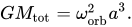
We start out with Kepler's third law, with the orbital frequency and the gravitational constant,

Using the definition of the center of mass location, ,[1] we can write

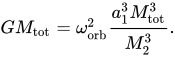
Inserting this expression for into Kepler's third law, we find

which can be rewritten to
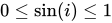
The peak radial velocity of object 1, , depends on the orbital inclination (an inclination of 0° corresponds to an orbit seen face-on, an inclination of 90° corresponds to an orbit seen edge-on). For a circular orbit (orbital eccentricity = 0) it is given by[7]


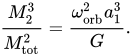
After substituting we obtain
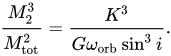
The binary mass function (with unit of mass) is[8][7][2][9][1][6][10]

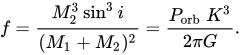
For an estimated or assumed mass of the observed object 1, a minimum mass can be determined for the unseen object 2 by assuming . The true mass depends on the orbital inclination. The inclination is typically not known, but to some extent it can be determined from observed eclipses,[2] be constrained from the non-observation of eclipses,[8][9] or be modelled using ellipsoidal variations (the non-spherical shape of a star in binary system leads to variations in brightness over the course of an orbit that depend on the system's inclination).[11]

Limits

[edit]

In the case of (for example, when the unseen object is an exoplanet[8]), the mass function simplifies to

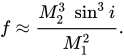
In the other extreme, when (for example, when the unseen object is a high-mass black hole), the mass function becomes[2] and since for , the mass function gives a lower limit on the mass of the unseen object 2.[6]

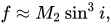
In general, for any or ,

Eccentric orbit

[edit]

In an orbit with eccentricity , the mass function is given by[7][12]

Applications

[edit]

X-ray binaries

[edit]

If the accretor in an X-ray binary has a minimum mass that significantly exceeds the Tolman–Oppenheimer–Volkoff limit (the maximum possible mass for a neutron star), it is expected to be a black hole. This is the case in Cygnus X-1, for example, where the radial velocity of the companion star has been measured.[13][14]

Exoplanets

[edit]

An exoplanet causes its host star to move in a small orbit around the center of mass of the star-planet system. This 'wobble' can be observed if the radial velocity of the star is sufficiently high. This is the radial velocity method of detecting exoplanets.[5][3] Using the mass function and the radial velocity of the host star, the minimum mass of an exoplanet can be determined.[15][16]: 9 [12][17] Applying this method on Proxima Centauri, the closest star to the Solar System, led to the discovery of Proxima Centauri b, a terrestrial planet with a minimum mass of 1.27 M🜨.[18]

Pulsar planets

[edit]

Pulsar planets are planets orbiting pulsars, and several have been discovered using pulsar timing. The radial velocity variations of the pulsar follow from the varying intervals between the arrival times of the pulses.[4] The first exoplanets were discovered this way in 1992 around the millisecond pulsar PSR 1257+12.[19] Another example is PSR J1719-1438, a millisecond pulsar whose companion, PSR J1719-1438 b, has a minimum mass approximate equal to the mass of Jupiter, according to the mass function.[8]

References

[edit]
Revisions and contributorsEdit on WikipediaRead on Wikipedia
from Grokipedia
The binary mass function is a fundamental quantity in astrophysics used to infer the masses of components in a binary star system from observable orbital parameters, particularly when only the motion of one star is detectable, such as in single-lined spectroscopic binaries.[1] It provides a lower limit on the mass of the unseen companion, assuming the observed star has negligible mass compared to it, and is expressed in units of solar mass (M⊙).[2] The binary mass function, denoted as $ f(m) $, is derived from Kepler's third law and radial velocity measurements, relating the orbital period $ P $, the projected semi-major axis $ a \sin i $ (where $ i $ is the inclination angle), and the gravitational constant $ G $.[1] Its standard form for a single-lined system is
f(m)=(m2sini)3(m1+m2)2=PK132πG, f(m) = \frac{(m_2 \sin i)^3}{(m_1 + m_2)^2} = \frac{P K_1^3}{2\pi G},
where $ m_1 $ is the mass of the observed star, $ m_2 $ is the mass of the companion, and $ K_1 $ is the radial velocity semi-amplitude of the observed star.[3] This equation highlights that $ f(m) $ depends solely on measurable quantities like $ P $ and $ K_1 $, but the unknown inclination $ \sin i $ (typically averaged as $ \langle \sin^3 i \rangle \approx 0.62 $ over random orientations) introduces uncertainty, yielding only mass constraints rather than exact values.[2] In practice, the binary mass function is crucial for studying stellar evolution, binary formation, and detecting compact objects like neutron stars or black holes in systems such as X-ray binaries or radio pulsars, where direct mass determination is challenging.[1] For instance, a high $ f(m) $ value (e.g., > 2 M⊙) indicates a massive companion, potentially ruling out a low-mass star and supporting more exotic interpretations.[2] It also extends to exoplanet detection via the radial velocity method, where small $ f(m) $ values constrain planetary masses, and statistical analyses of mass functions across populations reveal the initial mass function's role in star formation.[3]

Background on Binary Systems

Spectroscopic binaries

Spectroscopic binaries are binary star systems in which the individual components cannot be spatially resolved but their orbital motions are inferred from periodic Doppler shifts in the spectral lines of at least one star.[4] These shifts arise as the stars move toward or away from the observer along the line of sight, causing the spectral lines to alternate between blueshift and redshift over the orbital period. Such systems provide key insights into stellar masses and orbits when combined with Kepler's third law, which relates the orbital period to the total mass. Spectroscopic binaries are classified as single-lined (SB1) or double-lined (SB2) based on whether spectral lines from one or both components are detectable.[5] In SB1 systems, only the lines of the more massive or brighter primary star are visible, resulting in a single radial velocity curve, while the secondary's contribution is obscured by blending or low luminosity. SB2 systems, in contrast, exhibit two distinct sets of shifting lines, allowing measurement of both stars' velocities.[6] SB1 binaries are particularly important for mass function studies, as they represent the majority of detected spectroscopic systems where the companion's properties remain partially unknown.[7] From radial velocity observations, key orbital parameters are derived: the orbital period PP, which is the time for one complete orbit; the radial velocity semi-amplitude KK, representing half the peak-to-peak velocity variation; and the eccentricity ee, quantifying the orbit's deviation from circularity. These parameters are obtained by fitting model velocity curves to time-series spectra, often using least-squares methods. The discovery of spectroscopic binaries dates to the late 19th century, with German astronomer Hermann Vogel identifying the first examples in the 1880s through visual spectroscopy at the Potsdam Astrophysical Observatory.[8] In 1889, Vogel announced the spectroscopic nature of Algol (β Persei), observing periodic line shifts that confirmed its binary status and eclipsing variability. This breakthrough, followed by detections in Spica and other stars, established spectroscopy as a vital tool for probing unseen companions.[8]

Radial velocity observations

Radial velocity observations in binary systems are conducted using Doppler spectroscopy, which detects the periodic motion of stellar components along the line of sight through shifts in the wavelengths of absorption or emission lines in their spectra. The principle relies on the Doppler effect, where the observed wavelength shift Δλ\Delta \lambda relates to the radial velocity vv by the formula v=cΔλλv = c \frac{\Delta \lambda}{\lambda}, with cc being the speed of light and λ\lambda the rest-frame wavelength of the line.[9] This method is particularly applied to spectroscopic binaries, where the Doppler shifts reveal the orbital velocities of at least one star. The resulting radial velocity data form characteristic curves when plotted against time or orbital phase. For systems in circular orbits, these curves are sinusoidal, reflecting the uniform periodic approach and recession of the star. In contrast, eccentric orbits produce more complex, non-sinusoidal curves, with velocity variations that accelerate and decelerate according to the orbital geometry.[10] High-resolution echelle spectrographs are the primary instruments for these measurements, capturing detailed spectra to resolve narrow lines and measure small shifts. Wavelength calibration is achieved using iodine absorption cells, which are placed in the light path to superimpose a dense set of stable iodine lines on the stellar spectrum; these serve as a precise reference for both absolute wavelength scale and instrumental broadening effects.[9] Pioneering setups like the High Accuracy Radial velocity Planet Searcher (HARPS) on the European Southern Observatory's 3.6 m telescope at La Silla deliver long-term precisions of approximately 1 m/s for stable stars.[11] More advanced instruments, such as the Echelle SPectrograph for Rocky Exoplanets and Stable Spectroscopic Observations (ESPRESSO) on the Very Large Telescope, achieve instrumental precisions below 10 cm/s, enabling detection of subtle orbital signals.[12] Achieving such precision requires mitigating several error sources. Instrumental instabilities, including thermal drifts, mechanical flexure, and variations in the spectrograph's line spread function, can introduce systematic shifts if not controlled through vacuum enclosures and active stabilization.[13] Stellar activity, such as rotating spots, convection, or oscillations, modulates line profiles and induces apparent velocity jitter on timescales from hours to years.[14] Additionally, telluric absorption lines from Earth's atmosphere vary with observing conditions and must be modeled or removed to avoid contaminating the stellar signal.[15]

Derivation of the Binary Mass Function

Circular orbits

For binary systems with circular orbits, the derivation of the mass function begins with Kepler's third law adapted for two bodies orbiting their common center of mass. The law states that the square of the orbital period PP is proportional to the cube of the semi-major axis aa of the relative orbit:
P2=4π2a3G(M1+M2), P^2 = \frac{4\pi^2 a^3}{G (M_1 + M_2)},
where GG is the gravitational constant, M1M_1 is the mass of the observed star, and M2M_2 is the mass of the companion.[10] This relation assumes a circular orbit (e=0e = 0) and neglects higher-order effects such as relativistic corrections or tidal distortions. In a single-lined spectroscopic binary, only the radial velocity of the observed star (M1M_1) is measured, yielding the semi-amplitude K1K_1 of its velocity curve. For circular orbits, the orbital speed of M1M_1 around the center of mass is v1=2πa1Pv_1 = \frac{2\pi a_1}{P}, where a1a_1 is the semi-major axis of M1M_1's orbit. The center-of-mass condition gives M1a1=M2a2M_1 a_1 = M_2 a_2, so a1=aM2M1+M2a_1 = a \frac{M_2}{M_1 + M_2}, with a=a1+a2a = a_1 + a_2. The projected radial velocity semi-amplitude is then K1=v1sini=2πPa1sini=2πasiniPM2M1+M2K_1 = v_1 \sin i = \frac{2\pi}{P} a_1 \sin i = \frac{2\pi a \sin i}{P} \frac{M_2}{M_1 + M_2}, where ii is the orbital inclination.[10] To derive the mass function, substitute Kepler's third law into the expression for K1K_1. From Kepler's law,
a3=G(M1+M2)P24π2, a^3 = \frac{G (M_1 + M_2) P^2}{4\pi^2},
so
a=(G(M1+M2)P24π2)1/3. a = \left( \frac{G (M_1 + M_2) P^2}{4\pi^2} \right)^{1/3}.
Inserting this into the equation for K1K_1 yields
K1=2πP(G(M1+M2)P24π2)1/3M2siniM1+M2=(2πGP)1/3M2sini(M1+M2)2/3. K_1 = \frac{2\pi}{P} \left( \frac{G (M_1 + M_2) P^2}{4\pi^2} \right)^{1/3} \frac{M_2 \sin i}{M_1 + M_2} = \left( \frac{2\pi G}{P} \right)^{1/3} \frac{M_2 \sin i}{(M_1 + M_2)^{2/3}}.
This relation connects the observable K1K_1 and PP to the masses and inclination.[10] Cubing both sides and rearranging algebraically isolates the mass-dependent terms:
K13=2πGP(M2sini)3(M1+M2)2. K_1^3 = \frac{2\pi G}{P} \frac{(M_2 \sin i)^3}{(M_1 + M_2)^2}.
Multiplying through by P/(2πG)P / (2\pi G) gives the binary mass function
f(M2)=PK132πG=(M2sini)3(M1+M2)2. f(M_2) = \frac{P K_1^3}{2\pi G} = \frac{(M_2 \sin i)^3}{(M_1 + M_2)^2}.
This expression, valid under the assumptions of circular orbits and edge-on viewing for maximum sini=1\sin i = 1 (though ii is generally unknown), provides a lower limit on M2M_2 when M1M_1 is estimated from stellar models.[10]

Eccentric orbits

In binary systems with eccentric orbits, the radial velocity curve of the observed component (star 1) exhibits deviations from the sinusoidal pattern assumed for circular orbits, primarily due to the varying orbital speed and separation. The semi-amplitude KK represents the maximum radial velocity excursion, but it relates to the projected semi-major axis a1sinia_1 \sin i through a1sini=PK2π1e2a_1 \sin i = \frac{P K}{2\pi} \sqrt{1 - e^2}, where PP is the orbital period and ee is the eccentricity; this adjustment accounts for the reduced time-averaged projection in non-circular paths. The generalized binary mass function incorporates this eccentricity dependence, yielding
f(M2)=PK3(1e2)3/22πG=(M2sini)3(M1+M2)2, f(M_2) = \frac{P K^3 (1 - e^2)^{3/2}}{2\pi G} = \frac{(M_2 \sin i)^3}{(M_1 + M_2)^2},
where GG is the gravitational constant, M1M_1 and M2M_2 are the masses of the observed and unseen components, respectively, and ii is the inclination. This form derives from Kepler's third law applied to the relative orbit, P2=4π2a3G(M1+M2)P^2 = \frac{4\pi^2 a^3}{G(M_1 + M_2)}, combined with the projected velocity relation, ensuring the mass function provides a lower limit on M2M_2 independent of M1M_1 but scaled by sin3i\sin^3 i. The (1e2)3/2(1 - e^2)^{3/2} factor arises because KK scales as 1/1e21 / \sqrt{1 - e^2}, reflecting the higher peak speeds near periastron in eccentric orbits. Eccentricity ee is measured by fitting observed radial velocities to the theoretical curve, vr(t)=K[cos(ν+ω)+ecosω]+γv_r(t) = K [\cos(\nu + \omega) + e \cos \omega] + \gamma, where ν\nu is the true anomaly solved via Kepler's equation M=νesinνM = \nu - e \sin \nu (with mean anomaly M=2πt/PM = 2\pi t / P), ω\omega is the argument of periastron, and γ\gamma is the systemic velocity. The curve's asymmetry—sharper rises and falls near periastron—allows robust determination of ee even for moderate values, typically via least-squares minimization or Bayesian fitting techniques. When ee is low, the circular orbit approximation (where e=0e = 0) introduces minimal error, as (1e2)3/21(1 - e^2)^{3/2} \approx 1, preserving the mass function's accuracy for near-circular systems. However, for higher ee, neglecting this factor overestimates f(M2)f(M_2) since the true KK is amplified by eccentricity, leading to potentially significant biases in inferred companion masses without the correction. The orbital dynamics underlying this are captured by the vis-viva equation for the relative speed, v2=G(M1+M2)(2/r1/a)v^2 = G(M_1 + M_2) (2/r - 1/a), where rr varies from a(1e)a(1 - e) at periastron to a(1+e)a(1 + e) at apastron, causing the pronounced velocity peaks observed in radial velocity data.

Interpretation and Limitations

The mass function expression

The binary mass function f(M)f(M), derived from radial velocity measurements of the primary star in a single-lined spectroscopic binary, is expressed as
f(M)=(M2sini)3(M1+M2)2, f(M) = \frac{(M_2 \sin i)^3}{(M_1 + M_2)^2},
where M1M_1 is the mass of the observed primary star, M2M_2 is the mass of the unseen companion, and ii is the inclination of the orbital plane relative to the line of sight.[16] This quantity physically represents a strict lower bound on the companion mass M2M_2, as the unknown sini1\sin i \leq 1 and the functional form ensure f(M)M2f(M) \leq M_2 in the limit of an edge-on orbit and M2M1M_2 \gg M_1. In the more typical scenario where M1M2M_1 \gg M_2 and sini=1\sin i = 1, it approximates f(M)M23/M12f(M) \approx M_2^3 / M_1^2, providing the minimum M2M_2 via M2,min=(f(M)M12)1/3M_{2,\min} = (f(M) M_1^2)^{1/3}; generally, it constrains allowable mass ratios q=M2/M1q = M_2 / M_1 without uniquely determining individual masses.[16][1] The mass function is typically reported in solar masses (MM_\odot).[16] Given an independent estimate of M1M_1, possible values of M2M_2 (assuming sini=1\sin i = 1) are found by solving the cubic equation M23f(M)(M1+M2)2=0M_2^3 - f(M) (M_1 + M_2)^2 = 0, or equivalently in terms of q=M2/M1q = M_2 / M_1 as q3Bq22BqB=0q^3 - B q^2 - 2 B q - B = 0 with B=f(M)/M1B = f(M) / M_1; multiple real positive roots may exist, but physical context selects the appropriate solution.[16] For a fixed f(M)f(M), the relation traces curves in the M1M_1-M2M_2 plane, with physically allowed pairs lying in the region above the sini=1\sin i = 1 locus due to the sini\sin i degeneracy; this visualization highlights how increasing M1M_1 permits lower M2M_2 while maintaining the constraint.[16]

Inclination and mass ratio degeneracies

The binary mass function for single-lined spectroscopic binaries (SB1s) incorporates a sin3i\sin^3 i factor, where ii is the orbital inclination relative to the line of sight, providing only a lower limit on the companion mass M2M_2. Specifically, the observed mass function f(M)f(M) satisfies f(M)=(M2sini)3(M1+M2)2f(M) = \frac{(M_2 \sin i)^3}{(M_1 + M_2)^2}, meaning the true M2M_2 is underestimated by a factor of 1/sin3i1 / \sin^3 i. For edge-on systems (i=90i = 90^\circ), sini=1\sin i = 1, yielding the minimum M2M_2; however, for lower inclinations such as i=30i = 30^\circ (sini=0.5\sin i = 0.5), this factor reaches 8, though statistical averages over random orientations typically imply a correction factor of approximately 1.7 to 2 for typical mass estimates.[17] This inclination degeneracy couples with uncertainty in the mass ratio q=M2/M1q = M_2 / M_1, as SB1 observations yield only the primary's radial velocity amplitude K1K_1, leaving M1M_1 and thus qq undetermined. For a fixed f(M)f(M), varying qq produces a continuum of possible (M1,M2)(M_1, M_2) pairs, with M2M_2 minimized when M1M2M_1 \gg M_2 and increasing as qq approaches unity. Without additional data, this results in broad mass ranges, often spanning an order of magnitude, severely limiting precise characterization of individual systems.[18] To resolve these degeneracies, astrometric measurements can determine the orbital inclination by resolving the photocenter's angular motion, combining with spectroscopic data to yield true masses. For instance, interferometric astrometry has constrained ii to within 0.5° in massive binaries, enabling dynamical mass solutions of 53 MM_\odot and 39 MM_\odot. Alternatively, double-lined spectroscopic binaries (SB2s) observe both K1K_1 and K2K_2, directly providing qq and M1sin3i+M2sin3iM_1 \sin^3 i + M_2 \sin^3 i, which, if combined with astrometry or eclipses, fully breaks the degeneracies.[19] Statistical methods mitigate these issues population-wide by assuming random orbital orientations, where the inclination distribution follows P(i)disinidiP(i) \, di \propto \sin i \, di from 0° to 90°, allowing Bayesian inference of mass distributions from ensembles of SB1s. This approach averages the sin3i\sin^3 i correction using sin3i=3π/160.59\langle \sin^3 i \rangle = 3\pi / 16 \approx 0.59, enabling estimates of typical masses despite individual uncertainties. Overall, these degeneracies reduce mass determination accuracy to factors of 2–8 for unresolved systems, but complementary observations and statistics have improved constraints in modern surveys.[17]

Extreme mass ratio approximations

In cases where the masses of the two components in a single-lined spectroscopic binary differ significantly, the binary mass function permits simplified approximations that yield practical estimates or lower limits on the companion mass M2M_2, assuming the primary mass M1M_1 (the spectroscopically observed star) is known or estimated from stellar models. These extreme mass ratio regimes are particularly relevant for systems involving low-mass companions like planets or high-mass compact objects like black holes.[20] For the planet limit, where M2M1M_2 \ll M_1, the denominator (M1+M2)2M12(M_1 + M_2)^2 \approx M_1^2, simplifying the mass function to
f(M)(M2sini)3M12. f(M) \approx \frac{(M_2 \sin i)^3}{M_1^2}.
Solving for the companion gives M2sini(f(M)M12)1/3M_2 \sin i \approx (f(M) M_1^2)^{1/3}, providing a minimum mass estimate M2(f(M)M12)1/3M_2 \geq (f(M) M_1^2)^{1/3} when assuming edge-on inclination (sini=1\sin i = 1). This approximation is commonly applied in radial velocity searches for exoplanets, where the stellar mass M1M_1 dominates the orbital dynamics. For instance, in the pulsar binary PSR B1953+29, with f(M)=0.00272Mf(M) = 0.00272 \, M_\odot and M11.4MM_1 \approx 1.4 \, M_\odot, the approximation yields M2sini0.175MM_2 \sin i \approx 0.175 \, M_\odot (corresponding to M20.20MM_2 \approx 0.20 \, M_\odot assuming i=60i = 60^\circ).[21][20] In the opposite extreme, the black hole or stellar limit where M2M1M_2 \gg M_1, the total mass approximates M1+M2M2M_1 + M_2 \approx M_2, yielding
f(M)M2sin3i. f(M) \approx M_2 \sin^3 i.
Here, the minimum companion mass is M2f(M)M_2 \geq f(M) (again assuming sini=1\sin i = 1), independent of M1M_1, which is advantageous when the primary is a low-mass star and the companion is a compact object. This regime is typical for X-ray binaries with unseen massive companions, where radial velocity measurements of the optical star provide direct lower bounds on M2M_2. For example, in searches for hot subdwarf binaries with massive companions, mass functions exceeding 1.4M1.4 \, M_\odot confirm black hole candidates at high inclinations.[20][22] For intermediate mass ratios where the ratio q=M2/M11q = M_2 / M_1 \sim 1, these approximations break down, as the full expression f(M)=(M2sini)3(M1+M2)2f(M) = \frac{(M_2 \sin i)^3}{(M_1 + M_2)^2} must be solved numerically or iteratively, often requiring additional constraints like inclination from astrometry or photometry to resolve degeneracies. The planet limit holds reliably for q0.1q \lesssim 0.1, while the black hole limit applies for q10q \gtrsim 10; outside these ranges, errors in mass estimates can exceed 20-50% without full modeling. An illustrative case is a system with f(M)=0.1Mf(M) = 0.1 \, M_\odot and solar-like M1=1MM_1 = 1 \, M_\odot: the planet approximation gives M20.46MM_2 \gtrsim 0.46 \, M_\odot, but if q1q \approx 1, the true M2M_2 could be up to twice that value.[20][22]

Historical Development

Early studies of binary stars

The recognition of binary stars as physically bound systems originated with visual binaries, where astronomers observed the orbital motions of double stars through telescopes. In 1802, William Herschel systematically measured positions of numerous double stars and identified relative motions indicating that many were revolving around common centers of mass, rather than mere line-of-sight coincidences. These observations confirmed the applicability of gravitational laws to stellar scales, extending Kepler's principles beyond the solar system.[23] Herschel's catalogs, compiling over 700 such pairs, laid the groundwork for understanding binary dynamics, though accurate orbital elements required decades of follow-up measurements by observers like Wilhelm Struve.[24] The advent of spectroscopy revealed a new class of binaries invisible as doubles but detectable through spectral shifts. In 1889, Hermann Vogel at the Potsdam Astrophysical Observatory announced the first spectroscopic binary, Algol (β Persei), by detecting periodic Doppler shifts in its spectral lines corresponding to a 2.87-day orbital period.[25] This confirmed earlier photometric suspicions of eclipses causing Algol's variability and demonstrated that unseen companions could perturb the visible star's radial velocity, enabling indirect probes of binary masses.[26] Vogel's technique, using objective prism spectrographs, quickly identified additional systems like Spica in 1890, highlighting the prevalence of close binaries.[27] Eclipsing binaries provided complementary insights through photometric monitoring, linking light variations to orbital geometry. John Goodricke first proposed in 1782 that Algol's 2.87-day brightness dips resulted from mutual eclipses in a binary system, though the mechanism was debated until the late 19th century.[28] In the 1890s, detailed light curve analyses by astronomers including Edward C. Pickering and Seth Carlo Chandler refined these models, showing how eclipse depths and durations revealed stellar radii and inclinations relative to the line of sight.[29] For instance, Pickering's Harvard observations of Algol's light curve correlated photometric minima with spectroscopic velocities, establishing eclipsing systems as key for geometric constraints on orbits.[30] Early mass estimates combined visual, spectroscopic, and eclipsing data to infer component masses, despite observational limitations. In the 1900s, Henry Norris Russell pioneered statistical methods to derive masses from orbital elements, as in his 1910 analysis of Kruger 60—a visual binary with a faint companion—yielding a mass ratio of approximately 0.23 (m_B / m_A). Absolute masses required parallax measurements and were estimated later, initially around 0.69 M_⊙ for the primary and 0.21 M_⊙ for the secondary based on early parallax data, though modern values are lower at about 0.46 M_⊙ total.[31] Russell's mass-luminosity diagrams, based on binaries like Castor, plotted stellar masses against luminosities, revealing trends in main-sequence evolution.[32] These efforts relied on trigonometric parallaxes for absolute scales, often from Mount Wilson measurements.[33] Before the 1930s formalization of quantitative tools, challenges abounded in assessing unseen companions, particularly in single-lined spectroscopic binaries where only one velocity curve was observable. Astronomers could compute only minimum masses assuming an edge-on orbit (sin i = 1), underestimating true values for inclined systems and complicating companion nature—stellar or otherwise.[34] Limited spectral resolution and parallax accuracy further hindered precise ratios, as noted in Russell's critiques of incomplete orbits.[35] Such degeneracies underscored the need for multi-epoch, multi-wavelength data to resolve invisible partners.

Formalization of the mass function

The formalization of the binary mass function emerged in the 1930s and 1940s through derivations tailored to single-lined spectroscopic binary (SB1) systems, where only the radial velocity of the primary star is observable. Researchers published key works in the Astrophysical Journal, such as O. C. Wilson's 1941 paper on determining mass ratios, establishing methods to compute the minimum mass of the unseen companion from orbital parameters like period and velocity amplitude.[36] These early efforts highlighted the function's role in constraining companion masses without direct imaging, relying on Kepler's laws to link observed velocities to gravitational dynamics. The standard expression f(m) = P K_1^3 / (2π G) follows directly from applying Kepler's third law to SB1 observations. Post-World War II advancements built on this foundation, with statistical approaches integrating probability distributions to interpret observed radial velocity data and handle inclination uncertainties, marking a shift toward robust analysis of SB1 observations. By the 1960s, the rise of computational tools enabled the systematic application of the mass function to large datasets, including the Bright Star Catalogue (first edition 1964), which facilitated cataloging and analysis of thousands of potential binaries. This era saw the function become a standard diagnostic for binary population studies, allowing astronomers to derive aggregate properties from incomplete orbital information. The modern form of the binary mass function evolved in the 1970s with refinements for eccentric orbits, as detailed in works by Daniel M. Popper, who incorporated eccentricity corrections to improve accuracy in mass estimates for non-circular systems. Statistical treatments further advanced, addressing biases in sample selection and inclination effects to enhance reliability. A landmark contribution came from Duquennoy and Mayor's 1991 survey of G-dwarf binaries, which utilized the mass function to quantify binary frequency, period distributions, and mass ratios, solidifying its role as an essential tool in stellar astrophysics.[37]

Astrophysical Applications

Stellar and white dwarf binaries

In single-lined spectroscopic binaries (SB1s), the binary mass function provides a lower limit on the companion mass, enabling statistical reconstruction of companion mass distributions from large samples. By analyzing the distribution of mass functions in SB1 catalogs, researchers derive the underlying mass ratio distribution (q = m₂/m₁), often revealing a preference for low-mass companions in short-period systems. For instance, studies of nearby solar-type stars using homogeneous SB1 samples indicate that companion masses cluster around 0.1–0.5 M⊙, with the mass ratio distribution peaking at q ≈ 0.2 and declining toward unity, after correcting for observational thresholds in radial velocity amplitude.[38][39] For systems with white dwarf companions, the mass function is particularly useful in post-main-sequence binaries, where the unseen white dwarf often results from prior mass transfer. In barium dwarf and subgiant stars, which host white dwarf remnants of former asymptotic giant branch companions, the mass function typically yields values of 0.01–0.1 M⊙, corresponding to white dwarf masses around 0.6 M⊙ assuming typical primary masses of 1–1.5 M⊙ and random inclinations. These detections highlight evolutionary pathways, with white dwarfs in such binaries averaging ~0.55–0.6 M⊙, slightly lower than isolated counterparts due to binary interactions.[40][41] Surveys like Gaia DR3 have revolutionized mass determinations by combining astrometric orbits with spectroscopic data, resolving degeneracies in inclination for thousands of binaries. For SB1 and SB2 systems, Gaia provides relative orbit parameters, allowing direct computation of individual masses when paired with radial velocities; for example, analysis of 56 double-lined systems yields primary and secondary masses from 0.6 to 1.5 M⊙, establishing empirical mass-luminosity relations for low-mass stars. This has enabled mass estimates for over 10,000 spectroscopic binaries near the main sequence, including those with white dwarf companions, by lifting the sin i ambiguity through precise parallaxes and proper motions.[42][43] Statistical biases must be accounted for in these analyses, particularly in magnitude-limited samples where brighter, higher-mass primaries dominate detection. Low-mass companions are underrepresented because they produce smaller radial velocity signals, and volume-limited effects favor nearby, luminous systems, skewing mass function distributions toward higher q values. Corrections via simulations or Bayesian methods reveal that true companion mass functions are steeper at low masses than observed.[44][45] Recent 2020s studies using Gaia and ground-based surveys indicate that the binary fraction increases with primary mass for stars above ~0.7 M⊙, reaching 50–70% for solar-type and higher-mass stars compared to ~30% for M dwarfs. This trend, evident in open clusters and field populations, underscores mass-dependent formation mechanisms, with higher-mass stars forming in denser environments favoring multiplicity.[46][47]

X-ray binaries and black holes

In accreting X-ray binaries, the binary mass function plays a crucial role in identifying compact objects such as black holes and neutron stars by providing a lower limit on the mass of the unseen companion. When the mass function value f(M)f(M) exceeds approximately 3 MM_\odot, and considering typical donor star masses of 5–20 MM_\odot for high-mass systems or less for low-mass ones, the compact object's mass must surpass the Tolman-Oppenheimer-Volkoff limit of about 3 MM_\odot for neutron stars, strongly indicating a black hole.[48] This threshold has been instrumental in confirming black hole candidates, as seen in the classic case of Cygnus X-1, where early spectroscopic measurements yielded f(M)0.25Mf(M) \approx 0.25 \, M_\odot, but refined orbital parameters and dynamical modeling later established a black hole mass of 21 MM_\odot.[49] As of 2025, over 25 stellar-mass black holes have been dynamically confirmed.[50] Measurements of the mass function in these systems typically involve optical spectroscopy of the donor star to determine its radial velocity amplitude KK, combined with the orbital period PP often derived from X-ray timing observations that reveal periodic modulations in the accretion flow. For instance, in high-mass X-ray binaries, the donor's spectrum provides KK through absorption lines, while X-ray light curves from satellites like RXTE or NICER detect orbital phase variations due to occultation or variable accretion.[51] This approach has confirmed over 20 stellar-mass black holes, with masses generally ranging from 5 to 15 MM_\odot, though some exceed 20 MM_\odot. In cases where the inclination ii can be independently estimated, full masses are resolved; for example, in GRO J1655–40, relativistic jets exhibiting superluminal motion constrain i70i \approx 70^\circ, yielding a black hole mass of about 7 MM_\odot.[52] Recent all-sky surveys, such as the 2020s eROSITA mission aboard SRG, have uncovered hundreds of new X-ray binary candidates, enabling follow-up dynamical studies that refine the black hole mass distribution toward higher masses and better statistics on their formation.[53] These discoveries suggest a broader range of black hole masses in the Galaxy, with implications for binary evolution models, as transient outbursts reveal previously obscured systems. However, observations are limited by high interstellar extinction in the Galactic plane, which obscures optical counterparts and complicates spectroscopic confirmations for sources near the disk.[54] Some systems require adjustments for eccentric orbits to accurately interpret the mass function.[55]

Exoplanet detection

In radial velocity (RV) searches for exoplanets, the binary mass function provides a key observable that encodes information about the planet's minimum mass, given the stellar mass and orbital parameters derived from periodic Doppler shifts in the host star's spectrum. For planetary companions, where the planet mass $ m_p $ is much smaller than the stellar mass $ M_\star $, the mass function $ f $ takes on very low values, typically ranging from approximately $ 10^{-17} $ to $ 10^{-10} $ solar masses ($ M_\odot $) for Earth-mass to Jupiter-mass planets around solar-mass stars, respectively. This yields the relation $ m_p \sin i \approx (f M_\star^2)^{1/3} $, allowing astronomers to infer the projected planet mass $ m_p \sin i $ once $ M_\star $ is estimated from stellar spectroscopy or asteroseismology, though the true mass remains degenerate without knowledge of the orbital inclination $ i $.[56] The first application of this method to detect an exoplanet came in 1995 with 51 Pegasi b, a hot Jupiter orbiting a solar-type star, where the mass function was measured as $ f = (0.91 \pm 0.15) \times 10^{-10} , M_\odot $, implying $ m_p \sin i = 0.47 \pm 0.02 $ Jupiter masses ($ M_J $). More recently, in 2016, Proxima Centauri b was identified around the nearest star to the Sun using RV observations, with parameters yielding $ m_p \sin i = 1.27^{+0.19}{-0.17} $ Earth masses ($ M\Earth $), corresponding to an extremely low $ f \approx 3.7 \times 10^{-15} , M_\odot $ given the low-mass M-dwarf host. These detections highlight how the mass function enables identification of low-mass companions despite the extreme mass ratio approximation, where the planet's gravitational influence on the star is minimal. Detecting Earth-mass planets requires RV precisions on the order of 0.1–1 m/s to measure the tiny stellar wobble induced by such companions, particularly around stable, quiet stars like old G- or K-dwarfs to minimize stellar activity noise that can mimic planetary signals. Instruments such as HARPS, HIRES, and the newer ESPRESSO achieve meter-per-second stability, but reaching centimeter-per-second levels is essential for habitable-zone Earth analogs around Sun-like stars.[57] In the 2020s, follow-up RV campaigns for Transiting Exoplanet Survey Satellite (TESS) candidates have significantly expanded the sample, resolving masses for over 120 systems through combined transit and Doppler data, enabling density measurements and composition insights for a diverse range of sub-Neptune to super-Earth worlds. The inherent $ \sin i $ bias in RV surveys—favoring edge-on orbits with higher projected masses—distorts observed mass distributions toward lower values, but statistical corrections assuming isotropic inclinations deconvolve the true mass function by inverting the observed $ m_p \sin i $ histogram, revealing broader distributions with fewer low-mass deficits.[58]

Pulsar timing binaries

Pulsar timing provides a powerful method for studying binary systems involving pulsars, where the precise measurement of pulse arrival times reveals orbital modulations due to the companion's gravitational influence. The orbital period PbP_b is determined from the repetition of these modulations, while the projected orbital velocity amplitude KpK_p of the pulsar is derived from the amplitude of the arrival time delays. These parameters yield the binary mass function through the relation
f=PbKp32πG=(mcsini)3(mp+mc)2, f = \frac{P_b K_p^3}{2\pi G} = \frac{(m_c \sin i)^3}{(m_p + m_c)^2},
where mpm_p is the pulsar mass, mcm_c is the companion mass, ii is the orbital inclination, and GG is the gravitational constant; this constrains the minimum companion mass assuming an edge-on orbit and a pulsar mass comparable to typical neutron star values around 1.4 MM_\odot. The discovery of the first binary pulsar, PSR B1913+16, by Hulse and Taylor in 1974, demonstrated this technique's potential, with timing observations yielding a mass function of f=0.13126±0.00002Mf = 0.13126 \pm 0.00002 \, M_\odot, implying a compact companion of at least 0.18 MM_\odot for a 1.4 MM_\odot pulsar.[59] Subsequent long-term timing refined the parameters, confirming both components as neutron stars with masses mp=1.4384±0.0007Mm_p = 1.4384 \pm 0.0007 \, M_\odot and mc=1.3898±0.0007Mm_c = 1.3898 \pm 0.0007 \, M_\odot, nearly resolving the inclination to edge-on.[60] A landmark advancement came with the double pulsar system PSR J0737-3039, discovered in 2003, where both neutron stars are observable as radio pulsars, allowing independent measurements of KpK_p for pulsar A and KcK_c for pulsar B. This resolves the mass ratio and inclination degeneracies, yielding precise masses of mA=1.3381±0.0007Mm_A = 1.3381 \pm 0.0007 \, M_\odot and mB=1.2488±0.0007Mm_B = 1.2488 \pm 0.0007 \, M_\odot, with the mass function for pulsar A at fA0.2877Mf_A \approx 0.2877 \, M_\odot. Planetary-mass companions were first identified around the millisecond pulsar PSR B1257+12 in 1992, where timing residuals revealed multiple periodicities corresponding to orbits with periods of 25.3, 66.5, and 98.2 days. The equivalent mass functions for the inner two planets are on the order of 10^{-15} M⊙, indicating Earth-mass companions (approximately 4.3 and 3.9 MM_\oplus after inclination corrections), marking the first confirmed extrasolar planets and showcasing pulsar timing's sensitivity to low-mass objects. In relativistic binaries like PSR B1913+16 and PSR J0737-3039, the mass function combines with post-Keplerian parameters—such as periastron advance ω˙\dot{\omega} and orbital decay Pb˙\dot{P_b}—to test general relativity. For PSR B1913+16, the observed Pb˙=2.423(1)×1012\dot{P_b} = -2.423(1) \times 10^{-12} matches the general relativistic prediction from quadrupole gravitational wave emission to within 0.2%, using the derived total mass of 2.828 MM_\odot from the mass function and other parameters.[61][60] Similarly, PSR J0737-3039 provides even tighter constraints, with five independent tests of GR agreeing to better than 0.1%. Modern pulsar timing arrays, such as NANOGrav and the International Pulsar Timing Array (IPTA), have expanded these studies in the 2020s by monitoring dozens of millisecond pulsar binaries with nanosecond precision over baselines exceeding 15 years. These efforts yield refined mass functions for systems like PSR J1713+0747 (f0.008Mf \approx 0.008 \, M_\odot, white dwarf companion) and contribute to detecting the nanohertz gravitational wave background from supermassive black hole binaries, while constraining companion properties in over 60 timed pulsars. The 2023 confirmation of this background by NANOGrav/IPTA has enhanced understanding of binary populations.[62]

References

User Avatar
No comments yet.