



Community hub
Recent from talks
Contribute something
Nothing was collected or created yet.
Alternative stress measures
View on WikipediaIn continuum mechanics, the most commonly used measure of stress is the Cauchy stress tensor, often called simply the stress tensor or "true stress". However, several alternative measures of stress can be defined:[1][2][3]
- The Kirchhoff stress ().
- The nominal stress ().
- The Piola–Kirchhoff stress tensors
- The first Piola–Kirchhoff stress (). This stress tensor is the transpose of the nominal stress ().
- The second Piola–Kirchhoff stress or PK2 stress ().
- The Biot stress ()


Definitions
[edit]Consider the situation shown in the following figure. The following definitions use the notations shown in the figure.
 |
In the reference configuration , the outward normal to a surface element is and the traction acting on that surface (assuming it deforms like a generic vector belonging to the deformation) is leading to a force vector . In the deformed configuration , the surface element changes to with outward normal and traction vector leading to a force . Note that this surface can either be a hypothetical cut inside the body or an actual surface. The quantity is the deformation gradient tensor, is its determinant.


Cauchy stress
[edit]The Cauchy stress (or true stress) is a measure of the force acting on an element of area in the deformed configuration. This tensor is symmetric and is defined via

or

where is the traction and is the normal to the surface on which the traction acts.
Kirchhoff stress
[edit]The quantity,

is called the Kirchhoff stress tensor, with the determinant of . It is used widely in numerical algorithms in metal plasticity (where there is no change in volume during plastic deformation). It can be called weighted Cauchy stress tensor as well.
Piola–Kirchhoff stress
[edit]Nominal stress/First Piola–Kirchhoff stress
[edit]The nominal stress is the transpose of the first Piola–Kirchhoff stress (PK1 stress, also called engineering stress) and is defined via


or

This stress is unsymmetric and is a two-point tensor like the deformation gradient.
The asymmetry derives from the fact that, as a tensor, it has one index attached to the reference configuration and one to the deformed configuration.[4]
Second Piola–Kirchhoff stress
[edit]If we pull back to the reference configuration we obtain the traction acting on that surface before the deformation assuming it behaves like a generic vector belonging to the deformation. In particular we have
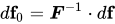
or,

The PK2 stress () is symmetric and is defined via the relation

Therefore,

Biot stress
[edit]The Biot stress is useful because it is energy conjugate to the right stretch tensor . The Biot stress is defined as the symmetric part of the tensor where is the rotation tensor obtained from a polar decomposition of the deformation gradient. Therefore, the Biot stress tensor is defined as



The Biot stress is also called the Jaumann stress.
The quantity does not have any physical interpretation. However, the unsymmetrized Biot stress has the interpretation

Relations
[edit]Relations between Cauchy stress and nominal stress
[edit]From Nanson's formula relating areas in the reference and deformed configurations:

Now,

Hence,

or,

or,

In index notation,

Therefore,

Note that and are (generally) not symmetric because is (generally) not symmetric.
Relations between nominal stress and second P–K stress
[edit]Recall that

and

Therefore,

or (using the symmetry of ),

In index notation,

Alternatively, we can write

Relations between Cauchy stress and second P–K stress
[edit]Recall that

In terms of the 2nd PK stress, we have

Therefore,

In index notation,

Since the Cauchy stress (and hence the Kirchhoff stress) is symmetric, the 2nd PK stress is also symmetric.
Alternatively, we can write

or,

Clearly, from definition of the push-forward and pull-back operations, we have
![{\displaystyle {\boldsymbol {S}}=\varphi ^{*}[{\boldsymbol {\tau }}]={\boldsymbol {F}}^{-1}\cdot {\boldsymbol {\tau }}\cdot {\boldsymbol {F}}^{-T}}](https://wikimedia.org/api/rest_v1/media/math/render/svg/a4d5f37efb8297f33270efe322adaabf46099ee9)
and
![{\displaystyle {\boldsymbol {\tau }}=\varphi _{*}[{\boldsymbol {S}}]={\boldsymbol {F}}\cdot {\boldsymbol {S}}\cdot {\boldsymbol {F}}^{T}~.}](https://wikimedia.org/api/rest_v1/media/math/render/svg/c3b707f11a8c67a3409dd4df7e6448d0ee9444cb)
Therefore, is the pull back of by and is the push forward of .
Summary of conversion formula
[edit]Key:


| Equation for | ||||||
|---|---|---|---|---|---|---|
| (non isotropy) | ||||||
| (non isotropy) | ||||||
| (non isotropy) | (non isotropy) |





See also
[edit]References
[edit]- ^ J. Bonet and R. W. Wood, Nonlinear Continuum Mechanics for Finite Element Analysis, Cambridge University Press.
- ^ R. W. Ogden, 1984, Non-linear Elastic Deformations, Dover.
- ^ L. D. Landau, E. M. Lifshitz, Theory of Elasticity, third edition
- ^ Three-Dimensional Elasticity. Elsevier. 1 April 1988. ISBN 978-0-08-087541-5.
Alternative stress measures
View on GrokipediaBackground
Role of Stress Measures
In continuum mechanics, stress is defined as a measure of the internal forces acting within a deformable body, quantified as the average force per unit area across a surface within the material. This concept captures the distribution of forces that arise due to external loads or internal interactions during deformation, enabling the analysis of how materials respond to mechanical influences such as tension, compression, or shear.[7] The origins of stress measures trace back to the 18th and 19th centuries, with foundational contributions from Leonhard Euler, who in 1776 introduced integral forms of momentum principles and concepts of internal pressure in fluids, laying early groundwork for understanding force distributions in continua.[8] Augustin-Louis Cauchy advanced this significantly between 1823 and 1827 by formulating the general mathematical theory of the stress tensor, initially for small deformations but encompassing finite-strain frameworks through his development of deformation tensors using material coordinates.[8] In the 20th century, Clifford Truesdell and others unified and extended these ideas into a comprehensive rational mechanics, refining stress measures for finite deformations and broadening their application in engineering and physics.[8] A key distinction exists between true stress and engineering stress. True stress accounts for the instantaneous cross-sectional area in the deformed configuration, providing a physically realistic representation of force transmission in the current state of the material.[9] Engineering stress, conversely, uses the original undeformed cross-sectional area as the reference, simplifying calculations for small strains but diverging from actual conditions in large deformations.[9] The Cauchy stress tensor represents the primary true stress measure in this context.[10] To comprehend alternative stress measures, it is essential to appreciate the role of the deformation gradient, a tensor that maps infinitesimal line elements from the reference to the current configuration. Stress measures must transform appropriately under this gradient to maintain consistency and objectivity, ensuring that descriptions of internal forces remain invariant under rigid body motions and accurately reflect material behavior in finite strain scenarios.[11][12]Cauchy Stress Tensor
The Cauchy stress tensor, denoted as , is a symmetric second-order tensor that represents the state of stress in a continuous material body, defined as the force per unit area acting on a surface in the current (deformed) configuration.[13] It arises from Cauchy's fundamental theorem, which posits that the traction vector on any surface with unit normal is given by , allowing the tensor to fully characterize internal forces across arbitrary orientations.[14] Physically, the components of the Cauchy stress tensor describe the stress on a surface element in the deformed body: the diagonal elements (no sum) represent normal stresses, while the off-diagonal elements (i ≠ j) denote shear stresses, quantifying the force in the -direction per unit area perpendicular to the -direction.[15] This interpretation aligns with the tensor's role in capturing the directional nature of forces, such as pressure and friction, in the instantaneous material state. Key properties of the Cauchy stress tensor include its symmetry, or , which follows from the balance of angular momentum and ensures no net torque on material elements in the absence of body couples.[13] It is also objective, transforming under rigid body rotations as , preserving its frame-indifference in describing physical stress states.[14] Additionally, the trace of the tensor, , relates to the hydrostatic pressure , representing the isotropic part of the stress that governs volumetric changes.[13] The Cauchy stress tensor satisfies the local balance of linear momentum, expressed as the Cauchy equation of motion: where is the divergence of the tensor, is the current mass density, is the body force per unit mass, and is the material acceleration.[16] This equation derives from applying Newton's second law to an infinitesimal volume element in the Eulerian frame. The advantages of the Cauchy stress tensor lie in its intuitive representation of forces relative to the deformed geometry, making it particularly suitable for analyses in fluid mechanics, where it directly incorporates pressure and viscous effects, and in small-strain solid mechanics, where deformations do not significantly alter areas or volumes.[17] However, in large-deformation scenarios, its dependence on the current configuration can complicate constitutive relations with reference-based strain measures.Motivations for Alternatives
Objectivity Requirements
In continuum mechanics, the principle of objectivity, also known as material frame indifference, stipulates that the mechanical behavior of a material must be independent of the observer's choice of reference frame, particularly under superposed rigid body motions such as translations and rotations. This ensures that stress measures reflect intrinsic material properties rather than artifacts of the coordinate system. Translations do not affect tensor components, but rotations require specific transformation rules to maintain physical consistency across observers. Mathematically, a second-order tensor defined in the spatial (current) configuration is deemed objective if, upon a superposed rigid rotation represented by an orthogonal tensor (with ), it transforms as This rule preserves the tensor's representation of physical quantities like stress under changes in observer orientation. The principle extends to constitutive relations, requiring that material response functions yield the same physical outcomes regardless of rigid superpositions. Formulated by Walter Noll in 1958, this axiom forms a cornerstone of modern continuum mechanics, ensuring the invariance of balance laws and constitutive equations under Euclidean transformations. Noll's framework emphasized that objectivity arises from the independence of mechanical descriptions from arbitrary rigid motions, enabling a unified theory for deformable media. The Cauchy stress tensor inherently satisfies objectivity, transforming as , since it is defined with respect to force per unit area in the current (deformed) configuration. However, in finite deformation analyses, this spatial reference poses significant challenges: the current configuration evolves with loading, making it difficult to directly link stress to fixed material coordinates or initial geometry where constitutive properties are typically defined and experimentally measured. This mismatch complicates the formulation of material models, integration in numerical schemes like finite elements, and interpretation of results relative to undeformed states. Alternative stress measures address these issues by referring forces to the reference (undeformed) configuration while adhering to objectivity through appropriate pull-back operations, allowing constitutive modeling in a fixed frame without loss of frame indifference. Without such measures, analyses in finite strains risk inconsistencies when deformations include large rotations. Non-objective stress measures, such as the engineering (nominal) stress—which approximates force per undeformed area without accounting for deformation-induced changes—fail the transformation rule, typically transforming as rather than . This leads to observer-dependent predictions, where the computed stress varies with the orientation of the simulation frame even for identical physical loading. In finite element simulations of structures undergoing rigid body rotations, such measures introduce spurious coupling between rotation and stress, resulting in artificial energy dissipation, inaccurate equilibrium paths, or divergent solutions under incremental loading.[18]Work Conjugacy with Strain Measures
In continuum mechanics, particularly for finite deformations, a stress measure and a strain measure are defined as work-conjugate if the internal virtual work per unit reference volume is expressed as the double contraction , ensuring that the integral over the domain accurately represents the total virtual work without additional transformation factors.[19] This conjugacy condition is fundamental for deriving consistent constitutive relations, as it guarantees that the stress power equals the rate of change of the internal energy density, .[19] The importance of work conjugacy is pronounced in hyperelasticity, where materials store energy path-independently through a strain energy potential , with the stress obtained as only for conjugate pairs; non-conjugate choices lead to inconsistencies in energy conservation.[19] In finite element methods for large-deformation problems, conjugate pairs preserve variational consistency in incremental formulations, promoting numerical stability by avoiding spurious energy modes and ensuring reliable convergence in nonlinear solvers.[18] For instance, violations of conjugacy in buckling analyses can introduce large errors in critical load predictions, as observed in simulations of compressed elastic solids.[18] Common work-conjugate pairs include the Cauchy stress tensor with the spatial rate of deformation (symmetric part of the velocity gradient), suitable for hypoelastic models; the second Piola-Kirchhoff stress with the Green-Lagrange strain , ideal for hyperelastic formulations in the reference configuration; and the first Piola-Kirchhoff stress with variations of the deformation gradient , often used in total Lagrangian schemes.[19] These pairs facilitate objective and efficient implementation in computational mechanics. An illustrative example arises in modeling hyperelastic materials like rubber under cyclic loading, where non-conjugate pairs—such as those in certain hypoelastic approximations—introduce artificial dissipation and path dependence, resulting in unphysical residual stresses and energy loss upon unloading, contrary to the reversible nature of hyperelasticity.[20] This underscores the need for conjugacy to maintain physical fidelity in large-strain simulations.Key Alternative Measures
Kirchhoff Stress
The Kirchhoff stress tensor, denoted as , is defined as , where is the Cauchy stress tensor and represents the Jacobian determinant of the deformation gradient , quantifying the local volume ratio between the current and reference configurations.[1] This measure is a spatial tensor, symmetric like the Cauchy stress, and operates in the current (deformed) configuration.[21] As a scalar multiple of the Cauchy stress tensor, the Kirchhoff stress shares the same principal directions but is scaled by the factor , which accounts for volumetric changes during deformation.[2] It is an objective stress measure, invariant under superposed rigid body rotations, preserving the transformation properties of the Cauchy stress while incorporating the volume scaling.[1] Physically, the Kirchhoff stress adjusts the true stress for both area and volume changes in finite strain analyses, providing a weighted representation of force per unit deformed area that bridges spatial and material descriptions without direct physical interpretation beyond this adjustment.[21] One key advantage of the Kirchhoff stress lies in updated Lagrangian formulations, where it simplifies the derivation of equilibrium equations by absorbing the Jacobian factor, facilitating clearer expressions for stress power as (with the rate of deformation tensor) and easing the handling of boundary conditions.[1] It is particularly prevalent in metal plasticity models, where plastic incompressibility implies , making and streamlining numerical implementations for isochoric flow in crystal plasticity simulations.[22]First Piola-Kirchhoff Stress
The first Piola-Kirchhoff stress tensor, also known as the nominal stress tensor or engineering stress tensor, is a measure that relates forces in the current (deformed) configuration to areas in the reference (undeformed) configuration. It is defined mathematically as , where is the Jacobian determinant of the deformation gradient , and is the Cauchy stress tensor.[23] This tensor serves as a pull-back of the Cauchy stress to the reference configuration, facilitating analysis in Lagrangian descriptions of finite deformations.[24] Unlike the symmetric Cauchy stress tensor, the first Piola-Kirchhoff stress tensor is generally not symmetric, even when is symmetric, due to the involvement of the inverse transpose of .[25] However, it satisfies the relation , reflecting the symmetry of .[24] Regarding frame indifference, transforms under a superposed rigid rotation as , embodying objectivity in a mixed sense as a two-point tensor connecting reference and current frames.[23] Physically, represents the force per unit area in the undeformed configuration, with the force vector expressed in the deformed configuration's basis.[26] In component form, using Cartesian bases for the current configuration and for the reference, the components are , where denotes the i-component of force per unit reference area normal to the J-direction.[23] This interpretation arises from Nanson's formula relating area vectors across configurations, ensuring maps reference normals to current traction vectors appropriately.[25] In applications, particularly finite element analysis of large deformations, is valuable for imposing boundary conditions, as prescribed loads naturally align with the initial geometry in the reference configuration.[25] It enables straightforward computation of equilibrium equations in the Lagrangian framework, such as , where is the reference divergence, body forces, and reference density.[24] This utility extends to hybrid stress formulations and variational principles in nonlinear solid mechanics simulations.[27]Second Piola-Kirchhoff Stress
The second Piola-Kirchhoff stress tensor, denoted as , is defined as the pull-back of the first Piola-Kirchhoff stress tensor by the inverse deformation gradient , yielding . Equivalently, it relates to the Cauchy stress tensor through , where is the Jacobian determinant.[23] This tensor was originally introduced by Gabrio Piola in 1833 and later formalized by Gustav Kirchhoff in 1852, providing a foundational measure for stress in finite deformation theory.[28] A key property of is its symmetry, , which follows directly from the symmetry of the Cauchy stress tensor under typical assumptions in continuum mechanics. Additionally, is objective in the Lagrangian sense, remaining unchanged under superposed rigid-body rotations on the current configuration, as its components are defined with respect to the fixed reference configuration.[23] Physically, represents a "corrected" engineering stress, interpreting the force per unit undeformed area but resolved in the undeformed material directions, thus accounting for the geometric changes in orientation during deformation.[23] In hyperelastic constitutive models, plays a central role, with the Cauchy stress obtained via the push-forward relation . This formulation simplifies the expression of material laws, as is often derived directly from the strain energy density function as a function of the Green-Lagrange strain tensor. Its advantages include ensuring energy conservation in total Lagrangian finite element formulations, where equilibrium is enforced in the reference configuration, thereby enhancing computational stability for large-deformation problems without frequent mesh updates.[29]Biot Stress
The Biot stress tensor, often denoted as , is also expressed as the symmetric part of the first Piola-Kirchhoff stress tensor rotated by the deformation, , where is the rotation tensor from the polar decomposition of .[10] The Biot stress tensor is generally unsymmetric unless the material is isotropic, in which case it shares symmetry with the underlying Cauchy stress.[30] Physically, it represents the internal force per unit reference area acting in the direction of the current deformed line elements, providing a direct interpretation of stress along extended material fibers without resolving rigid rotations.[31] This fiber-aligned perspective facilitates analysis of deformation work as , where is the right stretch tensor, establishing work conjugacy with the Biot strain measure.[32] Due to its basis in deformed fiber directions, the Biot stress finds niche applications in modeling anisotropic materials where directional reinforcement is prominent. In crystal plasticity, it aids in capturing slip along lattice directions under large strains, as seen in finite-strain formulations for polycrystals.[33] For fiber-reinforced composites, it supports homogenization of effective properties under finite deformations, enabling prediction of transverse loading responses.[34] In biomechanics, particularly for soft tissues like membranes or cardiovascular structures, it models nonlinear elasticity with fiber orientations, improving fits to experimental data on residual stresses and anisotropy.[35] These uses stem from seminal work by Biot on incremental deformations, though its complexity limits broader adoption compared to other measures.[36]Interconversion Relations
Cauchy to First Piola-Kirchhoff
The transformation from the Cauchy stress tensor to the first Piola-Kirchhoff stress tensor arises in the context of finite deformation continuum mechanics, where forces and areas are related between the current (deformed) and reference (undeformed) configurations. This relation ensures that the stress measure accounts for the mapping of surface elements under deformation, preserving the balance of forces in equilibrium equations.[23] The derivation begins with Cauchy's fundamental theorem, which states that the traction on a surface with normal in the current configuration is , where the magnitude relates to the force per unit deformed area . To refer this to the reference configuration, Nanson's formula provides the transformation for area vectors: , where is the Jacobian determinant of the deformation gradient , and is the reference area vector. Equating the forces, the traction in the reference configuration becomes , with satisfying , leading to the explicit relation . This push-forward/pull-back operation maintains objectivity under rigid body motions.[23][24] Geometrically, the term represents the cofactor matrix of , which scales areas by the deformation while accounting for orientation changes; it transforms infinitesimal reference areas into deformed ones, ensuring that computes force per unit reference area, in contrast to 's use of deformed areas. This is particularly useful for integrating equilibrium over fixed reference domains in numerical simulations.[1] In the example of uniaxial tension along the -direction, assume a bar with uniform deformation where for incompressibility (). The axial Cauchy stress is the true stress (force over current cross-section), while the corresponding first Piola-Kirchhoff component , which equals the engineering stress (force over original cross-section). This relation highlights how simplifies load boundary conditions in reference coordinates.[37] The transformation assumes quasi-static conditions or hyperelastic materials where the deformation gradient is invertible and the stress is symmetric in the current configuration, often derived within the framework of objective rates for rate-independent responses.[38] Numerically, this relation facilitates switches between updated Lagrangian formulations (using on current meshes) and total Lagrangian ones (using on reference meshes) in finite element analysis, enabling efficient handling of large deformations by transforming internal forces without remeshing.[39]First to Second Piola-Kirchhoff
The transformation from the first Piola-Kirchhoff stress tensor to the second Piola-Kirchhoff stress tensor is obtained by premultiplying with the inverse of the deformation gradient , yielding . This relation follows from the need to refer the traction vectors associated with —which act in the deformed configuration—back to directions in the reference configuration, effectively pulling back the stress measure to be consistent with Lagrangian descriptions of deformation. The derivation leverages the transformation properties of surface elements via Nanson's formula, ensuring that the resulting acts on reference area vectors to produce reference-aligned forces.[25][23] This conversion interprets as a fully Lagrangian stress measure, where both the force components and the referential areas are defined in the undeformed configuration, in contrast to the mixed Eulerian-Lagrangian nature of . A key property preserved in this transformation is the symmetry of when the Cauchy stress is symmetric, as the multiplication by eliminates the inherent asymmetry of arising from the deformation gradient's rotational components; additionally, is energetically conjugate to the Green-Lagrange strain tensor , such that the trace of represents the rate of internal energy per unit reference volume in hyperelastic materials.[40][23] In the example of simple shear deformation, where for shear amount , the first Piola-Kirchhoff stress exhibits asymmetry due to the coupling of shear and rigid rotation effects in the deformation. The transformation to symmetrizes this response, isolating the pure material shear contribution by effectively removing the rotational influence, which aligns with a form compatible with isotropic elasticity models.[41] A primary advantage of this transformation is that it facilitates the development of isotropic constitutive relations in the reference configuration, where can be expressed as a function of without complications from the current configuration's geometry or rotations, making it particularly suitable for finite element implementations in large-deformation problems.[40]Cauchy to Second Piola-Kirchhoff
The transformation from the Cauchy stress tensor to the second Piola-Kirchhoff stress tensor provides a direct mapping between the current and reference configurations in finite strain continuum mechanics. This relation is derived by combining the pull-back of the stress vector (directional transformation) with the adjustment for area changes across configurations. Specifically, the formula is , where is the Jacobian determinant representing the volume ratio, and is the deformation gradient tensor. This expression arises from Nanson's formula, which relates area vectors between configurations, and ensures that is an energy-conjugate measure suitable for variational principles in hyperelasticity. The derivation emphasizes the "full pull-back" to the reference configuration: the term transforms the stress directions from the deformed to the undeformed state, while the scalar accounts for the stretch in area elements, preserving the work done by the stress during deformation. This makes particularly useful for constitutive modeling, as it allows direct formulation of strain energy functions in terms of reference configuration quantities without explicit tracking of current geometry. In rate form, the Lie derivative of the second Piola-Kirchhoff stress is often employed in objective time derivatives for hypoelastic materials, ensuring frame-indifference (objectivity) under superposed rigid motions. For instance, in biaxial stretching of a rubber sheet, where the deformation gradient might be diagonal with stretches and in the plane and for incompressibility, the transformation modifies the principal Cauchy stresses to second Piola-Kirchhoff values that better reflect the material's reference response, such as reduced stress in highly stretched directions due to the inverse factors. This highlights how the mapping adjusts for geometric nonlinearities, aiding in the prediction of material failure. In finite element software like ABAQUS, this transformation is standard for implementing hyperelastic models, where is computed internally from to evaluate tangent stiffness matrices in the reference frame, improving numerical stability for large deformations. The first Piola-Kirchhoff stress serves an intermediate role in some derivations but is not required for this direct composite.Summary of Transformation Formulas
The transformation formulas between alternative stress measures in continuum mechanics facilitate the conversion among representations tied to different configurations, leveraging the deformation gradient tensor and its determinant . These relations ensure that work-conjugate pairs maintain consistency in variational formulations and finite element implementations. The Kirchhoff stress scales the Cauchy stress by the volume change factor, while the Piola-Kirchhoff stresses pull back forces to the reference configuration. The Biot stress incorporates the polar decomposition for a measure aligned with stretch directions.[2][42] The following table summarizes the primary forward transformation relations, expressed in modern tensor notation:| From | To | Formula |
|---|---|---|
| Cauchy | Kirchhoff | |
| Cauchy | First Piola-Kirchhoff | |
| First Piola-Kirchhoff | Second Piola-Kirchhoff | |
| Cauchy | Second Piola-Kirchhoff | |
| Second Piola-Kirchhoff or First Piola-Kirchhoff | Biot |
S = J * inv(F)' * sigma * inv(F); (noting transpose for row-major convention), with symbolic differentiation via the Symbolic Math Toolbox for hyperelastic derivatives. Such expressions appear in automated code generation for finite element analysis.[43]References
- https://classes.engineering.wustl.edu/2009/spring/mase5513/abaqus/docs/v6.6/[books](/page/The_Books)/stm/ch01s05ath09.html
- https://www.sciencedirect.com/topics/[engineering](/page/Engineering)/stress-measure