Hubbry Logo
Virtual workVirtual workMain
Open search
Virtual work
Community hub
Virtual work
logo
7 pages, 0 posts
0 subscribers
Be the first to start a discussion here.
Contribute something
Virtual work
Virtual work
from Wikipedia

In mechanics, virtual work arises in the application of the principle of least action to the study of forces and movement of a mechanical system. The work of a force acting on a particle as it moves along a displacement is different for different displacements. Among all the possible displacements that a particle may follow, called virtual displacements, one will minimize the action. This displacement is therefore the displacement followed by the particle according to the principle of least action.

The work of a force on a particle along a virtual displacement is known as the virtual work.

Historically, virtual work and the associated calculus of variations were formulated to analyze systems of rigid bodies,[1] but they have also been developed for the study of the mechanics of deformable bodies.[2]

History

[edit]

The principle of virtual work had always been used in some form since antiquity in the study of statics. It was used by the Greeks, medieval Arabs and Latins, and Renaissance Italians as "the law of lever".[3] The idea of virtual work was invoked by many notable physicists of the 17th century, such as Galileo, Descartes, Torricelli, Wallis, and Huygens, in varying degrees of generality, when solving problems in statics.[3] Working with Leibnizian concepts, Johann Bernoulli systematized the virtual work principle and made explicit the concept of infinitesimal displacement. He was able to solve problems for both rigid bodies as well as fluids. Bernoulli's version of virtual work law appeared in his letter to Pierre Varignon in 1715, which was later published in Varignon's second volume of Nouvelle mécanique ou Statique in 1725. This formulation of the principle is today known as the principle of virtual velocities and is commonly considered as the prototype of the contemporary virtual work principles.[3] In 1743 D'Alembert published his Traité de Dynamique where he applied the principle of virtual work, based on Bernoulli's work, to solve various problems in dynamics. His idea was to convert a dynamical problem into static problem by introducing inertial force.[4] In 1768, Lagrange presented the virtual work principle in a more efficient form by introducing generalized coordinates and presented it as an alternative principle of mechanics by which all problems of equilibrium could be solved. A systematic exposition of Lagrange's program of applying this approach to all of mechanics, both static and dynamic, essentially D'Alembert's principle, was given in his Mécanique Analytique of 1788.[3] Although Lagrange had presented his version of least action principle prior to this work, he recognized the virtual work principle to be more fundamental mainly because it could be assumed alone as the foundation for all mechanics, unlike the modern understanding that least action does not account for non-conservative forces.[3]

Overview

[edit]

If a force acts on a particle as it moves from point to point , then, for each possible trajectory that the particle may take, it is possible to compute the total work done by the force along the path. The principle of virtual work, which is the form of the principle of least action applied to these systems, states that the path actually followed by the particle is the one for which the difference between the work along this path and other nearby paths is zero (to the first order). The formal procedure for computing the difference of functions evaluated on nearby paths is a generalization of the derivative known from differential calculus, and is termed the calculus of variations.

Consider a point particle that moves along a path which is described by a function from point , where , to point , where . It is possible that the particle moves from to along a nearby path described by , where is called the variation of . The variation satisfies the requirement . The scalar components of the variation , and are called virtual displacements. This can be generalized to an arbitrary mechanical system defined by the generalized coordinates , . In which case, the variation of the trajectory is defined by the virtual displacements , .

Virtual work is the total work done by the applied forces and the inertial forces of a mechanical system as it moves through a set of virtual displacements. When considering forces applied to a body in static equilibrium, the principle of least action requires the virtual work of these forces to be zero.

Mathematical treatment

[edit]

Consider a particle P that moves from a point A to a point B along a trajectory r(t), while a force F(r(t)) is applied to it. The work done by the force F is given by the integral where dr is the differential element along the curve that is the trajectory of P, and v is its velocity. It is important to notice that the value of the work W depends on the trajectory r(t).

Now consider particle P that moves from point A to point B again, but this time it moves along the nearby trajectory that differs from r(t) by the variation δr(t) = εh(t), where ε is a scaling constant that can be made as small as desired and h(t) is an arbitrary function that satisfies h(t0) = h(t1) = 0. Suppose the force F(r(t) + εh(t)) is the same as F(r(t)). The work done by the force is given by the integral The variation of the work δW associated with this nearby path, known as the virtual work, can be computed to be

If there are no constraints on the motion of P, then 3 parameters are needed to completely describe P's position at any time t. If there are k (k ≤ 3) constraint forces, then n = (3 − k) parameters are needed. Hence, we can define n generalized coordinates qi (t) (i = 1,...,n), and express r(t) and δr = εh(t) in terms of the generalized coordinates. That is, Then, the derivative of the variation δr = εh(t) is given by then we have


The requirement that the virtual work be zero for an arbitrary variation δr(t) = εh(t) is equivalent to the set of requirements The terms Qi are called the generalized forces associated with the virtual displacement δr.

Static equilibrium

[edit]

Static equilibrium is a state in which the net force and net torque acted upon the system is zero. In other words, both linear momentum and angular momentum of the system are conserved. The principle of virtual work states that the virtual work of the applied forces is zero for all virtual movements of the system from static equilibrium. This principle can be generalized such that three dimensional rotations are included: the virtual work of the applied forces and applied moments is zero for all virtual movements of the system from static equilibrium. That is where Fi , i = 1, 2, ..., m and Mj , j = 1, 2, ..., n are the applied forces and applied moments, respectively, and δri , i = 1, 2, ..., m and δφj, j = 1, 2, ..., n are the virtual displacements and virtual rotations, respectively.

Suppose the system consists of N particles, and it has f (f ≤ 6N) degrees of freedom. It is sufficient to use only f coordinates to give a complete description of the motion of the system, so f generalized coordinates qk , k = 1, 2, ..., f are defined such that the virtual movements can be expressed in terms of these generalized coordinates. That is,


The virtual work can then be reparametrized by the generalized coordinates: where the generalized forces Qk are defined as Kane[5] shows that these generalized forces can also be formulated in terms of the ratio of time derivatives. That is,

The principle of virtual work requires that the virtual work done on a system by the forces Fi and moments Mj vanishes if it is in equilibrium. Therefore, the generalized forces Qk are zero, that is

Constraint forces

[edit]

An important benefit of the principle of virtual work is that only forces that do work as the system moves through a virtual displacement are needed to determine the mechanics of the system. There are many forces in a mechanical system that do no work during a virtual displacement, which means that they need not be considered in this analysis. The two important examples are (i) the internal forces in a rigid body, and (ii) the constraint forces at an ideal joint.

Lanczos[1] presents this as the postulate: "The virtual work of the forces of reaction is always zero for any virtual displacement which is in harmony with the given kinematic constraints." The argument is as follows. The principle of virtual work states that in equilibrium the virtual work of the forces applied to a system is zero. Newton's laws state that at equilibrium the applied forces are equal and opposite to the reaction, or constraint forces. This means the virtual work of the constraint forces must be zero as well.

Law of the lever

[edit]

A lever is modeled as a rigid bar connected to a ground frame by a hinged joint called a fulcrum. The lever is operated by applying an input force FA at a point A located by the coordinate vector rA on the bar. The lever then exerts an output force FB at the point B located by rB. The rotation of the lever about the fulcrum P is defined by the rotation angle θ.

This is an engraving from Mechanics Magazine published in London in 1824.

Let the coordinate vector of the point P that defines the fulcrum be rP, and introduce the lengths which are the distances from the fulcrum to the input point A and to the output point B, respectively.

Now introduce the unit vectors eA and eB from the fulcrum to the point A and B, so This notation allows us to define the velocity of the points A and B as where eA and eB are unit vectors perpendicular to eA and eB, respectively.

The angle θ is the generalized coordinate that defines the configuration of the lever, therefore using the formula above for forces applied to a one degree-of-freedom mechanism, the generalized force is given by

Now, denote as FA and FB the components of the forces that are perpendicular to the radial segments PA and PB. These forces are given by This notation and the principle of virtual work yield the formula for the generalized force as


The ratio of the output force FB to the input force FA is the mechanical advantage of the lever, and is obtained from the principle of virtual work as
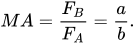
This equation shows that if the distance a from the fulcrum to the point A where the input force is applied is greater than the distance b from fulcrum to the point B where the output force is applied, then the lever amplifies the input force. If the opposite is true that the distance from the fulcrum to the input point A is less than from the fulcrum to the output point B, then the lever reduces the magnitude of the input force.

This is the law of the lever, which was proven by Archimedes using geometric reasoning.[6]

Gear train

[edit]

A gear train is formed by mounting gears on a frame so that the teeth of the gears engage. Gear teeth are designed to ensure the pitch circles of engaging gears roll on each other without slipping, this provides a smooth transmission of rotation from one gear to the next. For this analysis, we consider a gear train that has one degree-of-freedom, which means the angular rotation of all the gears in the gear train are defined by the angle of the input gear.

Illustration from Army Service Corps Training on Mechanical Transport, (1911), Fig. 112 Transmission of motion and force by gear wheels, compound train

The size of the gears and the sequence in which they engage define the ratio of the angular velocity ωA of the input gear to the angular velocity ωB of the output gear, known as the speed ratio, or gear ratio, of the gear train. Let R be the speed ratio, then

The input torque TA acting on the input gear GA is transformed by the gear train into the output torque TB exerted by the output gear GB. If we assume, that the gears are rigid and that there are no losses in the engagement of the gear teeth, then the principle of virtual work can be used to analyze the static equilibrium of the gear train.

Let the angle θ of the input gear be the generalized coordinate of the gear train, then the speed ratio R of the gear train defines the angular velocity of the output gear in terms of the input gear, that is

The formula above for the principle of virtual work with applied torques yields the generalized force

The mechanical advantage of the gear train is the ratio of the output torque TB to the input torque TA, and the above equation yields
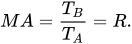
Thus, the speed ratio of a gear train also defines its mechanical advantage. This shows that if the input gear rotates faster than the output gear, then the gear train amplifies the input torque. And, if the input gear rotates slower than the output gear, then the gear train reduces the input torque.

Dynamic equilibrium for rigid bodies

[edit]

If the principle of virtual work for applied forces is used on individual particles of a rigid body, the principle can be generalized for a rigid body: When a rigid body that is in equilibrium is subject to virtual compatible displacements, the total virtual work of all external forces is zero; and conversely, if the total virtual work of all external forces acting on a rigid body is zero then the body is in equilibrium.

If a system is not in static equilibrium, D'Alembert showed that by introducing the acceleration terms of Newton's laws as inertia forces, this approach is generalized to define dynamic equilibrium. The result is D'Alembert's form of the principle of virtual work, which is used to derive the equations of motion for a mechanical system of rigid bodies.

The expression compatible displacements means that the particles remain in contact and displace together so that the work done by pairs of action/reaction inter-particle forces cancel out. Various forms of this principle have been credited to Johann (Jean) Bernoulli (1667–1748) and Daniel Bernoulli (1700–1782).

Generalized inertia forces

[edit]

Let a mechanical system be constructed from n rigid bodies, Bi, i=1,...,n, and let the resultant of the applied forces on each body be the force-torque pairs, Fi and Ti, i = 1,...,n. Notice that these applied forces do not include the reaction forces where the bodies are connected. Finally, assume that the velocity Vi and angular velocities ωi, i=1,...,n, for each rigid body, are defined by a single generalized coordinate q. Such a system of rigid bodies is said to have one degree of freedom.

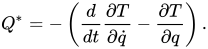
Consider a single rigid body which moves under the action of a resultant force F and torque T, with one degree of freedom defined by the generalized coordinate q. Assume the reference point for the resultant force and torque is the center of mass of the body, then the generalized inertia force Q* associated with the generalized coordinate q is given by This inertia force can be computed from the kinetic energy of the rigid body, by using the formula

A system of n rigid bodies with m generalized coordinates has the kinetic energy which can be used to calculate the m generalized inertia forces[7]

D'Alembert's form of the principle of virtual work

[edit]

D'Alembert's form of the principle of virtual work states that a system of rigid bodies is in dynamic equilibrium when the virtual work of the sum of the applied forces and the inertial forces is zero for any virtual displacement of the system. Thus, dynamic equilibrium of a system of n rigid bodies with m generalized coordinates requires that for any set of virtual displacements δqj. This condition yields m equations, which can also be written as The result is a set of m equations of motion that define the dynamics of the rigid body system, known as Lagrange's equations or the generalized equations of motion.


If the generalized forces Qj are derivable from a potential energy V(q1,...,qm), then these equations of motion take the form

In this case, introduce the Lagrangian, L = TV, so these equations of motion become These are known as the Euler-Lagrange equations for a system with m degrees of freedom, or Lagrange's equations of the second kind.

Virtual work principle for a deformable body

[edit]

Consider now the free body diagram of a deformable body, which is composed of an infinite number of differential cubes. Let's define two unrelated states for the body:

  • The -State : This shows external surface forces T, body forces f, and internal stresses in equilibrium.
  • The -State : This shows continuous displacements and consistent strains .

The superscript * emphasizes that the two states are unrelated. Other than the above stated conditions, there is no need to specify if any of the states are real or virtual.

Imagine now that the forces and stresses in the -State undergo the displacements and deformations in the -State: We can compute the total virtual (imaginary) work done by all forces acting on the faces of all cubes in two different ways:

  • First, by summing the work done by forces such as which act on individual common faces (Fig.c): Since the material experiences compatible displacements, such work cancels out, leaving only the virtual work done by the surface forces T (which are equal to stresses on the cubes' faces, by equilibrium).
  • Second, by computing the net work done by stresses or forces such as , which act on an individual cube, e.g. for the one-dimensional case in Fig.(c): where the equilibrium relation has been used and the second order term has been neglected.
    Integrating over the whole body gives: – Work done by the body forces f.

Equating the two results leads to the principle of virtual work for a deformable body:

where the total external virtual work is done by T and f. Thus,

The right-hand-side of (d,e) is often called the internal virtual work. The principle of virtual work then states: External virtual work is equal to internal virtual work when equilibrated forces and stresses undergo unrelated but consistent displacements and strains. It includes the principle of virtual work for rigid bodies as a special case where the internal virtual work is zero.

Proof of equivalence between the principle of virtual work and the equilibrium equation

[edit]

We start by looking at the total work done by surface traction on the body going through the specified deformation:
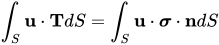
Applying divergence theorem to the right hand side yields:

Now switch to indicial notation for the ease of derivation.
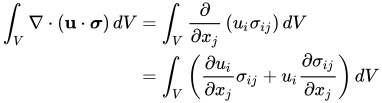
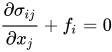
To continue our derivation, we substitute in the equilibrium equation . Then

The first term on the right hand side needs to be broken into a symmetric part and a skew part as follows: where is the strain that is consistent with the specified displacement field. The 2nd to last equality comes from the fact that the stress matrix is symmetric and that the product of a skew matrix and a symmetric matrix is zero.

Now recap. We have shown through the above derivation that

Move the 2nd term on the right hand side of the equation to the left:

The physical interpretation of the above equation is, the External virtual work is equal to internal virtual work when equilibrated forces and stresses undergo unrelated but consistent displacements and strains.

For practical applications:

  • In order to impose equilibrium on real stresses and forces, we use consistent virtual displacements and strains in the virtual work equation.
  • In order to impose consistent displacements and strains, we use equilibriated virtual stresses and forces in the virtual work equation.

These two general scenarios give rise to two often stated variational principles. They are valid irrespective of material behaviour.

Principle of virtual displacements

[edit]

Depending on the purpose, we may specialize the virtual work equation. For example, to derive the principle of virtual displacements in variational notations for supported bodies, we specify:

  • Virtual displacements and strains as variations of the real displacements and strains using variational notation such as and
  • Virtual displacements be zero on the part of the surface that has prescribed displacements, and thus the work done by the reactions is zero. There remains only external surface forces on the part that do work.

The virtual work equation then becomes the principle of virtual displacements:

This relation is equivalent to the set of equilibrium equations written for a differential element in the deformable body as well as of the stress boundary conditions on the part of the surface. Conversely, (f) can be reached, albeit in a non-trivial manner, by starting with the differential equilibrium equations and the stress boundary conditions on , and proceeding in the manner similar to (a) and (b).

Since virtual displacements are automatically compatible when they are expressed in terms of continuous, single-valued functions, we often mention only the need for consistency between strains and displacements. The virtual work principle is also valid for large real displacements; however, Eq.(f) would then be written using more complex measures of stresses and strains.

Principle of virtual forces

[edit]

Here, we specify:

  • Virtual forces and stresses as variations of the real forces and stresses.
  • Virtual forces be zero on the part of the surface that has prescribed forces, and thus only surface (reaction) forces on (where displacements are prescribed) would do work.

The virtual work equation becomes the principle of virtual forces:

This relation is equivalent to the set of strain-compatibility equations as well as of the displacement boundary conditions on the part . It has another name: the principle of complementary virtual work.

Alternative forms

[edit]

A specialization of the principle of virtual forces is the unit dummy force method, which is very useful for computing displacements in structural systems. According to D'Alembert's principle, inclusion of inertial forces as additional body forces will give the virtual work equation applicable to dynamical systems. More generalized principles can be derived by:

  • allowing variations of all quantities.
  • using Lagrange multipliers to impose boundary conditions and/or to relax the conditions specified in the two states.

These are described in some of the references.

Among the many energy principles in structural mechanics, the virtual work principle deserves a special place due to its generality that leads to powerful applications in structural analysis, solid mechanics, and finite element method in structural mechanics.

See also

[edit]

References

[edit]
[edit]

Bibliography

[edit]
Revisions and contributorsEdit on WikipediaRead on Wikipedia
from Grokipedia
Virtual work is a fundamental concept in that involves calculating the work done by forces acting through hypothetical infinitesimal displacements, known as , which are consistent with the geometric constraints of a mechanical system but do not correspond to actual motion over time. These are instantaneous and independent of time, allowing for the analysis of equilibrium without considering kinetics. The principle of virtual work states that a in static equilibrium will have zero total virtual work performed by all applied forces for any admissible , providing a powerful method to derive equilibrium equations by eliminating constraint forces that do no virtual work. The origins of the principle trace back to the in , with early formulations appearing in discussions of and levers, evolving through medieval and Latin mechanics during the . During the , varied statements of virtual work laws emerged as distinct principles of , setting the stage for further refinement. In the 18th century, systematized the concept using Leibnizian infinitesimal displacements, while formalized it in his Mécanique Analytique (1788), integrating it into and extending it to dynamics via . By the , the French school applied Lagrangian versions to , solidifying its role in modern engineering and physics. In and , the principle equates external virtual work—done by applied loads, body forces, and surface tractions through virtual displacements—to internal virtual work—arising from stresses and virtual strains within deformable bodies, enabling the computation of deflections and reactions without solving full force systems. For particle systems or under workless constraints (where constraint forces perform no virtual work), it reduces to the condition that the virtual work of applied forces alone is zero, simplifying equilibrium problems for systems with multiple . This method underpins the in , where discretized virtual displacements lead to stiffness matrices and load vectors for solving complex structures. Applications extend to nonlinear elasticity, dynamics, and even metamaterials , highlighting its versatility across scales from particles to continua.

Introduction

Overview

The principle of virtual work refers to the work performed by applied forces on a mechanical system during an virtual displacement that adheres to the system's geometric constraints, without considering time-dependent motion. This concept allows for the analysis of system behavior by imagining small, hypothetical changes in position that respect boundaries or linkages, enabling the evaluation of force effects in a constrained environment. The formal principle of virtual work emerged in the as a tool to streamline the solution of problems, building on ancient and medieval precursors and shifting focus from direct force balancing to energy-like considerations in equilibrium scenarios. It provides a general framework for handling complex where traditional methods, such as resolving individual forces, become cumbersome due to multiple constraints. In practice, the principle derives equilibrium conditions by requiring that the total virtual work vanish for any admissible in a constrained , thereby confirming balance without explicitly solving for constraint reactions. This approach connects directly to static equilibrium analysis, offering an alternative to Newtonian force equations. Today, the principle underpins variational principles across physics and engineering, forming the basis for advanced techniques like and finite element methods used in and simulation.

Historical Development

The principle of virtual work traces its conceptual roots to ancient discussions of equilibrium in mechanical systems, particularly through 's analysis of levers in the 4th century BCE. In his Physics and the pseudo-Aristotelian Mechanical Problems, Aristotle conceptualized "power" as the product of and , explaining the balance of a by the inverse proportionality of weights to their velocities, which anticipates the idea of displacements in equilibrium conditions. This qualitative approach, elaborated in the pseudo-Aristotelian Mechanical Problems, linked to circular motions and ratios, laying an early groundwork for later quantitative formulations without invoking explicit virtual displacements. Medieval scholars advanced these ideas toward a more systematic treatment of , with Jordanus de Nemore's contributions in the 13th century marking a pivotal step. In works such as De ratione ponderis (composed before 1260), Jordanus introduced the concept of "positional gravity," where the effective weight of a body varies with its position on an , effectively employing a precursor to virtual work by considering motions to determine equilibrium. His demonstrations, including proofs of the through virtual displacements, represented the first mathematical application of such principles in , drawing on decrypted Hellenistic sources and emphasizing the balance of moments in constrained systems. The formalization of the principle emerged in the , beginning with Johann Bernoulli's 1717 letter to Pierre Varignon, where he introduced the notion of "virtual displacements" as infinitesimal variations compatible with system constraints. Bernoulli posited that a body is in equilibrium if the sum of the products of applied forces and their corresponding virtual displacements equals zero, providing a general criterion for static systems beyond simple levers. This , later published in Varignon's Nouvelle mécanique (1725), shifted the focus from actual motions to hypothetical ones, enabling broader applications in . Leonhard Euler extended these ideas in the 1760s through his work on the mechanics of rigid bodies, incorporating virtual displacements into variational principles and demonstrating their utility for systems with multiple . A key milestone came with Joseph-Louis Lagrange's generalization in Mécanique Analytique (1788), which unified virtual work into a comprehensive framework for both and dynamics, treating constraints via multipliers and deriving from equilibrium conditions. Earlier, had transitioned the principle to dynamics in his Traité de dynamique (1743), applying virtual displacements to moving bodies by balancing inertial forces with external ones, effectively reducing dynamic problems to static equilibria.

Fundamental Concepts

Definition and Basic Principles

Virtual work is a foundational concept in that facilitates the analysis of systems in equilibrium by considering hypothetical rather than actual motions. Real displacements refer to the actual, finite changes in position that a mechanical system undergoes during its physical motion over time, governed by the dynamics of applied forces and constraints. In contrast, virtual displacements are infinitesimal, imaginary variations in the system's configuration that are compatible with the existing constraints but do not correspond to real-time evolution; they are "frozen" in time, meaning no actual movement or energy transfer occurs. The of virtual work states that a mechanical system is in equilibrium the total virtual work performed by all s acting on the system is zero for any admissible . This principle applies to both particles and rigid bodies, providing a scalar condition that simplifies equilibrium analysis without requiring vector resolutions of s. Virtual work is computed as the of a real vector with a vector, or equivalently, a virtual with a real displacement, though the former is standard for equilibrium problems. Forces in the context of virtual work are categorized into applied forces, such as or external loads, which generally contribute to the virtual work, and constraint forces, arising from ideal constraints like rigid links or smooth surfaces that enforce kinematic restrictions. Ideal constraints are assumed to perform no virtual work, meaning the constraint forces are perpendicular to the allowable virtual displacements, ensuring they do not dissipate or input energy in these hypothetical motions. The principle relies on specific assumptions about the system's constraints: they must be holonomic, meaning they can be expressed as functions of the without involving velocities, thereby reducing the system's to a set of independent coordinates. Additionally, the constraints are scleronomic, indicating they are time-independent and do not explicitly vary with time, which ensures that virtual displacements remain consistent across instantaneous configurations.

Virtual Displacements

Virtual displacements are infinitesimal, hypothetical changes in the position of a system or its components that occur instantaneously without any passage of time or actual motion, serving as a kinematic tool in the analysis of . Denoted typically as δr\delta \mathbf{r} for a particle's position vector r\mathbf{r}, these displacements are arbitrary in magnitude and direction but must be consistent with the geometric constraints of the at its current configuration. A key property of virtual displacements is their compatibility with the system's constraints, ensuring that they do not violate any imposed restrictions such as supports, joints, or surfaces. For holonomic constraints defined by equations f(r,t)=0f(\mathbf{r}, t) = 0, compatibility requires that the virtual displacement satisfies δf=fδr=0\delta f = \nabla f \cdot \delta \mathbf{r} = 0, meaning δr\delta \mathbf{r} is perpendicular to the normal vector n=f\mathbf{n} = \nabla f of the constraint surface. This condition guarantees that the displacement remains kinematically admissible, preserving the integrity of the configuration during the hypothetical variation. Kinematically, virtual displacements represent tangent vectors to the configuration manifold of the system, which is the space of all allowable configurations defined by the constraints. In this geometric framework, the set of all possible virtual displacements at a given point forms the , capturing the instantaneous directions of permissible motion without altering the constraint equations. For a two-dimensional rigid body, such as a beam pivoted at one end, virtual displacements consist of infinitesimal rotations δθ\delta \theta about the pivot and translations perpendicular to any additional constraints, like a fixed support that prohibits linear motion at the pivot point. In the case of a ladder leaning against a wall, a compatible virtual displacement might involve a small angular variation δϕ\delta \phi that adjusts the contact points while maintaining surface adherence. The collection of virtual displacements spans the allowable motion space of the system, with their corresponding to the , which quantify the number of independent parameters needed to specify the configuration. For instance, a in three dimensions has three , and its virtual displacements fill the full three-dimensional , whereas a constrained particle on a surface has two, restricted to the tangent plane. This spanning property allows virtual displacements to systematically explore equilibrium conditions within the reduced dimensionality imposed by constraints.

Mathematical Formulation

General Expression for Virtual Work

The general expression for virtual work in a mechanical describes the infinitesimal work performed by forces acting through compatible virtual displacements. For a discrete consisting of NN particles, the virtual work δW\delta W is given by δW=i=1NFiδri,\delta W = \sum_{i=1}^N \mathbf{F}_i \cdot \delta \mathbf{r}_i, where Fi\mathbf{F}_i denotes the on the ii-th particle and δri\delta \mathbf{r}_i is its , which must be consistent with the 's kinematic constraints. This summation extends naturally to multi-body systems, where it accounts for all particles within rigid bodies or interconnected components, treating rigid bodies as collections of particles with internal constraints that contribute no net virtual work. In continuous media, such as deformable solids, the virtual work principle equates the external virtual work to the internal virtual work. The external virtual work is δWext=VbδudV+StδudS,\delta W_\text{ext} = \int_V \mathbf{b} \cdot \delta \mathbf{u} \, dV + \int_S \mathbf{t} \cdot \delta \mathbf{u} \, dS, where b\mathbf{b} is the density, t\mathbf{t} is the surface traction, δu\delta \mathbf{u} is the field, VV is the , and SS is the surface. The internal virtual work is δWint=Vσ:δϵdV,\delta W_\text{int} = \int_V \boldsymbol{\sigma} : \delta \boldsymbol{\epsilon} \, dV, where σ\boldsymbol{\sigma} is the stress tensor and δϵ\delta \boldsymbol{\epsilon} is the virtual strain tensor derived from the virtual displacement field. Virtual work is inherently a scalar , representing the first-order to the actual work integral along an infinitesimal path in the configuration space, obtained by linearizing the displacement about the current position. For a system in equilibrium, the total virtual work vanishes for any admissible virtual displacement, expressed as δW=δWapplied+δWconstraint=0\delta W = \delta W_\text{applied} + \delta W_\text{constraint} = 0, where δWapplied\delta W_\text{applied} arises from external and body forces, and δWconstraint\delta W_\text{constraint} from reaction forces at supports or joints. The units of virtual work are those of energy, such as joules in the International System of Units (SI).

Static Equilibrium Applications

In static equilibrium, the principle of virtual work states that for a system at rest under the action of forces, the total virtual work performed by all applied forces through any admissible virtual displacement is zero. This condition, derived from the general expression for virtual work by setting it to zero in the absence of motion, ensures that the system remains balanced. Mathematically, for a system of particles or rigid bodies, it is expressed as Fδr=0\sum \mathbf{F} \cdot \delta \mathbf{r} = 0, where F\mathbf{F} represents the applied forces and δr\delta \mathbf{r} are infinitesimal virtual displacements consistent with the system's constraints. This equation implies the balance of both forces and moments, as virtual displacements can be chosen as pure translations (yielding F=0\sum \mathbf{F} = 0) or infinitesimal rotations (yielding M=0\sum \mathbf{M} = 0). A key advantage of this approach is the reduction of equations by eliminating unknown constraint forces. By selecting virtual displacements δr\delta \mathbf{r} that are orthogonal to the directions of constraint forces—meaning they satisfy the geometric constraints without violating them—the contributions from reactions (such as normal forces or tensions) vanish, as their with δr\delta \mathbf{r} is zero. This leaves only the applied s in the equilibrium equations, significantly simplifying the analysis for systems with multiple constraints. For instance, in the case of a particle resting on a horizontal plane under and a horizontal , an admissible virtual displacement might include a small vertical component δy\delta y and horizontal δx\delta x. The virtual work is then mgδyNδy+Fδx=0mg \delta y - N \delta y + F \delta x = 0, where NN is the normal ; choosing δy=0\delta y = 0 (horizontal displacement only) isolates the horizontal balance, while vertical equilibrium shows N=mgN = mg directly, canceling the normal without solving for it explicitly. Compared to traditional free-body diagrams, which require isolating each body and solving for all reaction components, the virtual work method handles complex constraints more efficiently by focusing solely on applied forces and compatible displacements. It is particularly useful for interconnected rigid bodies, where drawing complete free-body diagrams becomes cumbersome due to numerous unknowns. However, the principle assumes ideal, workless constraints without and scleronomic (time-independent) geometry, limiting its direct application to systems involving dissipative forces or moving boundaries.

Classical Applications in Statics

Constraint Forces

In the principle of virtual work applied to static equilibrium, constraint forces arising from ideal constraints perform no virtual work for any compatible δr\delta \mathbf{r}. This follows from the condition, where the constraint Fc\mathbf{F}_c is to the allowable virtual displacements, yielding Fcδr=0\mathbf{F}_c \cdot \delta \mathbf{r} = 0. Such ideal constraints, common in scleronomic systems without or other dissipative effects, allow the virtual work to simplify by eliminating constraint forces entirely, focusing only on applied forces. Constraint forces can be identified as residing in the to the subspace of admissible virtual displacements. In geometric terms, if the constraints define a manifold, the virtual displacements δr\delta \mathbf{r} are to this manifold, and Fc\mathbf{F}_c lies normal to it, ensuring zero . This underpins the efficiency of the virtual work method in reducing the for analysis. A practical example occurs in analyzing beams supported at multiple points, where virtual rotations can isolate reaction moments. Consider a fixed beam with a reaction moment MAM_A at support A; imposing a small virtual rotation δθ\delta \theta about A (while keeping other points fixed) results in the virtual work equation MAδθ+δWapplied=0M_A \delta \theta + \delta W_{\text{applied}} = 0, solving directly for MA=δWapplied/δθM_A = -\delta W_{\text{applied}} / \delta \theta, as other constraint forces contribute zero work under this specific displacement. For non-ideal constraints, such as those involving dissipation (e.g., Coulomb friction), constraint forces may perform non-zero virtual work, complicating the analysis; however, the virtual work principle typically assumes ideal constraints to maintain simplicity. In practical computations, specific virtual displacements δr\delta \mathbf{r} are selected to nullify the work of all forces except the desired constraint force, effectively isolating it within the equilibrium equation. This targeted choice, often a unit displacement in the direction of the unknown, facilitates solving for individual reactions without full system resolution.

Law of the Lever

The classical law of the lever describes the equilibrium condition for a rigid bar pivoted at a fulcrum, with two point masses m1m_1 and m2m_2 attached at horizontal distances d1d_1 and d2d_2 from the pivot, respectively, under the influence of . In this setup, the bar remains horizontal in equilibrium when the weights balance about the fulcrum, and the principle of virtual work provides a direct method to derive this condition without resolving individual forces. To apply the principle, consider a consisting of an δθ\delta\theta of the bar about the fulcrum, consistent with the kinematic constraints. This produces vertical virtual displacements δy1=d1δθ\delta y_1 = -d_1 \delta\theta for the first mass (downward) and δy2=+d2δθ\delta y_2 = +d_2 \delta\theta for the second mass (upward), assuming small angles where the vertical component approximates the . The corresponding virtual work done by is then δW=m1gδy1+m2gδy2=m1gd1δθ+m2gd2δθ\delta W = m_1 g \delta y_1 + m_2 g \delta y_2 = -m_1 g d_1 \delta\theta + m_2 g d_2 \delta\theta. For equilibrium, the total virtual work must vanish for any such admissible δθ\delta\theta, yielding m1gd1+m2gd2=0-m_1 g d_1 + m_2 g d_2 = 0, or equivalently, m1d1=m2d2m_1 d_1 = m_2 d_2. This equilibrium relation, m1d1=m2d2m_1 d_1 = m_2 d_2, is precisely , which states that two magnitudes are in equilibrium at distances reciprocally proportional to their weights, as proven geometrically in his work On the Equilibrium of Planes (Propositions 6 and 7). ' formulation, dating to around 250 BCE, predates the principle of virtual work but serves as a key precursor, later formalized through virtual displacements by eighteenth-century mechanicians like and to encompass broader static systems. The derivation extends naturally to unequal-arm levers, where d1d2d_1 \neq d_2, maintaining the balance condition m1d1=m2d2m_1 d_1 = m_2 d_2 as an expression of torque equilibrium about the fulcrum (τ1=τ2\tau_1 = \tau_2, with τ=mgd\tau = m g d). This torque interpretation underscores the lever's role in , where a smaller at greater balances a larger load at shorter , without altering the virtual work approach. The reaction at the pivot contributes no virtual work, as the virtual displacement there is zero.

Gear Trains

In gear trains, a series of meshed transmits while maintaining static equilibrium under applied loads, assuming frictionless operation and no slip at the contact points. The setup involves with pitch radii rir_i, where the virtual angular displacements δθi\delta \theta_i between consecutive satisfy δθiδθi+1=ri+1ri\frac{\delta \theta_i}{\delta \theta_{i+1}} = -\frac{r_{i+1}}{r_i}, reflecting the geometric constraint that the arc lengths at the pitch circles are equal in magnitude but opposite in direction. The principle of virtual work applied to such systems states that for equilibrium, the total virtual work done by all external torques is zero: τiδθi=0\sum \tau_i \delta \theta_i = 0, where τi\tau_i are the applied torques on each gear. Substituting the kinematic relations between the δθi\delta \theta_i yields the equilibrium condition that torque ratios are inverse to the speed ratios, with the magnitude of the torque amplification equal to the gear ratio defined by the number of teeth NN; for a simple pair, τ1τ2=N1N2\frac{\tau_1}{\tau_2} = -\frac{N_1}{N_2}. Consider a simple two-gear train where gear 1 (driver, with N1N_1 teeth) meshes with gear 2 (driven, with N2N_2 teeth), and an input τ1\tau_1 is applied to gear 1. A compatible virtual δθ1\delta \theta_1 of gear 1 induces δθ2=N1N2δθ1\delta \theta_2 = -\frac{N_1}{N_2} \delta \theta_1 on gear 2. The becomes τ1δθ1+τ2δθ2=0\tau_1 \delta \theta_1 + \tau_2 \delta \theta_2 = 0, leading to τ2=τ1N2N1\tau_2 = \tau_1 \frac{N_2}{N_1} (magnitude), ensuring the output torque balances the input through the gear ratio. This analysis holds under the idealization of rigid gears with instantaneous point contact, neglecting any energy losses.

Dynamic Extensions

Dynamic Equilibrium for Rigid Bodies

In dynamic equilibrium, the principle of extends to rigid bodies undergoing accelerated motion by requiring that the total virtual work performed by both applied forces and forces vanishes for any admissible consistent with the kinematic constraints of the system. This formulation accounts for the body's nonzero , differing from static cases where only applied forces contribute to zero virtual work. The terms effectively balance the applied loads during motion, enabling analysis without explicit resolution of constraint forces. For a single rigid body, the configuration space consists of 6 degrees of freedom: 3 for translational motion of the center of mass and 3 for rotational orientation. Virtual displacements δr and δθ are thus defined within this space, ensuring rigid body constraints (constant distances between points) are preserved, such that the virtual work of internal constraint forces is zero. The translational component of the virtual work equation is given by δWtrans=(Fma)δr=0,\delta W_\text{trans} = \sum (\mathbf{F} - m \mathbf{a}) \cdot \delta \mathbf{r} = 0, where the sum is over the body's mass elements or equivalently the net applied force F, total mass m, acceleration a of the center of mass, and compatible virtual displacement δr. Similarly, the rotational component is δWrot=(τIα)δθ=0,\delta W_\text{rot} = \sum (\boldsymbol{\tau} - \mathbf{I} \boldsymbol{\alpha}) \cdot \delta \boldsymbol{\theta} = 0, with τ representing net applied torques, I the inertia tensor about the center of mass, α the angular acceleration, and δθ the virtual angular displacement. In multi-body systems, such as chains of connected rigid elements (e.g., linkages or robotic arms), the principle applies by summing the virtual work contributions over all bodies, incorporating joint constraints that couple their motions. The overall becomes a generalized form aggregating translational and rotational terms across the n bodies, yielding 6n equations that describe the dynamic equilibrium in terms of . This approach eliminates the need to compute individual constraint reactions at , as their virtual work is zero by construction. This virtual work-based dynamic equilibrium is mathematically equivalent to Newton's laws of motion for rigid bodies but offers a constraint-free perspective, projecting the equations onto the independent degrees of freedom and simplifying analysis for complex geometries or mechanisms.

D'Alembert's Principle

D'Alembert's principle extends the concept of virtual work from statics to dynamics by incorporating inertia forces as fictitious forces that enable the treatment of dynamic systems as if they were in equilibrium. The principle states that for a system of particles in dynamic equilibrium, the total virtual work done by the applied forces and the inertia forces is zero: i(Fimiai)δri=0,\sum_i (\mathbf{F}_i - m_i \mathbf{a}_i) \cdot \delta \mathbf{r}_i = 0, where Fi\mathbf{F}_i is the applied force on the ii-th particle, mim_i is its mass, ai\mathbf{a}_i is its acceleration, and δri\delta \mathbf{r}_i is the virtual displacement consistent with the constraints. The term miai-m_i \mathbf{a}_i represents the inertia force, which balances the applied forces in the virtual work calculation. This formulation was originally presented by in his 1743 work Traité de dynamique, dans lequel les loix de l'équilibre & du mouvement des corps sont réduites au plus petit nombre possible, where he sought to unify the laws of equilibrium and motion under a single framework inspired by earlier ideas on virtual displacements. D'Alembert's approach emphasized reducing the complexity of dynamic problems by analogy to , avoiding direct appeals to Newton's second law in constrained systems. A key advantage of is that it transforms dynamic problems into equivalent static equilibrium problems by including inertia forces, which simplifies the analysis of systems with constraints since constraint forces do no virtual work and can often be eliminated from the equations. This method is particularly useful for systems involving multiple or non-Cartesian coordinates, as it allows the use of virtual displacements to derive without explicitly solving for constraint reactions. For example, in Atwood's machine with two masses M > m connected by a over a , assuming inextensible string constraint, a δs downward for M corresponds to -δs upward for m. The virtual work is [(M g) δs + (m g) (-δs) - (M + m) a δs] = 0, where a is the acceleration magnitude, yielding a = g (M - m)/(M + m). The tensions in the do no virtual work due to the constraint-compatible displacements and are eliminated from the equation. This illustrates how the principle incorporates dynamics via inertia while treating the system as equilibrated, without needing to solve for constraint forces. D'Alembert's principle serves as a direct precursor to the development of Lagrange's , providing the foundational virtual work framework that later generalized using and the Lagrangian function in his 1788 Mécanique Analytique.

Generalized Inertia Forces

In the dynamic analysis of rigid bodies using the principle of virtual work, generalized inertia forces account for the inertial effects that arise during motion, extending the static equilibrium condition to include acceleration-dependent terms. These forces are incorporated such that the total virtual work, including contributions from applied forces and , vanishes for admissible virtual displacements. This approach, rooted in , treats as equivalent to additional forces in a quasi-static framework. For a single , the force at any point includes the translational component maG-m \mathbf{a}_G, where mm is the and aG\mathbf{a}_G is the of of , along with rotational contributions such as the centripetal term ω×(ω×(rrG))-\boldsymbol{\omega} \times (\boldsymbol{\omega} \times (\mathbf{r} - \mathbf{r}_G)), where ω\boldsymbol{\omega} is the and rrG\mathbf{r} - \mathbf{r}_G is the position relative to of . However, in the virtual work formulation, these are aggregated through the with virtual displacements: the translational virtual work is maGδrG-m \mathbf{a}_G \cdot \delta \mathbf{r}_G, and rotational effects manifest as torques acting through virtual angular displacements δθ\delta \boldsymbol{\theta}. This ensures that the principle captures both linear and angular inertial effects without decomposing into separate particle motions. When employing qjq_j to describe the 's configuration, the virtual work due to forces takes the form δWinertia=jQjinδqj\delta W_{\text{inertia}} = \sum_j Q_j^{\text{in}} \delta q_j, where Qjin=ddt(Tq˙j)+TqjQ_j^{\text{in}} = -\frac{d}{dt} \left( \frac{\partial T}{\partial \dot{q}_j} \right) + \frac{\partial T}{\partial q_j} and TT is the total of the . This expression arises from expressing the accelerations in terms of the generalized coordinates and their derivatives, projecting onto the virtual displacements, and combining with applied generalized forces to yield the . For rigid bodies, TT includes terms like 12mvG2+12ωIω\frac{1}{2} m v_G^2 + \frac{1}{2} \boldsymbol{\omega} \cdot \mathbf{I} \boldsymbol{\omega}, where I\mathbf{I} is the tensor, allowing efficient computation even for complex geometries. In multi-body systems, such as those connected by joints in linkages, the generalized inertia forces exhibit between bodies due to shared constraints and kinematic dependencies. Jacobians relating Cartesian velocities to generalized coordinate rates propagate inertial effects across joints, resulting in a that couples the q¨j\ddot{q}_j terms in the dynamic equations. For instance, in a planar linkage, the inertia contribution from one link's affects the translational inertia of adjacent links through revolute or prismatic joints. A representative example is the slider-crank mechanism, where the crank angle θ\theta serves as a generalized coordinate. The inertia effects arise from the kinetic energy TT of the crank, connecting rod, and slider, leading to generalized inertia forces Qθin=ddt(Tθ˙)+TθQ_\theta^{\text{in}} = -\frac{d}{dt} \left( \frac{\partial T}{\partial \dot{\theta}} \right) + \frac{\partial T}{\partial \theta}, with TT encompassing rotational inertia of the crank (Jθ˙2/2J \dot{\theta}^2 / 2) and coupled translational terms for the rod and slider. This coupling produces inertia torques that vary with θ\theta and θ˙\dot{\theta}, influencing the input required at the crank. For rigid bodies analyzed in non-inertial reference , such as rotating or accelerating attached to a moving component, additional fictitious forces must be included in the virtual work. These comprise centrifugal forces mω×(ω×r)m \boldsymbol{\omega} \times (\boldsymbol{\omega} \times \mathbf{r}'), Coriolis forces 2mω×v-2m \boldsymbol{\omega} \times \mathbf{v}' (where primed quantities are relative to the frame), and Euler forces mω˙×r-m \dot{\boldsymbol{\omega}} \times \mathbf{r}', contributing virtual work terms analogous to the inertial ones: δWfict=Ffictδr\delta W_{\text{fict}} = \sum - \mathbf{F}_{\text{fict}} \cdot \delta \mathbf{r}'. This ensures the principle remains valid by treating fictitious effects as effective forces in the frame.

Deformable Bodies

Principle for Deformable Systems

The principle of virtual work for deformable systems generalizes the formulation by incorporating the effects of internal deformations, enabling the analysis of structures where bodies experience straining under loads. This extension, rooted in the works of Lagrange, allows for the equilibrium of continuous media to be expressed through energy balances involving stresses and strains. In deformable systems, the total virtual work δW\delta W comprises external and internal contributions. The external virtual work arises from body forces and surface tractions acting through a field δu(x)\delta \mathbf{u}(\mathbf{x}): δWext=VρbδudV+StδudS,\delta W_\text{ext} = \int_V \boldsymbol{\rho} \mathbf{b} \cdot \delta \mathbf{u} \, dV + \int_S \mathbf{t} \cdot \delta \mathbf{u} \, dS, where ρ\boldsymbol{\rho} is the , b\mathbf{b} the per unit , t\mathbf{t} the surface traction vector, VV the volume of the body, and SS its surface. The internal virtual work accounts for the stresses within the : δWint=Vσ:δϵdV,\delta W_\text{int} = -\int_V \boldsymbol{\sigma} : \delta \boldsymbol{\epsilon} \, dV, with σ\boldsymbol{\sigma} the Cauchy stress tensor and δϵ\delta \boldsymbol{\epsilon} the virtual strain tensor derived from δu\delta \mathbf{u}. Equilibrium holds when the total virtual work vanishes for all admissible virtual displacement fields δu\delta \mathbf{u} that are kinematically compatible, meaning they satisfy the essential boundary conditions and allow computation of compatible virtual strains δϵ=12(δu+(δu)T)\delta \boldsymbol{\epsilon} = \frac{1}{2} (\nabla \delta \mathbf{u} + (\nabla \delta \mathbf{u})^T): δW=δWext+δWint=0.\delta W = \delta W_\text{ext} + \delta W_\text{int} = 0. This condition ensures that the real stress field is in balance with the applied loads without requiring pointwise enforcement of differential equations. The virtual displacement field δu(x)\delta \mathbf{u}(\mathbf{x}) must be sufficiently smooth and compatible with the deformation kinematics of the system, such as continuity across element boundaries in discretized models, to guarantee that the virtual strains represent possible infinitesimal changes in shape. Applications of this principle are central to , particularly for analyzing beams under and shear, trusses with axial deformations, and general continua in finite element formulations. For instance, in a simply supported beam, applying admissible virtual displacements yields the governing for deflection, while in trusses, it facilitates efficient computation of member elongations and joint displacements. In continuum settings, it underpins the weak form of the equilibrium equations used in numerical simulations of elastic bodies. The principle assumes small deformations, where virtual displacements do not significantly alter the body's geometry or the definitions of stress and strain measures; linear elasticity is not strictly required, as the formulation applies to nonlinear materials provided the virtual fields remain consistent with the kinematics.

Principle of Virtual Displacements

The principle of virtual displacements provides a kinematic formulation of the virtual work principle specifically for deformable bodies in equilibrium, extending the general approach for deformable systems by focusing on admissible virtual displacements. In this method, an arbitrary virtual displacement field δu\delta \mathbf{u} is selected that satisfies the kinematic boundary conditions of the problem, such as fixed displacements on relevant surfaces, ensuring compatibility with the constraints of the deformable body. The principle states that for equilibrium, the total virtual work done by external and internal forces through these virtual displacements must vanish: δWext+δWint=0\delta W_{\text{ext}} + \delta W_{\text{int}} = 0. The external virtual work δWext\delta W_{\text{ext}} arises from body forces and surface tractions acting through the virtual displacements, expressed as δWext=VfδudV+ΓttδudΓ\delta W_{\text{ext}} = \int_V \mathbf{f} \cdot \delta \mathbf{u} \, dV + \int_{\Gamma_t} \mathbf{t} \cdot \delta \mathbf{u} \, d\Gamma, where f\mathbf{f} are body forces per unit volume, t\mathbf{t} are tractions on the traction boundary Γt\Gamma_t, VV is the volume of the body, and Γ\Gamma denotes the surface. The internal virtual work δWint\delta W_{\text{int}} accounts for the stresses within the deformable material deforming through the compatible virtual strain δϵ\delta \boldsymbol{\epsilon}, given by δWint=Vσ:δϵdV,\delta W_{\text{int}} = -\int_V \boldsymbol{\sigma} : \delta \boldsymbol{\epsilon} \, dV, where σ\boldsymbol{\sigma} is the and the colon denotes the double contraction. This enforces equilibrium in a variational sense, integrating over the domain rather than . Applying yields the weak form of the equilibrium equations, which reduces the order of derivatives required compared to forms and naturally incorporates boundary conditions. This weak form serves as the foundational framework for displacement-based finite element methods, where the virtual displacements are approximated by shape functions within elements to solve boundary value problems numerically. A representative example is the analysis of a cantilever beam under a tip load, modeled using Euler-Bernoulli theory. By choosing a virtual displacement field corresponding to a unit rotation at the free end (satisfying the fixed-end boundary condition), the principle equates the external virtual work from the tip load to the internal virtual work from bending stresses, yielding the deflection equation δ=PL33EI\delta = \frac{P L^3}{3 E I}, where PP is the load, LL the length, EE the modulus, and II the moment of inertia. This approach directly computes deflections without solving differential equations./03%3A_Analysis_of_Statically_Indeterminate_Structures/08%3A_Deflections_of_Structures-_Work-Energy_Methods/8.01%3A_Virtual_Work_Method) The kinematic nature of this makes it particularly suited for displacement boundary value problems, as it directly uses functions akin to the primary variables (displacements), facilitating straightforward in methods that prescribe essential boundary conditions on displacements while treating conditions (tractions) variationally.

Principle of Virtual Forces

The principle of virtual forces, also known as the principle of complementary virtual work, provides a static formulation for ensuring strain-displacement compatibility in deformable bodies under static loading. It posits that for a body with given real displacements u\mathbf{u} and corresponding strains ε\boldsymbol{\varepsilon}, the internal complementary virtual work performed by these strains on any admissible virtual stress field δσ\boldsymbol{\delta \sigma} equals the external complementary virtual work performed by the real displacements on the associated virtual tractions δt\boldsymbol{\delta t} and body forces δb\boldsymbol{\delta b}. Admissible virtual stress fields must satisfy equilibrium conditions: δσ+δb=0\nabla \cdot \boldsymbol{\delta \sigma} + \boldsymbol{\delta b} = \mathbf{0} in the volume VV and δt=δσn\boldsymbol{\delta t} = \boldsymbol{\delta \sigma} \cdot \mathbf{n} on the surface SS, where n\mathbf{n} is the normal. The governing is Vδσ:εdV=SδtudS+VδbudV,\int_V \boldsymbol{\delta \sigma} : \boldsymbol{\varepsilon} \, dV = \int_S \boldsymbol{\delta t} \cdot \mathbf{u} \, dS + \int_V \boldsymbol{\delta b} \cdot \mathbf{u} \, dV, which holds for all such equilibrated virtual fields. This approach is particularly advantageous when stress or traction boundary conditions are prescribed, as it directly incorporates them without requiring kinematic assumptions. As the adjoint to the principle of virtual displacements, the principle of virtual forces shifts focus from kinematic compatibility to static equilibrium of virtual fields, enabling solutions where displacements are harder to parameterize. In practice, virtual stress fields δσ\boldsymbol{\delta \sigma} are constructed to be self-equilibrated, often via finite element approximations or analytical patterns that satisfy the homogeneous equilibrium equations. For instance, in linear elasticity, assuming Hooke's law σ=Cε\boldsymbol{\sigma} = \mathbf{C} \boldsymbol{\varepsilon}, the principle enforces the inverse relation through variation, ensuring the real stress state derives from compatible strains. This duality facilitates hybrid methods in computational mechanics, where one principle handles equilibrium and the other compatibility. A representative application appears in the analysis of statically indeterminate trusses, where the force method employs virtual force patterns to resolve redundant member forces. The structure is first reduced to a statically determinate primary system by removing redundant members or supports; compatibility conditions are then enforced using the principle, with virtual unit forces applied along the redundant directions to generate equilibrated internal force patterns δNk\delta N_k in each member. The flexibility coefficients are computed as fij=δNiδNjLAEf_{ij} = \sum \frac{\delta N_i \delta N_j L}{A E}, where LL, AA, and EE are member length, area, and modulus, respectively; solving fijXj=Δi0\sum f_{ij} X_j = -\Delta_i^0 yields the redundant forces XjX_j, revealing the full member force distribution. This reveals how virtual force patterns directly contribute to determining the actual internal forces by balancing compatibility with the primary equilibrium solution./01%3A_Chapters/1.10%3A_Force_Method_of_Analysis_of_Indeterminate_Structures) The Hellinger-Reissner extends this framework into a mixed for linear elastostatics, treating displacements u\mathbf{u} and stresses σ\boldsymbol{\sigma} as independent variables within a single functional. The principle derives from combining the virtual forces and displacements principles, yielding the stationary condition Π(u,σ)=V[σ:(suC1σ)]dVSut(uu)dSSttudS=0,\Pi(\mathbf{u}, \boldsymbol{\sigma}) = \int_V \left[ \boldsymbol{\sigma} : (\nabla^s \mathbf{u} - \mathbf{C}^{-1} \boldsymbol{\sigma}) \right] dV - \int_{S_u} \mathbf{t} \cdot (\mathbf{u} - \overline{\mathbf{u}}) dS - \int_{S_t} \overline{\mathbf{t}} \cdot \mathbf{u} \, dS = 0, where s\nabla^s denotes the symmetric , C1\mathbf{C}^{-1} is the compliance tensor, and SuS_u, StS_t are displacement- and traction-prescribed boundaries. Variation with respect to σ\boldsymbol{\sigma} recovers the principle of virtual forces (compatibility), while variation with respect to u\mathbf{u} recovers the principle of virtual displacements (equilibrium). This extension is foundational for mixed finite element methods, avoiding locking in incompressible materials. In limit analysis and plasticity, the principle underpins the static (lower-bound) , where equilibrated virtual stress fields δσ\boldsymbol{\delta \sigma} (scaled to the collapse load factor) that nowhere violate the yield criterion provide a safe estimate of the ultimate load. For rigid-plastic materials, admissible stress fields satisfying equilibrium and yield bounds f(σ)0f(\boldsymbol{\sigma}) \leq 0 yield λλc\lambda \geq \lambda_c, with equality at the exact collapse mechanism. Applications include shakedown analysis for cyclic loading, ensuring long-term structural integrity without excessive plastic deformation, and optimizing plastic in frames or .

Advanced Formulations

Equivalence to Equilibrium Equations

The principle of virtual displacements states that for a deformable body in equilibrium, the virtual work done by internal stresses equals the virtual work done by external forces and body forces for any admissible virtual displacement field δu compatible with the boundary conditions. To establish its equivalence to the strong form of the equilibrium equations, consider the virtual work expression: δW=Vσ:δεdVVbδudVSttδudS=0,\delta W = \int_V \boldsymbol{\sigma} : \delta \boldsymbol{\varepsilon} \, dV - \int_V \mathbf{b} \cdot \delta \mathbf{u} \, dV - \int_{S_t} \mathbf{t} \cdot \delta \mathbf{u} \, dS = 0, where σ\boldsymbol{\sigma} is the , δε=\sym(δu)\delta \boldsymbol{\varepsilon} = \sym(\nabla \delta \mathbf{u}) is the virtual strain tensor, b\mathbf{b} are body forces per unit volume, and t\mathbf{t} are prescribed surface tractions on the traction boundary StS_t. Applying the and to the internal virtual work term yields: Vσ:δudV=Vδu(÷σ)dV+S(σn)δudS,\int_V \boldsymbol{\sigma} : \nabla \delta \mathbf{u} \, dV = \int_V \delta \mathbf{u} \cdot (\div \boldsymbol{\sigma}) \, dV + \int_S (\boldsymbol{\sigma} \cdot \mathbf{n}) \cdot \delta \mathbf{u} \, dS, assuming σ\boldsymbol{\sigma} is symmetric (as required by angular momentum balance). Substituting back into the virtual work equation and collecting terms gives: Vδu(÷σ+b)dV+Stδu(σnt)dS+Suδu(σn)dS=0,\int_V \delta \mathbf{u} \cdot (\div \boldsymbol{\sigma} + \mathbf{b}) \, dV + \int_{S_t} \delta \mathbf{u} \cdot (\boldsymbol{\sigma} \cdot \mathbf{n} - \mathbf{t}) \, dS + \int_{S_u} \delta \mathbf{u} \cdot (\boldsymbol{\sigma} \cdot \mathbf{n}) \, dS = 0, where SuS_u is the displacement boundary (with δu=0\delta \mathbf{u} = 0 there). Since δu\delta \mathbf{u} is arbitrary within the space of smooth, kinematically admissible fields (typically C1C^1 continuous and vanishing on SuS_u), the integrands must vanish pointwise: ÷σ+b=0\div \boldsymbol{\sigma} + \mathbf{b} = 0 in the volume VV (Cauchy's equilibrium equation) and σn=t\boldsymbol{\sigma} \cdot \mathbf{n} = \mathbf{t} on StS_t. The assumptions include sufficiently smooth fields for integration by parts to hold, such as C1C^1 continuity for δu\delta \mathbf{u} and twice-differentiable σ\boldsymbol{\sigma}. Dually, the principle of virtual forces (or complementary virtual work) recovers the strain compatibility equations. In this formulation, virtual stress fields δσ\delta \boldsymbol{\sigma} in equilibrium (satisfying ÷δσ+δb=0\div \delta \boldsymbol{\sigma} + \delta \mathbf{b} = 0 and compatible boundary tractions) are applied to real strains ε\boldsymbol{\varepsilon}, yielding Vε:δσdV=VδbudV+StδtudS\int_V \boldsymbol{\varepsilon} : \delta \boldsymbol{\sigma} \, dV = \int_V \delta \mathbf{b} \cdot \mathbf{u} \, dV + \int_{S_t} \delta \mathbf{t} \cdot \mathbf{u} \, dS. on this expression, under similar smoothness assumptions (e.g., C1C^1 for strains and virtual stresses), leads to the condition that ε=\sym(u)\boldsymbol{\varepsilon} = \sym(\nabla \mathbf{u}) must hold to ensure compatibility, preventing interpenetration and maintaining continuity in the deformation. Rigorous proofs establishing these equivalences in the framework of and , including handling of boundary conditions and field regularity, were advanced by researchers such as Eric Reissner in the mid-20th century through variational theorems that unified displacement and stress formulations.

Alternative Forms and Variations

One prominent alternative formulation of virtual work arises in the variational context, where it connects to through the condition that the variation of integral vanishes: δLdt=0\delta \int L \, dt = 0, with LL denoting the Lagrangian. This leads directly to the Euler-, providing a foundational framework for deriving in conservative systems and highlighting virtual work as a discrete instantiation of broader variational . Such a perspective unifies virtual work with action principles, enabling applications in fields like optimal control and field theories. For systems subject to non-holonomic constraints, which cannot be expressed as time-independent position relations, Gauss's principle of least constraint offers a key extension of virtual work. This principle posits that the actual motion minimizes a quadratic form involving the deviations of accelerations from unconstrained values, weighted by masses, under virtual displacements compatible with the constraints; equivalently, it minimizes the virtual work associated with inertia and constraint forces. Formulated originally by Carl Friedrich Gauss in 1829, it applies to nonlinear non-holonomic systems by adjusting the virtual work to account for velocity-dependent constraints, yielding equations of motion without explicit Lagrange multipliers in some cases. In , virtual work is extended to a covariant form using four-vectors, where equilibrium requires the Minkowski inner product of the and an infinitesimal four-displacement to vanish: Fμδxμ=0F^\mu \delta x_\mu = 0. The , defined as the proper-time of the , Kμ=dPμdτK^\mu = \frac{dP^\mu}{d\tau}, ensures Lorentz invariance, with the principle adapting classical virtual work to account for relativistic effects like in particle dynamics. This formulation is particularly useful in high-energy physics for analyzing constrained motions in accelerator systems or relativistic continua. Computational implementations of virtual work often employ discrete variants in multibody dynamics software, discretizing virtual displacements over time steps to generate algebraic equations for simulating complex assemblies of rigid and flexible components. These methods, rooted in variational integrators, preserve and in numerical schemes, facilitating real-time analysis in tools like Adams or Simscape Multibody for automotive and . By formulating joint forces via discrete virtual power, such approaches handle large-scale systems efficiently without continuous differentiation. Despite its versatility, the principle of virtual work faces limitations in dissipative systems, where non-ideal constraints like or perform non-zero virtual work, invalidating the assumption that constraint forces contribute nothing to the total virtual work. In such scenarios, the principle fails to directly yield correct equations unless modified, as seen in frictional contacts or viscoelastic materials. Alternatives include energy-based methods, such as the integrated into , which accounts for loss rates and provides a more robust framework for non-conservative dynamics. These extensions, often drawing on extended Noether theorems, better capture irreversible processes while maintaining variational structure.

References

Add your contribution
Related Hubs
Contribute something
User Avatar
No comments yet.