


Community hub
Recent from talks
Contribute something to knowledge base
Content stats: 0 posts, 0 articles, 1 media, 0 notes
Members stats: 0 subscribers, 0 contributors, 0 moderators, 0 supporters
Subscribers
Supporters
Contributors
Moderators
Hub AI
Wall Street crash of 1929 AI simulator
(@Wall Street crash of 1929_simulator)
Hub AI
Wall Street crash of 1929 AI simulator
(@Wall Street crash of 1929_simulator)
Wall Street crash of 1929
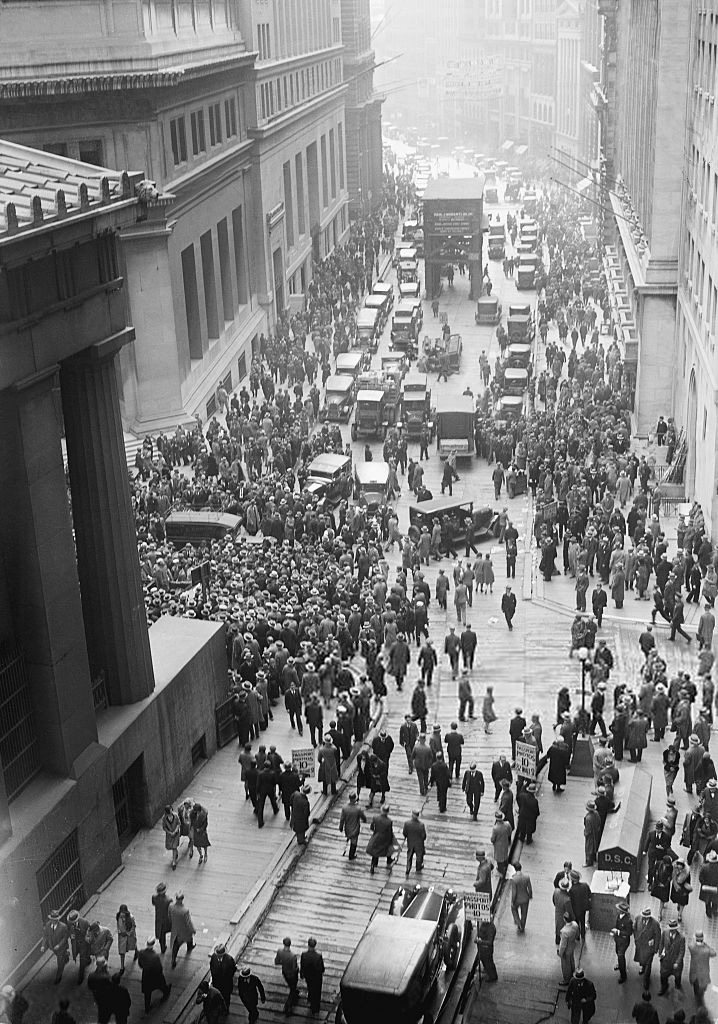
The Wall Street crash of 1929, also known as the Great Crash, was a major stock market crash in the United States which began in October 1929 with a sharp decline in prices on the New York Stock Exchange (NYSE). It triggered a rapid erosion of confidence in the U.S. banking system and marked the beginning of the worldwide Great Depression that lasted until 1939, making it the most devastating crash in the country's history. It is most associated with October 24, 1929, known as "Black Thursday", when a record 12.9 million shares were traded on the exchange, and October 29, 1929, or "Black Tuesday", when some 16.4 million shares were traded.
The "Roaring Twenties" of the previous decade had been a time of industrial expansion in the U.S., and much of the profit had been invested in speculation, including in stocks. Many members of the public, disappointed by the low interest rates offered on their bank deposits, committed their relatively small sums to stockbrokers. By 1929, the U.S. economy was showing signs of trouble; the agricultural sector was depressed due to overproduction and falling prices, forcing many farmers into debt, and consumer goods manufacturers also had unsellable output due to low wages and thus low purchasing power. Factory owners cut production and fired staff, reducing demand even further. Despite these trends, investors continued to buy shares in areas of the economy where output was declining and unemployment was increasing, so the purchase price of stocks greatly exceeded their real value.
By September 1929, more experienced shareholders realized that prices could not continue to rise and began to get rid of their holdings, which caused share values to stall and then fall, encouraging more to sell. As investors panicked, the selling became frenzied. After Black Thursday, leading bankers joined forces to purchase stock at prices above market value, a strategy used during the Panic of 1907. This encouraged a brief recovery before Black Tuesday. Further action failed to halt the fall, which continued until July 8, 1932; by then, the stock market had lost some 90% of its pre-crash value. Congress responded to the events by passing the Banking Act of 1933 (Glass–Steagall Act), which separated commercial and investment banking. Stock exchanges introduced a practice of suspending trading when prices fell rapidly to limit panic selling. Scholars differ over the crash's effect on the Great Depression, with some claiming that the price fluctuations were insufficient on their own to trigger a major collapse of the financial system, with others arguing that the crash, combined with the other economic problems in the U.S. in the 1920s, should be jointly interpreted as a stage in the business cycles which affect all capitalist economies.
The "Roaring Twenties", the decade following World War I that led to the crash, was a time of wealth and excess. Building on post-war optimism, rural Americans migrated to the cities in vast numbers throughout the decade with hopes of finding a more prosperous life in the ever-growing expansion of America's industrial sector.
Scholars believe that declines in the money supply caused by the Federal Reserve decisions had a severely contractionary effect on output. Despite the inherent risk of speculation, it was widely believed that the stock market would continue to rise forever. On March 25, 1929, after the Federal Reserve warned of excessive speculation, a small crash occurred as investors started to sell stocks at a rapid pace, exposing the market's shaky foundation. Two days later, banker Charles E. Mitchell announced that his company, the National City Bank, would provide $25 million in credit to stop the market's slide. Mitchell's move brought a temporary halt to the financial crisis, and call money declined from 20 to 8 percent. However, the American economy showed ominous signs of trouble. Steel production declined, construction was sluggish, automobile sales went down, and consumers were building up large debts because of easy credit.
Despite all the economic warning signs and the market breaks in March and May 1929, stocks resumed their advance in June, and the gains continued almost unabated until early September 1929 (the Dow Jones average gained more than 20% between June and September). The market had been on a nine-year run that saw the Dow Jones Industrial Average increase in value tenfold, peaking at 381.17 on September 3, 1929. Shortly before the crash, economist Irving Fisher famously proclaimed "Stock prices have reached what looks like a permanently high plateau". The optimism and the financial gains of the great bull market were shaken after a well-publicized September 5 prediction from financial expert Roger Babson that "a crash is coming, and it may be terrific". The initial September decline was thus called the "Babson Break" in the press. That was the start of the Great Crash, but until the severe phase of the crash in October, many investors regarded the September "Babson Break" as a "healthy correction" and buying opportunity.
On September 20, 1929, top British investor Clarence Hatry and many of his associates were jailed for fraud and forgery, leading to the suspension of his companies. This may have weakened the confidence of Americans in their own companies, although it had minimal impact on the London Stock Exchange. In the days leading up to the crash, the market was severely unstable. Periods of selling and high volumes were interspersed with brief periods of rising prices and recovery.[citation needed]
Conservative economists Jude Wanniski and Alan Reynolds have argued that the immediate cause of the crash was investor fears about the Smoot–Hawley Tariff Act, which was being negotiated in the U.S. Senate at the time. On October 23, 1929, while voting on an amendment to the bill, 16 senators who had been considered members of an anti-tariff coalition unexpectedly changed their votes and supported an increase in the tariff on calcium carbide imports from Canada. The crash began that afternoon and grew worse the following morning. In response, libertarian economist Scott Sumner has pointed out that this vote did not significantly change the anti-tariff coalition, which Sumner says was growing stronger during the days following October 23 while the crash was occurring. Instead, Sumner argues that ongoing conflict between pro-tariff and anti-tariff Republicans led investors to worry that the party could not govern effectively on economic issues. In particular, he cites the controversy over the appointment of Otto H. Kahn, a Wall Street banker who supported the tariff bill, as treasurer of the Republican Senatorial Campaign Committee. Kahn's appointment was announced on the evening of October 24, and fierce opposition from Progressive Republicans who opposed the bill forced him to publicly turn down the offer on October 29.
Wall Street crash of 1929
The Wall Street crash of 1929, also known as the Great Crash, was a major stock market crash in the United States which began in October 1929 with a sharp decline in prices on the New York Stock Exchange (NYSE). It triggered a rapid erosion of confidence in the U.S. banking system and marked the beginning of the worldwide Great Depression that lasted until 1939, making it the most devastating crash in the country's history. It is most associated with October 24, 1929, known as "Black Thursday", when a record 12.9 million shares were traded on the exchange, and October 29, 1929, or "Black Tuesday", when some 16.4 million shares were traded.
The "Roaring Twenties" of the previous decade had been a time of industrial expansion in the U.S., and much of the profit had been invested in speculation, including in stocks. Many members of the public, disappointed by the low interest rates offered on their bank deposits, committed their relatively small sums to stockbrokers. By 1929, the U.S. economy was showing signs of trouble; the agricultural sector was depressed due to overproduction and falling prices, forcing many farmers into debt, and consumer goods manufacturers also had unsellable output due to low wages and thus low purchasing power. Factory owners cut production and fired staff, reducing demand even further. Despite these trends, investors continued to buy shares in areas of the economy where output was declining and unemployment was increasing, so the purchase price of stocks greatly exceeded their real value.
By September 1929, more experienced shareholders realized that prices could not continue to rise and began to get rid of their holdings, which caused share values to stall and then fall, encouraging more to sell. As investors panicked, the selling became frenzied. After Black Thursday, leading bankers joined forces to purchase stock at prices above market value, a strategy used during the Panic of 1907. This encouraged a brief recovery before Black Tuesday. Further action failed to halt the fall, which continued until July 8, 1932; by then, the stock market had lost some 90% of its pre-crash value. Congress responded to the events by passing the Banking Act of 1933 (Glass–Steagall Act), which separated commercial and investment banking. Stock exchanges introduced a practice of suspending trading when prices fell rapidly to limit panic selling. Scholars differ over the crash's effect on the Great Depression, with some claiming that the price fluctuations were insufficient on their own to trigger a major collapse of the financial system, with others arguing that the crash, combined with the other economic problems in the U.S. in the 1920s, should be jointly interpreted as a stage in the business cycles which affect all capitalist economies.
The "Roaring Twenties", the decade following World War I that led to the crash, was a time of wealth and excess. Building on post-war optimism, rural Americans migrated to the cities in vast numbers throughout the decade with hopes of finding a more prosperous life in the ever-growing expansion of America's industrial sector.
Scholars believe that declines in the money supply caused by the Federal Reserve decisions had a severely contractionary effect on output. Despite the inherent risk of speculation, it was widely believed that the stock market would continue to rise forever. On March 25, 1929, after the Federal Reserve warned of excessive speculation, a small crash occurred as investors started to sell stocks at a rapid pace, exposing the market's shaky foundation. Two days later, banker Charles E. Mitchell announced that his company, the National City Bank, would provide $25 million in credit to stop the market's slide. Mitchell's move brought a temporary halt to the financial crisis, and call money declined from 20 to 8 percent. However, the American economy showed ominous signs of trouble. Steel production declined, construction was sluggish, automobile sales went down, and consumers were building up large debts because of easy credit.
Despite all the economic warning signs and the market breaks in March and May 1929, stocks resumed their advance in June, and the gains continued almost unabated until early September 1929 (the Dow Jones average gained more than 20% between June and September). The market had been on a nine-year run that saw the Dow Jones Industrial Average increase in value tenfold, peaking at 381.17 on September 3, 1929. Shortly before the crash, economist Irving Fisher famously proclaimed "Stock prices have reached what looks like a permanently high plateau". The optimism and the financial gains of the great bull market were shaken after a well-publicized September 5 prediction from financial expert Roger Babson that "a crash is coming, and it may be terrific". The initial September decline was thus called the "Babson Break" in the press. That was the start of the Great Crash, but until the severe phase of the crash in October, many investors regarded the September "Babson Break" as a "healthy correction" and buying opportunity.
On September 20, 1929, top British investor Clarence Hatry and many of his associates were jailed for fraud and forgery, leading to the suspension of his companies. This may have weakened the confidence of Americans in their own companies, although it had minimal impact on the London Stock Exchange. In the days leading up to the crash, the market was severely unstable. Periods of selling and high volumes were interspersed with brief periods of rising prices and recovery.[citation needed]
Conservative economists Jude Wanniski and Alan Reynolds have argued that the immediate cause of the crash was investor fears about the Smoot–Hawley Tariff Act, which was being negotiated in the U.S. Senate at the time. On October 23, 1929, while voting on an amendment to the bill, 16 senators who had been considered members of an anti-tariff coalition unexpectedly changed their votes and supported an increase in the tariff on calcium carbide imports from Canada. The crash began that afternoon and grew worse the following morning. In response, libertarian economist Scott Sumner has pointed out that this vote did not significantly change the anti-tariff coalition, which Sumner says was growing stronger during the days following October 23 while the crash was occurring. Instead, Sumner argues that ongoing conflict between pro-tariff and anti-tariff Republicans led investors to worry that the party could not govern effectively on economic issues. In particular, he cites the controversy over the appointment of Otto H. Kahn, a Wall Street banker who supported the tariff bill, as treasurer of the Republican Senatorial Campaign Committee. Kahn's appointment was announced on the evening of October 24, and fierce opposition from Progressive Republicans who opposed the bill forced him to publicly turn down the offer on October 29.
Recent media
Recent media