Hubbry Logo
Blacksmith lapwingBlacksmith lapwingMain
Open search
Blacksmith lapwing
Community hub
Blacksmith lapwing
logo
8 pages, 0 posts
0 subscribers
Be the first to start a discussion here.
Blacksmith lapwing
Blacksmith lapwing
from Wikipedia

Blacksmith lapwing
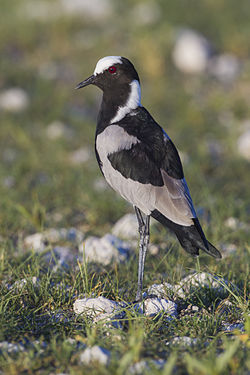
At Etosha National Park, Namibia
Scientific classification Edit this classification
Kingdom: Animalia
Phylum: Chordata
Class: Aves
Order: Charadriiformes
Family: Charadriidae
Genus: Vanellus
Species:
V. armatus
Binomial name
Vanellus armatus
(Burchell, 1822)
      resident range
Synonyms

Anitibyx armatus (Burchell, 1822)
Charadrius armatus Burchell, 1822

The blacksmith lapwing or blacksmith plover (Vanellus armatus) is a lapwing species that occurs commonly from Kenya through central Tanzania to southern and southwestern Africa. The vernacular name derives from the repeated metallic 'tink, tink, tink' alarm call, which suggests a blacksmith's hammer striking an anvil.

Description

[edit]

Blacksmith lapwings are very boldly patterned in black, grey and white, possibly warning colours to predators. It is one of five lapwing species (two African, one Asian and two Neotropical) that share the characteristics of red eyes and a bold pied plumage, with a carpal (wing) spur adorning the wrist joint; a sharp black protrusion which they use to aggressively defend their young from potential threats, through persistent aerial dives typically targeting the head. The portions of the bird's body bare to plumage average a black coloration for the bill, and either a black or white-grey dappling on the legs. Females average larger and heavier but the sexes are generally alike.[2]

Habitat and numbers

[edit]

The blacksmith lapwing occurs in association with wetlands of all sizes. Even very small damp areas caused by a spilling water trough can attract them. In South Africa they are most numerous in the mesic grassland region, less so in higher-rainfall grasslands. Like the crowned lapwing, this species may leave Zambia and Zimbabwe in years of high rainfall and return in dry years. It avoids mountains of any type.[3]

Blacksmith lapwings expanded their range in the 20th century into areas where dams were built and where intensive farming was practiced. Consequently, they are now numerous and established in the Western Cape region of South Africa, where they were absent until the 1930s.[3] In this region they have also entered estuarine mud flats in winter where they aggressively displace other waders.[2] Although they are partially migratory, they do not seem to engage in large-scale, regular migrations.[3]

Ecology

[edit]
A blacksmith lapwing walking on top of the Cape Town Castle.

During the breeding season, the species often reacts aggressively to other lapwings or African jacanas that may enter its wetland habitat. Nests are shallow depressions on bare ground or short grass, close to water, and tend to be spaced at least 400 m apart.[1] The blacksmith lapwing breeds in spring, but its choice of nesting site and timing may be opportunistic. The young separate gradually from their parents and do not return to natal areas afterwards.[3] This lapwing feeds on aquatic and terrestrial invertebrates.[2]

See also

[edit]

References

[edit]
[edit]

Further reading

[edit]
[edit]
Revisions and contributorsEdit on WikipediaRead on Wikipedia
from Grokipedia
The blacksmith lapwing (Vanellus armatus), also known as the blacksmith plover, is a boldly patterned wading bird in the plover family Charadriidae, characterized by its striking black, white, and grey plumage, including a white crown, black face and breast, grey wings, reddish eyes, black legs, and a prominent carpal spur on the wing. Native to sub-Saharan Africa, it ranges from southern Kenya through central Tanzania to Angola, southern Africa, and South Africa, though it is rare in arid regions like the Namib Desert and Kalahari, and absent from parts of northeastern Zimbabwe, Lesotho, and former Transkei. This species is a common resident in wetlands, short open grasslands, mudflats, riverbanks, lakes, estuaries, and even artificial habitats such as dams, sports fields, and irrigated areas, where it remains sedentary, nomadic, or partially migratory depending on rainfall patterns. Blacksmith lapwings are noisy and conspicuous, often seen singly, in pairs, or in small groups, and are renowned for their loud, metallic "tink-tink-tink" or "klink-klink-klink" calls, which sound like a hammering an anvil—hence their common name—and are frequently uttered from the ground or in flight. They exhibit bold and aggressive behavior, particularly during breeding, when pairs fiercely defend their territory and young by attacking large animals like African elephants or harassing aerial predators such as raptors and rollers, using distraction displays to lure threats away from nests. Their diet consists primarily of small aquatic and terrestrial , including , worms, larvae, molluscs, and crustaceans, supplemented occasionally by plant material, which they forage for by probing or picking in wet soils and adjacent drylands. Breeding occurs year-round across their range, with a peak from July to October in southern Africa; they lay 3–4 camouflaged, olive-brown eggs (measuring 37–43 × 27–31 mm) in a shallow scrape on the ground near water, lined with grass, stones, or debris for camouflage. Both parents share incubation duties for 26–33 days, and the precocial chicks are tended by adults, who continue protective behaviors post-hatching. Females are slightly larger than males, and immatures display more brownish tones before acquiring adult plumage. Classified as Least Concern by conservation assessments, the species has benefited from population increases due to its adaptability to human-modified environments and artificial wetlands.

Taxonomy

Etymology

The common name "blacksmith lapwing" originates from the bird's distinctive, repeated metallic alarm call, described as a sharp "tink-tink-tink" that evokes the sound of a blacksmith's hammer striking an anvil. This onomatopoeic association highlights early observers' impressions of the call's rhythmic, hammering quality, linking it to human artisanal activities in rural African landscapes. The scientific name Vanellus armatus comprises two Latin-derived elements. The genus Vanellus is a diminutive form of vannus, meaning "winnowing fan," alluding to the fan-like shape of the bird's tail or the whirring sound produced by its wings in flight. The specific epithet armatus, meaning "armed" or "equipped," refers to the prominent sharp, black carpal spurs on the wings, which the bird uses aggressively in defense. The was first formally described in 1822 by British naturalist William John Burchell as armatus in his account of travels across , based on specimens collected near Klaarwater (now Griquatown, ). Burchell's observations emphasized the bird's bold and vigilant , though the common name's connection to the call appears to have developed subsequently among European explorers and settlers familiar with the species' vocalizations.

Classification

The blacksmith lapwing ( armatus) belongs to the order , which encompasses shorebirds and related taxa, and is placed in the family , commonly known as plovers and lapwings. Within this family, it is assigned to the genus , a group of approximately 25 species characterized by their crested heads, bold patterns, and often aggressive territorial behaviors. This is monotypic, with no recognized , reflecting its relatively uniform morphology and genetic cohesion across its range.

Description

Physical characteristics

The blacksmith lapwing (Vanellus armatus) is a medium-sized measuring 28–31 cm in length and weighing 114–213 g. It has a slender build with long legs that are black or sometimes mottled with white-grey, a short black bill, and striking red eyes. The plumage is boldly patterned in contrasting black, white, and pale grey, potentially serving as warning coloration to predators. The crown and forehead are white, sharply demarcated from the glossy black face, foreneck, and breast; the nape is white, while the back, mantle, and upperwing coverts are pale grey. The underparts, including the belly and undertail coverts, are white, and the wings feature grey upper coverts, white underwing coverts, and black flight feathers. The tail is mostly white with a black tip. A key identifying feature is the sharp, black carpal spur on each wing bend, which is more prominent in adults and used for defense. Sexual dimorphism is minimal in , with both sexes sharing the same coloration, though females are slightly larger and heavier on average, and exhibit less pronounced spurs. Juveniles differ markedly, displaying a browner overall tone with buff fringes on the upperparts creating a scaly or spotted appearance, shorter spurs, and a more subdued pattern compared to adults.

Vocalizations

The blacksmith lapwing (Vanellus armatus) produces a variety of vocalizations characterized by their sharp, metallic quality, which play key roles in communication, alarm signaling, and territorial maintenance. The primary call is a repeated sharp "tink" or "kit!" note, delivered from the ground and evoking the sound of a blacksmith's striking an —a resemblance that inspired the bird's common name. This call functions as a contact signal among pairs, groups, or with chicks, but intensifies into an alarm when the bird is disturbed by potential threats. Other vocalizations include the "killy" call, an escalating series of piercing, nasal notes (e.g., "krreet...killy-killy-killy"), primarily associated with territorial defense and pair bonding. In flight, the bird emits high-pitched, repetitive calls with a similar metallic , often in response to disturbances or during pursuit of intruders. Softer variants, such as low "chuck-chuck" notes, serve for close-range contact between individuals. These vocalizations exhibit contextual variations in repetition rate and volume, becoming faster and louder during aggressive interactions to deter rivals or predators. The distinctive repetitive, metallic "tink-tink" quality aids in field identification, setting the blacksmith lapwing apart from similar species like the wattled lapwing (*), which produces a more raucous, creaking call.

Distribution and habitat

Geographic range

The Blacksmith lapwing (*) is native to , with its distribution spanning from southern and central in the north, westward through , and southward to , encompassing countries such as , , and . The range is fragmented in some areas, such as northeastern , the Desert, the Kalahari (where it is rare), and it is absent from and the former ; but the species is generally widespread in suitable lowland regions across this expanse. In the , the Blacksmith lapwing exhibited significant range expansion, particularly in , where it first reached the in 1939 and established breeding populations by 1947. This southward extension beyond the and into southeast Cape coastal areas has been facilitated by human-altered landscapes, including the proliferation of dams, irrigated farmlands, and artificial wetlands that mimic preferred open-water environments. The species remains absent along the arid coast, limiting its overall coastal presence. The Blacksmith lapwing is largely non-migratory in its core southern and central African range, with populations maintaining year-round residency in stable habitats. However, partial migration occurs locally, especially in northern and eastern portions of its distribution, where birds undertake nomadic movements or short-distance shifts in response to seasonal rainfall patterns, flooding, or . These movements typically involve flocks of 100–300 individuals but do not constitute large-scale migrations. Throughout its range, the species avoids high-elevation mountains and dense environments, restricting its occurrence to lowlands and open, accessible terrains.

Habitat preferences

The blacksmith lapwing (Vanellus armatus) primarily inhabits open wetlands, floodplains, marshes, and short in close proximity to water bodies such as lakes, rivers, dams, and estuaries. In , it shows a particular preference for mesic , where populations are most abundant compared to higher-rainfall grassland regions. These habitats provide the moist, open conditions essential for the species' ground-based lifestyle, including foraging and nesting. The species has adapted well to human-modified landscapes, thriving in areas like artificial dams, irrigated agricultural fields, and maintained open spaces such as and . Such environments mimic natural wetlands and short-grass areas, allowing the to exploit newly created moist habitats that have expanded its range over the past century. For nesting, the blacksmith lapwing selects microhabitats consisting of bare or sparsely vegetated ground, often along water edges or in shallow scrapes lined with pebbles, grass, or debris. These sites are typically located in seasonally inundated areas near permanent water sources, offering protection from flooding while remaining accessible for incubation. This nomadic behavior, influenced by rainfall patterns and habitat availability, enables it to track fluctuating wetland conditions across its range.

Behavior and ecology

Foraging and diet

The blacksmith lapwing (Vanellus armatus) primarily consumes a diet of aquatic and terrestrial , including such as beetles, , and ; crustaceans like crabs and shrimps; worms; and small mollusks such as snails. Although predominantly carnivorous, it occasionally ingests seeds or small vertebrates like tadpoles or tiny when available in foraging areas. Foraging occurs mainly on foot in open, wet substrates such as mudflats, shorelines, and short grasslands, where the bird employs typical techniques including visual scanning while standing or walking slowly, followed by short runs or dashes to peck at prey with its short bill. It also uses foot-trembling—rapid tapping of the foot to flush hidden from or —and probes or pecks at the surface while wading in shallow areas. In drier habitats, it supplements feeding by turning over animal dung pats or foraging in ploughed fields and among grazing to access . The species is diurnal, with foraging activity peaking in the early morning and late afternoon, aligning with periods of higher prey visibility and availability, such as insect emergences following rainfall that softens the ground and increases invertebrate activity. These patterns are influenced by habitat moisture levels, which affect prey abundance in wetlands and adjacent grasslands. Adaptations for efficient foraging include a narrow binocular visual field of approximately 19° width and 76° vertical extent, enabling precise bill placement for pecking at surface or near-surface prey without spontaneous eye movements. This visual setup supports targeted hunting in open areas, complemented by the bird's bold plumage for group coordination during pair or small-group foraging.

Breeding and reproduction

The breeding season of the blacksmith lapwing ( armatus) occurs year-round across its range, but peaks from to October in , with laying also frequent from April in regions like ; this timing often aligns with post-rainfall conditions that enhance availability for nesting and foraging. In northern parts of its distribution, such as , breeding may start earlier and extend variably depending on local rainfall patterns. Nests consist of shallow scrapes, approximately 140 mm wide by 40 mm deep, typically situated close to water bodies or in seasonally flooded grasslands to minimize flooding risks while providing access to food resources. These scrapes are lined with pebbles, plant material, or debris for , and clutches usually comprise 3 eggs (ranging from 1–4, rarely up to 6 if involving multiple females), which are cream to olive-colored and blotched with black, brown, or grey-green spots for concealment against the ground. Both parents share incubation duties, starting with the first egg laid, for a period of 23–31 days until hatching. Chicks are precocial, hatching at about 11 g and becoming mobile within hours, though they remain dependent on parents for protection and initial feeding during the first few weeks. Fledging occurs at 40–41 days, with full independence around 70 days, after which the young disperse from the natal territory and do not return. Parental aggression, including dive-bombing displays toward predators and intruders, significantly reduces predation on eggs and chicks, contributing to relatively high reproductive success in defended territories.

Territoriality and social behavior

The Blacksmith lapwing (Vanellus armatus) exhibits a centered on year-round monogamous pairs that maintain territories, with individuals typically observed solitary or in pairs within these areas. Outside the breeding , birds form small non-breeding flocks of up to 100 individuals, occasionally reaching 200–300, particularly during local movements prompted by flooding or resource availability. Intraspecific is rare, but pairs defend their territories vigorously against intruders using vocalizations and physical displays. Territoriality is pronounced, with pairs defending areas ranging from approximately 0.5 to 10 ha, depending on habitat quality and ; for instance, home ranges average 8.5 ha during breeding in urban grasslands. Defense involves aggressive displays, chases, and occasional spur fights using the sharp carpal s, alongside dive-bombing and screeching calls such as "Krrrrrrk" to repel threats. Nests are spaced at least 400 m apart in , ensuring adequate separation of territories. These behaviors extend beyond breeding, maintaining pair bonds and exclusive use of foraging grounds near wetlands. Interactions with conspecifics often involve noisy disputes, marked by loud "tink" or "killy" calls during territorial challenges. While primarily paired or solitary, Blacksmith lapwings associate loosely with other wetland birds, such as in mixed groups on floodplains, but generally avoid forming large multispecies aggregations beyond small flocks of 3–5 individuals. In non-breeding periods, they roost communally in flocks on islets or raised banks near water, facilitating rest while minimizing predation risk; movements are minimal and local, often undertaken by pairs rather than large migrations.

Conservation

The global population of the Blacksmith lapwing (Vanellus armatus) is estimated at 66,700–667,000 mature individuals. This is classified as Least Concern by the IUCN, reflecting its widespread distribution and overall abundance in . The population trend is increasing over the past three generations (approximately 14 years), driven by adaptability to human-modified landscapes. In , populations have shown notable increases, attributed to the creation of suitable habitats through dams, schemes, and agricultural development. Monitoring data from the Southern African Bird Atlas Project (SABAP), comparing periods from the (SABAP1) to the onward (SABAP2), reveal higher reporting rates and range expansion, indicating growing abundance in this region. Populations remain stable elsewhere within the core range, with no evidence of widespread declines. Local densities vary by habitat quality but can reach up to several breeding pairs per square kilometer in optimal areas, such as those near bodies with short grasslands. For example, in , densities of 1.4 pairs per km² have been recorded in areas with mown grass, vleis, and dam banks.

Threats and status

The Blacksmith lapwing (Vanellus armatus) is classified as Least Concern on the , reflecting its extensive distribution across and its ability to adapt to modified landscapes, including urban and agricultural areas. This status is justified by a large population estimated at 66,700–667,000 mature individuals and ongoing range expansion in regions like , where it has benefited from human-induced changes such as artificial sources. Primary threats to the species include habitat degradation through wetland drainage and conversion of grasslands to agriculture, which reduce suitable breeding and foraging sites in moist grasslands and riverine areas. Overgrazing by livestock exacerbates soil compaction and vegetation loss in these habitats, potentially limiting prey availability. Minor risks arise from pesticide use in agricultural fields, which can contaminate invertebrate prey and lead to indirect poisoning, as well as collisions with aircraft at airports near wetlands. Additionally, the species is susceptible to avian botulism outbreaks in wetland environments. Conservation efforts focus on wetland protection, with the Blacksmith lapwing benefiting from Important Bird and Biodiversity Areas (IBAs) and Key Biodiversity Areas (KBAs) across its range, many of which overlap with protected areas and Other Effective area-based Conservation Measures (OECMs). Monitoring through the International Waterbird Census supports management of Ramsar-designated wetlands, where the species occurs commonly, helping to mitigate drainage and pollution risks without requiring targeted recovery programs due to its resilience. The overall outlook remains stable, with potential localized declines in unmodified wetlands offset by the species' colonization of human-altered habitats, though ongoing grassland fragmentation could pose longer-term challenges if not addressed through broader landscape conservation.

References

Add your contribution
Related Hubs
User Avatar
No comments yet.