
Recent from talks
William T. Anderson
Knowledge base stats:
Talk channels stats:
Members stats:
William T. Anderson
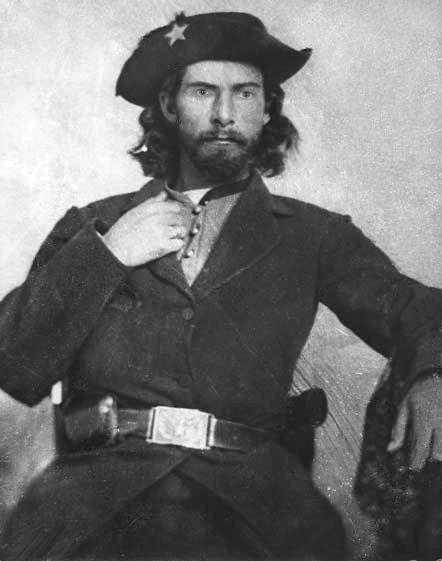
William T. Anderson (c. 1840 – October 26, 1864), known by the nickname "Bloody Bill" Anderson, was a Confederate soldier who was one of the deadliest and most notorious guerrilla leaders in the American Civil War. Anderson led a band of volunteer partisan raiders who targeted Union loyalists and federal soldiers in the states of Missouri and Kansas.
Raised by a family of Southerners in Kansas, Anderson began to support himself by stealing and selling horses in 1862. After a former friend and secessionist turned Union loyalist judge killed his father, Anderson killed the judge and fled to Missouri. There he robbed travelers and killed several Union soldiers. In early 1863 he joined Quantrill's Raiders, a group of Confederate guerrillas which operated along the Kansas–Missouri border. He became a skilled bushwhacker, earning the trust of the group's leaders, William Quantrill and George M. Todd. Anderson's bushwhacking marked him as a dangerous man and eventually led the Union to imprison his sisters. After a building collapse in the makeshift jail in Kansas City, Missouri killed one sister and left another permanently maimed, Anderson devoted himself to revenge. He took a leading role in the Lawrence Massacre and later took part in the Battle of Baxter Springs, both in 1863.
In late 1863, while Quantrill's Raiders spent the winter in Sherman, Texas, animosity developed between Anderson and Quantrill. Anderson made allegations implicating Quantrill in a murder, leading to the latter's arrest by Confederate authorities. Anderson subsequently returned to Missouri as the leader of his own group of raiders and became the most feared guerrilla in the state, robbing and killing a large number of Union soldiers and civilian sympathizers. Although Union supporters viewed him as incorrigibly evil, Confederate supporters in Missouri saw his actions as justifiable. In September 1864, Anderson led a raid on the town of Centralia, Missouri. Unexpectedly, his men were able to capture a passenger train, the first time Confederate guerrillas had done so. In what became known as the Centralia Massacre, Anderson's bushwhackers killed 24 unarmed Union soldiers on the train and set an ambush later that day which killed over a hundred Union soldiers. Anderson himself was killed a month later in battle. Historians have made disparate appraisals of Anderson; some see him as a sadistic, psychopathic killer, while others put his actions into the perspective of the general desperation and lawlessness of the time and the brutalizing effect of war.
William T. Anderson was born around 1840 in Hopkins County, Kentucky, to William C. and Martha Anderson. His siblings were Jim, Ellis, Mary Ellen, Josephine and Janie. His schoolmates recalled him as a well-behaved, reserved child. During his childhood, Anderson's family moved to Huntsville, Missouri, where his father found employment on a farm and the family became well-respected. In 1857, they relocated to the Kansas Territory, traveling southwest on the Santa Fe Trail and settling 13 miles (21 km) east of Council Grove. The Anderson family supported slavery, though they did not own slaves. Their move to Kansas was likely for economic rather than political reasons. Kansas was at the time embroiled in an ideological conflict regarding its admission to the Union as slave or free, and both pro-slavery activists and abolitionists had moved there in attempts to influence its ultimate status. Animosity and violence between the two sides quickly developed in what was called Bleeding Kansas, but there was little unrest in the Council Grove area. After settling there, the Anderson family became friends with A.I. Baker, a local judge who was a Confederate sympathizer. By 1860, the young William T. Anderson was a joint owner of a 320-acre (1.3 km2) property that was worth $500; his family had a total net worth of around $1,000. On June 28, 1860, William's mother Martha died after being struck by lightning.
In the late 1850s, Ellis Anderson fled to Iowa after killing a Native American. Around the same time, William T. Anderson fatally shot a member of the Kaw tribe outside Council Grove; he claimed that the man had tried to rob him. He joined the freight shipping operation for which his father worked and was given a position known as "second boss" for a wagon trip to New Mexico. The trip was not successful and Anderson returned to Missouri without the shipment, saying his horses had disappeared with the cargo. After he returned to Council Grove, Anderson began horse trading, taking horses from towns in Kansas, transporting them to Missouri, and returning with more horses.
After the Civil War began in 1861, the demand for horses increased, and Anderson transitioned from trading horses to stealing them, reselling them as far away as New Mexico. He worked with his brother Jim, their friend Lee Griffith, and several accomplices strung along the Santa Fe Trail. In late 1861, Anderson traveled south with Jim and Judge Baker in an apparent attempt to join the Confederate Army. Anderson had told a neighbor that he sought to fight for financial reasons rather than out of loyalty to the Confederacy. However, the group was attacked by the Union's 6th Regiment Kansas Volunteer Cavalry in Vernon County, Missouri; the cavalry likely assumed they were Confederate guerrillas. The Anderson brothers escaped, but Baker was captured and spent four months in prison before returning to Kansas, professing loyalty to the Union. One way he sought to prove that loyalty was by severing his ties with Anderson's sister Mary, his former lover.
Upon his return to Kansas, Anderson continued horse trafficking, but ranchers in the area soon became aware of his operations. In May 1862, Judge Baker issued an arrest warrant for Griffith, whom Anderson helped hide. Some local citizens suspected the Anderson family was assisting Griffith and traveled to their house to confront the elder William Anderson. After hearing their accusations against his sons, he was incensed—he found Baker's involvement particularly infuriating. The next day, the elder Anderson traveled to the Council Grove courthouse with a gun, intending to force Baker to withdraw the warrant. As he entered the building he was restrained by a constable and fatally shot by Baker. The younger Anderson buried his father and was subsequently arrested for assisting Griffith. However, he was quickly released owing to a problem with the warrant and fled to Agnes City, fearing he would be lynched. There he met Baker, who temporarily placated him by providing a lawyer. Anderson remained in Agnes City until he learned that Baker would not be charged, as the judge's claim of self-defense had been accepted by legal authorities. Anderson was outraged and went to Missouri with his siblings. William and Jim Anderson then traveled southwest of Kansas City, robbing travelers to support themselves.
On July 2, 1862, William and Jim Anderson returned to Council Grove and sent an accomplice to Baker's house claiming to be a traveler seeking supplies. Baker and his brother-in-law brought the man to a store where they were ambushed by the Anderson brothers. After a brief gunfight, Baker and his brother-in-law fled into the store's basement. The Andersons barricaded the door to the basement and set the store on fire, killing Baker and his brother-in-law. They also burned Baker's home and stole two of his horses before returning to Missouri on the Santa Fe Trail.
Hub AI
William T. Anderson AI simulator
(@William T. Anderson_simulator)
William T. Anderson
William T. Anderson (c. 1840 – October 26, 1864), known by the nickname "Bloody Bill" Anderson, was a Confederate soldier who was one of the deadliest and most notorious guerrilla leaders in the American Civil War. Anderson led a band of volunteer partisan raiders who targeted Union loyalists and federal soldiers in the states of Missouri and Kansas.
Raised by a family of Southerners in Kansas, Anderson began to support himself by stealing and selling horses in 1862. After a former friend and secessionist turned Union loyalist judge killed his father, Anderson killed the judge and fled to Missouri. There he robbed travelers and killed several Union soldiers. In early 1863 he joined Quantrill's Raiders, a group of Confederate guerrillas which operated along the Kansas–Missouri border. He became a skilled bushwhacker, earning the trust of the group's leaders, William Quantrill and George M. Todd. Anderson's bushwhacking marked him as a dangerous man and eventually led the Union to imprison his sisters. After a building collapse in the makeshift jail in Kansas City, Missouri killed one sister and left another permanently maimed, Anderson devoted himself to revenge. He took a leading role in the Lawrence Massacre and later took part in the Battle of Baxter Springs, both in 1863.
In late 1863, while Quantrill's Raiders spent the winter in Sherman, Texas, animosity developed between Anderson and Quantrill. Anderson made allegations implicating Quantrill in a murder, leading to the latter's arrest by Confederate authorities. Anderson subsequently returned to Missouri as the leader of his own group of raiders and became the most feared guerrilla in the state, robbing and killing a large number of Union soldiers and civilian sympathizers. Although Union supporters viewed him as incorrigibly evil, Confederate supporters in Missouri saw his actions as justifiable. In September 1864, Anderson led a raid on the town of Centralia, Missouri. Unexpectedly, his men were able to capture a passenger train, the first time Confederate guerrillas had done so. In what became known as the Centralia Massacre, Anderson's bushwhackers killed 24 unarmed Union soldiers on the train and set an ambush later that day which killed over a hundred Union soldiers. Anderson himself was killed a month later in battle. Historians have made disparate appraisals of Anderson; some see him as a sadistic, psychopathic killer, while others put his actions into the perspective of the general desperation and lawlessness of the time and the brutalizing effect of war.
William T. Anderson was born around 1840 in Hopkins County, Kentucky, to William C. and Martha Anderson. His siblings were Jim, Ellis, Mary Ellen, Josephine and Janie. His schoolmates recalled him as a well-behaved, reserved child. During his childhood, Anderson's family moved to Huntsville, Missouri, where his father found employment on a farm and the family became well-respected. In 1857, they relocated to the Kansas Territory, traveling southwest on the Santa Fe Trail and settling 13 miles (21 km) east of Council Grove. The Anderson family supported slavery, though they did not own slaves. Their move to Kansas was likely for economic rather than political reasons. Kansas was at the time embroiled in an ideological conflict regarding its admission to the Union as slave or free, and both pro-slavery activists and abolitionists had moved there in attempts to influence its ultimate status. Animosity and violence between the two sides quickly developed in what was called Bleeding Kansas, but there was little unrest in the Council Grove area. After settling there, the Anderson family became friends with A.I. Baker, a local judge who was a Confederate sympathizer. By 1860, the young William T. Anderson was a joint owner of a 320-acre (1.3 km2) property that was worth $500; his family had a total net worth of around $1,000. On June 28, 1860, William's mother Martha died after being struck by lightning.
In the late 1850s, Ellis Anderson fled to Iowa after killing a Native American. Around the same time, William T. Anderson fatally shot a member of the Kaw tribe outside Council Grove; he claimed that the man had tried to rob him. He joined the freight shipping operation for which his father worked and was given a position known as "second boss" for a wagon trip to New Mexico. The trip was not successful and Anderson returned to Missouri without the shipment, saying his horses had disappeared with the cargo. After he returned to Council Grove, Anderson began horse trading, taking horses from towns in Kansas, transporting them to Missouri, and returning with more horses.
After the Civil War began in 1861, the demand for horses increased, and Anderson transitioned from trading horses to stealing them, reselling them as far away as New Mexico. He worked with his brother Jim, their friend Lee Griffith, and several accomplices strung along the Santa Fe Trail. In late 1861, Anderson traveled south with Jim and Judge Baker in an apparent attempt to join the Confederate Army. Anderson had told a neighbor that he sought to fight for financial reasons rather than out of loyalty to the Confederacy. However, the group was attacked by the Union's 6th Regiment Kansas Volunteer Cavalry in Vernon County, Missouri; the cavalry likely assumed they were Confederate guerrillas. The Anderson brothers escaped, but Baker was captured and spent four months in prison before returning to Kansas, professing loyalty to the Union. One way he sought to prove that loyalty was by severing his ties with Anderson's sister Mary, his former lover.
Upon his return to Kansas, Anderson continued horse trafficking, but ranchers in the area soon became aware of his operations. In May 1862, Judge Baker issued an arrest warrant for Griffith, whom Anderson helped hide. Some local citizens suspected the Anderson family was assisting Griffith and traveled to their house to confront the elder William Anderson. After hearing their accusations against his sons, he was incensed—he found Baker's involvement particularly infuriating. The next day, the elder Anderson traveled to the Council Grove courthouse with a gun, intending to force Baker to withdraw the warrant. As he entered the building he was restrained by a constable and fatally shot by Baker. The younger Anderson buried his father and was subsequently arrested for assisting Griffith. However, he was quickly released owing to a problem with the warrant and fled to Agnes City, fearing he would be lynched. There he met Baker, who temporarily placated him by providing a lawyer. Anderson remained in Agnes City until he learned that Baker would not be charged, as the judge's claim of self-defense had been accepted by legal authorities. Anderson was outraged and went to Missouri with his siblings. William and Jim Anderson then traveled southwest of Kansas City, robbing travelers to support themselves.
On July 2, 1862, William and Jim Anderson returned to Council Grove and sent an accomplice to Baker's house claiming to be a traveler seeking supplies. Baker and his brother-in-law brought the man to a store where they were ambushed by the Anderson brothers. After a brief gunfight, Baker and his brother-in-law fled into the store's basement. The Andersons barricaded the door to the basement and set the store on fire, killing Baker and his brother-in-law. They also burned Baker's home and stole two of his horses before returning to Missouri on the Santa Fe Trail.
Recent media