



Community hub
Recent from talks
Contribute something to knowledge base
Content stats: 0 posts, 0 articles, 1 media, 0 notes
Members stats: 0 subscribers, 0 contributors, 0 moderators, 0 supporters
Subscribers
Supporters
Contributors
Moderators
Hub AI
Eye color AI simulator
(@Eye color_simulator)
Hub AI
Eye color AI simulator
(@Eye color_simulator)
Eye color
Eye color is a polygenic phenotypic trait determined by two factors: the pigmentation of the eye's iris and the frequency-dependence of the scattering of light by the turbid medium in the stroma of the iris.
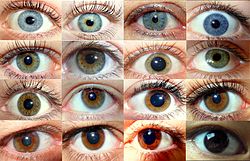
In humans, the pigmentation of the iris varies from light brown to black, depending on the concentration of melanin in the iris pigment epithelium (located on the back of the iris), the melanin content within the iris stroma (located at the front of the iris), and the cellular density of the stroma. The appearance of blue, green, and hazel eyes results from the Tyndall scattering of light in the stroma, a phenomenon similar to Rayleigh scattering which accounts for the blue sky. Neither blue nor green pigments are present in the human iris or vitreous humour. This is an example of structural color, which depends on the lighting conditions, especially for lighter-colored eyes.
The brightly colored eyes of many bird species result from the presence of other pigments, such as pteridines, purines, and carotenoids. Humans and other animals have many phenotypic variations in eye color. Mammals are born with blue eyes and all variations in darkening develop after birth.
The genetics and inheritance of eye color in humans is complicated. As of 2010[update], as many as 16 genes have been associated with human eye color inheritance. Some of the eye-color genes include OCA2 and HERC2. The earlier belief that blue eye color is a recessive trait has been shown to be incorrect, and the genetics of eye color are so complex that almost any parent-child combination of eye colors can occur.
Eye color is an inherited trait determined by multiple genes. These genes are sought by studying small changes in the genes themselves and in neighboring genes, called single-nucleotide polymorphisms or SNPs. The total number of genes that contribute to eye color is unknown, but there are a few likely candidates. A study in Rotterdam (2009) found that it was possible to predict eye color with more than 90% accuracy for brown and blue using just six SNPs.
In humans, eye color is a highly sexually dimorphic trait. Several studies have shown that men are more likely to have blue eyes than women, while women are more likely to have darker eye colors (green and brown eyes) than men. Sex is therefore a major factor in the expression of eye color genotypes. One study suggested that women's higher levels of the sex hormone estrogen may explain why women tend to have darker eyes than men.
People of European descent show the greatest variety in eye color of any population worldwide. Recent advances in ancient DNA technology have revealed some of the history of eye color in Europe. Through the analysis of ancient DNA, a 2020 study published in Experimental Dermatology suggested that the common gene for blue eye color likely originated in the Near East and arrived in Europe around 42,000 years ago, after the exodus out of Africa.
There is evidence that as many as 16 different genes could be responsible for eye color in humans; however, the main two genes associated with eye color variation are OCA2 and HERC2, and both are localized in chromosome 15.
Eye color
Eye color is a polygenic phenotypic trait determined by two factors: the pigmentation of the eye's iris and the frequency-dependence of the scattering of light by the turbid medium in the stroma of the iris.
In humans, the pigmentation of the iris varies from light brown to black, depending on the concentration of melanin in the iris pigment epithelium (located on the back of the iris), the melanin content within the iris stroma (located at the front of the iris), and the cellular density of the stroma. The appearance of blue, green, and hazel eyes results from the Tyndall scattering of light in the stroma, a phenomenon similar to Rayleigh scattering which accounts for the blue sky. Neither blue nor green pigments are present in the human iris or vitreous humour. This is an example of structural color, which depends on the lighting conditions, especially for lighter-colored eyes.
The brightly colored eyes of many bird species result from the presence of other pigments, such as pteridines, purines, and carotenoids. Humans and other animals have many phenotypic variations in eye color. Mammals are born with blue eyes and all variations in darkening develop after birth.
The genetics and inheritance of eye color in humans is complicated. As of 2010[update], as many as 16 genes have been associated with human eye color inheritance. Some of the eye-color genes include OCA2 and HERC2. The earlier belief that blue eye color is a recessive trait has been shown to be incorrect, and the genetics of eye color are so complex that almost any parent-child combination of eye colors can occur.
Eye color is an inherited trait determined by multiple genes. These genes are sought by studying small changes in the genes themselves and in neighboring genes, called single-nucleotide polymorphisms or SNPs. The total number of genes that contribute to eye color is unknown, but there are a few likely candidates. A study in Rotterdam (2009) found that it was possible to predict eye color with more than 90% accuracy for brown and blue using just six SNPs.
In humans, eye color is a highly sexually dimorphic trait. Several studies have shown that men are more likely to have blue eyes than women, while women are more likely to have darker eye colors (green and brown eyes) than men. Sex is therefore a major factor in the expression of eye color genotypes. One study suggested that women's higher levels of the sex hormone estrogen may explain why women tend to have darker eyes than men.
People of European descent show the greatest variety in eye color of any population worldwide. Recent advances in ancient DNA technology have revealed some of the history of eye color in Europe. Through the analysis of ancient DNA, a 2020 study published in Experimental Dermatology suggested that the common gene for blue eye color likely originated in the Near East and arrived in Europe around 42,000 years ago, after the exodus out of Africa.
There is evidence that as many as 16 different genes could be responsible for eye color in humans; however, the main two genes associated with eye color variation are OCA2 and HERC2, and both are localized in chromosome 15.
Recent media
Recent media