Recent from talks
Nothing was collected or created yet.
Boeing Model 2
View on Wikipedia
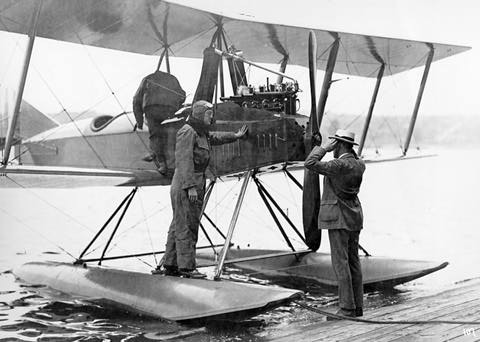
The Boeing Model 2, also referred to as the Boeing Model C, and its derivatives were United States two-place training seaplanes, the first "all-Boeing" design and the company's first financial success.
Key Information
Design and development
[edit]The Boeing Airplane Company, previously known as Pacific Aero Products Co., built the Model C naval trainer as its first mass-produced airplane. Early design work was started by George Conrad Westervelt in late 1915, with the first wind tunnel tests being conducted at the Massachusetts Institute of Technology's 4 ft (1.2 m) wind tunnel in May 1916. Most of the design work during early-to-mid 1916 by James Foley, who had previously assisted Westervelt in designing the Boeing Model 1. Westervelt, who had been reassigned to the East Coast in December 1915, consulted heavily on the design. Wong Tsu, an MIT graduate who was hired by Boeing in May 1916, also contributed to the design, specifically lending his expertise in the analysis of wind tunnel data. A total of 56 C-type trainers were built; 55 used twin pontoons. The Model C-1F had a single main pontoon and small auxiliary floats under each wing and was powered by a Curtiss OX-5 engine.
Operational history
[edit]The success of the Model C led to Boeing's first military contract in April 1917 and prompted both its reincorporation as the Boeing Airplane Company and relocation from Lake Union, Washington to a former shipyard on the Duwamish River, also in Washington. The United States Navy bought 51 of the Model C trainers, including the C-1F, and the United States Army bought two landplane versions with side-by-side seating, designated the EA.
The final Model C was built for William Boeing and was called the C-700 (the last Navy plane had been Navy serial number 699). On March 3, 1919, Boeing and Eddie Hubbard flew the C-700 on the first international mail delivery, carrying 60 letters from Vancouver, British Columbia to Seattle, Washington.
Variants
[edit]- Model 2 – original design (one built)
- Model C-1F[1] – Model 2 remanufactured with single pontoon
- Model 3 – version with revised cabane struts (three built)
- Model 4 – a.k.a. EA landplane version for US Army (two built)
- Model 5 – revised Model 3 for US Navy (50 built)
- Model C-700 – Model 5 outfitted as mailplane
Operators
[edit]Specifications (Model 3)
[edit]Data from Boeing: History[2][3]
General characteristics
- Crew: two
- Length: 27 ft 0 in (8.23 m)
- Wingspan: 43 ft 10 in (13.36 m)
- Height: 12 ft 7 in (3.84 m)
- Wing area: 495 sq ft (45.99 m2)
- Empty weight: 1,898 lb (861 kg)
- Gross weight: 2,395 lb (1,086 kg)
- Powerplant: 1 × Hall-Scott A-7A engine , 100 hp (74.6 kW)
Performance
- Maximum speed: 72.7 mph (117 km/h, 63.2 kn)
- Cruise speed: 65 mph (105 km/h, 56 kn)
- Range: 200 mi (322 km, 170 nmi)
- Service ceiling: 6,500 ft (1,981 m)
References
[edit]- ^ Model C-1F with single pontoon. aerofiles.com (© The Boeing Comp, "one" any) [1]
- ^ Model C Trainer. The Boeing Company."Boeing: History -- Products - Boeing Model C Trainer". Archived from the original on April 29, 2010. Retrieved April 18, 2010. Access date: 24 March 2007.
- ^ Bowers 1989, p. 41.
- Bowers, Peter M. (1989). Boeing aircraft since 1916. London: Putnam Aeronautical Books. ISBN 0-85177-804-6.
- Pedigree of Champions: Boeing Since 1916, Third Edition. Seattle, WA: The Boeing Company, 1969.
External links
[edit]
Boeing Model 2
View on GrokipediaBackground and development
Early Boeing aircraft
William Boeing, a successful timber magnate from Seattle, developed a keen interest in aviation in the early 1910s after attending air shows and recognizing the potential of powered flight for transportation and business. In 1915, he traveled to Los Angeles to train at the Glenn L. Martin Flying School, where he completed his pilot certification. Upon finishing his course, Boeing purchased a Glenn L. Martin Model TA seaplane for personal use, which was delivered to him in October 1915; the aircraft was powered by a Hall-Scott A-7 engine and shipped to Seattle for operation on local waters like Lake Washington.[6][7][8] Shortly after acquisition, Boeing experienced his first seaplane flight on July 4, 1915, during a demonstration ride over Lake Washington with pilot Terah Maroney, which further fueled his enthusiasm. He then used the modified Martin seaplane for personal flights and public demonstrations in the Seattle area throughout 1915 and into 1916, often showcasing its capabilities to friends and potential investors. During this period, Boeing collaborated closely with U.S. Navy Lieutenant George Conrad Westervelt, whom he had met through mutual aviation contacts; together, they worked on enhancements to the Martin design, addressing its structural vulnerabilities revealed in early operations. However, a crash landing soon after delivery severely damaged the aircraft, and when Boeing sought replacement parts from Martin, he was informed of significant delays—potentially months—due to supply constraints and the custom nature of the build. These limitations, including the seaplane's fragility and poor parts availability, highlighted the shortcomings of relying on external manufacturers and prompted Boeing and Westervelt to initiate work on an original design that would incorporate more reliable components and improved seaworthiness.[9][6][8][7] The frustrations with the Martin seaplane directly inspired the duo's pursuit of a fully indigenous aircraft, leading to the development of the Boeing Model 1 (B&W seaplane), which featured a Hall-Scott A-5 engine for better performance and was constructed in a makeshift hangar on Lake Union. Boeing's first solo flight occurred in late 1915 following his training, marking a pivotal personal milestone in his aviation journey. On July 15, 1916, just after the prototype B&W's initial test flight on June 15, Boeing formally incorporated the Pacific Aero Products Company in Seattle to produce these innovative seaplanes, laying the groundwork for systematic aircraft manufacturing. This venture represented Boeing's transition from enthusiast to entrepreneur, setting the stage for the evolution into the Model C series.[10][6][7]Design of the Model C series
The Model C series stemmed from a collaborative effort between William E. Boeing, a Seattle lumber magnate with a growing interest in aviation, and U.S. Navy Lieutenant George Conrad Westervelt, an engineer stationed at the Bremerton Naval Shipyard, who partnered in late 1915 to develop a two-seat flying boat suited for naval training and utility roles.[11] Their design work drew inspiration from contemporary seaplanes like the Martin Trainer, but aimed for improvements in stability and ease of operation on water, leading to the prototype known as the B&W seaplane (Boeing Model 1), which established the baseline configuration for the subsequent Model C production variants. Following the U.S. Navy's rejection of the B&W prototype, Boeing pursued an independent design leading to the Model C series.[12][13] To support construction, Boeing incorporated the Pacific Aero Products Company on July 15, 1916, utilizing a rented facility on Seattle's Lake Union for assembly.[12] Key engineering features of the Model C series included a single-bay biplane layout with staggered upper and lower wings of equal span, providing a robust yet lightweight structure for water operations; the fuselage was enclosed with plywood sheathing for hydrodynamic efficiency, while the wings employed fabric covering stretched over wooden spars to minimize weight.[2] Twin main floats were mounted beneath the fuselage for buoyancy and directional control on water, complemented by a pusher propeller arrangement that positioned the engine rearward to avoid spray ingestion during takeoff and landing.[2] The powerplant chosen was the Hall-Scott A-7, a water-cooled inline-six-cylinder engine delivering 100 horsepower, strategically placed behind the trailing edge of the wings in the pusher setup to enhance pilot visibility and reduce vibration effects on the airframe.[2] Construction emphasized traditional wooden techniques prevalent in early aviation, featuring a spruce wood frame for the primary structure due to its high strength-to-weight ratio, a mahogany plywood fuselage for durability against water exposure, and wings covered in doped linen fabric to ensure tautness and weather resistance.[14][15] These materials were sourced locally where possible, reflecting Boeing's timber industry background, and assembled with wire bracing for rigidity without excessive weight.[12] The prototype B&W achieved its maiden flight on June 15, 1916, piloted by test pilot Herb Munter from the waters of Lake Union in Seattle; early flights highlighted lateral stability challenges on the water, which engineers mitigated by incorporating auxiliary wingtip floats to improve roll resistance during taxiing and low-speed maneuvers.[16] Westervelt departed the project in mid-1916, reassigned to East Coast Navy duties amid escalating World War I preparations, compelling Boeing to oversee completion and refinement independently with assistance from engineers like Wong Tsu.[11] Following successful prototyping and initial Navy interest, the company rebranded as the Boeing Airplane Company on April 26, 1917, solidifying its focus on seaplane production.[1]Variants
Model 2 (C-4)
The Boeing Model 2, also designated as the C-4, served as the sole prototype for the Model C series of two-seat training seaplanes, marking the first complete aircraft designed and built in-house by the Pacific Aero Products Company (later renamed Boeing Airplane Company).[17] This designation reflected it as Boeing's third airplane design and fourth overall aircraft owned, including prior models like the Martin seaplane and B&W.[4] Construction began in late 1915 under the guidance of designers James Foley and Wong Tsu, following the departure of co-founder Conrad Westervelt to active U.S. Navy duty in mid-1916.[4] The prototype was completed in late 1916 and made its maiden flight on November 15, 1916, over Seattle's Lake Union.[1] From the baseline Model C design, the C-4 incorporated targeted modifications to enhance reliability and stability, including small vertical radiators positioned along the fuselage for more effective engine cooling and parallel center-section struts between the upper and lower wings for added structural reinforcement.[17] The airframe's fabric covering received a varnish treatment for improved weather resistance, resulting in a characteristic dark finish visible in period photographs.[17] It was powered by the original Hall-Scott A-7 inline engine, producing approximately 100 horsepower, and featured no armaments, bomb racks, or other specialized military equipment, emphasizing its role as a basic trainer demonstrator.[4] As the initial realization of the Model C concept, the C-4 was employed by Boeing for promotional and evaluation flights, helping to demonstrate the aircraft's capabilities to potential customers, including the U.S. Navy, which led to an order for 50 production examples in 1917.[1] The prototype's successful test flights validated key design elements like its biplane configuration with pronounced wing stagger and dihedral for inherent stability, paving the way for the series' adoption as an early financial success for the company.[17]Model 3 (C-5 and C-6)
The Boeing Model 3 represented an early militarized adaptation of the company's Model C seaplane series, designated specifically for the C-5 and C-6 aircraft as part of initial U.S. Navy evaluations following America's entry into World War I. Evolving directly from the Model 2 prototype (C-4), the Model 3 incorporated targeted revisions to enhance its suitability as a primary flight trainer, with two units constructed in 1917 by the Pacific Aero Products Company—soon to be renamed Boeing Airplane Company. These aircraft featured a rearranged center-section strut configuration, where the struts converged at the upper wing centerline to improve aerodynamic efficiency over the prototype design. Additionally, larger radiators were integrated for better cooling performance during extended training flights, while military markings were applied to the airframes in accordance with Navy standards.[17][18] Ordered by the U.S. Navy in April 1917 shortly after the declaration of war, the C-5 and C-6 were procured explicitly for assessing their potential in primary pilot instruction, marking Boeing's inaugural military contract. Both aircraft retained the core tandem two-seat open-biplane floatplane layout powered by a 100 hp Hall-Scott A-7A inline engine, emphasizing inherent stability for novice aviators. Construction included provisions for basic flight instrumentation suited to student pilots. The hulls were built with minor reinforcements to withstand saltwater exposure typical of seaplane operations, and propellers were tuned for optimized low-speed handling critical to training maneuvers.[1][17][19] The C-5, assigned Navy serial A-147 (Boeing construction number 6), and C-6, serial A-148 (construction number 7), were delivered to the Navy in 1917, with the pair based at the newly established Naval Air Station Seattle for trials on Lake Washington. These aircraft served as precursors to the larger production run of 50 Model C trainers (serials A-650 through A-699) ordered later that year, validating the design's viability before full-scale wartime mobilization. A third Model 3 airframe, designated C-11 and rebuilt from the original C-4 prototype, was completed for civilian use but underscored the iterative development path.[19][17][18]Model 5 (C-1F)
The Boeing Model 5 encompassed the primary production trainers of the Model C series as well as experimental adaptations, with the U.S. Navy designating the standard twin-float versions as C-650 through C-699 (approximately 50 aircraft ordered in 1917 and delivered 1918). These production Model 5s were twin-float seaplanes powered by the 100 hp Hall-Scott A-7A engine, serving as the backbone of Navy primary training.[17][2][19] The C-1F was a one-off experimental variant completed in 1918 to test a single-float configuration. It shared the hull design from earlier Model C variants but introduced a single main float with auxiliary wingtip floats to enhance hydrodynamic performance and reduce drag compared to the twin-float setup. This update aimed to better suit scout and training roles in naval operations.[2] Major modifications included the replacement of the standard Hall-Scott A-7A inline engine with a 100 hp Curtiss OXX-6 inline powerplant for equivalent output in the reconfigured airframe, along with reinforced metal struts for the [landing gear](/page/Landing gear) to support the altered float arrangement. These changes were intended to demonstrate refinements in seaplane efficiency amid wartime demands.[17] Developed primarily to showcase advancements in floatplane technology using surplus materials and design principles, the C-1F underwent testing for possible export or civilian applications but saw no production follow-on. Construction drew on salvaged and standard parts from the Model C production run at Boeing's Seattle facilities, allowing rapid assembly of the sole example. Following limited test flights, the aircraft was dismantled around 1919 due to the cessation of hostilities and lack of further Navy interest.[2]Operational history and operators
US Navy service
The Boeing Model 3 variants, designated C-5 and C-6, were the initial examples acquired by the US Navy in 1917 for evaluation as twin-float primary seaplane trainers shortly after the United States entered World War I.[2] These aircraft were evaluated and used for training at Naval Air Station Pensacola, Florida, where early naval aviation training was centered.[2] The C-5 and C-6 featured Hall-Scott A-7A engines, which proved underpowered and unreliable for operational use, limiting their role to evaluation rather than extensive training or advanced maneuvers.[20] This led to their supplemental role alongside more capable types, and the Navy opted for production improvements in subsequent orders. Successful aspects of the evaluation, particularly the airframe design, prompted a contract for 50 production Model C aircraft (designated C-1 series) in July 1917, equipped with more reliable 100 hp Curtiss OX-5 engines and delivered from April to November 1918 for primary flight instruction, water operations, and formation training during the war.[1] The Navy ultimately acquired 51 Model C trainers, including the evaluation prototypes and production variants.[21] These trainers supported the instruction of numerous naval aviators in basic seaplane skills, contributing to the expansion of US Navy aviation capabilities amid wartime demands. In service, Model C aircraft, including evaluation and production variants, participated in training at bases such as Naval Air Station Hampton Roads, Virginia, where one example was used in August 1918 for early parachute detachment experiments from seaplanes.[22] Photographs from November 1918 also document their continued use as training platforms at naval stations.[23] The underpowered nature of the early Model 3s highlighted engine limitations but informed refinements in naval trainer designs. Following the Armistice in November 1918, the Navy's Model C fleet, including the evaluation aircraft, was rapidly drawn down; both C-5 and C-6 were stricken from service in 1919, with limited post-war utility leading to scrapping or parts recovery.[2] Overall, the Model 3 evaluation and subsequent Model C trainers played a foundational role in building the US Navy's seaplane expertise, paving the way for more advanced flying boat and patrol aircraft in the interwar period.[21]US Army service
In 1917, the US Army Signal Corps acquired two landplane variants of the Boeing Model C series, designated as the EA, for evaluation and primary training purposes. These aircraft, based on the Model 3 design, represented Boeing's first delivery of airplanes to the US Army and marked the company's initial entry into Army aviation contracts. The EA trainers featured conventional wheel landing gear and side-by-side seating to facilitate instruction for Army aviators transitioning from ground-based roles to flight operations. They were employed in short-term pilot training programs, providing familiarization with basic seaplane-derived handling characteristics adapted for land use. Similar to the Navy's Model 3 in overall configuration, the EA emphasized stability and ease of control for novice pilots.[2][18] During 1917 and 1918, the aircraft underwent evaluation flights and logged limited operational hours in training exercises, demonstrating their potential for introductory aviation instruction amid the expanding demands of World War I. However, with only two units available, their role remained confined to supplemental familiarization rather than widespread deployment.[17] The EA faced challenges in scaling for the Army's growing needs, as priorities shifted toward more robust and numerous trainers post-armistice, resulting in their rapid obsolescence and phase-out by 1919. Corrosion and maintenance issues were minimal compared to seaplane variants, but the land-focused Army operations highlighted limitations in versatility for diverse terrains. The aircraft were returned to storage and likely scrapped thereafter, with no further service recorded.[2] This brief tenure established Boeing as a supplier to the US Army Air Service, laying groundwork for subsequent contracts, including the Model 8 pursuit fighter.Specifications
Model 2 and Model 3
The Boeing Model 2 and Model 3 were two-seat training seaplanes with nearly identical technical specifications, the Model 3 incorporating minor revisions such as rearranged center section struts and propeller adjustments for enhanced stability while retaining the same published performance metrics.[18][17] General characteristics- Crew: 2 (in tandem)[2]
- Length: 27 ft 0 in (8.23 m)[17]
- Wingspan: 43 ft 10 in (13.36 m)[2]
- Height: 12 ft 7 in (3.84 m)[17]
- Wing area: 495 sq ft (46 m²)[17]
- Empty weight: 1,898 lb (861 kg)[4]
- Gross weight: 2,395 lb (1,086 kg)[4]
- Powerplant: 1 × Hall-Scott A-7A 4-cylinder inline engine, 100 hp (75 kW)[2]
- Maximum speed: 73 mph (117 km/h) at sea level[2]
- Cruise speed: 65 mph (105 km/h)[2]
- Range: 200 mi (320 km)[4]
- Service ceiling: 6,500 ft (1,981 m)[2]
Model 5
The Boeing Model 5, designated as the C-1F, was a 1918 single-float variant of the Model C series developed for USN scout-trainer roles. It featured a single central float with small auxiliary floats under the wings for stability and was powered by a Curtiss OXX-6 engine. Only one prototype was built, with specifications similar to the Model 3 but adjusted for the float configuration and conducted ground and flight tests during World War I.[2][17][21] General characteristics- Crew: 2 (pilot and observer/instructor in tandem open cockpits)[17]
- Length: 27 ft 2 in (8.28 m)[2]
- Wingspan: 43 ft 10 in (13.36 m)[2]
- Height: 12 ft 7 in (3.84 m)[17]
- Wing area: 495 sq ft (46 m²)[17]
- Empty weight: 1,898 lb (861 kg)[17]
- Gross weight: 2,395 lb (1,086 kg)[17]
- Powerplant: 1 × Curtiss OXX-6 V-8 engine, 100 hp (75 kW)[2]
- Maximum speed: 70 mph (113 km/h) at sea level[2]
- Cruise speed: 65 mph (105 km/h)[2]
- Range: 200 mi (320 km)[17]
- Service ceiling: 6,500 ft (1,981 m)[17]
