
Recent from talks
Boilerplate (spaceflight)
Knowledge base stats:
Talk channels stats:
Members stats:
Boilerplate (spaceflight)
A boilerplate spacecraft, also known as a mass simulator, is a nonfunctional craft or payload that is used to test various configurations and basic size, load, and handling characteristics of rocket launch vehicles. It is far less expensive to build multiple, full-scale, non-functional boilerplate spacecraft than it is to develop the full system (design, test, redesign, and launch). In this way, boilerplate spacecraft allow components and aspects of cutting-edge aerospace projects to be tested while detailed contracts for the final project are being negotiated. These tests may be used to develop procedures for mating a spacecraft to its launch vehicle, emergency access and egress, maintenance support activities, and various transportation processes.
Boilerplate spacecraft are most commonly used to test crewed spacecraft; for example, in the early 1960s, NASA performed many tests using boilerplate Apollo spacecraft atop Saturn I rockets, and Mercury spacecraft atop Atlas rockets (for example Big Joe 1). The engine-less Space Shuttle Enterprise was used as a boilerplate to test launch stack assembly and transport to the launch pad. NASA's now-canceled Constellation program and ongoing Artemis program used boilerplate Orion spacecraft for various testing.
Mercury boilerplates were manufactured "in-house" by NASA Langley Research Center technicians prior to McDonnell Aircraft Company building the Mercury spacecraft. The boilerplate capsules were designed and used to test spacecraft recovery systems, and escape tower and rocket motors. Formal tests were done on the test pad at Langley and at Wallops Island using the Little Joe rockets.
The term boilerplate originated from the use of boilerplate steel for the construction of test articles/mock-ups. Historically, during the development of the Little Joe series of 7 launch vehicles, there was only one actual boilerplate capsule and it was called such since its conical section was made of steel at the Norfolk Naval Shipyard. This capsule was used in a beach abort test, and then subsequently used in the LJ1A flight. However, the term subsequently came to be used for all the prototype capsules (which in their own right were nearly as complicated as the orbital capsules). This usage was technically incorrect, as those other capsules were not made of boilerplate, but the boilerplate term had effectively been genericized.[citation needed]
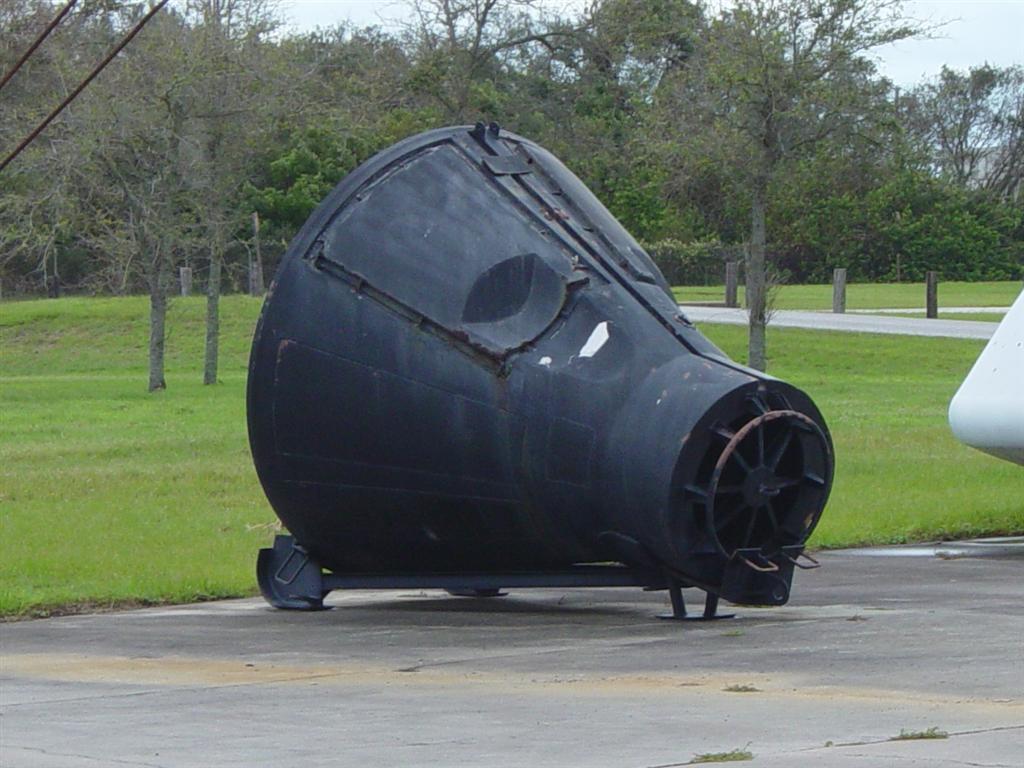
There were seven specifically named Gemini boilerplates: BP-1, 2, 3, 3A, 4, 5 and 201. Boilerplate 3A had functional doors and had multi-uses for testing watertightness, flotation collars, and egress procedures.[citation needed] Other boilerplates were designated FA-1A, MSC 312, MSC 313 and MSC-307.
NASA created a variety of Apollo boilerplates.
Apollo boilerplate command modules were used for tests of the launch escape system (LES) jettison tower rockets and procedures:
BP-1101A was used in numerous tests to develop spacecraft recovery equipment and procedures. Specifically, 1101A tested the air bags as part of the uprighting procedure when the Apollo lands upside down in the water. The sequence of the bags inflating caused the capsule to roll and upright itself.
Hub AI
Boilerplate (spaceflight) AI simulator
(@Boilerplate (spaceflight)_simulator)
Boilerplate (spaceflight)
A boilerplate spacecraft, also known as a mass simulator, is a nonfunctional craft or payload that is used to test various configurations and basic size, load, and handling characteristics of rocket launch vehicles. It is far less expensive to build multiple, full-scale, non-functional boilerplate spacecraft than it is to develop the full system (design, test, redesign, and launch). In this way, boilerplate spacecraft allow components and aspects of cutting-edge aerospace projects to be tested while detailed contracts for the final project are being negotiated. These tests may be used to develop procedures for mating a spacecraft to its launch vehicle, emergency access and egress, maintenance support activities, and various transportation processes.
Boilerplate spacecraft are most commonly used to test crewed spacecraft; for example, in the early 1960s, NASA performed many tests using boilerplate Apollo spacecraft atop Saturn I rockets, and Mercury spacecraft atop Atlas rockets (for example Big Joe 1). The engine-less Space Shuttle Enterprise was used as a boilerplate to test launch stack assembly and transport to the launch pad. NASA's now-canceled Constellation program and ongoing Artemis program used boilerplate Orion spacecraft for various testing.
Mercury boilerplates were manufactured "in-house" by NASA Langley Research Center technicians prior to McDonnell Aircraft Company building the Mercury spacecraft. The boilerplate capsules were designed and used to test spacecraft recovery systems, and escape tower and rocket motors. Formal tests were done on the test pad at Langley and at Wallops Island using the Little Joe rockets.
The term boilerplate originated from the use of boilerplate steel for the construction of test articles/mock-ups. Historically, during the development of the Little Joe series of 7 launch vehicles, there was only one actual boilerplate capsule and it was called such since its conical section was made of steel at the Norfolk Naval Shipyard. This capsule was used in a beach abort test, and then subsequently used in the LJ1A flight. However, the term subsequently came to be used for all the prototype capsules (which in their own right were nearly as complicated as the orbital capsules). This usage was technically incorrect, as those other capsules were not made of boilerplate, but the boilerplate term had effectively been genericized.[citation needed]
There were seven specifically named Gemini boilerplates: BP-1, 2, 3, 3A, 4, 5 and 201. Boilerplate 3A had functional doors and had multi-uses for testing watertightness, flotation collars, and egress procedures.[citation needed] Other boilerplates were designated FA-1A, MSC 312, MSC 313 and MSC-307.
NASA created a variety of Apollo boilerplates.
Apollo boilerplate command modules were used for tests of the launch escape system (LES) jettison tower rockets and procedures:
BP-1101A was used in numerous tests to develop spacecraft recovery equipment and procedures. Specifically, 1101A tested the air bags as part of the uprighting procedure when the Apollo lands upside down in the water. The sequence of the bags inflating caused the capsule to roll and upright itself.
Recent media