Hubbry Logo
Space Shuttle EnterpriseSpace Shuttle EnterpriseMain
Open search
Space Shuttle Enterprise
Community hub
Space Shuttle Enterprise
logo
8 pages, 0 posts
0 subscribers
Be the first to start a discussion here.
Contribute something
Space Shuttle Enterprise
from Wikipedia

Enterprise
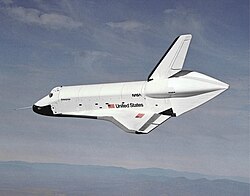
Enterprise glides to the left in this view, banked slightly towards the camera, showing "United States" on the port side and American flags on the port side and the port wing. Enterprise has a long probe sticking forward of the nose cone for calibration of instruments, and an aeroshell covering the engine area. Most of the backdrop is sky, but at the bottom, the mountainous horizon of California can be seen through haze.
Enterprise in flight in 1977, during ALT-13
TypeSpaceplane
ClassSpace Shuttle orbiter
EponymUSS Enterprise (NCC-1701)
Other nameConstitution (1975–1977)
Serial no.OV-101
OwnerNASA
ManufacturerRockwell International
History
First flight
  • August 12, 1977 (1977-08-12)
  • ALT-12
Last flight
  • October 26, 1977 (1977-10-26)
  • ALT-16
Flights5
Flight time20 m, 58 s above Earth
FatePrototype
Location
Space Shuttle orbiters

Space Shuttle Enterprise (Orbiter Vehicle Designation: OV-101) is the first orbiter of the Space Shuttle system. Rolled out on September 17, 1976, it was built for NASA as part of the Space Shuttle program to perform atmospheric test flights after being launched from a modified Boeing 747.[1] It was constructed without engines or a functional heat shield. As a result, it was not capable of spaceflight.[2]

Originally, Enterprise had been intended to be refitted for orbital flight to become the second space-rated orbiter in service.[1] However, during the construction of Space Shuttle Columbia, details of the final design changed, making it simpler and less costly to build Challenger around a body frame that had been built as a test article.[1] Similarly, Enterprise was considered for refit to replace Challenger after the latter was destroyed, but Endeavour was built from structural spares instead.[1][3]

Enterprise was restored and placed on display in 2003 at the Smithsonian's new Steven F. Udvar-Hazy Center in Virginia.[4] Following the retirement of the Space Shuttle fleet, Discovery replaced Enterprise at the Udvar-Hazy Center, and Enterprise was transferred to the Intrepid Museum in New York City, where it has been on display since July 2012.[5]

Differences between Enterprise and future shuttles

[edit]

The design of Enterprise was not the same as that planned for Columbia, the first flight model; the aft fuselage was constructed differently, and it did not have the interfaces to mount OMS pods. A large number of subsystems—ranging from main engines to radar equipment—were not installed on Enterprise, but the capacity to add them in the future was retained, as NASA originally intended to refit the orbiter for spaceflight at the conclusion of its testing. Instead of a thermal protection system, its surface was primarily covered with simulated tiles made from polyurethane foam. Fiberglass was used for the leading edge panels in place of the reinforced carbon–carbon ones of spaceflight-worthy orbiters. Only a few sample thermal tiles and some Nomex blankets were real.[6] Enterprise used fuel cells to generate its electrical power, but these were not sufficient to power the orbiter for spaceflight.[7]

Platform to the Stars: Space Shuttle (1980) Official NASA Space Shuttle program information film reel.

Enterprise also lacked reaction control system thrusters and hydraulic mechanisms for the landing gear; the landing gear doors were simply opened through the use of explosive bolts and the gear dropped down solely by gravity.[7] As it was only used for atmospheric testing, Enterprise featured a large nose probe mounted on its nose cap, common on test aircraft because the location provides the most accurate readings for the test instruments, being mounted out in front of the disturbed airflow.

Enterprise was equipped with Lockheed-manufactured zero-zero ejection seats like those its sister Columbia carried on its first four missions.[7]

Construction milestones

[edit]
Date Milestone[8]
1972 July 26 Contract Award to North American Rockwell
1972 August 9 Construction authorization from NASA
1974 June 4 Start structural assembly of crew module at Downey plant
1974 August 26 Start structural assembly of aft fuselage at Downey plant
1975 March 27 Mid fuselage arrives at Palmdale from General Dynamics
1975 May 23 Wings arrive at Palmdale from Grumman
1975 May 25 Vertical stabilizer arrives at Palmdale from Fairchild Republic
1975 August 25 Start of Final Assembly
1975 September 9 Aft fuselage on dock, Palmdale
1975 October 31 Lower forward fuselage on dock, Palmdale
1975 December 1 Upper forward fuselage on dock, Palmdale
1976 January 16 Crew module on dock, Palmdale
1976 March 3 Payload bay doors on dock, Palmdale
1976 March 12 Complete final assembly and closeout systems installation
1976 March 15 Start functional checkout
1976 June Complete functional checkout, start ground vibration and proof load tests
1976 September 17 Rollout from Palmdale[9]
1976 October–November Start systems retest, complete integrated systems checkout
1977 February 18 First captive flight
1977 June 18 First crewed captive flight[10]
1977 August 12 First free flight

Service

[edit]
Star Trek creator Gene Roddenberry (third from right, in dark brown), the Star Trek cast (with the exception of William Shatner) and NASA administrators attending Enterprise's rollout ceremony

Construction began on Enterprise on June 4, 1974.[1] Designated OV-101, it was originally planned to be named Constitution and unveiled on Constitution Day, September 17, 1976. Fans of Star Trek asked US President Gerald Ford, through a letter-writing campaign, to name the orbiter after the television show's fictional starship, USS Enterprise.[11]

In an official memo, White House advisors cited "hundreds of thousands of letters" from Trekkies, "one of the most dedicated constituencies in the country", as a reason for giving the shuttle the name.[12] Although Ford did not publicly mention the campaign, the president said that he was "partial to the name" Enterprise, and directed NASA officials to change the name.[3][13][14][11]

In mid-1976 the orbiter was used for ground vibration tests, allowing engineers to compare data from an actual flight vehicle with theoretical models.[1]

On September 17, 1976, Enterprise was rolled out of Rockwell's plant at Palmdale, California. In recognition of its fictional namesake, Star Trek creator Gene Roddenberry and most of the principal cast of the original series of Star Trek were on hand at the dedication ceremony.[15]

Approach and landing tests (ALT)

[edit]
Fred Haise and Gordon Fullerton (wearing oxygen mask) in Enterprise's cockpit, 1977

On January 31, 1977, Enterprise was taken by road to Dryden Flight Research Center at Edwards Air Force Base to begin operational testing.[1][16]

While at NASA Dryden, Enterprise was used by NASA for a variety of ground and flight tests intended to validate aspects of the shuttle program.[17] The initial nine-month testing period was referred to by the acronym ALT, for "Approach and Landing Test".[1][18] These tests included a maiden "flight" on February 18, 1977, atop a Boeing 747 Shuttle Carrier Aircraft (SCA) to measure structural loads and ground handling and braking characteristics of the mated system. Ground tests of all orbiter subsystems were carried out to verify functionality prior to atmospheric flight.[10]

The mated Enterprise/SCA combination was then subjected to five test flights with Enterprise uncrewed and unactivated. The purpose of these test flights was to measure the flight characteristics of the mated combination. These tests were followed with three test flights with Enterprise crewed to test the shuttle flight control systems.[1]

On August 12, 1977, Enterprise flew on its own for the first time.[19] Enterprise underwent four more free flights where the craft separated from the SCA and was landed under astronaut control. These tests verified the flight characteristics of the orbiter design and were used to carry out several aerodynamic and weight configurations.[18] The first three flights were flown with a tailcone placed at the end of Enterprise's aft fuselage, which reduced drag and turbulence when mated to the SCA. The final two flights saw the tailcone removed and mockup main engine nozzles installed. On the fifth and final glider flight, pilot-induced oscillation problems were revealed, which had to be addressed before the first orbital launch occurred.[17]

A crane hoists Enterprise into the Dynamic Structural Test Facility to undergo dynamic testing in launch configuration.

Mated Vertical Ground Vibration Test (MGVT)

[edit]

Following the conclusion of the ALT test flight program, on March 13, 1978, Enterprise was flown once again, but this time halfway across the country to NASA's Marshall Space Flight Center (MSFC) in Alabama for the Mated Vertical Ground Vibration Testing (MGVT). The orbiter was lifted up on a sling very similar to the one used at Kennedy Space Center and placed inside the Dynamic Test Stand building, and mated to the Vertical Mate Ground Vibration Test tank (VMGVT-ET), which in turn was attached to a set of inert Solid Rocket Boosters (SRB) to form a complete shuttle launch stack, and marked the first time in the program's history that all Space Shuttle elements, an Orbiter, an External Tank (ET), and two SRBs, were mated together. During the course of the program, Enterprise and the rest of the launch stack would be exposed to a punishing series of vibration tests simulating as closely as possible those expected during various phases of launch, some tests with and others without the SRBs in place.[20]

Planned preparations for spaceflight

[edit]
OV-101 Enterprise roll-out ceremony.

At the conclusion of this testing, Enterprise was due to be taken back to Palmdale for retrofitting as a fully spaceflight capable vehicle. Under this arrangement, Enterprise would be launched on its maiden spaceflight in July 1981 to launch a communications satellite and retrieve the Long Duration Exposure Facility, then planned for a 1980 release on the first operational orbiter, Columbia. Afterward, Enterprise would conduct two Spacelab missions.[21] However, in the period between the rollout of Enterprise and the rollout of Columbia, a number of significant design changes had taken place, particularly with regard to the weight of the fuselage and wings. This meant that retrofitting the prototype would have been a much more expensive process than previously realized, involving the dismantling of the orbiter and the return of various structural sections to subcontractors across the country. As a consequence, NASA made the decision to convert an incomplete Structural Test Article, numbered STA-099, which had been built to undergo a variety of stress tests, into a fully flight-worthy orbiter, which became Challenger.

Planned orbital missions[21]
# Date Designation Launch pad Notes
1 July 16, 1981 STS-17 39-A Deployment of Intelsat V satellite and retrieval of Long Duration Exposure Facility
2 September 30, 1981 STS-20 39-A Spacelab mission
3 November 25, 1981 STS-22 39-A Spacelab mission

Fit checks

[edit]
Enterprise visited Kennedy Space Center LC-39A in launch configuration 20 months before the first Shuttle launch.[22]

Following the MGVT program and with the decision to not use Enterprise for orbital missions, it was ferried to Kennedy Space Center on April 10, 1979. By June 1979, it was mated with an external tank and solid rocket boosters (known as a boilerplate configuration) and tested in a launch configuration at KSC Launch Complex 39A for a series of fit checks of the facilities there.[3]

After this period, Enterprise was returned to NASA's Dryden Flight Research Facility in September 1981.[23] In 1983 and 1984, Enterprise underwent an international tour visiting France, West Germany, Italy, the United Kingdom, and Canada. Enterprise also visited California, Alabama, and Louisiana (while visiting the 1984 Louisiana World Exposition).

Enterprise visited Vandenberg SLC-6 in launch configuration 17 months before the first West Coast Shuttle launch was scheduled

Between November 1984 and May 1985, Enterprise was again mated with an external tank and solid rocket boosters in a boilerplate configuration for a series of fit checks of the never-used shuttle facilities at Vandenberg Air Force Base in California.[24][25][26]

On November 18, 1985, Enterprise was ferried to Washington, D.C., where it became property of the Smithsonian Institution and was stored in the National Air and Space Museum's hangar at Dulles International Airport.

Post-Challenger

[edit]

After the Challenger disaster, NASA considered using Enterprise as a replacement. Refitting the shuttle with all of the necessary equipment for it to be used in space was considered, but NASA decided to use spare parts constructed at the same time as Discovery and Atlantis to build Endeavour.[3]

Post-Columbia

[edit]
Damage to the leading edge of the wing from the post-Columbia impact tests

In 2003 after the breakup of Columbia during re-entry, the Columbia Accident Investigation Board conducted tests at Southwest Research Institute, which used an air cannon to shoot foam blocks of similar size, mass and speed to that which struck Columbia at a test structure which mechanically replicated the orbiter wing leading edge. They removed a section of fiberglass leading edge from Enterprise's wing to perform analysis of the material and attached it to the test structure, then shot a foam block at it.[27] While the leading edge was not broken as a result of the test, which took place on May 29, 2003, the impact was enough to permanently deform a seal and leave a thin gap 22 in (56 cm) long.[28][29][30] Since the strength of the reinforced carbon–carbon (RCC) on Columbia is "substantially weaker and less flexible" than the test section from Enterprise, this result suggested that the RCC would have been shattered.[30] A section of RCC leading edge from Discovery was tested on June 6, to determine the effects of the foam on a similarly aged leading edge, resulting in a three in (7.6 cm) crack on panel 6 and cracking on a T-shaped seal between panels 6 and 7.[31][32] On July 7, using a leading edge from Atlantis and focused on panel 8 with refined parameters stemming from the Columbia accident investigation, a second test created a ragged hole approximately 16 by 16 in (41 by 41 cm) in the RCC structure.[33][32] The tests clearly demonstrated that a foam impact of the type Columbia sustained could seriously breach the protective RCC panels on the wing leading edge.[32]

The board determined that the probable cause of the accident was that the foam impact caused a breach of a reinforced carbon-carbon panel along the leading edge of Columbia's left wing, allowing hot gases generated during re-entry to enter the wing and cause structural collapse. This caused Columbia to tumble out of control, breaking up with the loss of the entire crew.[34]

Museum exhibit

[edit]

New Orleans, Louisiana

[edit]
Enterprise on display at the 1984 Louisiana World Exposition in New Orleans.

In 1984, Enterprise was on display during the 1984 Louisiana World Exposition (World's Fair) in New Orleans.

Washington, D.C.

[edit]
Enterprise on display in a black hangar filled with other space artifacts including the tops of Mercury and Gemini capsules, rockets and satellites, a Manned Maneuvering Unit, and other space artifacts. An American flag hangs on the wall of the hangar in the back. The Shuttle is resting on its landing gear with the payload bay doors closed, and museum visitors are kept away by stanchions. 13 visitors are visible in this picture, one group is wearing matching yellow shirts. There is ample room for more visitors.
Enterprise on display at the Steven F. Udvar-Hazy Center.
Enterprise and Discovery meet, rolling on their landing gear, seemingly nose to nose, along a paved path at Dulles airport. A throng of people standing on grass in the foreground has gathered to see the spectacle. Both orbiters have aeroshells covering the engine area.
Enterprise (left) stands with Discovery on the latter's delivery to the Smithsonian in Washington D.C.

From 1985 to 2003,[10] Enterprise was stored at the Smithsonian's hangar at Washington Dulles International Airport before it was restored and moved to the Smithsonian's newly built National Air and Space Museum Steven F. Udvar-Hazy Center at Washington Dulles, where it was the centerpiece of the space collection.[35] On April 12, 2011, NASA announced that Discovery, the most traveled orbiter in the fleet, would replace Enterprise in the Smithsonian's collection once the Shuttle fleet was retired, with ownership of Enterprise transferred to the Intrepid Museum in New York City. On April 17, 2012, Discovery was transported by Shuttle Carrier Aircraft to Dulles from Kennedy Space Center, where it made several passes over the Washington D.C. metro area.[36][37] After Discovery had been removed from the Shuttle Carrier Aircraft, both orbiters were displayed nose-to-nose outside the Steven F. Udvar-Hazy Center before Enterprise was made ready for its flight to New York.[38]

New York

[edit]
Space Shuttle Enterprise
Enterprise being lifted onto the deck of Intrepid in June 2012
LocationNew York City
NRHP reference No.13000071
Added to NRHPMarch 13, 2013

On December 12, 2011, ownership of Enterprise was officially transferred to the Intrepid Museum in New York City.[39][40][41] In preparation for the anticipated relocation, engineers evaluated the vehicle in early 2010 and determined that it was safe to fly on the Shuttle Carrier Aircraft once again.[42] At approximately 13:40 UTC on April 27, 2012, Enterprise took off from Dulles International Airport en route to a fly-by over the Hudson River, New York's JFK International Airport, the Statue of Liberty, the George Washington and Verrazano–Narrows Bridges, and several other landmarks in the city, in an approximately 45-minute "final tour". At 15:23 UTC, Enterprise touched down at JFK International Airport.[43][44]

The mobile Mate-Demate Device and cranes were transported from Dulles to the ramp at JFK and the shuttle was removed from the SCA overnight on May 12, 2012, placed on a specially designed flat bed trailer and returned to Hangar 12.[45] On June 3 a Weeks Marine barge took Enterprise to Jersey City. The Shuttle sustained cosmetic damage to a wingtip when a gust of wind blew the barge towards a piling.[46] It was hoisted June 6 onto the Intrepid Museum in Manhattan.[47]

Enterprise went on public display on July 19, 2012, at the Intrepid Museum's new Space Shuttle Pavilion, a temporary shelter consisting of a pressurized, air-supported fabric bubble constructed on the aft end of the carrier's flight deck.[48]

Damage from Hurricane Sandy

On October 29, 2012, storm surges from Hurricane Sandy caused Pier 86, including the Intrepid Museum's visitor center, to flood, and knocked out the museum's electrical power and both backup generators. The loss of power caused the Space Shuttle Pavilion to deflate, and high winds from the hurricane caused the fabric of the Pavilion to tear and collapse around the orbiter. Minor damage was spotted on the vertical stabilizer of the orbiter, as a portion of the tail fin above the rudder/speedbrake had broken off.[49] The broken section was recovered by museum staff. While the pavilion itself could not be replaced for some time in 2013, the museum erected scaffolding and sheeting around Enterprise to protect it from the environment.[50]

By April 2013, the damage sustained to Enterprise's vertical stabilizer had been fully repaired, and construction work on the structure for a new pavilion was under way.[51] The pavilion and exhibit reopened on July 10, 2013.[52]

Enterprise was listed on the National Register of Historic Places on March 13, 2013, reference number 13000071, in recognition of its role in the development of the Space Shuttle Program. The historic significance criteria are in space exploration, transportation, and engineering.[53]

[edit]

See also

[edit]

References

[edit]
[edit]
Revisions and contributorsEdit on WikipediaRead on Wikipedia
from Grokipedia
The Space Shuttle Enterprise (OV-101) was the prototype orbiter of , constructed primarily for ground and atmospheric testing to validate the vehicle's design for approach, landing, and integration with launch systems, rather than orbital missions. Development of Enterprise began following President Richard M. Nixon's approval of the on January 5, 1972, with awarding the prime contract to Rockwell International's Space Transportation Systems Division on July 26, 1972. Construction commenced in , and the orbiter was rolled out during a public ceremony on September 17, 1976, attended by officials and cast members from the television series , after which it was named. Originally designated for the name Constitution to honor the U.S. bicentennial, the orbiter was renamed Enterprise at the request of President Gerald R. Ford, influenced by a widespread write-in campaign from Star Trek fans petitioning and the White House. From February to November 1977, Enterprise underwent the Approach and Landing Tests (ALT) program at NASA's Dryden Flight Research Center (now ) in , consisting of taxi tests, eight captive flights atop a modified , and five free flights to evaluate the orbiter's unpowered and landing capabilities. The first free flight occurred on August 12, 1977, piloted by astronauts Fred W. Haise Jr. and C. Gordon Fullerton, successfully demonstrating the vehicle's aerodynamic stability despite modifications like the absence of main engines and thermal tiles. In April 1979, Enterprise arrived at NASA's for launch configuration tests at Pad 39A, where it was mated with an external tank and solid rocket boosters to verify fit and procedures, completing these activities by July 23, 1979. Additional vibration and simulations were conducted at Vandenberg Air Force Base's Space Launch Complex 6 in 1984 and 1985. Decommissioned in 1985 after its test roles were fulfilled, Enterprise was transferred to the in 1985 and displayed at the in Washington, D.C., until 2011. In 2012, it was relocated to the Intrepid Sea, Air & Space Museum in , where it remains on public exhibit suspended in a vertical launch configuration.

Background and Development

Origins in the Space Shuttle Program

The Space Shuttle program originated from NASA's efforts in the late 1960s and early 1970s to develop a cost-effective, reusable spacecraft system capable of supporting a range of scientific, commercial, and military missions in low Earth orbit. On January 5, 1972, President Richard M. Nixon announced his approval for the program, directing NASA to proceed with the development of a partially reusable vehicle that could launch like a rocket and land like an airplane, thereby reducing the expense of space access compared to expendable rockets. This decision followed extensive studies and congressional debates, culminating in an initial authorization of approximately $5.5 billion over several years to achieve operational capability by the early 1980s. Following the program approval, NASA solicited bids for the orbiter's design and construction in March 1972, receiving proposals from major aerospace firms including North American Rockwell, , McDonnell Douglas, and Lockheed. On July 26, 1972, NASA awarded the prime contract for the orbiter to North American Rockwell, valued at about $2.6 billion, with the company tasked with leading overall vehicle integration and initial development of a full-scale to refine the design before committing to flight hardware. This , completed in 1972, allowed for early subsystem integration checks and aerodynamic validations on the ground, setting the stage for transitioning to a dedicated test vehicle. Enterprise, designated as Orbiter Vehicle-101 (OV-101), was established as the lead article in the planned fleet of five orbiters, with commencing on , 1974, at Rockwell's Palmdale facility. Unlike operational orbiters, OV-101 was engineered specifically as a for atmospheric testing, incorporating a flightworthy structure to demonstrate the vehicle's aerodynamic stability and unpowered landing capabilities without main engines, orbital maneuvering systems, or a full thermal protection shield. This approach prioritized proving the orbiter's glide performance and ground handling prior to full orbital qualification of subsequent vehicles. Fiscal pressures in 1976, amid broader federal budget limitations for , prompted key adjustments to the program's scope. Instead, resources were redirected to finalize OV-101's assembly and initiate production of the first operational orbiter, ensuring the program's progression within constrained . This decision underscored the Shuttle initiative's emphasis on efficiency, limiting non-essential hardware while advancing core development milestones.

Naming and Intended Role

The Space Shuttle Enterprise (OV-101) received its name during a public rollout ceremony on September 17, 1976, at the facility in , attended by Administrator and several members of the original cast, including , , , James Doohan, , and . Originally designated for the name to commemorate the U.S. bicentennial, the orbiter was renamed in response to a vigorous letter-writing campaign by fans, who sent hundreds of thousands of letters to the urging the tribute to the series' fictional starship USS Enterprise. Ford, reportedly partial to the name due to its historical naval significance and the public enthusiasm, directed to approve the change just days before the ceremony. As the first orbiter in NASA's , Enterprise was designed exclusively as a pathfinder vehicle to support pre-operational validation, focusing on structural testing, ground integration with launch infrastructure, and atmospheric flight trials to confirm the airframe's aerodynamic stability and landing capabilities. Unlike the subsequent operational orbiters, it was never intended for orbital missions, orbital reentry, or crewed beyond Earth's atmosphere, thereby allowing to prioritize proof-of-concept demonstrations for the reusable shuttle concept without the risks and expenses of full space qualification. To optimize development efficiency and reduce expenses, Enterprise omitted critical systems including the three space shuttle main engines, a complete thermal protection system of heat-resistant tiles and blankets, and operational equipment, features that would have added substantial weight and complexity unnecessary for its terrestrial test profile. This approach minimized costs compared to flight-ready orbiters, enabling faster assembly and allocation of resources toward the program's broader goals. Building on the legacy of prior experimental aircraft like the , which pioneered data and reusable wing-body configurations in the , Enterprise served as an essential milestone in certifying the structural dynamics and integrated performance of a partially system.

Design and Construction

Design Differences from Operational Orbiters

The Space Shuttle Enterprise, designated OV-101, was constructed as a test for atmospheric flight evaluations rather than orbital operations, resulting in several key structural and functional omissions compared to the operational orbiters such as Columbia, Challenger, Discovery, , and Endeavour. Notably, Enterprise lacked the three Space Shuttle Main Engines (SSMEs) required for launch and ascent, as well as the two (OMS) pods used for in-space propulsion and attitude control; these systems were deemed unnecessary for its low-altitude (ALT). Additionally, the wing leading edges did not incorporate reinforced carbon-carbon (RCC) material, which protects operational orbiters from the extreme heat of atmospheric reentry. Unlike the operational orbiters, which were covered with thousands of heat-resistant thermal protection system (TPS) tiles to withstand reentry temperatures exceeding 1,650°C (3,000°F), Enterprise featured a standard aluminum skin finished with white polyurethane paint and fiberglass cloth for basic weather protection, eliminating the need for a full TPS. This simplification contributed to a lighter overall structure, with Enterprise's empty weight at rollout measuring approximately 68,650 kg (67 metric tons), compared to the roughly 78,000 kg (75 metric tons) for later operational orbiters before engine installation. The absence of propulsion systems, TPS, and other flight hardware reduced Enterprise's mass relative to its flight-ready counterparts, optimizing it for ground vibration tests and airborne evaluations. To support its role in structural and aerodynamic testing, Enterprise was outfitted with extensive distributed across the to measure stresses, strains, vibrations, and temperatures during taxi runs, captive flights, and free flights in the ALT program. These sensors provided critical data on without the complexity of operational or reaction control systems, focusing instead on aerodynamic surfaces like elevons, body flaps, and the speed brake. For the final two free-flight tests, three dummy SSME replicas were temporarily installed to mimic the weight distribution and drag profile of an operational orbiter, ensuring realistic landing simulations. Enterprise's payload bay and doors were configured identically to those of operational orbiters in terms of size, shape, and mechanisms, allowing for fit checks with mock payloads and of door operations during ground tests. However, the bay lacked internal systems such as the , transfer tunnel, or remote manipulator system (RMS) arm mounting provisions, as these were not required for atmospheric testing. This design approach prioritized cost savings and test efficiency, enabling Enterprise to validate the orbiter's basic integrity before the integration of full orbital capabilities in subsequent vehicles.

Assembly Milestones

The prime contract for the development and manufacture of the Space Shuttle orbiter was awarded to Rockwell International's Space Division on July 26, 1972. Construction of the prototype orbiter, designated OV-101, began on June 4, 1974, at Rockwell's Downey, California, plant, where structural assembly of the crew module and fuselage sections took place. These components were subsequently transported to the company's Palmdale facility for integration with other major elements, including the wings and vertical tail assembly, during 1975 and early 1976. Final assembly of Enterprise was completed at Palmdale in March 1976, after which the orbiter underwent initial systems checks. On September 17, 1976, Enterprise was rolled out in a public ceremony at the Palmdale facility, drawing more than 35,000 spectators, including members of the cast from the television series , whose fans had successfully petitioned to name the vehicle after the fictional starship. Following the rollout, Enterprise was moved 36 miles overland to NASA's Dryden Flight Research Center (now ) in January 1977 for ground testing. The first ground taxi tests occurred on February 15, 1977, consisting of three runs to validate the orbiter's landing gear deployment, hydraulic systems, and ground-handling characteristics while mated to the modified .

Atmospheric Test Program

Approach and Landing Tests Overview

The (ALT) program for Space Shuttle Enterprise was initiated in February 1977 at , , to verify the orbiter's aerodynamic stability and unpowered landing performance prior to orbital operations. This nearly year-long effort was a critical step in the , focusing on certifying the vehicle's ability to glide and land autonomously after reentry, using ground-based and airborne simulations to mitigate risks for future crewed missions. The program employed a modified , designated the (SCA), which had been adapted with structural reinforcements and a custom cradle to ferry Enterprise aloft for testing. The ALT unfolded in four progressive phases designed to build confidence in the orbiter's handling: initial tests on the dry lakebed to evaluate ground mobility and systems integration; five captive-inactive flights with the orbiter secured to the SCA and its systems unpowered, assessing mated vehicle aerodynamics; three captive-active flights with onboard systems energized to test control responses while attached; and culminating in five free flights where Enterprise was released from the SCA at altitude to execute independent glides and landings. These phases incrementally increased complexity, from static evaluations to dynamic, pilot-controlled maneuvers. Astronaut crews were assigned to oversee and operate during the powered phases, with Fred W. Haise Jr. and C. Gordon Fullerton comprising the primary team for the initial tests, drawing on their Apollo-era experience. Joe H. Engle and alternated as the backup crew, participating in subsequent flights to provide comprehensive pilot feedback on low-speed handling. Success criteria centered on achieving key performance benchmarks essential for operational , including a subsonic glide ratio of 4.5:1 to ensure efficient energy dissipation during descent and the capability for cross-range maneuvers up to 1,200 nautical miles, allowing flexibility in from orbital trajectories. Enterprise's structural design, optimized for atmospheric flight without the thermal tiles or main engines of production orbiters, facilitated these tests by emphasizing the vehicle's inherent aerodynamic qualities.

Captive and Free-Flight Tests

The captive phase of the (ALT) for Space Shuttle Enterprise began with the first captive-inert flight on February 18, 1977, lasting 19 minutes at an altitude of 5,000 feet, which successfully validated the structural interface between the orbiter and the modified (SCA). This initial test, conducted without orbiter systems powered or crew aboard, confirmed aerodynamic stability and load distribution during mated flight, providing essential data for subsequent phases. Four additional captive-inert flights followed in March 1977, progressively increasing altitude and speed to refine SCA handling and orbiter attachment mechanisms. The captive-active phase commenced in June 1977, with three flights in June and July that activated Enterprise's onboard systems, including and , while the orbiter remained attached to the SCA. These tests, crewed by astronauts such as Fred W. Haise Jr. and C. Gordon Fullerton, reached altitudes up to 22,000 feet and demonstrated the orbiter's hydraulic actuators and elevons responding effectively to pilot inputs in a real-flight environment. Key achievements included verification of flight control software integration and crew interface procedures, with no major structural or systems failures reported. Transitioning to unpowered operations, the free-flight phase consisted of five successful glides from August to October 1977, where Enterprise separated from the SCA at approximately 25,000 feet and descended to a runway landing at Edwards Air Force Base. The inaugural free flight on August 12, 1977, piloted by Haise and Fullerton, lasted five minutes and covered a 13-mile glide path, confirming the orbiter's stability and handling during separation, turns, and final approach without propulsion. Subsequent flights—September 13 (Haise and Richard H. Truly), September 23 (Fullerton and Joe H. Engle), October 12 (Engle and Truly), and October 26 (Haise and Fullerton)—progressively tested configurations, including removal of the tail cone on the final two to simulate operational thermal protection exposure. Throughout the free flights, minor anomalies such as elevon oscillations were encountered and resolved mid-program through software adjustments and pilot technique refinements, ensuring control authority during low-speed maneuvers. All five free flights achieved landings within 1,500 feet of the designated target point on the 15,000-foot runway, validating the orbiter's unpowered descent profile and energy management for future orbital returns. These tests collectively demonstrated Enterprise's aerodynamic predictability and pilot controllability, paving the way for operational shuttle certification.

Ground Integration Tests

Mated Vertical Ground Vibration Test

The Mated Vertical Ground Vibration Test (MVGVT) represented a pivotal phase in the Space Shuttle program's ground testing efforts, focusing on the dynamic characteristics of the integrated launch vehicle stack. Conducted at NASA's Marshall Space Flight Center in Huntsville, Alabama, from October 1978 to March 1979, the test marked the first time the complete Space Shuttle configuration—orbiting vehicle, external tank, and solid rocket boosters—was assembled and suspended vertically for structural evaluation. The Enterprise orbiter was mated to a full-scale external tank and two solid rocket booster mockups inside the Dynamic Test Stand, a facility originally used for Saturn V testing, to replicate the launch posture while allowing controlled suspension from its apex. The primary objective of the MVGVT was to experimentally determine the natural frequencies, ratios, and mode shapes of the mated stack, ensuring compatibility with anticipated launch from engines, , and flow without risking structural or . Engineers employed electrodynamic —ranging from 150 to 1,000 foot-pound units—attached at strategic locations to induce sinusoidal excitations across the vehicle's relevant frequency spectrum, typically emphasizing low-frequency bending and torsional modes. included over 300 channels, along with strain gauges, transducers, and load cells, strategically distributed across the stack to record responses at hundreds of points, enabling comprehensive . This setup allowed for both symmetric and antisymmetric excitations to isolate specific dynamic behaviors, with systems capturing time histories for post-test correlation with finite element models. The MVGVT results validated the analytical predictions for the Shuttle stack's dynamics, revealing no unanticipated resonances or excessive that could interact adversely with operational loads, such as pogo oscillations from the engines. Measured natural frequencies aligned closely with pre-test simulations, confirming the structural integrity and stability of the mated configuration under vertical suspension and vibrational inputs. These outcomes provided essential data for refining vehicle models, mitigating risks in subsequent integration phases, and ultimately supporting the transition to flight hardware assembly for operational orbiters.

Payload Bay Fit Checks

In 1979, the Space Shuttle Enterprise underwent a series of fit checks at NASA's as part of pathfinder activities to validate launch configuration and procedures. These tests, conducted from April to July, involved mating the orbiter with an external tank and inert solid rocket boosters in the , followed by rollout to 39A on May 1, 1979. Technicians assessed the compatibility of the orbiter with launch infrastructure, including assembly, transport on the , and pad servicing access. A countdown demonstration test was performed with the external tank loaded with cryogenic propellants to verify procedures and identify issues such as ice buildup. These evaluations confirmed the fit and alignment of the mated stack components, resolving minor discrepancies in fixtures and interfaces through adjustments. Although Enterprise was not configured for orbital missions, these ground integration tests provided critical validation of launch processing and infrastructure compatibility, supporting the development of procedures for operational orbiters like Columbia. No major issues were encountered, contributing to the reliability of the system's ground operations.

Planned Orbital Operations

Preparations for Spaceflight

In 1979, considered modifications to the Space Shuttle Enterprise, including the installation of main engines, for powered landing tests to simulate abort scenarios, with partial funding allocated for related upgrades that supported further vehicle development. This initiative aimed to enhance the orbiter's capabilities beyond its initial atmospheric test role, where it had been used without operational propulsion or thermal protection systems. Originally intended to become the second operational orbiter, plans to upgrade Enterprise were deferred in favor of constructing Challenger. In the early , again considered refitting Enterprise for orbital flight, including the addition of thermal protection tiles and (OMS) pods to enable space operations. These modifications represented a significant step toward potentially converting the test vehicle into a flight-ready orbiter, though no specific mission was assigned. Enterprise also supported astronaut crew training through realistic simulations of approach and landing procedures, providing hands-on practice that informed operational techniques for subsequent shuttle missions. The orbiter's use in these sessions allowed pilots to refine unpowered glide profiles and landing dynamics in a full-scale vehicle configuration.

Cancellation of Flight Plans

In 1985, abandoned plans to convert the Space Shuttle Enterprise for orbital flight, primarily due to the prohibitive costs of the required modifications, including installation of a full thermal protection system, main engines, and systems. The decision reflected broader budget shortfalls within the shuttle program, where limited funds were redirected to certify and support the operational orbiters Discovery and for their scheduled missions. Plans were canceled in 1985, reverting the orbiter to ground testing and backup roles while halting major modifications. Partial disassembly of the initiated upgrades, such as preliminary thermal protection elements, preserved the vehicle for potential future use as a structural test article or display piece, avoiding complete scrapping. By November 18, 1985, following its final ground integration tests, transferred ownership of Enterprise to the , marking the end of its active role in flight preparations and dedicating it to public education and preservation.

Post-Program Utilization

Storage and Refurbishment

Following the completion of its ground integration tests at in July 1979, Enterprise was ferried to Dryden Flight Research Center in August 1979 and then to Palmdale for removal of equipment in October 1979. It was returned to the Dryden Flight Research Facility at for long-term storage on September 6, 1981. During this period from 1981 to 1983, the orbiter underwent periodic inspections as part of NASA's broader control program for the shuttle fleet, which addressed structural integrity issues such as adhesion and subsurface to maintain overall airworthiness. These inspections ensured the vehicle remained in a preserved state, capable of potential reactivation as a test asset amid uncertainties in the shuttle program's expansion. In May 1983, Enterprise departed Dryden for an international promotional tour from May 13 to June 13, visiting the , , , (including the ), and to showcase U.S. space capabilities. The orbiter was transported atop a modified , with public displays at air shows and airports, marking a shift from operational testing to symbolic representation. Periodic maintenance during the tour focused on systems preservation to protect against environmental exposure, aligning with NASA's ongoing orbiter corrosion monitoring protocols established since 1981. From April to November 1984, Enterprise was displayed at the Louisiana World Exposition in New Orleans. By late 1984, prepared Enterprise for additional ground verification tasks. The orbiter was refurbished to facilitate mating with a boilerplate external tank and solid rocket boosters, enabling fit checks at Vandenberg Air Force Base's Space Launch Complex 6 starting in November 1984. This refurbishment emphasized preservation of structural and thermal protection systems, including checks for and integrity to simulate launch configurations without risking flight hardware. These activities underscored Enterprise's evolving role from an active test vehicle to a static pathfinder, preserving its potential utility while transitioning toward non-operational status.

Response to Challenger Disaster

Following the Challenger disaster on January 28, 1986, NASA grounded the entire Space Shuttle fleet for over two years to investigate the accident and implement extensive safety modifications, including new crew escape capabilities. Although Enterprise was a non-orbital test vehicle and not part of the operational fleet, it served as a valuable mockup for developing and validating post-accident safety enhancements. In 1987, NASA used Enterprise to conduct bailout procedure tests at Dulles International Airport in Virginia, simulating emergency crew egress from a distressed orbiter during ascent. These tests focused on the newly designed Inflight Escape (ICES), which featured a telescoping pole deployed from the forward crew compartment side hatch. Crew members would hook onto the pole with suit hardware and slide to clear the orbiter's wing before parachuting to safety, providing a limited but critical bailout option not available during Challenger's flight. The simulations confirmed the system's functionality under realistic conditions, contributing to its installation on operational orbiters like Discovery and . Enterprise also underwent temporary modifications, such as the addition of escape hatches and related hardware in the crew module, to facilitate these ground-based and taxi-run simulations. This work supported for the 1988 return-to-flight mission, on , by allowing practice of egress procedures without risking flight hardware. Beyond technical contributions, Enterprise's utilization symbolized NASA's commitment to safety and recovery, boosting program morale during a period of uncertainty; however, no efforts were made to upgrade it for actual , as building the replacement orbiter Endeavour proved more efficient. Following the successful resumption of flights in September 1988, the escape-related modifications to Enterprise were reversed, restoring it to its original configuration for eventual public exhibition.

Response to Columbia Disaster

Following the Space Shuttle Columbia disaster on February 1, 2003, the Columbia Accident Investigation Board (CAIB) determined that foam debris from the external tank had struck and damaged the reinforced carbon-carbon (RCC) panels on the orbiter's left wing leading edge during launch, leading to the vehicle's breakup during re-entry. To investigate and replicate this failure mechanism, NASA engineers removed several wing leading edge panels—fiberglass-reinforced plastic mockups simulating RCC—from Enterprise and subjected them to high-speed foam impact tests at facilities including the Southwest Research Institute in San Antonio, Texas, and NASA Glenn Research Center in Cleveland, Ohio. These May 2003 tests fired foam blocks at velocities matching launch conditions, producing damage consistent with the observed breach on Columbia and confirming the vulnerability of RCC-like materials. From 2003 to 2005, additional wing impact simulations using foam debris were conducted to assess repair methods and material reinforcements, directly supporting the modifications required for the Space Shuttle fleet's return to flight. At the Smithsonian Institution's , Enterprise was used in evaluations that informed the redesigned components for operational use. The results informed the installation of reinforced leading edges on Discovery, enabling its safe launch on in July 2005 as the first post-Columbia mission. In preparation for its ongoing role in training and display during the return-to-flight era, Enterprise was restored in 2004 at the Smithsonian Institution's in , including repainting its exterior in the operational color scheme of white fuselage with black heat shield accents to more accurately represent flight-ready orbiters. With the conclusion of the after Atlantis's final mission in July 2011, Enterprise—having served for over 30 years in testing, training, and engineering roles—was officially decommissioned. then prepared the orbiter for public exhibition by coordinating its transfer from the Udvar-Hazy Center to the Intrepid Sea, Air & Space Museum in , where ownership was formally handed over on December 12, 2011, and it arrived for display in June 2012.

Exhibitions and Legacy

Initial Public Display in New Orleans

The Space Shuttle Enterprise made its debut public exhibition at the in New Orleans, serving as a centerpiece of NASA's display in the U.S. Pavilion from May 12 to November 11, 1984. Transported to the fairgrounds via barge along the , the orbiter was positioned horizontally in a prominent elevated display within the pavilion, allowing visitors to walk beneath and around it for an immersive view of the program's technological achievements. This exhibition highlighted Enterprise's role as the prototype orbiter, showcasing its design and engineering without the operational hardware for , and it became one of the fair's major attractions amid themes of international innovation and the . The exposition, held along the riverfront in New Orleans' Warehouse District, drew approximately 7.3 million visitors over its six-month run, with NASA's pavilion featuring Enterprise alongside interactive exhibits on and . The display underscored the Shuttle program's progress following Enterprise's atmospheric test flights in the late , fostering public enthusiasm for NASA's ambitions. Monorail systems and riverfront access enhanced visitor engagement, positioning the orbiter as a symbol of American ingenuity and drawing crowds eager to experience a piece of the emerging era. Following the fair's closure on November 11, 1984, Enterprise was relocated for further ground testing at Vandenberg Air Force Base in , marking the end of its New Orleans exhibition.

Transfer to Washington, D.C.

After completing ground vibration tests at Vandenberg Air Force Base, Enterprise was ferried to NASA's (KSC) in on September 20, 1985, where it was placed on temporary public display near the for two months. This exhibition allowed visitors to view the prototype orbiter alongside the rocket on display, highlighting its contributions to the . In November 1985, the Space Shuttle Enterprise arrived at Washington Dulles International Airport aboard a modified carrier aircraft after its final public display at in . NASA officially transferred ownership to the Smithsonian Institution's on December 6, 1985, during a ceremony at the museum's Paul E. Garber Preservation, Restoration, and Storage Facility in , where it entered temporary storage. This marked the beginning of Enterprise's long-term association with the Smithsonian, serving as a key artifact in the museum's collection dedicated to and . On November 19, 2003, Enterprise was transported by road from the Garber Facility to the newly constructed in , adjacent to Dulles Airport, in preparation for restoration and public exhibition ahead of the center's opening on December 15, 2003. Following restoration work, it was installed as the centerpiece of the James S. McDonnell Space in 2004, suspended horizontally from the ceiling using specialized cranes to simulate a flight configuration. The display positioned Enterprise alongside a mock external tank and solid rocket boosters to illustrate the shuttle system's launch assembly, drawing an estimated 1.2 million visitors annually to the Udvar-Hazy Center during its tenure there. The exhibit surrounding Enterprise focused on the engineering innovations of the , featuring interactive displays, artifacts from precursor missions like Mercury, Gemini, and Apollo, and educational panels explaining orbiter design, thermal protection systems, and atmospheric testing. These elements highlighted Enterprise's role as the prototype orbiter built for , emphasizing its contributions to development without orbital flight capabilities. In April 2011, announced that Enterprise would be reassigned to the Intrepid Sea, Air & Space Museum in to accommodate the retiring Space Shuttle Discovery at the Udvar-Hazy Center. Preparations for the transfer began in early 2012, culminating on April 19 when Enterprise was carefully lowered from its suspension using cranes, rolled out of the hangar, and prepared for shipment without major disassembly such as wing removal. This process cleared space for Discovery's installation, ending Enterprise's nearly three-decade stay at the Smithsonian after its 1985 arrival.

Permanent Installation in New York City

Following its disassembly at the Smithsonian's Udvar-Hazy Center, the Space Shuttle Enterprise was transported to New York City, beginning with a ceremonial flyover of Manhattan on April 27, 2012, aboard a modified Boeing 747 shuttle carrier aircraft. The orbiter was then offloaded at John F. Kennedy International Airport and moved to Bayonne, New Jersey, for barge transport up the Hudson River, arriving at the Intrepid Sea, Air & Space Museum on June 6, 2012. There, it was hoisted by crane onto the flight deck of the USS Intrepid, marking the start of its permanent exhibition setup. The installation involved constructing the dedicated Space Shuttle Pavilion on the museum's flight deck, a process that included elevating the orbiter approximately 10 feet (3 meters) above the deck to allow visitors unobstructed views of its undercarriage and thermal tiles. The transport and initial setup costs totaled around $12 million, funded through a combination of contributions and museum fundraising efforts. The pavilion, featuring interactive exhibits on the shuttle program's history, officially opened to the public on July 19, 2012, drawing immediate crowds and integrating displays to contextualize Enterprise's role as the program's . Since its debut, the exhibit has attracted over 500,000 visitors annually, contributing significantly to the museum's total attendance exceeding 1 million people per year and serving as a key draw for educational programs on . Enhancements include simulations, such as the "Apollo 11 & Beyond VR" experience, which immerses guests in historical missions and complements the physical display of Enterprise. As of November 2025, no major structural changes have occurred to the installation, with the orbiter remaining in its elevated horizontal position within the pavilion. Enterprise's placement at the Intrepid has solidified its legacy as a public ambassador for NASA's Space Shuttle program, inspiring generations through close-up access and storytelling about its Approach and Landing Test flights conducted in the 1970s. Ongoing maintenance is handled by the museum's dedicated restoration team, ensuring the orbiter's preservation against environmental factors like Hudson River humidity and urban pollution. This exhibit not only highlights the engineering innovations of OV-101 but also underscores the broader impact of the shuttle era on American aerospace achievement.

References

Add your contribution
Related Hubs
Contribute something
User Avatar
No comments yet.