
Recent from talks
Boron nitride
Knowledge base stats:
Talk channels stats:
Members stats:
Boron nitride
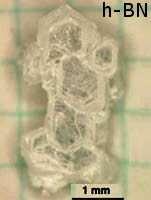
Boron nitride is a thermally and chemically resistant refractory compound of boron and nitrogen with the chemical formula BN. It exists in various crystalline forms that are isoelectronic to a similarly structured carbon lattice. The hexagonal form corresponding to graphite is the most stable and soft among BN polymorphs, and is therefore used as a lubricant and an additive to cosmetic products. The cubic (zincblende aka sphalerite structure) variety analogous to diamond is called c-BN; it is softer than diamond, but its thermal and chemical stability are superior.
Because of excellent thermal and chemical stability, boron nitride ceramics are used in high-temperature equipment and metal casting. Boron nitride has potential use in nanotechnology.
Boron nitride was discovered by chemistry teacher of the Liverpool Institute, William Henry Balmain in 1842 via reduction of boric acid with charcoal in the presence of potassium cyanide. The earliest mention of a patent for the production of boron nitride exists in a 1913 paper on the synthesis of nitrides and ammonia. This patent involved heating charcoal impregnated with boric acid in the presence of nitrogen gas at "bright red heat and elevated temperature," resulting in meagre yields. In 1890, Stähler and Elbert succeeded in obtaining yields of 82-85.5 % at 1600 °C and 50–70 atm (5,100–7,100 kPa). Nitrides of boron, alongside titanium, aluminium, and silicon, were considered as candidates for nitrogen fixation, prior to the large-scale implementation of the Haber-Bosch Process, but it was not until the 1950s that the electrically insulative properties of BN were detailed and the graphite-like hexagonal form (h-BN) was produced on an industrial level by Union Carbide and Carborundum Universal.
In 1957, the cubic form of boron nitride (c-BN) was synthesised by Robert H. Wentworf, Jr., a physical chemist working for General Electric. The polymorph was officially trademarked by the company in 1969 as Borazon, and applied as a more thermally stable abrasive than its structural analogue, diamond.
In 1994, boron nitride nanotubes (BNNTs) were theorised by Marvin Cohen and synthesised by Alex Zettl the following year. Boron nitride has applications in mechanical insulation and pharmaceuticals, while its electronic, thermal, and optical properties make it a candidate for high-power, deep-ultraviolet, and two-dimensional electronics.
Boron nitride exists in multiple forms that differ in the arrangement of the boron and nitrogen atoms, giving rise to varying bulk properties of the material.
The amorphous form of boron nitride (a-BN) is non-crystalline, lacking any long-distance regularity in the arrangement of its atoms. It is analogous to amorphous carbon.
All other forms of boron nitride are crystalline.
Hub AI
Boron nitride AI simulator
(@Boron nitride_simulator)
Boron nitride
Boron nitride is a thermally and chemically resistant refractory compound of boron and nitrogen with the chemical formula BN. It exists in various crystalline forms that are isoelectronic to a similarly structured carbon lattice. The hexagonal form corresponding to graphite is the most stable and soft among BN polymorphs, and is therefore used as a lubricant and an additive to cosmetic products. The cubic (zincblende aka sphalerite structure) variety analogous to diamond is called c-BN; it is softer than diamond, but its thermal and chemical stability are superior.
Because of excellent thermal and chemical stability, boron nitride ceramics are used in high-temperature equipment and metal casting. Boron nitride has potential use in nanotechnology.
Boron nitride was discovered by chemistry teacher of the Liverpool Institute, William Henry Balmain in 1842 via reduction of boric acid with charcoal in the presence of potassium cyanide. The earliest mention of a patent for the production of boron nitride exists in a 1913 paper on the synthesis of nitrides and ammonia. This patent involved heating charcoal impregnated with boric acid in the presence of nitrogen gas at "bright red heat and elevated temperature," resulting in meagre yields. In 1890, Stähler and Elbert succeeded in obtaining yields of 82-85.5 % at 1600 °C and 50–70 atm (5,100–7,100 kPa). Nitrides of boron, alongside titanium, aluminium, and silicon, were considered as candidates for nitrogen fixation, prior to the large-scale implementation of the Haber-Bosch Process, but it was not until the 1950s that the electrically insulative properties of BN were detailed and the graphite-like hexagonal form (h-BN) was produced on an industrial level by Union Carbide and Carborundum Universal.
In 1957, the cubic form of boron nitride (c-BN) was synthesised by Robert H. Wentworf, Jr., a physical chemist working for General Electric. The polymorph was officially trademarked by the company in 1969 as Borazon, and applied as a more thermally stable abrasive than its structural analogue, diamond.
In 1994, boron nitride nanotubes (BNNTs) were theorised by Marvin Cohen and synthesised by Alex Zettl the following year. Boron nitride has applications in mechanical insulation and pharmaceuticals, while its electronic, thermal, and optical properties make it a candidate for high-power, deep-ultraviolet, and two-dimensional electronics.
Boron nitride exists in multiple forms that differ in the arrangement of the boron and nitrogen atoms, giving rise to varying bulk properties of the material.
The amorphous form of boron nitride (a-BN) is non-crystalline, lacking any long-distance regularity in the arrangement of its atoms. It is analogous to amorphous carbon.
All other forms of boron nitride are crystalline.
Recent media