
Recent from talks
Botfly
Knowledge base stats:
Talk channels stats:
Members stats:
Botfly
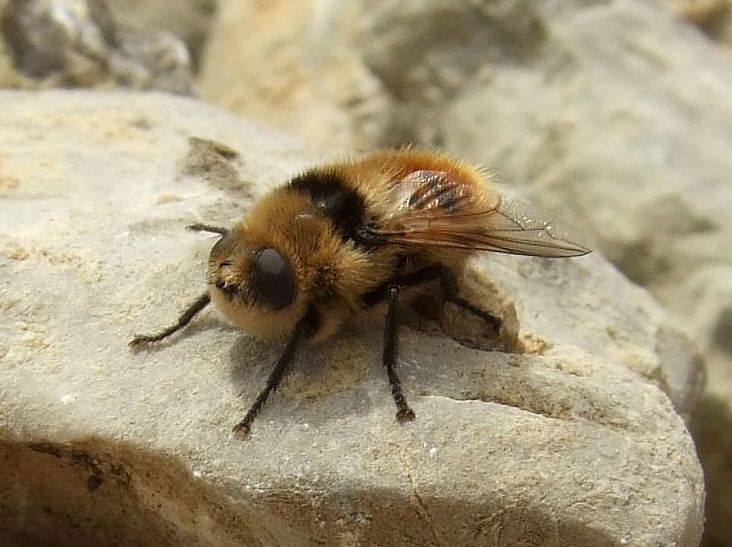
Botflies, also known as warble flies, heel flies, and gadflies, are flies of the family Oestridae. Their larvae are internal parasites of mammals, some species growing in the host's flesh and others within the gut. Dermatobia hominis is the only species of botfly known to parasitize humans routinely, though other species of flies cause myiasis in humans.
A botfly, also written bot fly, bott fly or bot-fly in various combinations, is any fly in the family Oestridae. Their life cycles vary greatly according to species, but the larvae of all species are internal parasites of mammals. Largely according to species, they also are known variously as warble flies, heel flies, and gadflies. The larvae of some species grow in the flesh of their hosts, while others grow within the hosts' alimentary tracts.
The word "bot" in this sense means a maggot. A warble is a skin lump or callus such as might be caused by an ill-fitting harness, or by the presence of a warble fly maggot under the skin. The human botfly, Dermatobia hominis, is the only species of botfly whose larvae ordinarily parasitise humans, though flies in some other families episodically cause human myiasis and are sometimes more harmful.[citation needed]
The Oestridae now are generally defined as including the former families Oestridae, Cuterebridae, Gasterophilidae, and Hypodermatidae as subfamilies.
The Oestridae, in turn, are a family within the superfamily Oestroidea, together with the families Calliphoridae, Mesembrinellidae, Mystacinobiidae, Polleniidae, Rhiniidae, Rhinophoridae, Sarcophagidae, Tachinidae, and Ulurumyiidae.
Of families of flies causing myiasis, the Oestridae include the highest proportion of species whose larvae live as obligate parasites within the bodies of mammals. Roughly 150 species are known worldwide. Most other species of flies implicated in myiasis are members of related families, such as blow-flies.
Botflies deposit eggs on a host, or sometimes use an intermediate vector such as the common housefly, mosquitoes, and, in the case of D. hominis, a species of tick. After mating, the female botfly captures the phoretic insect by holding onto its wings with her legs. She then makes the slip—attaching 15 to 30 eggs onto the insect or arachnid's abdomen, where they incubate. The fertilized female does this over and over again to distribute the 100 to 400 eggs she produces in her short adult stage of life of only 8–9 days. Larvae from these eggs, stimulated by the warmth and proximity of a large mammal host, drop onto its skin and burrow underneath. Intermediate vectors are often used since many animal hosts recognize the approach of a botfly and flee.
Eggs are deposited on larger animals' skin directly, or the larvae hatch and drop from the eggs attached to the intermediate vector; the body heat of the host animal induces hatching upon contact or immediate proximity. Some forms of botfly also occur in the digestive tract after ingestion by licking.
Hub AI
Botfly AI simulator
(@Botfly_simulator)
Botfly
Botflies, also known as warble flies, heel flies, and gadflies, are flies of the family Oestridae. Their larvae are internal parasites of mammals, some species growing in the host's flesh and others within the gut. Dermatobia hominis is the only species of botfly known to parasitize humans routinely, though other species of flies cause myiasis in humans.
A botfly, also written bot fly, bott fly or bot-fly in various combinations, is any fly in the family Oestridae. Their life cycles vary greatly according to species, but the larvae of all species are internal parasites of mammals. Largely according to species, they also are known variously as warble flies, heel flies, and gadflies. The larvae of some species grow in the flesh of their hosts, while others grow within the hosts' alimentary tracts.
The word "bot" in this sense means a maggot. A warble is a skin lump or callus such as might be caused by an ill-fitting harness, or by the presence of a warble fly maggot under the skin. The human botfly, Dermatobia hominis, is the only species of botfly whose larvae ordinarily parasitise humans, though flies in some other families episodically cause human myiasis and are sometimes more harmful.[citation needed]
The Oestridae now are generally defined as including the former families Oestridae, Cuterebridae, Gasterophilidae, and Hypodermatidae as subfamilies.
The Oestridae, in turn, are a family within the superfamily Oestroidea, together with the families Calliphoridae, Mesembrinellidae, Mystacinobiidae, Polleniidae, Rhiniidae, Rhinophoridae, Sarcophagidae, Tachinidae, and Ulurumyiidae.
Of families of flies causing myiasis, the Oestridae include the highest proportion of species whose larvae live as obligate parasites within the bodies of mammals. Roughly 150 species are known worldwide. Most other species of flies implicated in myiasis are members of related families, such as blow-flies.
Botflies deposit eggs on a host, or sometimes use an intermediate vector such as the common housefly, mosquitoes, and, in the case of D. hominis, a species of tick. After mating, the female botfly captures the phoretic insect by holding onto its wings with her legs. She then makes the slip—attaching 15 to 30 eggs onto the insect or arachnid's abdomen, where they incubate. The fertilized female does this over and over again to distribute the 100 to 400 eggs she produces in her short adult stage of life of only 8–9 days. Larvae from these eggs, stimulated by the warmth and proximity of a large mammal host, drop onto its skin and burrow underneath. Intermediate vectors are often used since many animal hosts recognize the approach of a botfly and flee.
Eggs are deposited on larger animals' skin directly, or the larvae hatch and drop from the eggs attached to the intermediate vector; the body heat of the host animal induces hatching upon contact or immediate proximity. Some forms of botfly also occur in the digestive tract after ingestion by licking.
Recent media