
Recent from talks
Fly
Knowledge base stats:
Talk channels stats:
Members stats:
Fly
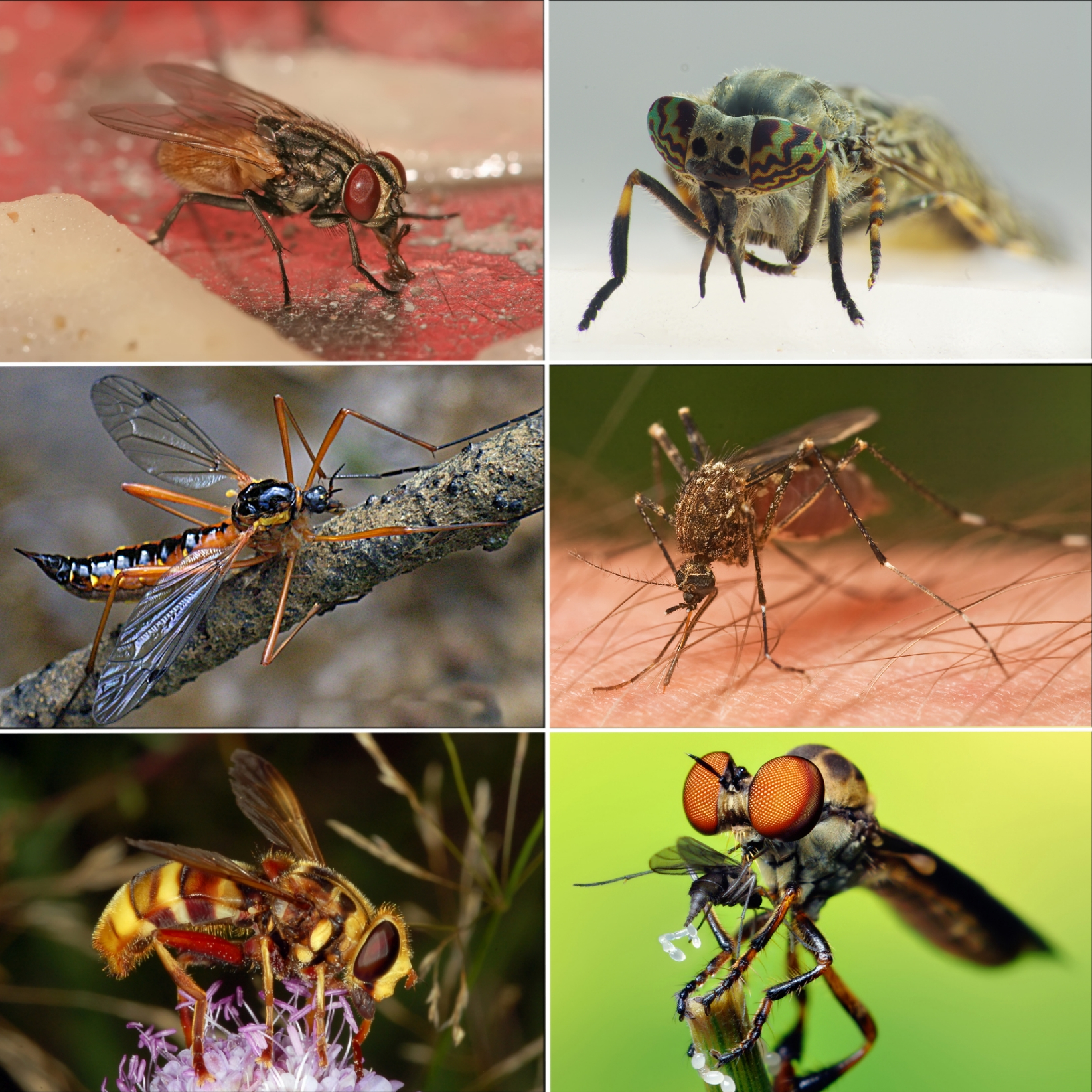
Flies are insects of the order Diptera, the name being derived from the Greek δι- di- "two", and πτερόν pteron "wing". Insects of this order use only a single pair of wings to fly, the hindwings having evolved into advanced mechanosensory organs known as halteres, which act as high-speed sensors of rotational movement and allow dipterans to perform advanced aerobatics. Diptera is a large order containing more than 150,000 species including horse-flies, crane flies, hoverflies, mosquitoes and others.
Flies have a mobile head, with a pair of large compound eyes, and mouthparts designed for piercing and sucking (mosquitoes, black flies and robber flies), or for lapping and sucking in the other groups. Their wing arrangement gives them great manoeuvrability in flight, and claws and pads on their feet enable them to cling to smooth surfaces. Flies undergo complete metamorphosis; the eggs are often laid on the larval food-source and the larvae, which lack true limbs, develop in a protected environment, often inside their food source. Other species are ovoviviparous, opportunistically depositing hatched or hatching larvae instead of eggs on carrion, dung, decaying material, or open wounds of mammals. The pupa is a tough capsule from which the adult emerges when ready to do so; flies mostly have short lives as adults.
Diptera is one of the major insect orders and of considerable ecological and human importance. Flies are major pollinators, second only to the bees and their Hymenopteran relatives. Flies may have been among the evolutionarily earliest pollinators responsible for early plant pollination. Fruit flies are used as model organisms in research, but less benignly, mosquitoes are vectors for malaria, dengue, West Nile fever, yellow fever, encephalitis, and other infectious diseases; and houseflies, commensal with humans all over the world, spread foodborne illnesses. Flies can be annoyances especially in some parts of the world where they can occur in large numbers, buzzing and settling on the skin or eyes to bite or seek fluids. Larger flies such as tsetse flies and screwworms cause significant economic harm to cattle. Blowfly larvae, known as gentles, and other dipteran larvae, known more generally as maggots, are used as fishing bait, as food for carnivorous animals, and in medicine in debridement, to clean wounds.
Dipterans are holometabolous, meaning that they undergo radical metamorphosis. They belong to the Mecopterida, alongside the Mecoptera, Siphonaptera, Lepidoptera and Trichoptera. The possession of a single pair of wings distinguishes most true flies from other insects with "fly" in their names. However, some true flies such as Hippoboscidae (louse flies) have become secondarily wingless.
The cladogram represents the current consensus view.
The first true dipterans known are from the Middle Triassic (around 240 million years ago), and they became widespread during the Middle and Late Triassic. Modern flowering plants did not appear until the Cretaceous (around 140 million years ago), so the original dipterans must have had a different source of nutrition other than nectar. Based on the attraction of many modern fly groups to shiny droplets, it has been suggested that they may have fed on honeydew produced by sap-sucking bugs which were abundant at the time, and dipteran mouthparts are well-adapted to softening and lapping up the crusted residues. The basal clades in the Diptera include the Deuterophlebiidae and the enigmatic Nymphomyiidae. Three episodes of evolutionary radiation are thought to have occurred based on the fossil record. Many new species of lower Diptera developed in the Triassic, about 220 million years ago. Many lower Brachycera appeared in the Jurassic, some 180 million years ago. A third radiation took place among the Schizophora at the start of the Paleogene, 66 million years ago.
The phylogenetic position of Diptera has been controversial. The monophyly of holometabolous insects has long been accepted, with the main orders being established as Lepidoptera, Coleoptera, Hymenoptera and Diptera, and it is the relationships between these groups which has caused difficulties. Diptera is widely thought to be a member of Mecopterida, along with Lepidoptera (butterflies and moths), Trichoptera (caddisflies), Siphonaptera (fleas), Mecoptera (scorpionflies) and possibly Strepsiptera (twisted-wing flies). Diptera has been grouped with Siphonaptera and Mecoptera in the Antliophora, but this has not been confirmed by molecular studies.
Diptera were traditionally broken down into two suborders, Nematocera and Brachycera, distinguished by the differences in antennae. The Nematocera are identified by their elongated bodies and many-segmented, often feathery antennae as represented by mosquitoes and crane flies. The Brachycera have rounder bodies and much shorter antennae. Subsequent studies have identified the Nematocera as being paraphyletic with modern phylogenies placing the Brachycera within grades of groups formerly placed in the Nematocera. The construction of a phylogenetic tree has been the subject of ongoing research. The following cladogram is based on the FLYTREE project.
Hub AI
Fly AI simulator
(@Fly_simulator)
Fly
Flies are insects of the order Diptera, the name being derived from the Greek δι- di- "two", and πτερόν pteron "wing". Insects of this order use only a single pair of wings to fly, the hindwings having evolved into advanced mechanosensory organs known as halteres, which act as high-speed sensors of rotational movement and allow dipterans to perform advanced aerobatics. Diptera is a large order containing more than 150,000 species including horse-flies, crane flies, hoverflies, mosquitoes and others.
Flies have a mobile head, with a pair of large compound eyes, and mouthparts designed for piercing and sucking (mosquitoes, black flies and robber flies), or for lapping and sucking in the other groups. Their wing arrangement gives them great manoeuvrability in flight, and claws and pads on their feet enable them to cling to smooth surfaces. Flies undergo complete metamorphosis; the eggs are often laid on the larval food-source and the larvae, which lack true limbs, develop in a protected environment, often inside their food source. Other species are ovoviviparous, opportunistically depositing hatched or hatching larvae instead of eggs on carrion, dung, decaying material, or open wounds of mammals. The pupa is a tough capsule from which the adult emerges when ready to do so; flies mostly have short lives as adults.
Diptera is one of the major insect orders and of considerable ecological and human importance. Flies are major pollinators, second only to the bees and their Hymenopteran relatives. Flies may have been among the evolutionarily earliest pollinators responsible for early plant pollination. Fruit flies are used as model organisms in research, but less benignly, mosquitoes are vectors for malaria, dengue, West Nile fever, yellow fever, encephalitis, and other infectious diseases; and houseflies, commensal with humans all over the world, spread foodborne illnesses. Flies can be annoyances especially in some parts of the world where they can occur in large numbers, buzzing and settling on the skin or eyes to bite or seek fluids. Larger flies such as tsetse flies and screwworms cause significant economic harm to cattle. Blowfly larvae, known as gentles, and other dipteran larvae, known more generally as maggots, are used as fishing bait, as food for carnivorous animals, and in medicine in debridement, to clean wounds.
Dipterans are holometabolous, meaning that they undergo radical metamorphosis. They belong to the Mecopterida, alongside the Mecoptera, Siphonaptera, Lepidoptera and Trichoptera. The possession of a single pair of wings distinguishes most true flies from other insects with "fly" in their names. However, some true flies such as Hippoboscidae (louse flies) have become secondarily wingless.
The cladogram represents the current consensus view.
The first true dipterans known are from the Middle Triassic (around 240 million years ago), and they became widespread during the Middle and Late Triassic. Modern flowering plants did not appear until the Cretaceous (around 140 million years ago), so the original dipterans must have had a different source of nutrition other than nectar. Based on the attraction of many modern fly groups to shiny droplets, it has been suggested that they may have fed on honeydew produced by sap-sucking bugs which were abundant at the time, and dipteran mouthparts are well-adapted to softening and lapping up the crusted residues. The basal clades in the Diptera include the Deuterophlebiidae and the enigmatic Nymphomyiidae. Three episodes of evolutionary radiation are thought to have occurred based on the fossil record. Many new species of lower Diptera developed in the Triassic, about 220 million years ago. Many lower Brachycera appeared in the Jurassic, some 180 million years ago. A third radiation took place among the Schizophora at the start of the Paleogene, 66 million years ago.
The phylogenetic position of Diptera has been controversial. The monophyly of holometabolous insects has long been accepted, with the main orders being established as Lepidoptera, Coleoptera, Hymenoptera and Diptera, and it is the relationships between these groups which has caused difficulties. Diptera is widely thought to be a member of Mecopterida, along with Lepidoptera (butterflies and moths), Trichoptera (caddisflies), Siphonaptera (fleas), Mecoptera (scorpionflies) and possibly Strepsiptera (twisted-wing flies). Diptera has been grouped with Siphonaptera and Mecoptera in the Antliophora, but this has not been confirmed by molecular studies.
Diptera were traditionally broken down into two suborders, Nematocera and Brachycera, distinguished by the differences in antennae. The Nematocera are identified by their elongated bodies and many-segmented, often feathery antennae as represented by mosquitoes and crane flies. The Brachycera have rounder bodies and much shorter antennae. Subsequent studies have identified the Nematocera as being paraphyletic with modern phylogenies placing the Brachycera within grades of groups formerly placed in the Nematocera. The construction of a phylogenetic tree has been the subject of ongoing research. The following cladogram is based on the FLYTREE project.
Recent media