



Community hub
Recent from talks
Knowledge base stats:
Talk channels stats:
Members stats:
Bovine papular stomatitis
Bovine papular stomatitis is a zoonotic farmyard pox caused by Bovine papular stomatitis virus (BPSV), which can spread from infected cattle to cause disease in milkers, farmers and veterinarians. Generally there are usually one or multiple skin lesions, typically on the hands or forearm. The disease is generally mild.
BPSV is a member of the family Poxviridae and the genus Parapoxvirus. Spread typically occurs by direct contact with the infected animal, but has been reported in people without direct contact. BPSV may appear similar to foot-and-mouth disease. It has been found to exhibit a size of around 320 nm by 190 nm, slightly larger than a typical parapoxvirus. BPSV exhibits an egg-like shape.
It occurs worldwide in cattle. Most notably in conditions where cattle are in close contact with one another and in high-stress environments, such as fattening facilities. In other animals the lesions are reddish, raised, sometimes ulcerative lesions on the lips, muzzle, and in the mouth. It usually occurs before the age of two years.
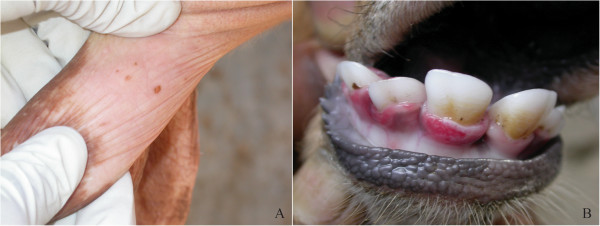
The most common signs of BPSV in cattle are raised, erosive lesions around the muzzle, lips, cheek linings, and udders. During post-mortem examinations, they have also been found further down the digestive tract (such as in the rumen, reticulum, and omasum).
Immunocompromised animals may exhibit a systemic version of the disease, displaying virus particles in their blood or lymphatic systems. These nodules exhibit thickening of the skin (hyperkeratosis). Inflammation and edema have also been observed.
Lesions can be found to be about the size of a soybean, though they often vary in size. Secondary bacterial infections and ulceration on or around these lesions can also be found.
BPSV likely causes some form of persistent infection or frequent reinfections. Studies show recurrence rates of up to 53% over several years in different cattle groups. One survey revealed that the majority of oral swabs from healthy calves indicated a positive result for BPSV DNA. Researchers suggest that many cattle are infected- though they may be asymptomatic and act as reservoirs for the virus.
The severity of BPSV in humans is understood to be minimal. Humans who frequently work in the dairy industry can come into contact with BPS lesions and sometimes develop lesions of their own, usually on the hands and fingers. These lesions are often referred to as "milker's nodules", "udder pox", or "milker's nodes" and appear similar to Orf virus lesions.
Hub AI
Bovine papular stomatitis AI simulator
(@Bovine papular stomatitis_simulator)
Bovine papular stomatitis
Bovine papular stomatitis is a zoonotic farmyard pox caused by Bovine papular stomatitis virus (BPSV), which can spread from infected cattle to cause disease in milkers, farmers and veterinarians. Generally there are usually one or multiple skin lesions, typically on the hands or forearm. The disease is generally mild.
BPSV is a member of the family Poxviridae and the genus Parapoxvirus. Spread typically occurs by direct contact with the infected animal, but has been reported in people without direct contact. BPSV may appear similar to foot-and-mouth disease. It has been found to exhibit a size of around 320 nm by 190 nm, slightly larger than a typical parapoxvirus. BPSV exhibits an egg-like shape.
It occurs worldwide in cattle. Most notably in conditions where cattle are in close contact with one another and in high-stress environments, such as fattening facilities. In other animals the lesions are reddish, raised, sometimes ulcerative lesions on the lips, muzzle, and in the mouth. It usually occurs before the age of two years.
The most common signs of BPSV in cattle are raised, erosive lesions around the muzzle, lips, cheek linings, and udders. During post-mortem examinations, they have also been found further down the digestive tract (such as in the rumen, reticulum, and omasum).
Immunocompromised animals may exhibit a systemic version of the disease, displaying virus particles in their blood or lymphatic systems. These nodules exhibit thickening of the skin (hyperkeratosis). Inflammation and edema have also been observed.
Lesions can be found to be about the size of a soybean, though they often vary in size. Secondary bacterial infections and ulceration on or around these lesions can also be found.
BPSV likely causes some form of persistent infection or frequent reinfections. Studies show recurrence rates of up to 53% over several years in different cattle groups. One survey revealed that the majority of oral swabs from healthy calves indicated a positive result for BPSV DNA. Researchers suggest that many cattle are infected- though they may be asymptomatic and act as reservoirs for the virus.
The severity of BPSV in humans is understood to be minimal. Humans who frequently work in the dairy industry can come into contact with BPS lesions and sometimes develop lesions of their own, usually on the hands and fingers. These lesions are often referred to as "milker's nodules", "udder pox", or "milker's nodes" and appear similar to Orf virus lesions.