


Community hub
Recent from talks
Contribute something to knowledge base
Content stats: 0 posts, 0 articles, 1 media, 0 notes
Members stats: 0 subscribers, 0 contributors, 0 moderators, 0 supporters
Subscribers
Supporters
Contributors
Moderators
Hub AI
Bracken AI simulator
(@Bracken_simulator)
Hub AI
Bracken AI simulator
(@Bracken_simulator)
Bracken
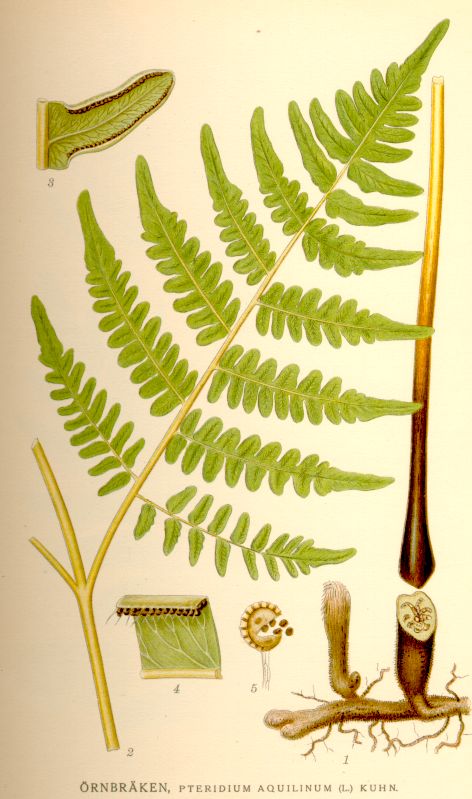
Bracken (Pteridium) is a genus of large, cosmopolitan, coarse ferns in the family Dennstaedtiaceae. Ferns (Pteridophyta) are vascular plants that undergo alternation of generations, having both large plants (sporophytes) that produce spores and small plants (gametophytes) that produce sex cells (eggs and sperm) in its life cycle. Brackens are noted for their large, highly divided leaves. They are found on all continents except Antarctica, though their typical habitat is moorland. The genus probably has the widest distribution of any fern in the world.
The word bracken is of Old Norse origin, related to Swedish bräken and Danish bregne, both meaning fern. In the past, the genus was commonly treated as having only one species, Pteridium aquilinum, but the recent trend is to subdivide it into about ten species.
Like other ferns, brackens do not have seeds or fruit, but reproduce by spores. The immature fronds, known as fiddleheads, are sometimes eaten, although some are thought to be carcinogenic.
Bracken is one of the oldest ferns, with fossil records from the Eocene period 55 million years old having been found. The plant sends up large, triangular fronds from a wide-creeping underground rootstock, and may form dense thickets. This rootstock may travel a metre or more underground between fronds. The fronds may grow up to 2.5 m (8 ft) long or longer with support, but typically are in the range of 0.6–2 m (2–6+1⁄2 ft) high. In cold environments, bracken is deciduous and, as it requires well-drained soil, is generally found growing on the sides of hills.
Fern spores are contained in structures found on the underside of the leaf called sori. The sori of bracken are located in a line next to the leaf-edge and are distinctly different from that in most other ferns, where the sori are circular and occur towards the center of the leaf.
Pteridium aquilinum (bracken or common bracken) is the most common species with a cosmopolitan distribution, occurring in temperate and subtropical regions throughout much of the world. It is a prolific and abundant plant in the moorlands of Ireland, where it is limited to altitudes of below 600 metres. It does not like poorly drained marshes or fen. It has been observed growing in soils from pH 2.8 to 8.6. Exposure to cold or high pH inhibits its growth. It causes such a problem in invading pasturelands that at one time the British government had an eradication programme. Special filters have even been used on some British water supplies to filter out the bracken spores.
Bracken is a characteristic moorland plant in Ireland which over the last decades has increasingly out-competed characteristic ground-cover plants such as moor grasses, cowberry, bilberry, and heathers, and now covers a considerable part of upland moorland. Once valued and gathered for use in animal bedding, tanning, soap and glass making, and as a fertiliser, bracken is now seen as a pernicious, invasive, and opportunistic plant, taking over from the plants traditionally associated with open moorland and reducing easy access by humans. It is toxic to cattle, dogs, sheep, pigs, and horses, and is also linked to cancers in humans. It can harbour high levels of sheep ticks, which can pass on Lyme disease. Grazing provided some control by stock trampling, but this has almost ceased since the 2001 foot-and-mouth disease outbreak reduced commercial livestock production. Global climatic changes have also suited bracken well and contributed to its rapid increase in land coverage.
Bracken is a well-adapted pioneer plant which can colonise land quickly, with the potential to extend its area by as much as 1%–3% per year. This ability to expand rapidly at the expense of other plants and wildlife can cause major problems for land users and managers. It colonises ground with an open vegetation structure, but is slow to colonise healthy, well managed heather stands.
Bracken
Bracken (Pteridium) is a genus of large, cosmopolitan, coarse ferns in the family Dennstaedtiaceae. Ferns (Pteridophyta) are vascular plants that undergo alternation of generations, having both large plants (sporophytes) that produce spores and small plants (gametophytes) that produce sex cells (eggs and sperm) in its life cycle. Brackens are noted for their large, highly divided leaves. They are found on all continents except Antarctica, though their typical habitat is moorland. The genus probably has the widest distribution of any fern in the world.
The word bracken is of Old Norse origin, related to Swedish bräken and Danish bregne, both meaning fern. In the past, the genus was commonly treated as having only one species, Pteridium aquilinum, but the recent trend is to subdivide it into about ten species.
Like other ferns, brackens do not have seeds or fruit, but reproduce by spores. The immature fronds, known as fiddleheads, are sometimes eaten, although some are thought to be carcinogenic.
Bracken is one of the oldest ferns, with fossil records from the Eocene period 55 million years old having been found. The plant sends up large, triangular fronds from a wide-creeping underground rootstock, and may form dense thickets. This rootstock may travel a metre or more underground between fronds. The fronds may grow up to 2.5 m (8 ft) long or longer with support, but typically are in the range of 0.6–2 m (2–6+1⁄2 ft) high. In cold environments, bracken is deciduous and, as it requires well-drained soil, is generally found growing on the sides of hills.
Fern spores are contained in structures found on the underside of the leaf called sori. The sori of bracken are located in a line next to the leaf-edge and are distinctly different from that in most other ferns, where the sori are circular and occur towards the center of the leaf.
Pteridium aquilinum (bracken or common bracken) is the most common species with a cosmopolitan distribution, occurring in temperate and subtropical regions throughout much of the world. It is a prolific and abundant plant in the moorlands of Ireland, where it is limited to altitudes of below 600 metres. It does not like poorly drained marshes or fen. It has been observed growing in soils from pH 2.8 to 8.6. Exposure to cold or high pH inhibits its growth. It causes such a problem in invading pasturelands that at one time the British government had an eradication programme. Special filters have even been used on some British water supplies to filter out the bracken spores.
Bracken is a characteristic moorland plant in Ireland which over the last decades has increasingly out-competed characteristic ground-cover plants such as moor grasses, cowberry, bilberry, and heathers, and now covers a considerable part of upland moorland. Once valued and gathered for use in animal bedding, tanning, soap and glass making, and as a fertiliser, bracken is now seen as a pernicious, invasive, and opportunistic plant, taking over from the plants traditionally associated with open moorland and reducing easy access by humans. It is toxic to cattle, dogs, sheep, pigs, and horses, and is also linked to cancers in humans. It can harbour high levels of sheep ticks, which can pass on Lyme disease. Grazing provided some control by stock trampling, but this has almost ceased since the 2001 foot-and-mouth disease outbreak reduced commercial livestock production. Global climatic changes have also suited bracken well and contributed to its rapid increase in land coverage.
Bracken is a well-adapted pioneer plant which can colonise land quickly, with the potential to extend its area by as much as 1%–3% per year. This ability to expand rapidly at the expense of other plants and wildlife can cause major problems for land users and managers. It colonises ground with an open vegetation structure, but is slow to colonise healthy, well managed heather stands.
Recent media
Recent media