


Community hub
Recent from talks
Contribute something
Nothing was collected or created yet.
Bradgate Formation
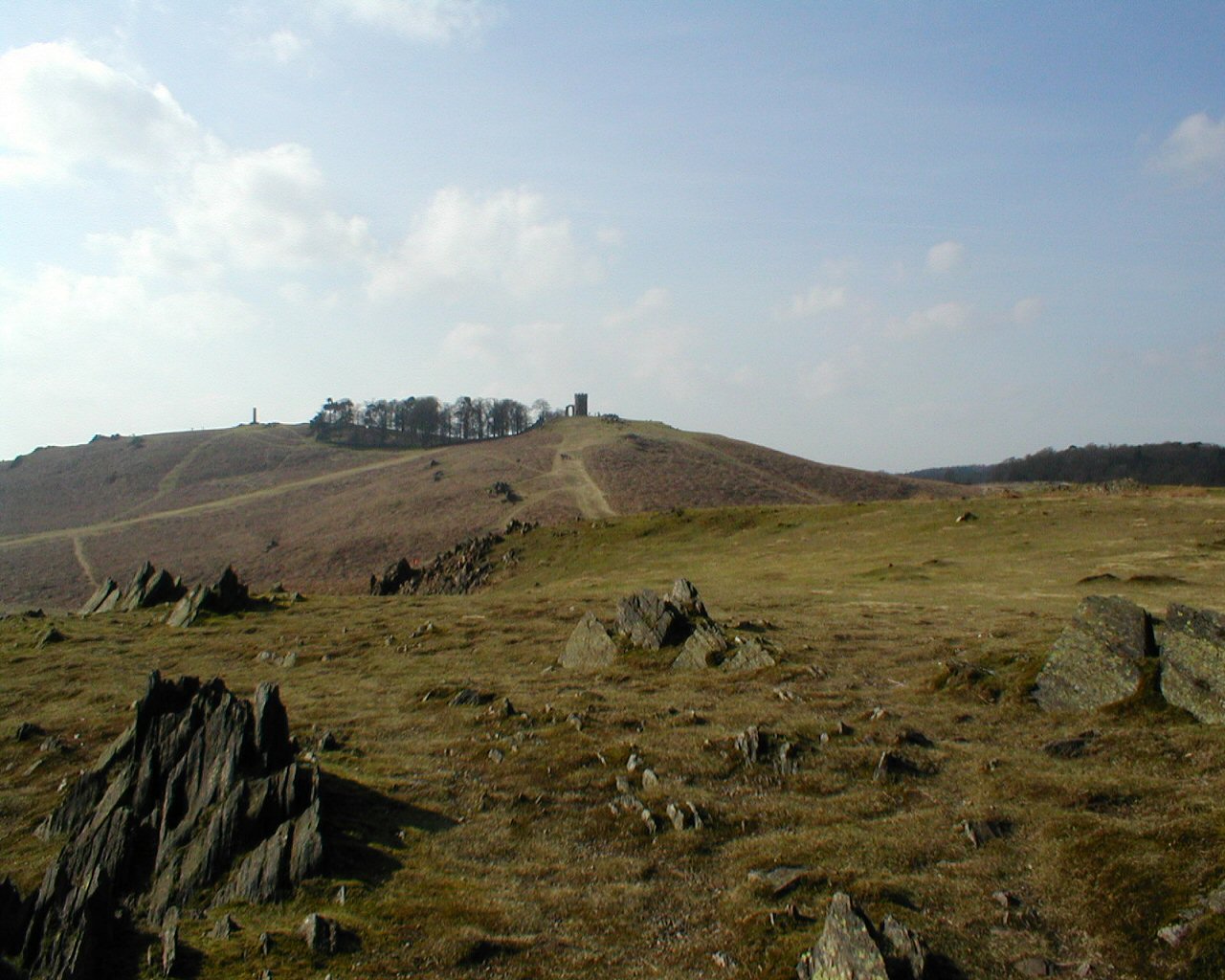
View on WikipediaThe Bradgate Formation is a geologic formation in Leicestershire, and lies within the wider Bradgate Park area. It also preserves fossils dating back to the late Ediacaran period.
Key Information


Geology
[edit]The formation is composed of various volcaniclastic rocks, like tuff, and is broken up into two members.[2] It is overlain by the Hanging Rocks Formation, whilst it is underlain by the Beacon Hill Formation.[2][1]
Members
[edit]The Bradgate Formation is formally split up into two members, which are as follows, in ascending age:
- Sliding Stone Slump Breccia Member: This member, also sometimes referred to as "Park Breccia Member", is the thinnest of the two, only getting up to 9 m (30 ft) thick. The lower 4 m (13 ft) of this member is primarily composed of slump breccias as the name suggests, which contain clasts that are composed of dust tuff, alongside tuffaceous pelites, set into a matrix of coarse-grained tuffs and medium-grained graywackes.[2] Meanwhile the upper 5 m (16 ft) of this member sees the breccias fade away, only being composed of coarse-grained tuffs that are andesitic in nature, and slowly turn into medium-grained tuffaceous graywackes.[2]
- Hallgate Member: This member is the thickest of the two, getting up to 640 m (2,100 ft) thick. It is predominated by tuffaceous pelites, as well as pelites and dust tuffs. Through-out, there are also thin layers coarse-grained tuffs and medium-grained graywackes.[2]
Dating
[edit]At the base of the Bradgate Formation, zircon samples were collected to take U-Pb dating on them and determine the overall age of the formation and fossils. The zircon sample JNC 912, from the base of the formation, returned a date of 561.85±0.33 Ma. Meanwhile a zircon sample, JNC 846, collected from near the base of the overlying Hanging Rocks Formation returned an age of 556.6±6.4 Ma, which would constrain the Bradgate Formation entirely within the Avalon assemblage, and correlating it roughly with the Trepassey Formation.[1]
Paleobiota
[edit]The Bradgate Formation contains the richest fossil beds within the Charnian Supergroup, from frondose organisms like Bradgatia and Charnia, which when the latter was discovered, showed definitive proof that macroscopic life did indeed exist before the Cambrian,[3] to discoid forms like Aspidella.
Color key
|
Notes Uncertain or tentative taxa are in small text; |
Petalonamae
[edit]| Genus | Species | Notes | Images |
|---|---|---|---|
| Bradgatia[4] |
|
Sessile frondose organism. |  |
| Charnia[3] |
|
Sessile frondose organism, and first organism found within this formation. |  |
| Charniodiscus[3] |
|
Sessile frondose organism. |  |
| Hylaecullulus[5] |
|
Sessile frondose organism. | |
| Primocandelabrum[6] |
|
Sessile frondose organism. | |
| Vinlandia[7] |
|
Sessile frondose organism. |  |
Cnidaria
[edit]| Genus | Species | Notes | Images |
|---|---|---|---|
| Auroralumina[8] |
|
Early sessile crown-group medusozoan cnidarian. |  |
incertae sedis
[edit]| Genus | Species | Notes | Images |
|---|---|---|---|
| Aspidella[9] |
|
Enigmatic discoidal fossil. |  |
| Thectardis[9] |
|
Discoid organism, possibly holdfasts of petalonamids. |  |
Undescribed forms
[edit]| Genus | Species | Notes | Images |
|---|---|---|---|
| Gladius form[4] |
|
Enigmatic fossil, described to be in the shape of a gladius sword. | |
| Hemispherical form[4] |
|
Enigmatic fossil, described to be hemispherical in shape, with bifurcating radial ribs. | |
| Lanceolate frond[10] |
|
Enigmatic frondose fossil, described to be in the shape of a lance head, which has collapsed in onto itself. |
See also
[edit]


References
[edit]- Various Contributors to the Paleobiology Database. "Fossilworks: Gateway to the Paleobiology Database". Retrieved 17 December 2021.
- ^ a b c Noble, Stephen R.; Condon, Daniel J.; Carney, John N.; Wilby, Philip R.; Pharaoh, Timothy C.; Ford, Trevor D. (January 2015). "U-Pb geochronology and global context of the Charnian Supergroup, UK: Constraints on the age of key Ediacaran fossil assemblages". Geological Society of America Bulletin. 127 (1–2): 250–265. doi:10.1130/B31013.1.
- ^ a b c d e f g h Moseley, John; Ford, Trevor. "The Sedimentology of the Charnian Supergroup" (PDF). Mercian Geologist.
- ^ a b c Ford, T. D. (September 1958). "PRE-CAMBRIAN FOSSILS FROM CHARNWOOD FOREST". Proceedings of the Yorkshire Geological Society. 31 (3): 211–217. doi:10.1144/pygs.31.3.211.
- ^ a b c Kenchington, Charlotte G.; Harris, Simon J.; Vixseboxse, Philip B.; Pickup, Chris; Wilby, Philip R. (June 2018). "The Ediacaran fossils of Charnwood Forest: Shining new light on a major biological revolution". Proceedings of the Geologists' Association. 129 (3): 264–277. doi:10.1016/j.pgeola.2018.02.006.
- ^ Kenchington, Charlotte G.; Dunn, Frances S.; Wilby, Philip R. (October 2018). "Modularity and Overcompensatory Growth in Ediacaran Rangeomorphs Demonstrate Early Adaptations for Coping with Environmental Pressures". Current Biology. 28 (20): 3330–3336.e2. doi:10.1016/j.cub.2018.08.036.
- ^ Kenchington, Charlotte G.; Wilby, Philip R. (January 2017). "Rangeomorph classification schemes and intra-specific variation: are all characters created equal?". Geological Society, London, Special Publications. 448 (1): 221–250. doi:10.1144/SP448.19.
- ^ Brasier, Martin D.; Antcliffe, Jonathan B.; Liu, Alexander G. (September 2012). "The architecture of Ediacaran Fronds". Palaeontology. 55 (5): 1105–1124. doi:10.1111/j.1475-4983.2012.01164.x.
- ^ Dunn, F. S.; Kenchington, C. G.; Parry, L. A.; Clark, J. W.; Kendall, R. S.; Wilby, P. R. (25 July 2022). "A crown-group cnidarian from the Ediacaran of Charnwood Forest, UK". Nature Ecology & Evolution. 6 (8): 1095–1104. doi:10.1038/s41559-022-01807-x. PMC 9349040.
- ^ a b Wilby, Philip R.; Carney, John N.; Howe, Michael P.A. (1 July 2011). "A rich Ediacaran assemblage from eastern Avalonia: Evidence of early widespread diversity in the deep ocean". Geology. 39 (7): 655–658. doi:10.1130/G31890.1.
- ^ Bowers, Aron. "Further Precambrian (Ediacaran) fossil discoveries in Charnwood Forest, Leicestershire" (PDF). Monash University. Mercian Geologist. Retrieved 5 May 2025.