Hubbry Logo
Bradgate ParkBradgate ParkMain
Open search
Bradgate Park
Community hub
Bradgate Park
logo
8 pages, 0 posts
0 subscribers
Be the first to start a discussion here.
Bradgate Park
Bradgate Park
from Wikipedia

Bradgate Park and surrounding villages

Key Information

Reginald Grey Pedigree of Grey of Groby displayed within Bradgate Hall ruins.

Bradgate Park (/ˌbrædɡət/) is a public park in Charnwood Forest, in Leicestershire, England, northwest of Leicester. It covers 850 acres (340 hectares). The park lies between the villages of Newtown Linford, Anstey, Cropston, Woodhouse Eaves and Swithland. The River Lin runs through the park, flowing into Cropston Reservoir which was constructed on part of the park. To the north-east lies Swithland Wood. The park's two well known landmarks, Old John and the war memorial, both lie just above the 210 m (690 ft) contour.[3] The park is part of the 399.3 hectare Bradgate Park and Cropston Reservoir Site of Special Scientific Interest, which has been designated under both biological and geological criteria.[4][5]

Following a fire in April 2017, the owners Bradgate Trust advised that all visitors are expected to be alert to the risk of causing fire,[6] though another fire in June destroyed one of the ancient oaks.[7]

History

[edit]

The area now enclosed as Bradgate Park was one of a number of parks surrounding Charnwood Forest. Since medieval times it has been part of the Manor of Groby.[8] In the reign of Edward the Confessor, the area was owned by a landowner named Ulf. The manor, along with some 100 others in and around Leicestershire, was awarded to Hugh de Grandmesnil in the eleventh century as reward for his assistance in battle to William I.[9] The name Bradgate is thought to derive from Norse or Anglo-Saxon, meaning "broad road" or "broad gate" respectively.[9] The first mention of Bradgate Park is from 1241, by which time it was laid out as a hunting park, although rather smaller than the current boundary.[8] It was subsequently acquired by the Beaumont family, passing to the de Quincy family and on to William de Ferrers of Groby. It remained in the de Ferrers family until 1445, when it passed to the Grey family after William's only surviving daughter married Edward Grey.[9] The inquisition into the estates of de Ferrers, made after his death, mentions the park, with "herbage, pannage and underwood, worth 40 shillings yearly".[10] The Grey family retained it for the next 500 years, and in the 19th century was opened to the public several days a week.[11][12] In 1928 it was bought by Charles Bennion and given, as a plaque in the park describes, 'to be preserved in its a natural state for the quiet enjoyment of the people of Leicestershire'.

Medieval deer park

[edit]

The park was originally enclosed using a bank and ditch topped by vertical pales of oak. These first ditchworks cross the River Lyn east of the Little Matlock Gorge. A parker, living in a moated house, was the only occupant, maintaining stocks of deer for the lord of Groby Manor to hunt.[8] The park was greatly extended by the first marquis in the late 15th century, to occupy land previously farmed by both Newtown Linford and the now lost village of Bradgate.[8] Lichen dating of the dry-stone walls suggest that the north and west boundary walls were built in the 17th and early 18th centuries, when Bradgate was still occupied by the earls of Stamford. The walled spinneys are a later feature, built and planted in the early 19th century as coverts for shooting.[9] The park still has herds of red and fallow deer, which probably have an unbroken occupancy since medieval times.[8]

Bradgate House

[edit]

Edward Grey's son Sir John Grey of Groby married Elizabeth Woodville, who after John's death married King Edward IV. Their son Thomas Grey, 1st Marquess of Dorset, prepared for building Bradgate House in the late fifteenth century but died before he was able to begin. It was his son Thomas Grey, 2nd Marquess of Dorset, who built Bradgate House, the likely completion date being 1520. There is now some confusion over this completion date however, as an older house has been discovered under the visible walls and findings have suggested that Lady Jane Grey, who wasn't born until 12 October 1537, lived in the older house.[13]

Sir Thomas Grey died in 1530 and was succeeded by his son Henry, the 3rd Marquess of Dorset, who was married to Frances, the daughter of the Duke of Suffolk and Mary Tudor, King Henry VIII's younger sister.

Their daughter Lady Jane Grey was born at Bradgate House probably in October 1537. Notably in July 1553, at the age of fifteen, the Duke of Northumberland (her husband's father) proclaimed her Queen of England and Ireland, in opposition to Mary Tudor. However Mary had more support, and when the Lord Mayor of London proclaimed Mary queen on 19 July, the Duke of Northumberland lost all support, and he, his son, and Lady Jane Grey, the Nine Days Queen, were beheaded for treason.

There is a longstanding tradition that the oak trees of Bradgate were pollarded at the time of Lady Jane's death. Pollarding of the trees was a practice that was undertaken then, as before and since as it kept the new growth high up, away from browsing deer and has enabled the ancient trees to reach their great age. It is not known if the estate workers of 1554 attached any particular significance to the practice.[14]

The ruins of Bradgate House, completed around 1520
The Bradgate ruins
The Bradgate ruins

Old John

[edit]

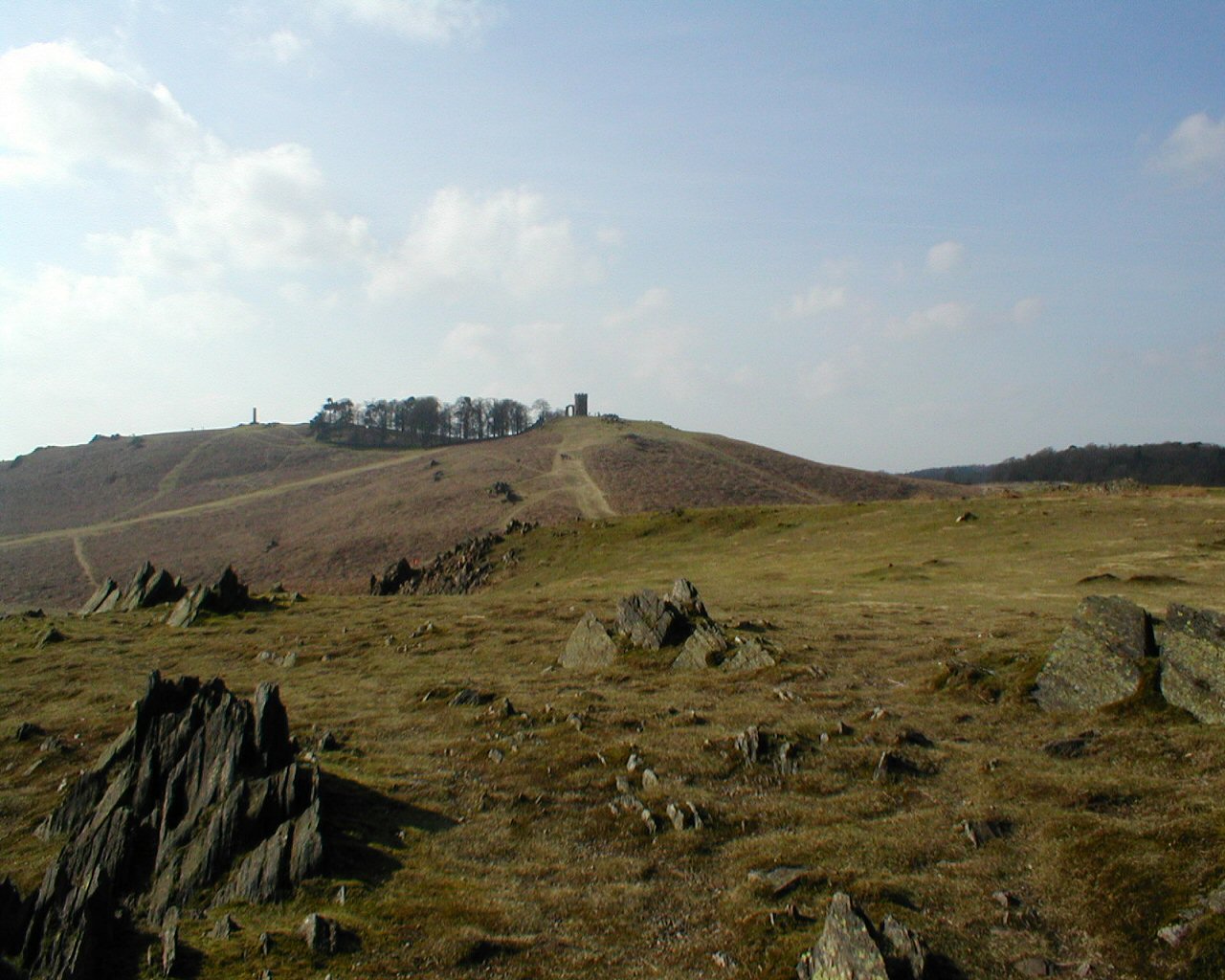
A prominent landmark is the folly known as 'Old John' on the top of the highest hill in the park. Built by the Greys in 1784, the folly is, by local legend, a memorial to John, an estate worker killed in a bonfire accident during celebrations of the 21st birthday of George Grey, the future sixth Earl of Stamford. It is reputed that the stonework at the side of the tower was altered to look like a handle, perhaps knowing John's liking of ale.[15] However he was not 21 until 1786, and a map of 1745 names the hill as 'Old John'. The tower was used during the 19th century as a viewing point for the horse-racing practice circuit laid out by the seventh earl.

In 2001, Bradgate Park Trust registered the design of the building as a trademark, and in 2018 told a local artist that she would have to pay them if she continued to sell her paintings of it.[16]

Cropston Reservoir

[edit]

Cropston Reservoir was constructed in the south-east corner of the park in 1871, submerging the Head Keeper's house[9] and a substantial area of former parkland.[8] It was Leicester's second reservoir (after Thornton), built in response to the 1831 and 1841 cholera epidemics. The water level was raised 2 feet (60 centimetres) in 1887, to increase capacity and the original steam powered beam engines ran until 1956.[17] A number of pools were also constructed along the course of the River Lin through the park, to allow silt to settle before reaching the reservoir.[9] A second, covered reservoir was added on the northern side of the park in the early 1960s.[9]

Public park

[edit]

In 1905 the estate was bequeathed on the death of the 7th Earl of Stamford's widow to the earl's niece, Mrs Arthur Duncombe. Limited public access had been allowed while the park was in the hands of the Greys. In 1928, the ancient Deer Park with the ruins of Bradgate House was included in the sale of the whole Grey estate and the Park was bought by local businessman and British United Shoe Machinery founder Charles Bennion who gave it in perpetuity to the people of Leicestershire. Plaques on Old John and the main path through the park commemorate the gift. Bennion's son subsequently added the gift of an adjacent piece of land, and in 1936 the City Council purchased an additional 46.5 acres of land abutting the park.[18] The nearby Swithland Wood had previously been sold in 1921 to the Leicester timber merchant William Gimson, who began to extract the timber commercially, with the aim of dividing up the land for building plots as it was gradually cleared. Following public concern about the threatened loss of this ancient woodland of importance for its geological, natural history and industrial history features, in 1925 the Rotary Club of Leicester, with the cooperation of William Gimson, bought the whole site of approximately 137 acres (55 ha) for preservation and to provide access to the public for recreation "as a national heritage". The Rotary Club established the Swithland Wood Trust, repaired and renewed the fencing of the area, provided car parking and restored the paths, spending around £6,000 on the original purchase, fencing and landscaping. The Club opened Swithland Wood to the public on August Bank Holiday, 2 August 1925, employing its own staff to manage the Wood and visitor services. In 1928 the Club initiated the annual Bluebell Service in the Wood, in partnership with Swithland Parish Church. On 29 December 1929 the Bradgate Park Charity with trustees nominated by the County Council and the National Trust was established to manage Charles Bennion's purchase and gift of Bradgate Park, with the appropriate senior officers of the Council providing the necessary professional and administrative services, including land management, legal, secretariat and financial support. Although there does not seem to have been a formal opening of Bradgate Park, public access to the Park became available soon afterwards in 1929. In 1931, once the Bradgate Park Trust was fully operational and established, the Rotary Club approached the County Council and trustees about the possibility of merging the two properties and charities under the Bradgate Park trustees and this was completed in 1931.[19] The park is now administered by the Bradgate Park and Swithland Wood Charitable Trust, with trustees nominated by Leicestershire County Council, Leicester City Council and the National Trust.[20] With the consent of the Charity Commission, the charity has adopted the shorter working title of Bradgate Park Trust.

Civil parish

[edit]

It was formerly an extra-parochial tract,[21] in 1858 Bradgate Park became a separate civil parish,[22] on 25 March 1884 the parish was abolished and merged with Newtown Linford, Anstey and Ulverscroft.[23] In 1881 the parish had a population of 6.[24]

Geology

[edit]
Old John

The visible geology in Bradgate Park ranges from some of the oldest (Precambrian) fossil bearing rocks in England to the youngest (Quaternary). The rock outcrops were created in conditions varying from volcanos rising out of the ocean, to magma flowing deep underground and from tropical deserts to Ice sheets. Within the park the outcrops are widely distributed as hillside crags and outcrops, both along the valley sides of the River Lin and on the hilltop of Old John. They include rocks with some of the oldest known developed forms of fossil animal life in Western Europe.[25]

Precambrian rocks

[edit]
Map of the geology of Bradgate Park[25]

The Precambrian outcrops include four 'type-members' of the Charnian Supergroup,[26] formed some 560 million years ago.[25] Bradgate is one of the few areas of Britain where these ancient basement rocks can be seen at the surface. The oldest of the Charnian rocks within Bradgate Park are the rocks nearest the Old John and memorial summits.[25] This is the Beacon Hill Formation. It appears to have formed in deep water, out of sediments of volcanic ash and other pyroclastic material, which were then subject to slumping and submarine flows, to create rocks with various degrees of stratification. The volcano itself was in the north-west of Charnwood Forest, and the whole area was in the southern tropic, off the coast of the continent of Gondwana. (A modern parallel might be the sea surrounding Montserrat.[25]) Some of the layers show great variation, showing how an initial volcanic eruption would result in larger sediments rapidly settling to create course-grained tuff, followed by settling of much finer material to form much smoother dust-tuffs – smooth light-grey to creamy coloured rocks seen to the north of Old John.[27] The various layers were subsequently deeply buried, subject to vast periods of mountain-building (orogeny), heat, pressure and erosion of overlying material, to expose the hard, jagged outcrops seen in the photograph.

Overlying the Beacon Hill Formation, but found a little further down the hillside to the south, are the Bradgate Formation beds, the most notable of which is the Sliding Stone Slump Breccia rocks. Forming a line of crags below Old John, these are laminated mudstones, with layers of sandstone, mainly of volcanic origin. The beds are substantially warped, contorted and folded. Many of the more intricate folds and 'sag' patterns are thought to have occurred while the sediments were unconsolidated and water saturated.[25] Suggested causes for these include slumping, earth tremors and fault-movements, trapped water or gases and volcanic bomb impacts.[25] Outcrops of other rocks of the Bradgate Formation are found further down the slope. These are younger than and stratigraphically above the breccia, but the uplift from ancient mountain-building, the dip of the beds and erosion of overlying rocks mean that the younger rocks are encountered at progressively lower altitudes.

The youngest of the Precambrian rocks are the South Charnwood Diorites. These are known locally as granite, (geologically they were formerly described as markfieldite) and are quarried commercially at Groby and Markfield. These are igneous intrusions of magma which formed within the existing Beacon Hill and Bradgate Formations. They cooled slowly and at great depth to create their large crystalline structure,[28] and were subsequently exposed by erosion of the uplifted rocks above. The Diorites are the cliffs and blocks seen along the Lin valley, through the so-called Little Matlock Gorge and near Bradgate House. They are massive blocky outcrops[27] made up of crystals of feldspar, quartz and mafic minerals.[25]

Cambrian rocks

[edit]

An area of rock overlooking Cropston Reservoir is of Hanging Rocks Formation, the only other example being at Hangingstone Hills, near the Outwoods, 4 km to the north. It is unclear if this is late Precambrian or early Cambrian. It is distinguished by conglomerates with well-rounded volcanic pebbles mostly 5–15 mm but some up to 100 mm in diameter, which may have been smoothed on a volcanic shoreline before being washed, along with much finer material, into deeper water. These are younger than the Bradgate Formation, but again at a lower altitude. A possibly explanation is that it formed in a channel cut into the existing sea floor, but a preferred conclusion is that movement along fault-lines has relocated it relative to its surrounding rocks. The relationship between the different outcrops in Bradgate are made more obscure by the overlying peat and Boulder clay, which mean the contacts between adjacent stratigraphic sequences are nowhere exposed.

Previously classed as precambrian, but now accepted as early Cambrian are the Brand Group of rocks which include Swithland Slate, locally important as a source of roof slates and gravestones. The nearby Swithland Wood has extensive outcrops and was one of the principal quarry areas until the mid 19th century.[28] Rocks close in age to the slate can be seen in the 'stable pit', a medieval quarry near Bradgate House. This outcrop is part of the Brand Group and is known as the Stable Pit Member, a Quartz arenite rock with a smooth glassy appearance.[25] A metre-wide dyke of diorite also runs through the exposed rocks of the quarry, possibly of late Ordovician age, which places it at a similar age to the Mountsorrel granite formations.[25]

Triassic rocks

[edit]

During the Triassic period, some 350 million years after those ancient rocks were formed, they were exposed due to the erosion of the rocks above. By this point they were part of the Pangea supercontinent and desert conditions resulted in an accumulation of windblown Loess, which now forms the Mercia Mudstone Group. With the subsequent sinking of the East Midlands crust, these deposits became waterlogged and formed into red clay. It is this clay that was used to make the bricks for Bradgate House. The mudstone is only visible where it was extracted, across the stream from Bradgate House. However, it covers much of the valley floor around and beneath Cropston Reservoir, – demonstrating that the present Lin valley was also there 220 million years ago.[25]

Quaternary deposits

[edit]

Bradgate Park and its surrounding areas were heavily overlain in the (geologically) recent past by glacial deposits of Boulder Clay. The Quaternary period includes the last ice age. As the ice melted, some 10,000 years ago, the solid material within the ice settled over the 'natural' rocks below. This material includes unsorted clay and sand particles, small and large pebbles and large stones and boulders. It travelled great distances within the ice sheets and glaciers, so individual rocks, whether on the ground, or within the great lengths of stone walls of the Park, may be local stone, or may be a specimen from northern Britain or even from northern Europe.

Precambrian fossils

[edit]

The fossils at Bradgate and in other nearby Charnian rocks are the only known Precambrian fossils in Western Europe.[25] Until 1957 it had been thought that complex life forms and perhaps life itself began with the Cambrian Period and that all rocks older than this developed in a world without plants or animals. The 1957 discoveries, by Roger Mason, in rocks near Woodhouse Eaves, subsequently named in his honour as Charnia masoni, required a re-evaluation of when life began. It also resulted in the re-classification of other rocks in Southern Australia and Newfoundland, which have similar fossil marks. At Bradgate Park there are some 50 known examples. They mainly take the form of two-dimensional impressions of fronds and disks and have at various times been described as seaweed, jelly fish, corals or sea anemones. They are now described as belonging to the Ediacara biota, with no consensus on which kingdom, current or extinct, they should be placed.[25] The Bradgate examples include Bradgatia linfordensis and Charniodiscus concentricus as well as Charnia masoni. Because of the risk of vandalism and damage, specific locations of these fossils are not disclosed and those wishing to investigate them should first of all seek the permission of the Bradgate Park Trust. None of the rocks in Bradgate Park should be chipped, hammered, or otherwise sampled, replicated or removed.

Flora and fauna

[edit]
Male fallow deer in Bradgate Park

The landscape is rocky moorland with a covering of coarse grass and bracken. Several spinneys of woodland (pine and mixed deciduous) are enclosed by stone walls and are not accessible to the public. There are a number of magnificent specimens of ancient oaks several hundreds of years old. The park is home to herds of red deer and fallow deer. Birdlife is profuse – the reservoir attracts many species of wildfowl, as does the river and the spinneys provide secluded nesting areas for many other species, including large colonies of rooks. Species such as yellowhammer, reed bunting, skylark and meadow pipit are a common sight in the open areas of the park. Deadly nightshade is allowed to grow within the ruins of Bradgate House, having been originally established there during World War II by Leicester Polytechnic's School of Pharmacy for medicinal purposes.[9]

Dogs

[edit]

As of 2015 deer numbers were around 450 but concerns have been raised about dogs chasing deer.[29] Trust notices displayed at the entrances now advise that dogs must be on a lead in specified areas near the main footpath. Dogs are allowed off lead in around 75% of the area of the park, so long as they are kept under effective control and do not worry the deer. The Daily Telegraph highlighted Bradgate in an article referencing the busybodies charter though it failed to mention the deer.[30]

Café and information centres

[edit]

In July 2016 a visitor centre opened in the Deer Barn buildings off the main path east of Bradgate House in addition to the existing cafe. The geology section features details of the park's formation during its stages of volcanism, glacial erosion and inhabitation by Ediacara biota. It also shows the tracks of a later land based lizard. The archaeology section features work by Leicester University beginning in 2014 and includes evidence of Creswellian sites from 14,500 years ago.

The Deer Barns café in the centre of the park is open 7 days a week and offers sandwiches, toasties, jacket potatoes and other cold snacks and hot and cold drinks.

There is also a café at the Newtown Linford car park which is operated externally as of 2021.

Access

[edit]
Sunshine across a winter scene.

Car

[edit]

Pay&Display car parks are operated at the Hallgates entrance and Hunts Hill (at the top of the park near Old John). At Newtown Linford an automatic number plate recognition (ANPR) system is in operation and visitors pay on exit. The park is open from dawn until dusk all year round, though the public footpaths which run through the area mean that in practice the park is always accessible.

Bus

[edit]

A limited service 125 operates by the Newtown Linford entrance Monday to Saturday and Arriva 29B operates an infrequent Sunday service both serve Leicester City Centre and Coalville.

Walking

[edit]

One path is directly opposite the bus stop on Link Road, between Cropston Road and Hazelhead Road. The path is signposted from Link Road and crosses several fields before entering the park proper. Another route, which joins the main path, is accessible from the edge of the village, adjacent to the last houses on Bradgate Road.

Cycling

[edit]

The park is within easy cycling distance from the city centre of Leicester.

References

[edit]
Revisions and contributorsEdit on WikipediaRead on Wikipedia
from Grokipedia
Bradgate Park is an 830-acre public park in , , , situated approximately three miles northwest of city center, offering accessible countryside with a rugged landscape of rocky outcrops, ancient oak trees exceeding 500 years in age, and panoramic views across the region. Enclosed as a medieval deer park around 800 years ago with its first written reference in 1241, the park supports populations of approximately 550 red and —predominantly fallow—and is traversed by the River Lin, Leicestershire's shortest river at about three miles long, which features Victorian-era waterfalls and is designated as a for its diverse wildlife. Geologically, Bradgate Park preserves some of the oldest rocks in , dating to the era over 560 million years ago, including volcanic ash deposits and globally significant fossils such as , the first such fossil discovered in 1957, highlighting its importance for understanding early multicellular life. In May 2024, the park along with adjacent Swithland Wood was designated 's 51st National Nature Reserve to protect these rare features and biodiversity. The park's historical significance is epitomized by the ruins of Bradgate House, a built between 1490 and 1520 by the Grey family as a pioneering Renaissance-style mansion with innovative features like large glass windows and a central . This Tudor manor served as the childhood home of , born there in 1537, who was proclaimed Queen of in 1553 but reigned for only nine days before her execution at age 16; the house was occupied by the Grey family until the mid-18th century, after which it was abandoned and fell into ruin, having been previously damaged by a in 1694. Another iconic landmark is Old John Tower, an 18th-century folly constructed around 1784 atop a hill, designed in the shape of a soup tureen to honor a benefactor and serving as a prominent viewpoint and symbol of ; in April 2025, the tower was opened to the public for the first time. Additionally, the park includes the Leicestershire War Memorial, erected in 1924 to commemorate local soldiers lost in . In November 2025, researchers named a new fossil species discovered in the park. Managed by the Bradgate Park Trust since its donation to the people of in 1928, the park attracts over 700,000 visitors annually for walking trails, cycling, fishing, and educational programs, while conservation efforts maintain its status as the only remaining enclosed medieval deer park in the and protect habitats for species like otters, , and rare . A provides free exhibitions on the estate's , , and , and the park produces award-winning from its managed deer herds, emphasizing sustainable land use.

Overview

Location and extent

Bradgate Park is situated in , within , , approximately 10 km northwest of city centre. The park occupies high ground on the southeastern edge of the forest, providing a prominent in the region. The park encompasses 830 acres (340 hectares) of publicly accessible land, managed by the Bradgate Park & Swithland Wood Charity. This area includes the adjacent Swithland Wood, which covers 170 acres and forms an integral part of the overall estate. The boundaries are defined by surrounding villages, including Newtown Linford to the south, Anstey to the east, and Cropston to the southeast, with additional proximity to Groby and Swithland. Key water features within the park include the River Lin, which flows through the lower section, and the adjacent Cropston Reservoir, into which the river drains. The terrain is characterized by rugged hills rising to the park's highest point at Old John Tower, dramatic rocky outcrops, ancient woodlands dominated by gnarled trees over 500 years old, and expansive open grasslands that support a herd of approximately 550 deer. These features create a diverse of elevated landscapes and valleys, enhancing the park's visual and spatial extent.

Historical and natural significance

Bradgate Park holds profound historical and natural significance as a preserved that bridges medieval heritage with globally rare geological features. In May 2024, it was designated as a National Nature Reserve (NNR) alongside Swithland Wood, forming a 439-hectare that safeguards rocks dating back over 560 million years and supports diverse , including rare species habitats. This status, the 220th NNR in , underscores the park's role in conserving ancient fossils and woodlands vital for ecological connectivity and scientific study. The park's historical prominence is epitomized by its association with , known as the "Nine Days' Queen" during her brief reign in 1553, who spent her childhood at Bradgate House within the estate. The ruins of this early Tudor mansion, one of England's first major brick-built country houses, stand as a Scheduled Ancient Monument, protected for their architectural and cultural value by . This site not only evokes the Tudor era but also represents the park's evolution from a medieval deer park, originating in the 13th century, into a enduring cultural landmark. Managed by the Bradgate Park Trust—a registered charity founded in 1928 to ensure public access and preservation—the park draws over 700,000 visitors annually, drawn to its seamless integration of historical ruins, thriving wildlife such as free-roaming deer, and recreational opportunities amid rugged terrain. It has inspired notable figures, including , whose childhood explorations there ignited his lifelong passion for . Recent scientific advancements further highlight its importance, with the 2025 naming of a new , Charnia brasieri, discovered in the park's ancient rocks, advancing understanding of early multicellular life.

History

Medieval deer park

Bradgate Park was first documented as a deer park in 1241, when Roger de Quincy, 2nd Earl of Winchester, was granted the right to deer there using nine bows and six hounds, indicating its early establishment as a managed estate within the Manor of Groby. The consisted of an earthen bank with an internal ditch, likely surmounted by a timber to contain the herd and prevent escapes, a standard feature for medieval parks designed to support both and limited . Initially smaller in extent, the park's boundaries were expanded around 1500 under Thomas Grey, 7th Ferrers of Groby and later Marquis of Dorset, to create a larger landscaped domain that incorporated the site for the future Bradgate House. The park was stocked primarily with , managed by rangers appointed by at least 1371 to maintain , oversee breeding, and facilitate while protecting the herd from poachers. A moated timber-framed hunting lodge, in the mid-13th century and measuring approximately 21 by 8 meters, served as the primary residence for the park keeper, featuring base-cruck with local timbers and roofing from nearby Groby quarries; it was abandoned by the late 14th or early as management shifted. Timber management was integral, with underwood coppices providing wood for fuel, , and fencing repairs, alongside opportunities for ( ) and herbage . In the medieval economy, the park contributed significantly to the estate's resources, yielding for meat, hides for leather, and wood products, with an annual value estimated at 40 shillings by the through leasing rights and direct yields. Ownership transitioned in 1445 when the de Ferrers family's holdings, including Bradgate, passed to the via the marriage of Elizabeth Ferrers to Edward Grey, Viscount Lisle. The Greys retained control through subsequent generations, evolving into the Earls of Stamford by the 17th century, under whose stewardship the park's deer population and wooded areas persisted into the 18th century.

Bradgate House and Tudor connections

Bradgate House, constructed in the 1490s by Thomas Grey, the 1st Marquess of Dorset, stands as one of England's earliest unfortified brick manor houses and an exemplar of early Tudor architecture, which incorporated emerging Renaissance influences such as balanced proportions and open interiors. The building's design emphasized symmetry, with a central hall flanked by wings extending around three sides of a courtyard, creating an imposing yet accessible residence within the deer park landscape. Key features included a grand gatehouse providing entry from the park, large mullioned windows that flooded interiors with light, and a dedicated chapel for family worship, reflecting the Greys' status and piety. The house's elevated position and expansive galleries allowed residents to overlook the surrounding deer park, facilitating views of the herds that were central to the estate's medieval origins. The house served as the childhood home of , born there in 1537 and residing until approximately 1553, when political maneuvers drew her into the Tudor court's intrigues. As the great-granddaughter of Henry VII, Jane's time at Bradgate was marked by scholarly pursuits under tutors, amid the opulent yet turbulent world of the , who held sway during the reigns of , , and Mary I. The chapel itself witnessed significant Tudor events, including the 1547 marriage of Sir William Cavendish and Elizabeth "Bess" Hardwick, whose descendants would later influence English nobility. Jane's brief proclamation as queen in 1553 and subsequent execution in 1554 cemented the house's association with her tragic legacy, transforming it into a poignant symbol of Tudor dynastic ambition and misfortune. Following centuries of occupancy, Bradgate House suffered a damaging fire in 1694 that affected its northwest tower, though repairs allowed continued use until the early . The structure was abandoned around 1719 upon the death of the 2nd , Thomas Grey, leading to gradual decay as stones were quarried for local buildings and the site reverted to nature. By the , the ruins faced further deterioration, but preservation efforts began after the park's acquisition in 1928 by industrialist Charles Bennion, who gifted it to the public with the intent to maintain its historical features in their natural state. Subsequent stabilization by the Bradgate Park Trust has consolidated the standing walls and prevented collapse, ensuring the ruins remain a accessible testament to Tudor grandeur. In July 2025, the chapel was fully restored and reopened to the public, with ongoing major repairs to the ruins funded by nearly £1 million to ensure long-term stability. The cultural legacy of Bradgate House endures through its inspiration for literature depicting Lady Jane Grey's life, from historical novels to dramatic retellings that romanticize her intellect and fate, drawing parallels to broader themes of power and Protestant resistance in Tudor England. As a key within Bradgate Park, the ruins annually welcome visitors seeking to connect with this pivotal historical narrative, bolstered by interpretive signage and guided tours. Recent archaeological excavations, led by the since 2017, have uncovered Tudor-era foundations and artifacts such as pottery and structural remnants beneath the brick , providing fresh insights into the house's early phases and Jane's possible living spaces.

18th- and 19th-century developments

In the 18th and 19th centuries, Bradgate Park underwent significant landscape modifications under the ownership of the , Earls of Stamford, reflecting Georgian and Victorian interests in estates, , and urban infrastructure needs. These changes included the erection of architectural , tree plantations for aesthetic enhancement and game management, and major water engineering projects that altered the park's boundaries and features. A prominent addition was the folly, constructed in 1784 atop the park's highest hill at approximately 690 feet (210 meters) elevation. Commissioned by , the 5th , and built by local architect Thomas Sketchley, the circular stone tower was designed as a mock ruin resembling an upturned beer mug, serving primarily as a rather than a functional structure. In the mid-19th century, the 7th modified the folly into a viewing platform overlooking a new track in the park, further integrating it into recreational landscaping. Landscaping efforts during this period emphasized both practical utility and ornamental design, with the 6th overseeing the planting of —small wooded copses—between 1831 and 1841 to support . Plantations of oaks and beeches were also introduced to create picturesque groupings and shelter belts, enhancing the park's natural beauty while providing timber and habitat for ; these efforts built on earlier 18th-century avenues and walls to frame views and enclose the estate. Additionally, the park maintained a rabbit warren as part of its sporting , supplying for hunts and estate tables until it was submerged by later developments. The construction of Cropston Reservoir marked a major infrastructural intervention, begun in the late and completed in 1871 by the Leicester Water Works Company under authority from the Leicester Corporation. Designed to supply clean to the expanding city of amid concerns like outbreaks, the reservoir flooded about 180 acres of the park's northeastern corner, including the rabbit warren, a keeper's , and remnants of medieval field systems. With a capacity of 480 million gallons, it reduced the park's perimeter from six miles to four and created a new water feature that integrated with the landscape, though at the cost of submerging historic elements. A proposed 19th-century railway line, the , stirred controversy but ultimately failed to materialize. Introduced via a parliamentary bill in to connect to local quarries and villages through the park, the scheme faced opposition from landowners and park interests concerned about disruption to the scenic estate. The bill's preamble was not proven during committee review, leading to its rejection and preservation of the park's unspoiled character.

20th century to present

In 1928, local industrialist Charles Bennion purchased Bradgate Park and gifted it to as a public park for perpetual recreation, marking its transition to public ownership and opening as one of the UK's early country parks. The Bradgate Park Trust was established the same year under a trust deed to oversee its management, with Swithland Wood added to the estate in 1931 through a transfer from the Rotary Club of . A Charity Commission scheme in 1980 formalized the Trust's governance, enhancing its independent operational structure while preserving the park's natural and historical features. Throughout the , the Trust focused on enhancements to support public access and conservation, including the restoration and maintenance of historic paths to combat from foot traffic and weather, the introduction of basic visitor facilities such as information points, and of the deer to maintain ecological balance. The red and population, numbering around 550 animals, has been sustainably managed through and monitoring, with production supporting local economies without artificial feeds. In recent years, Bradgate Park achieved National Nature Reserve (NNR) designation in May 2024, recognizing its geological significance and committing to enhanced protections for ancient rock formations and biodiversity. A landmark conservation effort in June 2025 saw over 20 hazel dormice reintroduced to a site on the estate, establishing Leicestershire's only known of the species after decades of absence, through collaboration with the People's Trust for Endangered Species. In August 2025, the first baby dormice were born from the reintroduced , marking a key milestone in the conservation effort. In April 2025, Tower was opened to visitors on Thursdays following repairs, providing internal access for the first time in years. Ongoing initiatives address threats like path erosion via resurfacing projects and control of such as , ensuring the park's habitats remain resilient amid increasing visitor numbers.

Geology

Rock formations

Bradgate Park's geology features a diverse array of rock formations spanning from the to the periods, shaped by ancient volcanic, sedimentary, and glacial processes. The park's rugged terrain, particularly in the area, exposes these rocks, with resistant Precambrian outcrops forming prominent crags and hills, while younger deposits mantle the lower landscapes. The oldest rocks in the park belong to the era, dating back over 541 million years, primarily from the Beacon Hill Formation and associated intrusions. The Beacon Hill Formation consists of tuffaceous mudstones, siltstones, and sandstones formed from marine volcaniclastic deposits during explosive around 560-566 million years ago, deposited in deep-water environments via turbidity currents and exhibiting features like . These rocks are highly resistant to , creating craggy knolls such as those near Tower, where the formation's type section is exposed at coordinates SK 5255 1131. Intruding into these sequences are the South Charnwood Diorites, medium- to coarse-grained igneous rocks with a mottled pink-grey texture, representing the final magmatic activity near Bradgate House at SK 5346 1013. These intrusions and volcanics are distributed across the higher elevations of the park, protruding visibly through overlying strata to define the local topography. Minor exposures of rocks, approximately 530 million years old, occur in the area, including ancient sandstones from the Swithland Formation and related units. These sandstones, composed of small, rounded, uniform grains, were deposited in shallow tidal sea settings as part of offshore marine sediments, now visible as cleaved silty mudrocks and sandstones in locations like Swithland Wood and the Stable Pit south of Bradgate House ruins near the River Lin. Their distribution is limited compared to outcrops, appearing in quarry exposures and along paths, contributing to the park's varied geological profile. Triassic rocks of the Mercia Mudstone Group dominate the lower park areas, consisting of red silty mudstones formed around 247 million years ago in a environment through wind-blown and fluvial deposition during regional . These mudstones, blocky to laminated and often covering older rocks, are visible in low-lying valleys like the Lin valley at the Pheasantry (SK 5317 0987) and were historically quarried for brick-making, providing the red clay used in constructing Bradgate House. Overlying these are deposits from the last , approximately 10,000 years ago, including glacial s and s transported by retreating glaciers from northern Britain. These unconsolidated sediments, comprising sheets of from mid-Pleistocene Anglian glaciation and associated and horizons, are distributed discontinuously across the park, influencing development, drainage patterns, and the overlying heathland. Their visibility is subtle, often masked by vegetation but evident in stream cuts and lowlands where they overlie the mudstones.

Fossils and paleontology

Bradgate Park is renowned for preserving fossils of the genus Charnia from the period, dating to approximately 565–541 million years ago, which represent some of the earliest known complex multicellular organisms on Earth. These frond-like impressions were first discovered in 1957 by schoolchildren Tina Negus and Roger Mason during a in the area, including exposures within the park. The find, initially overlooked, was confirmed as Charnia masoni—named after Mason—and marked the global first identification of macrofossils, proving that macroscopic life existed tens of millions of years before the . This breakthrough revolutionized paleontological views on evolution, establishing as evidence of early rangeomorphs—enigmatic, sessile organisms that likely filter-fed on microbial mats in ancient seafloors. In 2025, a new , , was formally described from specimens collected in Bradgate Park, honoring the late geologist Martin Brasier (1947–2014) for his pioneering work on biota. This , capable of growing up to one meter long, highlights morphological diversity within the genus and advances understanding of their and ecological roles. Key Charnia specimens, including casts of the C. masoni holotype, are exhibited at the New Walk Museum and Art Gallery in , allowing public access to these pivotal artifacts while originals remain protected. In recognition of their global scientific value, Bradgate Park's fossil sites gained enhanced protection in May 2024 when the area was designated a by , safeguarding the rare assemblages from erosion, vandalism, and unauthorized removal. In July 2025, , encompassing Bradgate Park, announced a bid for Global Geopark status to further recognize its geological heritage, with a decision expected in 2027. Visitors can observe the fossils in their natural outcrops along designated trails, but collection is strictly forbidden to maintain the integrity of these irreplaceable geological features.

Ecology

Flora

Bradgate Park's flora is characterized by ancient woodlands, encompassing over 500-year-old pollard oaks, plantations, and mixed trees including birch, , and lime. These woodlands form a significant part of the park's 830-acre landscape, providing shaded canopies and contributing to seasonal foliage changes. The pollard oaks, many estimated at 800 years or older, represent veteran trees that enhance the area's ecological complexity and historical continuity. The park's grasslands and heaths feature seasonal blooms of wildflowers, ferns such as bracken, and shrubs like hawthorn, creating open habitats amid the rugged terrain. Notable plants include henbane (Hyoscyamus niger), a scarce species found in the open areas. Rocky outcrops, influenced by the underlying acidic geology, support specialized communities of lichens and mosses, including nationally important saxicolous species on Precambrian formations. These elements foster a mosaic of vegetation types, from coarse grasses to acid-loving plants adapted to the moorland conditions. The River Lin, designated as a , sustains flora such as reeds and aquatic species along its short course through the lower park, bolstering overall in riparian zones. Conservation initiatives by the managing charity emphasize controlling invasive through clearance and grazing to favor native plants, while areas like Memorial Wood serve as protected habitats for ancient oaks and diverse native vegetation enclosed by deer fencing.

Fauna

Bradgate Park supports a population of approximately 550 red and fallow deer, with about three-quarters being fallow deer, and the herd is actively managed through culls to maintain health and prevent overgrazing. In 2025, over 20 hazel dormice were reintroduced to a woodland area within the park as part of a conservation project led by the People's Trust for Endangered Species, marking the first such effort in Leicestershire and resulting in the birth of the species' first offspring there by August. Grey squirrels are occasionally observed in the park's woodlands, though red squirrels are not confirmed as resident. The park hosts a diverse avian population, including green woodpeckers (Picus viridis) and great spotted woodpeckers (Dendrocopos major), which are regular breeders in the ancient woodlands. Wildfowl such as mallards (Anas platyrhynchos) and little grebes (Tachybaptus ruficollis) frequent the adjacent Cropston , while riverine species like (Alcedo atthis) and otters (Lutra lutra) inhabit areas along the River Lin, with otters observed near the reservoir indicating recovery in the local mammal . Open meadows and scrub support breeding birds including yellowhammers (Emberiza citrinella) and reed buntings (Emberiza schoeniclus). Invertebrate life thrives in the park's meadows and grasslands, with butterflies such as those from the Polyommatus and Argynnis genera commonly sighted during summer months. The park is also home to the nationally rare Charnwood spider (Mastigusa diversa), associated with ant nests in the rocky habitats. diversity is enhanced by the varied habitats, though specific management focuses on protecting these populations from disturbance. To safeguard , including ground-nesting birds and small mammals, dogs must be kept on leads in the lower park section between the River Lin and the Middle Wall, with violations potentially leading to prosecution for chasing or harassing animals. Wildlife management at Bradgate Park includes guided walks, such as deer-focused tours and ranger-led rambles, which educate visitors on species behavior and conservation efforts. Venison from sustainably culled deer is harvested and sold locally through park facilities, supporting the herd's ecological balance while providing a resource from the managed population.

Visitor facilities

Information centres and cafés

The Visitor Centre, located in the heart of Bradgate Park near the Deer Barns, offers free entry to visitors and features interactive exhibitions covering the park's geological history, archaeological significance, ecological diversity, and the story of , including displays of artefacts. It provides essential resources such as maps, guided trail information, and details on options for visitors with disabilities. The centre operates on Fridays, Saturdays, Sundays, and during school holidays from 11:00 a.m. to 4:00 p.m., with a small shop selling local products including and souvenirs. The Deer Barn Café, situated near the main entrance in the central area of the park, serves a range of hot meals like jacket potatoes and toasties, snacks including sandwiches and cakes, and hot and cold drinks alongside ice creams. It also stocks products from the park's herd, available for purchase from on-site freezers. The café maintains seasonal hours, open daily from 10:00 a.m. to 4:00 p.m. (November 2025), with indoor and extensive outdoor seating options. At Bradgate House ruins, visitor facilities include self-guided exploration of the Tudor-era remains and volunteer-guided tours focusing on the site's historical displays and the legacy of , available Wednesdays, Saturdays, and Sundays from 11:00 a.m. to 3:00 p.m., with no booking required. The ruins are open Wednesdays, Saturdays, and Sundays between 11:00 a.m. and 3:00 p.m. The Estate Office serves as the administrative hub for park management, handling visitor inquiries via telephone and email. Visitors are welcome to drop in Monday to Friday from 9:00 a.m. to 4:00 p.m. at the Deer Barn Buildings in Newtown Linford.

Amenities and activities

Bradgate Park provides various accessibility features to ensure visitors with mobility challenges can enjoy the site. The lower section of the park features a tarmac that offers wheelchair-friendly access, allowing exploration of gentler terrain along the River Lin and past waterfalls. Additionally, a concessionary parking scheme is available for Blue Badge holders and those unable to walk long distances, with free parking in designated spots. For remote access, an interactive 360-degree comprising 80 images is available online, enabling virtual navigation through the park's landscapes and ruins. The park hosts a range of guided events and activities to engage visitors with its natural and historical elements. Guided walks focus on topics such as deer observation in the and geological features spanning over 560 million years, typically led by rangers on weekends. Talks and workshops, including those on and , occur seasonally at the visitor centre. Seasonal events include Santa visits at the Deer Barn grotto, scheduled for late November and December 2025, featuring crafts and gifts for children. The "Magic of Bradgate" immersive tours blend , geology, and storytelling through ancient formations and ruins, offering a journey through time. Picnic areas enhance the recreational experience, with designated spots along the River Lin and in the Little Matlock area, which mimics landscapes and provides scenic views for relaxation. The park also features war memorials, including the Leicestershire Yeomanry Memorial, a stone on a raised base commemorating soldiers from the Boer War and both World Wars, located near Tower. Parking charges apply at main entrances, ranging from £4 to £6 per vehicle depending on duration, day, and location (as of April 2025), with early bird rates of £1 on weekdays and £2 on weekends. Volunteer programs play a vital role in maintaining the park as a National Nature Reserve (NNR). Opportunities include conservation tasks such as dry-stone walling, habitat management, fence repairs, and litter picking, supporting the preservation of its ecological and historical integrity. These efforts, often organized weekly, involve community groups and corporate teams in seasonal activities across the estate.

Access

By car

Bradgate Park is accessible by car primarily through two main entrances: the Newtown Linford entrance, reached via the A50 from M1 Junction 22 or , and the Hallgates entrance near Cropston, accessed via the B591 or local roads such as the B5328 from . The recommended satnav postcode for the main Newtown Linford entrance is LE6 0HB, while Hallgates uses LE7 7HQ. The park features four main car parks: Newtown Linford (the largest, with overflow grassed areas during busy periods), Hallgates (near the Deer Barn Café), Hunts Hill (near ), and two at Swithland Wood (north and south). Parking charges, effective from 1 April 2025, are £4 for up to three hours and £5 for a full day on weekdays at Newtown Linford, Hallgates, and Hunts Hill; weekends and bank holidays cost £5 for up to three hours and £6 for a full day. Swithland Wood charges are lower at £2 weekdays and £3 weekends for a full day. Payments are cashless: (ANPR) with contactless options at Newtown Linford, and coin/card pay-and-display machines or the PayByPhone app at the others. Designated Blue Badge parking spaces are limited and available only at Newtown Linford and Hallgates, though holders must pay the standard fees. The rural location means access roads, such as those leading from the A50 to Newtown Linford, can become congested during peak visitor times, often resulting in overflow parking on nearby lanes and access issues. No overnight parking is allowed, as all car parks close at sunset (no later than 8:30 PM in summer) with barriers and gates installed to secure the sites.

By public transport

Bradgate Park is accessible by several bus routes from and surrounding areas, providing convenient options without the need for a private vehicle. The primary services connect to key entrances, such as Newtown Linford and Hallgates, with stops located a short walk from the park boundaries. Key bus routes include the Centrebus 154, which operates Monday to Sunday from St Margaret's Bus Station to , stopping at Bradgate Arms in Cropston for access to the Hallgates entrance; the journey from takes approximately 25-30 minutes. Additionally, Arriva's LC15 service, running Monday to Friday since July 2025, travels from to via Newtown Linford, with a dedicated stop opposite Bradgate Park near the main entrance; this route serves as a direct link, taking about 30-40 minutes from the . On Sundays, Arriva's 29B extends to Newtown Linford, stopping at the same pub location for park access. There is no direct rail service to the park; the nearest stations are (approximately 6 miles away) and (about 8 miles), both with frequent trains from major cities. From these stations, visitors can connect via the aforementioned bus routes or , with the full journey typically taking 45-60 minutes including transfers. Bus timetables generally operate from around 7:00 AM to 8:00 PM, with frequencies varying by route—such as hourly on the 154 during peak hours and limited services (3-5 per day) on the LC15 and 29B. Seasonal variations apply, particularly for routes like the LC15, and users should consult operator apps or websites like Traveline for real-time updates. All listed services stop directly at or very near park entrances, minimizing upon arrival. For accessibility, most buses on these routes are low-floor vehicles equipped with ramps for users, and combined ticketing options (such as day passes covering multiple operators) are available through apps like Arriva's or the ticketing system. Visitors with mobility needs may also arrange from rail stations for a seamless connection.

On foot and by bicycle

Bradgate Park offers extensive opportunities for visitors arriving on foot, with a network of well-maintained paths and permissive tracks that connect the main entrances at Newtown Linford, Hallgates, and Hunts Hill. These routes allow pedestrians to explore the park's rugged landscapes, ancient woodlands, and historical sites while minimizing disturbance to through signposted conservation areas above the middle wall. The park is approximately 6 miles northwest of city centre, making it accessible via a scenic walk through nearby villages like Groby, which adds about 2 miles to the journey from the city outskirts. Longer walking options include sections of the National Forest Way, a 75-mile that passes through the park and links it to Beacon Hill and Thornton Reservoir, providing immersive experiences in Charnwood Forest's craggy uplands and diverse habitats. Pedestrians have priority on all paths, and the terrain varies from gentle carriageways to steeper hillside trails, suitable for a range of abilities. Cycling is permitted solely on designated routes to protect the park's , including the tarmac Estate road or carriageway running from the Newtown Linford entrance through to Hallgates, and on bridleways and permissive tracks in adjacent Swithland Wood, which are waymarked for clarity. Off-road is prohibited outside these areas, with violations potentially incurring significant fines under park bye-laws. The park integrates with the Sustrans , enabling cyclists to approach via regional on-road and off-road paths from towns, such as connections near the A50 and local lanes. For safety, all paths are shared between pedestrians, cyclists, and occasional horse riders, requiring cyclists to proceed at low speeds, yield , and dismount if necessary, particularly during peak visitor times like weekends and bank holidays when cycling may be prohibited except for young children. Helmets are recommended for all cyclists, and during seasonal wildlife events—such as the deer rutting period from to October or fawning season in May to July—visitors must adhere to guidance to remain on paths, keep at least 50 meters from deer, and leash dogs to avoid disturbances or hazards.

References

Add your contribution
Related Hubs
User Avatar
No comments yet.