


Community hub
Recent from talks
Contribute something to knowledge base
Content stats: 0 posts, 0 articles, 1 media, 0 notes
Members stats: 0 subscribers, 0 contributors, 0 moderators, 0 supporters
Subscribers
Supporters
Contributors
Moderators
Hub AI
Brainstem AI simulator
(@Brainstem_simulator)
Hub AI
Brainstem AI simulator
(@Brainstem_simulator)
Brainstem
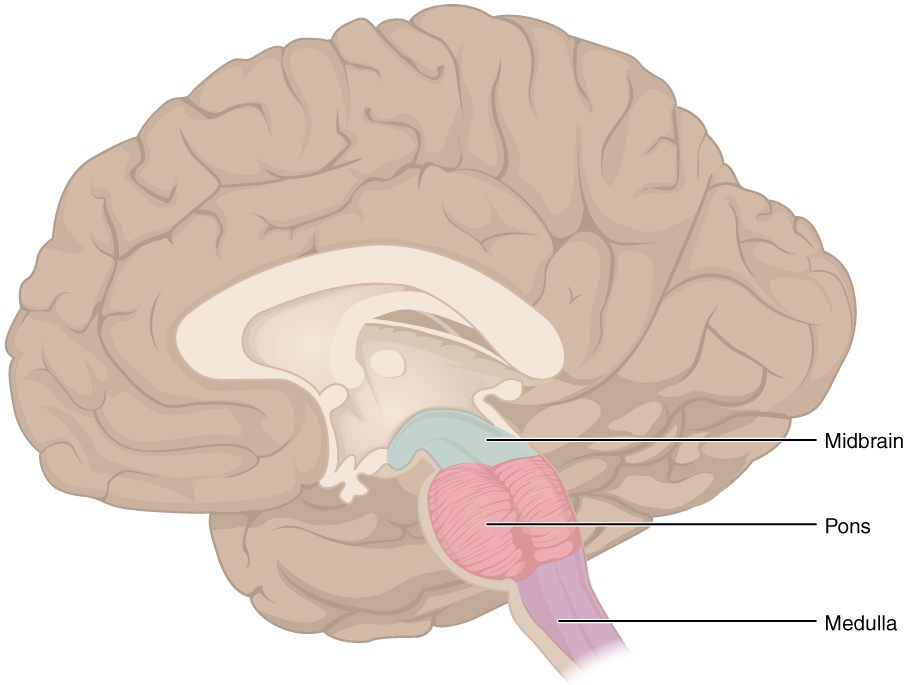
The brainstem (or brain stem) is the posterior stalk-like part of the brain that connects the cerebrum with the spinal cord. In the human brain the brainstem is composed of the midbrain, the pons, and the medulla oblongata. The midbrain is continuous with the thalamus of the diencephalon through the tentorial notch, and sometimes the diencephalon is included in the brainstem.
The brainstem is very small, making up around only 2.6 percent of the brain's total weight. It has the critical roles of regulating heart and respiratory function, helping to control heart rate and breathing rate. It also provides the main motor and sensory nerve supply to the face and neck via the cranial nerves. Ten pairs of cranial nerves come from the brainstem. Other roles include the regulation of the central nervous system and the body's sleep cycle. It is also of prime importance in the conveyance of motor and sensory pathways from the rest of the brain to the body, and from the body back to the brain. These pathways include the corticospinal tract (motor function), the dorsal column-medial lemniscus pathway (fine touch, vibration sensation, and proprioception), and the spinothalamic tract (pain, temperature, itch, and crude touch).
The parts of the brainstem are the midbrain, the pons, and the medulla oblongata; the diencephalon is sometimes considered part of the brainstem.
The brainstem extends from just above the tentorial notch superiorly to the first cervical vertebra below the foramen magnum inferiorly.
The midbrain is further subdivided into three parts: tectum, tegmentum, and the ventral tegmental area. The tectum forms the ceiling. The tectum comprises the paired structure of the superior and inferior colliculi and is the dorsal covering of the cerebral aqueduct. The inferior colliculus is the principal midbrain nucleus of the auditory pathway and receives input from several peripheral brainstem nuclei, as well as inputs from the auditory cortex. Its inferior brachium (arm-like process) reaches to the medial geniculate nucleus of the diencephalon. The superior colliculus is positioned above the inferior colliculus, and marks the rostral midbrain. It is involved in the special sense of vision and sends its superior brachium to the lateral geniculate body of the diencephalon.
The tegmentum which forms the floor of the midbrain, is ventral to the cerebral aqueduct. Several nuclei, tracts, and the reticular formation are contained here.
The ventral tegmental area (VTA) is composed of paired cerebral peduncles. These transmit axons of upper motor neurons.
The midbrain consists of:
Brainstem
The brainstem (or brain stem) is the posterior stalk-like part of the brain that connects the cerebrum with the spinal cord. In the human brain the brainstem is composed of the midbrain, the pons, and the medulla oblongata. The midbrain is continuous with the thalamus of the diencephalon through the tentorial notch, and sometimes the diencephalon is included in the brainstem.
The brainstem is very small, making up around only 2.6 percent of the brain's total weight. It has the critical roles of regulating heart and respiratory function, helping to control heart rate and breathing rate. It also provides the main motor and sensory nerve supply to the face and neck via the cranial nerves. Ten pairs of cranial nerves come from the brainstem. Other roles include the regulation of the central nervous system and the body's sleep cycle. It is also of prime importance in the conveyance of motor and sensory pathways from the rest of the brain to the body, and from the body back to the brain. These pathways include the corticospinal tract (motor function), the dorsal column-medial lemniscus pathway (fine touch, vibration sensation, and proprioception), and the spinothalamic tract (pain, temperature, itch, and crude touch).
The parts of the brainstem are the midbrain, the pons, and the medulla oblongata; the diencephalon is sometimes considered part of the brainstem.
The brainstem extends from just above the tentorial notch superiorly to the first cervical vertebra below the foramen magnum inferiorly.
The midbrain is further subdivided into three parts: tectum, tegmentum, and the ventral tegmental area. The tectum forms the ceiling. The tectum comprises the paired structure of the superior and inferior colliculi and is the dorsal covering of the cerebral aqueduct. The inferior colliculus is the principal midbrain nucleus of the auditory pathway and receives input from several peripheral brainstem nuclei, as well as inputs from the auditory cortex. Its inferior brachium (arm-like process) reaches to the medial geniculate nucleus of the diencephalon. The superior colliculus is positioned above the inferior colliculus, and marks the rostral midbrain. It is involved in the special sense of vision and sends its superior brachium to the lateral geniculate body of the diencephalon.
The tegmentum which forms the floor of the midbrain, is ventral to the cerebral aqueduct. Several nuclei, tracts, and the reticular formation are contained here.
The ventral tegmental area (VTA) is composed of paired cerebral peduncles. These transmit axons of upper motor neurons.
The midbrain consists of:
Recent media
Recent media