


Community hub
Recent from talks
Contribute something to knowledge base
Content stats: 0 posts, 0 articles, 1 media, 0 notes
Members stats: 0 subscribers, 0 contributors, 0 moderators, 0 supporters
Subscribers
Supporters
Contributors
Moderators
Hub AI
Proprioception AI simulator
(@Proprioception_simulator)
Hub AI
Proprioception AI simulator
(@Proprioception_simulator)
Proprioception
Proprioception (/ˌproʊpri.oʊˈsɛpʃən, -ə-/ PROH-pree-oh-SEP-shən, -ə-) is the sense of self-movement, force, and body position.
Proprioception is mediated by proprioceptors, a type of sensory receptor, located within muscles, tendons, and joints. Most animals possess multiple subtypes of proprioceptors, which detect distinct kinesthetic parameters, such as joint position, movement, and load. Although all mobile animals possess proprioceptors, the structure of the sensory organs can vary across species.
Proprioceptive signals are transmitted to the central nervous system, where they are integrated with information from other sensory systems, such as the visual system and the vestibular system, to create an overall representation of body position, movement, and acceleration. In many animals, sensory feedback from proprioceptors is essential for stabilizing body posture and coordinating body movement.
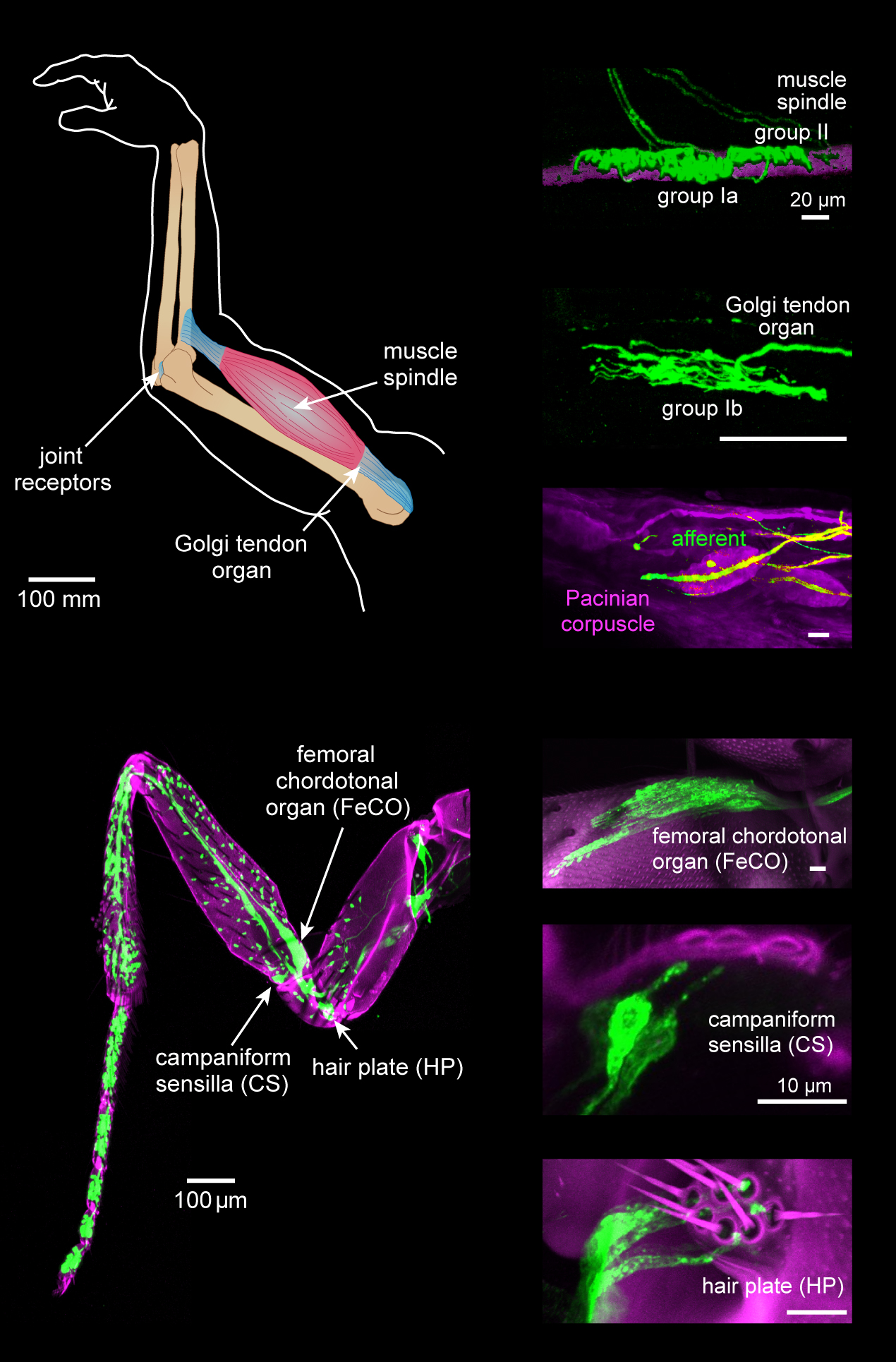
In vertebrates, limb movement and velocity (muscle length and the rate of change) are encoded by one group of sensory neurons (type Ia sensory fiber) and another type encode static muscle length (group II neurons). These two types of sensory neurons compose muscle spindles. There is a similar division of encoding in invertebrates; different subgroups of neurons of the chordotonal organ encode limb position and velocity.
To determine the load on a limb, vertebrates use sensory neurons in the Golgi tendon organs: type Ib afferents. These proprioceptors are activated at given muscle forces, which indicate the resistance that muscle is experiencing. Similarly, invertebrates have a mechanism to determine limb load: the campaniform sensilla. These proprioceptors are active when a limb experiences resistance.
A third role for proprioceptors is to determine when a joint is at a specific position. In vertebrates, this is accomplished by Ruffini endings and Pacinian corpuscles. These proprioceptors are activated when the joint is at a threshold position, usually at the extremes of joint position. Invertebrates use hair plates to accomplish this; a field of bristles located within joints that detects the relative movement of limb segments through the deflection of the associated cuticular hairs.
The sense of proprioception is ubiquitous across mobile animals and is essential for the motor coordination of the body. Proprioceptors can form reflex circuits with motor neurons to provide rapid feedback about body and limb position. These mechanosensation circuits are important for flexibly maintaining posture and balance, especially during locomotion. For example, consider the stretch reflex, in which stretch across a muscle is detected by a sensory receptor (e.g., muscle spindle, chordotonal neurons), which activates a motor neuron to induce muscle contraction and oppose the stretch. During locomotion, sensory neurons can reverse their activity when stretched, to promote rather than oppose movement.
In humans, a distinction is made between conscious proprioception and nonconscious proprioception:
Proprioception
Proprioception (/ˌproʊpri.oʊˈsɛpʃən, -ə-/ PROH-pree-oh-SEP-shən, -ə-) is the sense of self-movement, force, and body position.
Proprioception is mediated by proprioceptors, a type of sensory receptor, located within muscles, tendons, and joints. Most animals possess multiple subtypes of proprioceptors, which detect distinct kinesthetic parameters, such as joint position, movement, and load. Although all mobile animals possess proprioceptors, the structure of the sensory organs can vary across species.
Proprioceptive signals are transmitted to the central nervous system, where they are integrated with information from other sensory systems, such as the visual system and the vestibular system, to create an overall representation of body position, movement, and acceleration. In many animals, sensory feedback from proprioceptors is essential for stabilizing body posture and coordinating body movement.
In vertebrates, limb movement and velocity (muscle length and the rate of change) are encoded by one group of sensory neurons (type Ia sensory fiber) and another type encode static muscle length (group II neurons). These two types of sensory neurons compose muscle spindles. There is a similar division of encoding in invertebrates; different subgroups of neurons of the chordotonal organ encode limb position and velocity.
To determine the load on a limb, vertebrates use sensory neurons in the Golgi tendon organs: type Ib afferents. These proprioceptors are activated at given muscle forces, which indicate the resistance that muscle is experiencing. Similarly, invertebrates have a mechanism to determine limb load: the campaniform sensilla. These proprioceptors are active when a limb experiences resistance.
A third role for proprioceptors is to determine when a joint is at a specific position. In vertebrates, this is accomplished by Ruffini endings and Pacinian corpuscles. These proprioceptors are activated when the joint is at a threshold position, usually at the extremes of joint position. Invertebrates use hair plates to accomplish this; a field of bristles located within joints that detects the relative movement of limb segments through the deflection of the associated cuticular hairs.
The sense of proprioception is ubiquitous across mobile animals and is essential for the motor coordination of the body. Proprioceptors can form reflex circuits with motor neurons to provide rapid feedback about body and limb position. These mechanosensation circuits are important for flexibly maintaining posture and balance, especially during locomotion. For example, consider the stretch reflex, in which stretch across a muscle is detected by a sensory receptor (e.g., muscle spindle, chordotonal neurons), which activates a motor neuron to induce muscle contraction and oppose the stretch. During locomotion, sensory neurons can reverse their activity when stretched, to promote rather than oppose movement.
In humans, a distinction is made between conscious proprioception and nonconscious proprioception:
Recent media
Recent media