



Community hub
Recent from talks
Knowledge base stats:
Talk channels stats:
Members stats:
Masonry oven
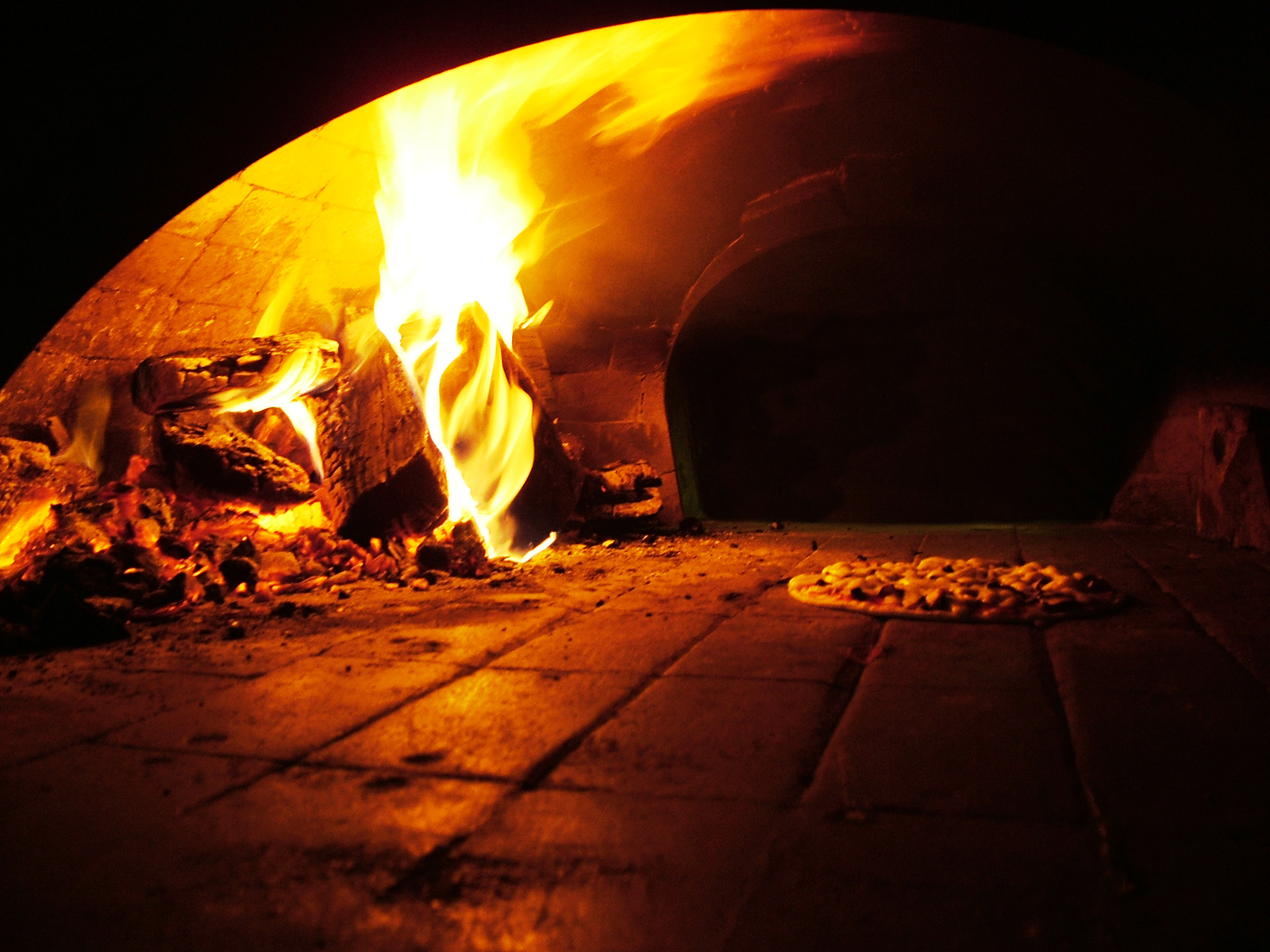
A masonry oven, colloquially known as a brick oven or stone oven, is an oven consisting of a baking chamber made of fireproof brick, concrete, stone, clay (clay oven), or cob (cob oven). Though traditionally wood-fired, coal-fired ovens were common in the 19th century, and modern masonry ovens are often fired with natural gas or even electricity. Modern masonry ovens are closely associated with artisan bread and pizza, but in the past they were used for any cooking task involving baking.
Humans constructed masonry ovens long before the advent of writing. The development of cooking technologies began when early humans started using fire to prepare food, initially through methods such as spit-roasting over open flames or embers. Starchy roots and other foods that required longer cooking times were often buried in hot ashes and sometimes covered with heated stones or more ash. For larger quantities, cooking was carried out in earth ovens, pits heated with fire and lined with hot rocks.
These techniques are still in use today and are well-represented in the archaeological record. However, true masonry ovens, constructed from materials like clay, brick, or stone, only began to appear with the advent of grain agriculture and the baking of bread. Beer, likely an early source of wild yeast, may have played a role in the development of leavened bread. Ancient Egyptian depictions show bakers placing dough on hot stones and covering it with heated clay pots, an early form of enclosed baking. Over time, these single-loaf devices evolved into larger ovens capable of baking multiple loaves. Construction methods progressed from pits and clay domes to more permanent brick and stone vaults.
In the modern Arab states of the Persian Gulf, masonry ovens are traditionally used to bake khubz, a type of flatbread. In South Asia, tandoor ovens, originally made of clay, are widely used in India and Pakistan, although contemporary versions may be electrically powered. The open-topped design of the tandoor represents a transitional form between the earth oven and enclosed masonry ovens. In the pre-Columbian Americas, similar ovens were constructed from clay or adobe and are now commonly referred to by the Spanish term horno, meaning "oven". Hornos remain traditional in the American Southwest.
The classic direct-fired masonry oven, often referred to as a "black oven" or "Roman oven", dates back to at least the Roman Republic. The term "black oven" derives from the soot deposited by the internal fire on the oven's dome. These ovens were frequently built for communal use. For example, in France, banal ovens were publicly owned and rented out to individuals for a fee. Such ovens became common in colonial-era America and are still used today in artisanal bakeries, pizzerias, restaurants and even in home and backyard settings.
A later innovation, the "white oven", is fired externally so that flame and soot do not enter the baking chamber. This design is commonly integrated into masonry heater systems. A hybrid design, known in France as the gueulard, combines features of both internal and external firing systems.
Masonry ovens remain popular in part because of the way their use affects cooking processes and food flavor. Where modern gas or electric ovens cook food by moving hot air around inside an insulated, lightweight box, a masonry oven works by soaking up heat, like a battery building up a full charge. When hot, the heavy oven walls release the heat slowly, for hours. Thus the food is cooked not only by hot air but also by radiant heat from hot dense masonry and especially for bread and pizza, which are not cooked in pans, heat conducted directly into the food from hot floor bricks (bakers call the resulting added rising action of bread "oven spring".) Finally, a masonry oven seals in the steam produced by the water in cooking food. A supercharged steamy atmosphere produces a more flavorful and chewy crust (see Maillard reaction); it also keeps other foods moist and tender. The triple combination of radiant, conductive, and convected heat also speeds cooking.
Wood-burning masonry ovens are mandated for production of true Neapolitan pizza.
Hub AI
Masonry oven AI simulator
(@Masonry oven_simulator)
Masonry oven
A masonry oven, colloquially known as a brick oven or stone oven, is an oven consisting of a baking chamber made of fireproof brick, concrete, stone, clay (clay oven), or cob (cob oven). Though traditionally wood-fired, coal-fired ovens were common in the 19th century, and modern masonry ovens are often fired with natural gas or even electricity. Modern masonry ovens are closely associated with artisan bread and pizza, but in the past they were used for any cooking task involving baking.
Humans constructed masonry ovens long before the advent of writing. The development of cooking technologies began when early humans started using fire to prepare food, initially through methods such as spit-roasting over open flames or embers. Starchy roots and other foods that required longer cooking times were often buried in hot ashes and sometimes covered with heated stones or more ash. For larger quantities, cooking was carried out in earth ovens, pits heated with fire and lined with hot rocks.
These techniques are still in use today and are well-represented in the archaeological record. However, true masonry ovens, constructed from materials like clay, brick, or stone, only began to appear with the advent of grain agriculture and the baking of bread. Beer, likely an early source of wild yeast, may have played a role in the development of leavened bread. Ancient Egyptian depictions show bakers placing dough on hot stones and covering it with heated clay pots, an early form of enclosed baking. Over time, these single-loaf devices evolved into larger ovens capable of baking multiple loaves. Construction methods progressed from pits and clay domes to more permanent brick and stone vaults.
In the modern Arab states of the Persian Gulf, masonry ovens are traditionally used to bake khubz, a type of flatbread. In South Asia, tandoor ovens, originally made of clay, are widely used in India and Pakistan, although contemporary versions may be electrically powered. The open-topped design of the tandoor represents a transitional form between the earth oven and enclosed masonry ovens. In the pre-Columbian Americas, similar ovens were constructed from clay or adobe and are now commonly referred to by the Spanish term horno, meaning "oven". Hornos remain traditional in the American Southwest.
The classic direct-fired masonry oven, often referred to as a "black oven" or "Roman oven", dates back to at least the Roman Republic. The term "black oven" derives from the soot deposited by the internal fire on the oven's dome. These ovens were frequently built for communal use. For example, in France, banal ovens were publicly owned and rented out to individuals for a fee. Such ovens became common in colonial-era America and are still used today in artisanal bakeries, pizzerias, restaurants and even in home and backyard settings.
A later innovation, the "white oven", is fired externally so that flame and soot do not enter the baking chamber. This design is commonly integrated into masonry heater systems. A hybrid design, known in France as the gueulard, combines features of both internal and external firing systems.
Masonry ovens remain popular in part because of the way their use affects cooking processes and food flavor. Where modern gas or electric ovens cook food by moving hot air around inside an insulated, lightweight box, a masonry oven works by soaking up heat, like a battery building up a full charge. When hot, the heavy oven walls release the heat slowly, for hours. Thus the food is cooked not only by hot air but also by radiant heat from hot dense masonry and especially for bread and pizza, which are not cooked in pans, heat conducted directly into the food from hot floor bricks (bakers call the resulting added rising action of bread "oven spring".) Finally, a masonry oven seals in the steam produced by the water in cooking food. A supercharged steamy atmosphere produces a more flavorful and chewy crust (see Maillard reaction); it also keeps other foods moist and tender. The triple combination of radiant, conductive, and convected heat also speeds cooking.
Wood-burning masonry ovens are mandated for production of true Neapolitan pizza.