


Community hub
Recent from talks
Contribute something
Nothing was collected or created yet.
Broome Hall
View on Wikipedia

Key Information


.jpg)
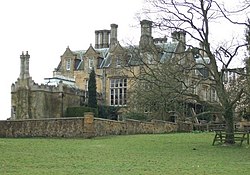
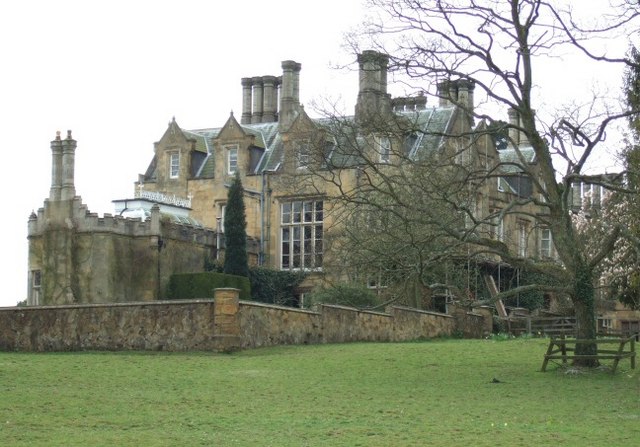
Broome Hall is a Grade II-listed country house with grounds including cottages and outhouses on the wooded, upper southern slopes of the Greensand Ridge near Coldharbour in Surrey, England.
It was built around 1830 for the politician and printer Andrew Spottiswoode, and had a succession of similarly wealthy family owners before the main house was converted into eleven flats, each separately owned, in the late 20th century. It was owned, for a number of years in the 1970s, by actor Oliver Reed.
Broom(e) refers to the genus (and specifically several species) of often flowering plants Genisteae (along with gorse, lupins and laburnum). Along with evergreens, broom dominates the sandy soil in the region.
19th century
[edit]The house was built about 1830 for the printer-politician and investor Andrew Spottiswoode, and extended in the late 19th century for Sir Alexander Brown, 1st Baronet.[2] It was also home from 1865 to the international merchant-politician Frederick Pennington (died 1914) and his suffragette wife, Margaret.[3][4]
20th century
[edit]In the Second World War, it served as headquarters of Canadian forces in Britain. Its gravel drive was reinforced with concrete to withstand the weight of tanks.[5]
In 1954, the White Fathers, Christian missionaries in Africa and an order of monks, bought the property and used it as their British novitiate, for training new monks.[5]
The actor Oliver Reed bought the 56-bedroom property in 1971[6][7][8] and became the so-called "Master of Broome Hall" for eight years.[9][5] Reed only bought the house because he was looking for a field for a horse he had bought from Johnny Kidd, the father of future supermodel Jodie Kidd, who ran a stud farm in Ewhurst.[6] He then spent a fortune renovating it.[9] The naked wrestling scene with Reed and Alan Bates in Ken Russell's 1969 film Women in Love is said to have been filmed there.[5] Reed was banned from his local pub there for descending a chimney naked and shouting out: "Ho! Ho! Ho! I'm Santa Claus."[5] According to an estate agent's negotiator, Reed buried the jewellery collection of a former girlfriend in the grounds where it still lies.[5]
The house was then bought by a property developer who converted it into flats.[5] It was assessed and recognised as a Grade II-listed building in 1987.[2]
References
[edit]- ^ Andrew Spottiswoode. National Portrait Gallery. Retrieved 13 August 2018.
- ^ a b Historic England. "Broome Hall (Grade II) (1028759)". National Heritage List for England. Retrieved 11 August 2018.
- ^ "The Country Estates - Dorking Museum & Heritage Centre". Dorking Museum & Heritage Centre. Retrieved 12 August 2018.
- ^ Crawford, Elizabeth. (2006). The Women's Suffrage Movement in Britain and Ireland: A Regional Survey. Abingdon: Routledge. ISBN 9781136010545.
- ^ a b c d e f g Vendrickas, Ginetta (15 March 2007). "Still reeling from its colourful past". The Telegraph. Retrieved 12 August 2018.
- ^ a b "Oliver Reed at home in Broom Hall". 17 January 1977. Retrieved 19 November 2022.
- ^ "Oliver Reed At Home". gettyimages.co.uk. Retrieved 19 November 2022.
- ^ Toner, Niall (28 April 2013). "Dad swept in and the wild times began". The Sunday Times. Retrieved 19 November 2022.
- ^ a b Martin, Guy (10 July 2013). "Oliver Reed's unique lifestyle remembered in new book". SurreyLive. Retrieved 12 August 2018.
Further reading
[edit]- Sellers, Robert. (2014) What Fresh Lunacy is This? London: Constable.
External links
[edit]- Oliver Reed at home in Broom Hal - Nationwide, BBC Archive, with Valerie Singleton, originally broadcast 17 January, 1977
 Media related to Broome Hall at Wikimedia Commons
Broome Hall
View on GrokipediaHistory
Construction and 19th-century ownership
Broome Hall was constructed circa 1830 as a country house on the Greensand Ridge near Coldharbour in Surrey for Andrew Spottiswoode (1787–1866), a Scottish-born printer, publisher, and politician who served as Member of Parliament for Saltash (1826–1830) and Colchester (1831).[1][6] Spottiswoode, head of the prominent printing firm Eyre & Spottiswoode—which held the position of Queen's Printer from 1838 and produced official government documents and Bibles—commissioned the house as a private residence amid the wooded slopes below Leith Hill, reflecting the era's trend among industrial and political elites to establish rural estates symbolizing wealth and status derived from London's burgeoning print trade.[7][8] Spottiswoode resided at Broome Hall until his death in 1866, after which ownership passed to subsequent affluent figures, including members of the Labouchere family, such as John Peter Labouchere (1798–1863), a banker whose family maintained ties to the property during the mid-19th century.[9] The estate then became the seat of J. W. Pennington, a Liberal Member of Parliament for Stockport, underscoring its appeal to politically connected industrialists and financiers in an age of expanding railway and trade networks that facilitated such gentry lifestyles.[10][11] By the late 19th century, Broome Hall was acquired by Sir Alexander Hargreaves Brown (1844–1922), a banker and Conservative MP for Wenlock, who undertook extensions to the original structure, adapting it further to Victorian tastes while preserving its role as a symbol of establishment prosperity linked to London's financial and printing sectors.[1][10] These ownership transitions highlight the house's function as a retreat for Britain's emerging mercantile and parliamentary class, unencumbered by aristocratic precedents but grounded in self-made fortunes from commerce and governance.[10]Early 20th-century ownership and modifications
In the early 20th century, Broome Hall continued as a private country estate under the ownership of affluent individuals, transitioning from Frederick Pennington, who had resided there since 1865, until his death on 3 February 1914 at age 94.[4] Pennington, a former Liberal MP for Totnes (1857–1865), maintained the property as a venue for weekend gatherings of politicians, artists, and literati, reflecting its role in Edwardian social circles amid the pre-World War I stability of Britain's landed elite.[12] Upon Pennington's death, ownership passed to Sir Alexander Hargreaves Brown, 1st Baronet (1844–1922), a merchant banker, shipowner, and former Liberal Unionist MP for Wenlock (1885–1906), who held the estate from 1914 until his passing on 12 March 1922.[4] Brown, elevated to baronetcy as "of Broome Hall, Holmwood, Surrey" in 1903, oversaw the property during a period of minor adaptations to Edwardian tastes, including upkeep of its sandstone ashlar structure and late-19th-century extensions he had previously commissioned, such as additional wings to accommodate family and staff.[1] These changes emphasized functionality for a large household—evidenced by the presence of his son Captain Gordon Hargreaves Brown (1880–1914), who lived there until his wartime death—while preserving the Regency Gothic core built circa 1830.[13] Following Brown's death, the estate inherited through familial lines to successors bearing the Pigott-Brown baronetcy, ensuring continuity as a private residence into the interwar years despite broader challenges to British country houses from post-1918 death duties, agricultural depression, and rising maintenance costs that prompted sales or demolitions of over 1,000 similar properties by 1939.[14] Broome Hall's relative stability stemmed from its owners' commercial wealth—Brown's Liverpool shipping and banking interests provided resilience against these fiscal pressures—allowing sustained elite use without major structural overhauls or fragmentation until the eve of World War II.[4] Historical records indicate no recorded sales or distress disposals, contrasting with the era's gentry retrenchment, and underscore proactive maintenance that foreshadowed its later Grade II listing for architectural integrity.[1]Use during World War II
During World War II, Broome Hall was requisitioned for use by the Canadian armed forces as a headquarters facility in Britain, operating from roughly 1940 to 1945 to support command and logistical functions amid the buildup of Allied operations.[11][4] To accommodate heavy military traffic, the estate's gravel driveway was surfaced with concrete reinforcements capable of bearing the weight of tanks and other vehicles, reflecting practical adaptations for vehicular access and parking in proximity to the main house.[11] This temporary military occupation prioritized operational utility, with the estate's outbuildings and grounds leveraged for storage and support activities, though detailed records of troop deployments or specific command operations at the site are sparse in declassified archives.[11] The structure and infrastructure remained largely intact following demobilization, facilitating its handover back to private hands without documented extensive repairs.[11]Post-war missionary seminary (1950s–1970s)
In 1954, the Society of Missionaries of Africa, commonly known as the White Fathers, acquired Broome Hall from Mrs. Pigott-Brown to serve as their British novitiate for training prospective missionaries destined primarily for evangelization and education in Africa.[15][16] The property, a Victorian mansion near Dorking in Surrey, provided spacious accommodations for novices undergoing initial formation, including philosophy studies and spiritual preparation that emphasized monastic discipline and community life.[17] By 1955, it functioned fully as a seminary, housing students from England, the Netherlands, and occasionally Africa, such as novices Ron and Josaphat, who participated in daily routines of Mass, retreats, prayer, and communal activities like walks and swimming in the estate's lake to build camaraderie and resilience for missionary hardships.[16] The training program focused on forming priests and brothers committed to the society's apostolic work amid Africa's decolonization era, with instruction in theology, languages relevant to African contexts, and practical skills for rural outreach, reflecting the White Fathers' charter since their 1868 founding to convert Africa through inculturation and self-reliance.[18] Key staff included figures like Fr. Len Marchant and Fr. van den Bosch, who oversaw spiritual direction and procuratorship. In the early 1960s, a chapel was established on the grounds to support liturgical needs, accommodating the growing emphasis on Eucharistic-centered formation without major structural expansions to the main house.[16] Operations continued through the 1960s, with the novitiate adapting to post-Vatican II shifts by renaming the core year the "Spiritual Year" around 1969, but enrollment dwindled due to broader declines in religious vocations across Catholic orders. In 1971, the society closed the Broome Hall facility, transferring remaining novices—including staff like Fr. Mike Targett, recently returned from Ghana—to Birkdale for consolidation, marking the end of its seminary role after 17 years.[16] This transition aligned with the White Fathers' efforts to streamline formation amid fewer entrants, prioritizing efficiency over dispersed provincial houses.[16]Oliver Reed's residency and associated events (1960s–1980s)
Actor Oliver Reed purchased Broome Hall in 1971 from its previous monastic owners, acquiring the 56-bedroom Victorian mansion in Surrey's Coldharbour area.[19] He resided there for about eight years, utilizing the expansive property as a private retreat amid his active film career in the 1970s.[20] Reed embraced the estate's grandeur, styling himself as the "Master of Broome Hall" and undertaking renovations shortly after acquisition, as documented in photographs from December 1971 showing him working on the premises.[21] Reed's residency featured his characteristic hard-living habits, including lavish parties that drew local attention and reinforced his public image as a hellraiser.[22] A infamous episode occurred when Reed descended the chimney of a nearby pub naked, shouting "Ho! Ho! Ho! I'm Santa Claus," leading to his ban from the Coldharbour establishment—a detail corroborated across contemporary accounts of his antics.[23] [24] Such behaviors exemplified Reed's unbridled persona, though they strained relations with locals and maintenance of the aging hall, which required ongoing repairs during his tenure.[25] By the late 1970s, Reed sold Broome Hall amid escalating personal declines, including worsening health effects from chronic heavy drinking such as gout and kidney strain, prompting his move to Guernsey as a tax exile.[4] The sale aligned with his broader lifestyle challenges, which had intensified alcohol-related issues documented in medical warnings by the mid-1980s, though direct property ties to specific health episodes remain anecdotal.[26] The estate's disposal marked the end of Reed's Surrey era, transitioning the property toward later conversions.[27]Late 20th- and 21st-century developments
Following Oliver Reed's sale of the property in the early 1980s, Broome Hall was purchased by a property developer who subdivided the main house into residential apartments while converting associated estate buildings into mews houses.[23] The structure was designated a Grade II listed building in 1987, recognizing its architectural and historical value despite the alterations.[1] Subsequent ownership included comedian Jim Davidson, who held the property until 2004, when it was sold to businessman Spencer Day for £2.5 million.[28] Day undertook extensive refurbishments costing approximately £5 million, addressing wear from prior intensive use and adapting spaces for modern residential purposes while adhering to listing constraints.[28] The estate faced market challenges, with a 2009 listing at a guide price exceeding £10 million failing to attract buyers, leading to a 2018 auction at a reduced valuation reflecting property market fluctuations and the multi-unit configuration.[28] [29] Broome Hall maintains its status as private residential apartments on the outskirts of Dorking, with no recorded public access or commercial event usage amid ongoing obligations for listed building maintenance to preserve its fabric against natural decay.[30]Architecture and estate
The main house
Broome Hall's main house is a two-storey structure with attics, constructed circa 1830 and extended in the late 19th century, featuring sandstone blocks with ashlar copings and dressings, slate roofs, and stone stacks.[1] The entrance front adopts an L-shaped plan with double wings, incorporating gabled dormers, oriel windows, and a vaulted portico displaying a coat of arms.[1] Mullioned and transomed windows with leaded casements, alongside angle bays and multiple chimney stacks, contribute to its architectural character.[1] The garden front includes a Gothic-style cloister, battlemented parapet, and perpendicular elements, reflecting a blend of Regency and early Victorian influences atypical of simpler vernacular Surrey manor houses, which often emphasize timber framing or plain brickwork over such ornamental detailing.[1] Internally, original features persist despite subdivision into multiple units, including a conservatory with a coved glazed roof and wrought-iron railings.[1] The building's designation as Grade II listed in 1987 recognizes its special architectural and historic interest under the Planning (Listed Buildings and Conservation Areas) Act 1990, affirming the retention of core fabric amid later modifications.[1] ![Broome Hall main house exterior][float-right]Grounds, gardens, and outbuildings
The grounds of Broome Hall include a walled garden, a fishing lake, and tennis courts, which date to the 19th-century development of the estate.[11] [23] These features supported recreational and ornamental uses for residents and guests, with the tennis courts remaining accessible into the 21st century despite the estate's subdivision into private shares.[23] A rectangular lawn bordered by gravel paths connects to a secluded slope garden, characterized by rose arbors that enhance its formal yet intimate design.[11] This "secret garden" exemplifies period landscaping practices, integrating terraced elements to navigate the site's natural topography on the Greensand Ridge. The broader estate occupies wooded slopes of the Greensand Ridge, providing a naturalistic backdrop with informal paths traversing the terrain for access and leisure.[11] Outbuildings, including staff and guest cottages, complement the main house and were adapted for varied purposes, such as during World War II when the site served as a military headquarters.[4] These structures underscore the estate's evolution from a self-contained rural retreat to a multifunctional property.Cultural and historical significance
Role in film and media
References
- https://en.wikisource.org/wiki/Page:The_Victoria_History_of_the_County_of_Surrey_Volume_3.djvu/188
- https://en.wikisource.org/wiki/Catholic_Encyclopedia_%281913%29/White_Fathers