


Community hub
Recent from talks
Contribute something
Nothing was collected or created yet.
Novitiate
View on Wikipedia | This article relies largely or entirely on a single source. (December 2023) |

The novitiate, also called the noviciate, is the period of training and preparation that a Christian novice (or prospective) monastic, apostolic, or member of a religious order undergoes prior to taking vows in order to discern whether they are called to vowed religious life. It often includes times of intense study, prayer, living in community, studying the vowed life, deepening one's relationship with God, and deepening one's self-awareness. In the Catholic Church, the canonical time of the novitiate is one year; in case of additional length, it must not be extended over two years.[1] In religious communities belonging to the Evangelical-Lutheran Churches, the duration of the novitiate depends on the specific Evangelical-Lutheran monastery or convent; for example, for the Sisters of St. Francis at Klaradals Convent, the time spent as a novice is typically two to three years.[2] In the Eastern Orthodox Church, the novitiate is officially set at three years before one may be tonsured a monk or nun, though this requirement may be waived. The novitiate is in any case a time both for the novice to get to know the community and the community to get to know the novice. The novice should aspire to deepening their relationship to God and discovering the community's charism. The novitiate in many communities includes a concentrated program of prayer, study, reflection and limited ministerial engagement.
The novitiate, through which life in an institute is begun, is arranged so that the novices better understand their divine vocation, and indeed one which is proper to the institute, experience the manner of living of the institute, and form their mind and heart in its spirit, and so that their intention and suitability are tested.
- —CIC, can. 646
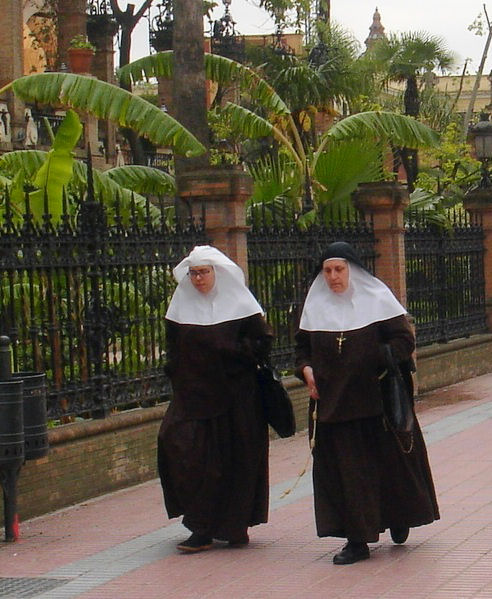
In some novitiate communities, mostly monastic, the novice often wears clothing that is distinct from secular dress but is not the full habit worn by professed members of the community. The novices' day normally includes participation in the canonical hours, manual labor, and classes about the religious life. Spiritual exercises and tests of humility are common features of a novitiate.
A superior should ideally appoint an experienced member of the community to serve as novice master or mistress.
Different religious communities have varying requirements for the duration of the novitiate. The novice must complete a postulancy before being admitted to the novitiate, the duration of which can be short or extend up to three years.
A novice is free to leave the novitiate at any time and in most communities, the superiors are free to dismiss them with or without cause. At the end of the novitiate, the novices are either admitted to temporary vows or asked to leave. The binding, life-long commitment to consecrated life comes at a later point.
The term novitiate also refers to the building, house, or complex devoted to the novices' cells or dormitory and other needs, such as study and education.
References
[edit]- ^ CIC, canon 648
- ^ "Systraskapet" (in Swedish). Klaradals Kloster. 2025. Retrieved 21 October 2025.
Så småningom kan hon komma som postulant, för att ungefär ett år leva och arbeta tillsammans med systrarna. Nästa steg är att träda in i systraskapet som novis för två till tre år. Sedan kan hon avlägga löftena om fattigdom, kyskhet och lydnad för tre år, och efter det kan hon avlägga dem för livet. Vid varje steg sker en prövning, för att både hon själv och systraskapet skall kunna urskilja vad som är Guds vilja för fortsättning. När alla är ense om det, kan ett nytt steg tas.


| International | |
|---|---|
| Other | |

Novitiate
View on GrokipediaDefinition and Terminology
Definition
A novitiate is the probationary period of training and initiation for a novice entering a Christian religious order, monastic community, or similar group, during which the individual discerns and prepares for profession of vows. This stage marks the formal beginning of life within the community, where novices undergo structured formation to assimilate its charism, spirituality, and communal practices under the guidance of a designated director. In essence, it serves as a time of trial and education, distinct from preliminary or subsequent phases, to foster a deep integration into the religious vocation.[2] The primary purpose of the novitiate is to facilitate vocational discernment for both the novice and the community, enabling the individual to clarify their call to religious life through intensive prayer, doctrinal study, communal living, and personal self-examination. It allows for mutual assessment, ensuring that the novice's suitability aligns with the community's mission while the community evaluates the candidate's readiness for full commitment. This process emphasizes spiritual growth. Key characteristics of the novitiate include a deliberate withdrawal from secular pursuits to focus exclusively on formation. During this time, novices engage in a regimen tailored to the community's traditions, prioritizing interior development, though some traditions may incorporate limited external activities. This temporary commitment underscores its probationary nature, providing space for growth without the finality of professed membership.[2] The novitiate is distinct from the preceding postulancy, which is an introductory phase of discernment and acclimation without formal entry into the community, and from profession, the subsequent step of pronouncing vows that bind the individual to the community. While postulancy often involves initial contact and basic orientation, the novitiate intensifies formation; profession then consummates the commitment begun in the novitiate.Etymology and Usage
The term "novitiate" derives from the Latin novitius, meaning "newcomer" or "newly arrived," which itself stems from novus, signifying "new." This Late Latin adjective novicius evolved into Medieval Latin novitiatus, referring to the state of being a novice, and entered English either directly from this Latin form or via Middle French noviciat around the early 16th century, with the first attested use in English dated to 1517–1518.[3][4][5] Historically, the term was first applied to the probationary period in monastic rules, particularly within Benedictine traditions, where the Rule of St. Benedict (circa 530 CE) outlines a structured novitiate for testing a candidate's vocation through study, obedience, and endurance of trials, lasting at least one year before profession of vows. This usage emphasized initiation into communal religious life, with the novice living separately under supervision to discern their commitment.[6] In modern contexts, "novitiate" primarily denotes the probationary phase in Christian religious orders, but it has extended metaphorically to secular apprenticeships or initiatory periods, describing the beginner stage in any discipline, such as "the novitiate of a young artist." It also refers to the physical quarters housing novices, known as a novitiate house. Variations include the alternative spelling "noviciate," more common in British English, and phrases like "novice period" in some Protestant traditions, such as Anglican communities, where formal monastic novitiates are less emphasized but probationary phases persist.[7][8][9]Historical Development
Origins in Early Christianity
The concept of the novitiate in early Christianity drew its roots from Jewish apprenticeship models, where disciples underwent periods of instruction and testing under rabbinic or prophetic guidance, as seen in the ascetic practices of groups like the Therapeutae and the solitary lives of figures such as Elijah and John the Baptist.[10] These influences merged with the communal structures of apostolic communities described in the New Testament, particularly the shared life in Acts 2:44-47 and 4:32-35, where new believers were integrated through teaching, prayer, and mutual support to foster spiritual maturity.[11] As Christianity expanded beyond Jewish contexts in the 2nd and 3rd centuries, these elements evolved into more structured ascetic formations, laying the groundwork for monastic probationary practices amid growing emphasis on renunciation and discipline.[12] The novitiate was formalized in 4th-century monasticism, particularly through the rules established in Egyptian and Syrian desert communities, where aspirants to the monastic life underwent supervised probation to discern their vocation. St. Basil the Great's Longer Rules (c. 370 AD), composed for his communities in Cappadocia, outlined a rigorous admission process involving examination of the candidate's past life, confession of sins, and attachment to a stern superior for testing in humility, obedience, and renunciation of personal will.[13] This probation served as a gradual initiation, ensuring candidates memorized Scripture, observed silence, and performed communal labor under oversight, with full admission requiring community consent and public profession.[13] John Cassian's Institutes of the Coenobia (c. 420 AD), drawing from his experiences in Egyptian monasteries like those of Tabenna, further detailed the novice testing process as an "ordeal" to probe perseverance and detachment from worldly ties.[14] Novices were initially rejected at the monastery gates for up to ten days, enduring insults to demonstrate steadfastness, followed by scrutiny for hidden possessions and assignment to an elder for a year of supervised labor and instruction in monastic garb, prayer, and vices.[14] Failure in obedience led to expulsion, with preserved belongings returned, emphasizing the novitiate's role in purifying motives and building endurance against temptations.[14] The initial purpose of the novitiate was to safeguard against impulsive vows, providing time for instruction in core ascetic virtues—poverty, chastity, obedience, and manual work—while protecting communities from unfit members who might disrupt harmony.[14] In Basil's framework, this period cultivated a "clean vessel" for divine grace through unquestioning submission, aligning personal conduct with Gospel ideals.[13] Cassian highlighted its protective function by comparing hasty entrants to "thieves" who steal monastic peace, underscoring testing as essential for genuine conversion.[14] These Eastern practices spread rapidly through Egyptian centers founded by Pachomius (c. 320 AD) and Syrian anchors like those influenced by Basil, where probationary formation became standard for cenobitic life.[15] Cassian's transmission of these traditions to the West via his writings profoundly shaped Latin monasticism, notably informing St. Benedict of Nursia's Rule (c. 530 AD), which adapted the novice year of testing (Chapter 58) from Eastern models to emphasize listening to the master's instructions and communal integration.[16][17] This influence ensured the novitiate's endurance as a foundational rite across Christian monastic traditions.[16]Medieval and Post-Reformation Evolution
The novitiate in Western monasticism was formalized in the early medieval period through the Rule of St. Benedict, composed around 530 AD, which prescribed a one-year probationary period for entrants to test their suitability for communal life under the abbot's guidance, including the right to depart if unable to persevere.[6] This structure emphasized spiritual formation, obedience, and familiarity with the monastic discipline, marking a shift from earlier, less standardized practices in early Christianity. The Rule's provisions for the novitiate, detailed in Chapter 58, required reading the entire Rule to the novice in stages over the year to ensure informed commitment.[18] The influence of Benedict's Rule spread widely through monastic reforms in the 10th and 11th centuries, notably the Cluniac movement founded in 910 at the Abbey of Cluny in Burgundy, which centralized oversight of affiliated houses while adhering strictly to the Rule's novitiate requirements to restore discipline amid feudal disruptions.[19] Similarly, the Cistercian reform, established in 1098 at Cîteaux, reinforced the one-year novitiate as part of its austere return to primitive Benedictinism, emphasizing manual labor and poverty alongside spiritual probation, and rapidly expanding to over 300 houses by the mid-12th century.[20] These reforms preserved and propagated the novitiate as a foundational rite of passage, adapting it to broader European contexts without altering its core duration. In the 13th century, the rise of mendicant orders like the Franciscans and Dominicans integrated the novitiate into their itinerant, apostolic charisms, with Pope Innocent III's decree in 1210 mandating a minimum one-year period to prevent hasty professions and ensure preparation in poverty, chastity, and obedience, while emphasizing intellectual study for preaching and evangelical work.[18] The Franciscan Rule, approved in 1223, and the Dominican constitutions of 1228, both incorporated this probationary year, tailoring it to foster radical poverty for Franciscans and doctrinal study for Dominicans, amid the Fourth Lateran Council's broader regulations on religious life.[21] The Reformation in the 16th century prompted divergent evolutions: Protestant reformers, led by Martin Luther, rejected monastic vows and the novitiate as unbiblical works-righteousness, dissolving many communities and viewing them as distractions from universal priesthood, though limited monastic retention occurred in Lutheran contexts like certain German houses.[22] In response, the Catholic Church's Council of Trent (1545–1563) standardized the novitiate at a minimum of one year in an approved house, uninterrupted and under a qualified master, to validate professions and counter Protestant critiques by reinforcing formation in evangelical counsels.[18] Anglican traditions, emerging from the English Reformation, largely suppressed monasticism initially but saw revivals in the 19th century, preserving novitiate-like probation in emerging communities influenced by the Oxford Movement.[23] Amid 19th-century secularization and revolutionary upheavals, Catholic revival movements such as Ultramontanism bolstered the novitiate's role by promoting papal authority and religious renewal, with Pope Pius IX's 1851 encyclical mandating common life in dedicated novitiate houses to deepen formation against liberal pressures.[18] This reinforcement aligned with broader restorations of orders, ensuring the novitiate remained a vital safeguard for vocational discernment in an era of declining vocations and state encroachments on religious freedom.[24]Novitiate in Christianity
Catholic Practices
In the Roman Catholic Church, the novitiate represents a critical phase of formation in religious institutes, governed primarily by Canons 646–653 of the 1983 Code of Canon Law. This period initiates the candidate's life within the institute, aiming to deepen their understanding of their divine vocation, foster an experience of the community's manner of living, and cultivate the mind and heart in the spirit of the institute through a process of discernment and testing of suitability.[1] The novitiate typically follows a preparatory postulancy, during which candidates further discern their call, and must last at least twelve months spent within the novitiate community itself for validity, though the overall period cannot exceed two years.[25] Extensions of up to six months are permitted if doubts arise regarding the novice's suitability, ensuring a thorough evaluation before progression.[1] Central to the novitiate is the role of the novice master (or director), a perpetually professed religious legitimately appointed by the institute's superiors, who bears primary responsibility for the novices' integral formation.[1] This includes discerning each novice's vocation, nurturing virtues such as prayer, self-denial, and obedience, and immersing them in the institute's charism through doctrinal instruction, liturgical participation, and scriptural study, all in accordance with the institute's proper law.[1] The broader community supports this guidance by providing a stable environment that exemplifies fraternal life and the evangelical counsels, while the novice master collaborates with superiors to ensure balanced human, spiritual, and apostolic development.[25] Absences from the novitiate house are strictly regulated—exceeding three months invalidates the period, and shorter interruptions require compensation—to maintain focus on this formative immersion.[1] Novices typically adopt a simplified habit distinct from the full religious garb of professed members, serving as a visible symbol of their transitional and probationary commitment without implying full incorporation.[18] They refrain from public ministry during this time to prioritize interior growth and detachment, though limited apostolic activities may occur in the novitiate's second year if they align with the formation program and reinforce the unity of contemplation and action.[25] The novitiate concludes with the admission of suitable candidates to temporary profession of the evangelical vows of poverty, chastity, and obedience, typically in a liturgical rite connected to the Eucharist; those deemed incompatible may be dismissed by the superiors, preserving the integrity of the institute.[1] Novices retain the freedom to withdraw at any point, underscoring the voluntary nature of this discernment.[1]Eastern Orthodox and Oriental Traditions
In the Eastern Orthodox tradition, the novitiate serves as a probationary period for candidates seeking monastic life, typically lasting a minimum of three years before tonsure into the rassophore stage, where initial monastic vows are taken; this duration may be shortened to as little as six months in exceptional cases for experienced candidates.[26] During this time, novices wear simple black garments without a monastic hood and focus on testing their vocation through communal prayer, manual labor, and spiritual guidance under the monastery's superior.[27] Key rituals emphasize the rassophore stage as the entry point following the novitiate, marked by the first tonsure and receipt of a cassock and prayer rope, symbolizing commitment to monastic discipline. Central to this formation is the practice of hesychasm, a tradition of inner stillness and unceasing noetic prayer—often the Jesus Prayer—pursued alongside strict obedience to one's spiritual elder, which purifies the soul and fosters divine grace.[28] Obedience is paramount, viewed as an imitation of Christ that calms the mind and enables theological insight, with novices submitting fully to their elder's direction in daily life and prayer.[28] The community role of novices underscores deep elder-disciple relationships, where the novice acts as a spiritual child, often isolated in cells for contemplation and hesychastic prayer to cultivate humility and detachment from worldly concerns.[29] In Oriental Orthodox traditions, such as the Coptic and Armenian churches, the novitiate integrates intensive liturgical training with monastic formation, preparing candidates for roles in divine services alongside vows of chastity, poverty, and obedience. Coptic novices undergo a testing period of at least three years in monasteries, involving daily participation in midnight praises, the Divine Liturgy, and recitation from the Book of Hours to deepen liturgical proficiency.[30] In Armenian traditions, the novitiate lasts eight years, during which candidates prepare for monastic life under St. Basil's rule, including strict fasting. Similar probationary periods exist in other Oriental Orthodox traditions, such as the Syriac and Ethiopian churches, focusing on monastic vows and liturgical formation, though durations vary by monastery.[15]Protestant and Anglican Variations
In Protestant and Anglican traditions, the novitiate-like period is generally less formalized than in Catholic practice, often emphasizing discernment, community integration, and theological education rather than strict ascetic isolation or perpetual vows. Anglican religious communities, such as the Society of St. John the Evangelist (SSJE), maintain a structured yet adaptable formation process influenced by Benedictine models of conversion and communal discernment.[31] In SSJE, the novitiate typically lasts two years, with the possibility of extension to a third year, during which novices engage in progressive initiation into community life, including spiritual disciplines, scriptural study, Christian doctrine, and practical work to foster obedience, humility, and generosity.[31] Novices receive guidance from a novice guardian and senior brothers, culminating in a retreat and evaluation leading to initial vows, but with limited early involvement in external ministries to prioritize inner formation.[31] Lutheran and Reformed traditions exhibit even greater variation in probationary periods, often prioritizing theological study and practical ministry over intensive asceticism, reflecting the Reformation's critique of medieval monastic excesses. For instance, in the Order of Lutheran Franciscans, formation begins with a minimum 12-month postulancy focused on learning the order's rule and building relationships, followed by a novitiate of at least five years emphasizing vows of poverty, chastity, and obedience alongside cohort-based theological exploration.[32] This extended phase allows novices to test their commitment through renewable annual vows, integrating scriptural study with communal living in a way that aligns Lutheran emphases on grace and faith. Reformed communities, being rarer, adapt similar models; probationary times vary but commonly stress discernment for mission-oriented service, with less rigid separation from lay involvement.[32] Evangelical orders, such as the ecumenical Taizé Community with its Protestant roots, feature informal candidacy periods centered on mission discernment and reconciliation. New brothers at Taizé begin with several months of voluntary work during community meetings, transitioning to residence in the brothers' house while studying the Bible, theology, and practical tasks like welcoming visitors.[33] This initial phase, part of a broader six-year formation, lasts roughly six months to two years before deeper commitments, focusing on ecumenical prayer, simplicity, and outreach rather than formal vows.[33] A key distinction across these traditions is the reduced emphasis on binding vows compared to Catholic novitiates; instead, Protestant and Anglican approaches integrate novices more quickly into lay ministry and emphasize personal discernment through study and service, allowing flexibility for those not pursuing lifelong monasticism.[31][32][33]Analogous Concepts in Other Religions
Buddhist Novice Training
In Buddhism, the novitiate equivalent is the period of training for novices known as sāmaṇera (for males) or sāmaṇerī (for females), which serves as an introductory phase to monastic life before full ordination. This stage emphasizes initial renunciation and discipline, allowing candidates to test their commitment to the monastic path. The entry into novicehood is marked by the pabbajjā ceremony, meaning "going forth," where the aspirant receives a robe, shaves their head, and takes basic vows, distinguishing it from the subsequent upasampadā, or full ordination, which confers higher precepts. This probationary period is rooted in the Buddha's own establishment of monastic communities, as described in early texts like the Vinaya Pitaka.[34] The duration of novice training varies by tradition and region, typically lasting until the novice is deemed ready for full ordination. In Theravada Buddhism, prevalent in Southeast Asia, the novice period often varies in length, with temporary ordinations common for shorter durations such as months during school vacations, and full ordination typically occurring at age 20. Mahayana traditions, such as those in [East Asia](/page/East Asia), may integrate novice training with broader doctrinal studies over one or two years. In Tibetan Vajrayana, novice training involves taking the 36 getsul vows and living in the monastery under the guidance of senior monastics, with the duration varying—often around two years—before progressing to full ordination. These timelines allow for gradual adaptation, with the exact length determined by the novice's maturity and the monastery's guidelines.[35] Core practices during this novice phase center on learning the ten precepts, which include abstaining from killing, stealing, sexual misconduct, lying, intoxicants, eating at the wrong time (after noon), entertainment, luxurious bedding, garlands and perfumes, and accepting gold and silver—stricter than the five for laypeople but fewer than the 227 for fully ordained monks in Theravada. Novices engage in daily meditation, such as samatha (calm abiding) or vipassanā (insight), alongside scriptural study of texts like the Pali Canon in Theravada or sutras in Mahayana. Renunciation is emphasized through simple living, alms rounds (piṇḍapāta), and obedience to senior monastics, all guided by a preceptor who provides personalized instruction. This holistic training fosters ethical conduct, mental discipline, and wisdom, preparing novices for lifelong monastic vows.[34] Cultural variations highlight the adaptability of novice training. In Thailand's Theravada tradition, temporary novicehood is common for boys aged 7 to 20, often lasting weeks or months during school vacations, serving as a rite of passage that instills moral values without requiring permanent commitment. Conversely, in Zen schools of Mahayana Buddhism in Japan, the probationary period incorporates koan study—paradoxical riddles to provoke enlightenment—alongside rigorous meditation retreats (sesshin), testing the novice's resolve under a master's scrutiny. These practices reflect Buddhism's emphasis on contextual application, ensuring the novice path aligns with societal and doctrinal needs across diverse regions.Hindu and Other Traditions
In Hinduism, the concept of a novitiate finds its closest analogue in the brahmacharya stage, the first of the four traditional ashramas (life stages) outlined in ancient texts like the Manusmriti. This phase, typically spanning from childhood to around age 25, involves a student living under the guidance of a guru in a disciplined environment focused on celibacy (brahmacharya literally meaning "conduct toward Brahman"), rigorous study of the Vedas and other scriptures, and selfless service to the teacher. The purpose is to cultivate moral purity, intellectual discipline, and spiritual foundation before advancing to later life stages, serving as a probationary period to test the aspirant's commitment to dharma (righteous living). Entry into brahmacharya is marked by diksha, a formal initiation rite that symbolizes the novice's dedication to spiritual pursuit, often involving rituals like head shaving, wearing simple ochre robes, and receiving a sacred thread (upanayana). The duration and specifics vary by sampradaya (sectarian tradition); for instance, in certain Shaiva orders, the novice period may last three years of intensive discipleship before progressing to full ascetic vows. This initiatory phase ensures the novice undergoes moral and spiritual testing, weeding out those unprepared for deeper renunciation. Beyond Hinduism, analogous novitiate-like periods appear in other non-Abrahamic traditions. In Sufism, a mystical branch of Islam, the murid (disciple) undergoes a probationary discipleship under a shaykh (spiritual guide), typically lasting one to three years, involving seclusion, ethical training, and trials to assess readiness for full initiation into the tariqa (path). Similarly, indigenous shamanic apprenticeships in Native American traditions, such as among the Lakota, require novices to endure extended vision quests and mentorship under elders, often spanning years of isolation and purification to verify spiritual calling before assuming healer roles. In various African contexts, like the Yoruba babalawo training, apprentices serve a multi-year probation under a master diviner, focusing on ritual knowledge and ethical trials to prepare for priestly responsibilities. These practices universally emphasize probationary testing for moral integrity and spiritual maturity prior to lifelong commitment to ascetic or priestly paths.Structure and Process
Stages of Formation
The formation process in Christian novitiate traditions typically progresses through a series of sequential stages designed to foster gradual discernment, spiritual growth, and commitment to religious life, ensuring candidates transition from initial inquiry to full integration into the community.[36] This structured path, rooted in canonical guidelines, emphasizes probationary periods to test vocation without binding obligations until readiness is confirmed.[1] The pre-novitiate stage, known as postulancy, serves as an introductory period for candidates to discern their calling through immersion in community life and initial spiritual guidance. Lasting from three to six months up to one year depending on the religious institute, postulancy allows postulants to trial daily routines, receive basic formation, and assess compatibility without formal vows.[37] In Catholic practice, this phase precedes entry into the novitiate and is governed by the institute's proper law to facilitate human and spiritual maturation.[25] During the novitiate itself, candidates enter a core probationary period focused on intensive spiritual direction, theological study, and limited manual work to deepen their understanding of the vowed life. Typically spanning one to two years as prescribed by canon law, this stage isolates novices from external distractions to prioritize prayer, scriptural reflection, and obedience to superiors, while retaining the unrestricted right to depart at any time.[1] The novitiate culminates in first profession if the candidate affirms their vocation, marking the transition to professed membership.[38] Following the novitiate, the post-novitiate phase involves temporary vows of poverty, chastity, and obedience, renewable for periods totaling three to six years (up to a maximum of nine), during which professed members engage in further formation, apostolic work, and community integration.[39] Upon completion, candidates proceed to perpetual or solemn profession, committing for life, with ongoing formation continuing indefinitely to sustain spiritual vitality and adaptation to the institute's mission.[25] This progression, while standardized in Catholic canons, shows variations in other Christian traditions such as Anglican orders, where similar postulancy and novitiate phases lead to lifelong promises.[31]Daily Life and Requirements
The daily life of a novice in a Christian religious institute, particularly within Catholic traditions, revolves around a structured schedule designed to foster spiritual growth and integration into community life. This typically includes participation in the Liturgy of the Hours, with Morning Prayer around 7:00 a.m., followed by daily Eucharist at 8:00 a.m., and Evening Prayer at 5:45 p.m., concluding with Night Prayer. Meditation and personal prayer periods are incorporated, often emphasizing lectio divina and contemplation of Scripture, alongside classes on theology, liturgy, and the institute's charism, scheduled for several hours in the morning or afternoon. Manual labor, such as gardening, house chores, or simple work projects, occupies about two hours daily, promoting humility and self-denial while balancing contemplation with practical involvement in the community.[40][25][41] Novices are expected to practice strict obedience to superiors and the novice director, who governs formation and discerns vocational suitability, as this submission reflects the evangelical counsel of obedience and aids in cultivating virtues. Periods of silence are enforced, particularly during prayer times and meals, to encourage interior reflection and solitude, with regulated quiet hours extending into the evening. Humility is fostered through exercises like performing menial tasks and active collaboration in community activities, while the vow of poverty is observed by renouncing personal possessions, including electronics and financial independence, with all needs provided by the community. Absences are limited to prevent disruption, with more than 15 days requiring compensation to maintain the integrity of the 12-month minimum novitiate period.[1][25][40] Spiritual formation emphasizes retreats, such as annual 6-8 day directed retreats or monthly recollection days, alongside regular confession through biweekly spiritual direction sessions that provide vocational counseling and discernment support. This regimen balances intensive contemplation—through prolonged prayer and self-denial—with limited community involvement, such as brief apostolic exercises, to deepen the novice's relationship with God and the institute's mission. Novices wear distinct clothing, often a simple habit received at investiture, symbolizing detachment, and external contact is restricted, with family visits limited after an initial period to minimize distractions and promote focus on formation.[25][42][40]Modern Novitiates
Contemporary Duration and Adaptations
In the Catholic Church, the canonical duration of the novitiate remains a minimum of twelve months spent in the novitiate community, with the total period not exceeding two years, as stipulated in the 1983 Code of Canon Law.[1] In Eastern Orthodox traditions, the novitiate typically lasts up to three years before tonsure, though this may be adjusted based on individual readiness and monastic discretion.[43] Protestant and Anglican communities exhibit greater flexibility, with novitiate-like formation periods often ranging from one to two years or tailored to the community's rule, such as the Society of Saint John the Evangelist's standard two-year novitiate.[31] Modern adaptations to novitiate formation have incorporated psychological evaluation and support to address candidates' emotional and mental health, as outlined in the 1990 Directives on Formation in Religious Institutes, which endorse the use of psychological expertise during initial and ongoing discernment without supplanting spiritual direction.[25] The COVID-19 pandemic prompted widespread shifts to online components, including virtual discernment retreats and classes, as seen in Jesuit vocation programs and Salesian second novitiates relocated to digital platforms to maintain continuity.[44][45] For older vocations, some institutes offer condensed timelines or integrated prior life experience into formation, recognizing the unique maturity of candidates entering later in life, though canon law maintains the core minimum duration.[25] In regions like Asia and Africa, novitiate programs increasingly integrate local cultural elements, such as incorporating indigenous languages and communal rituals in Indian Franciscan novitiates or adapting African monastic practices to emphasize familial solidarity and environmental stewardship.[46] Ecumenical novitiates, often inter-congregational within Christianity, foster dialogue by uniting novices from diverse denominations for shared formation, as exemplified by collaborative programs that promote mutual understanding across traditions.[47] The Second Vatican Council's decree Perfectae caritatis (1965) encouraged personalizing novitiate formation to contemporary needs, influencing ongoing adaptations like flexible curricula that balance contemplation with active ministry.[48] In the 21st century, greater lay involvement has emerged, with non-ordained associates participating in novitiate guidance and community life, as in Dominican lay formation programs that mirror religious novitiates for extended spiritual commitment.[49]Challenges and Reforms
Modern novitiates face significant challenges due to declining vocations, with a 2020 study reporting 2,471 individuals in initial formation across U.S. religious institutes (a 6% drop since 2009), including 532 novices.[50] However, new entrants increased by 30% from 279 in 2023 to 362 in 2024.[51] This decline, marked by a 15% reduction among men and 36% among women in total religious membership from 2009 to 2019, has continued, with women religious numbering around 35,000 as of 2024.[52][53] Secularism exacerbates this, as cultural shifts toward individualism and materialism diminish interest in consecrated life, with many discerners citing insufficient familial or parish support as barriers.[50] Mental health strains, particularly from isolation during formation, pose another critical issue, as novices often experience emotional tolls like depression and anxiety in enclosed or remote settings.[54] In religious communities, the demands of communal life and self-denial can intensify feelings of disconnection, especially for those with pre-existing vulnerabilities, leading to higher departure rates of 30% during novitiate.[55] Cultural clashes in increasingly diverse novitiates further complicate formation, as intercultural differences in customs, languages, and worldviews challenge community cohesion and require formators to navigate tensions without domination by any single cultural group.[56] Post-Vatican II reforms have addressed these by emphasizing integral human formation, including emotional maturity and psychological balance, to prepare candidates for consecrated life. The 1990 Directives on Formation in Religious Institutes mandate psychological evaluations for admission and ongoing support for affective development during novitiate, adapting to modern candidates' needs like relativism and emotional instability.[25] These changes highlight emotional regulation and self-knowledge as essential for chastity and community living, shifting from rigid spiritual focus to holistic growth. Reforms also incorporate women's experiences more fully, recognizing the unique impacts of Vatican II on female religious, such as renewed emphasis on personal vocation and relational formation amid cultural upheavals.[57] Contemporary issues include safeguarding against abuse scandals through enhanced screening, including psychological testing to identify risks like psychopathic disturbances before formation entry, as recommended in Vatican guidelines since 2008.[58] Recent studies on abuse in women's congregations underscore the need for vigilant discernment to protect vulnerable novices, with federations coordinating safer formation environments.[59] Adapting to digital distractions remains a hurdle, as social media and technology fragment attention during prayer and study, prompting formators to integrate mindfulness and limited access to foster deeper contemplation.[60] Looking ahead, proposals for hybrid models blend traditional novitiate with professional training, such as intercongregational programs combining spiritual discernment with practical skills to attract younger, career-oriented candidates.[61] Ecumenical collaborations, including shared formation resources across denominations, aim to enrich intercultural learning and address isolation through broader peer networks, ensuring novitiates remain relevant in a pluralistic world.References
- https://en.wiktionary.org/wiki/novitiate