
Recent from talks
Broughton Castle
Knowledge base stats:
Talk channels stats:
Members stats:
Broughton Castle
Broughton Castle is a medieval fortified manor house in the village of Broughton, which is about two miles (3 km) southwest of Banbury in Oxfordshire, England, on the B4035 road (grid reference SP418382).
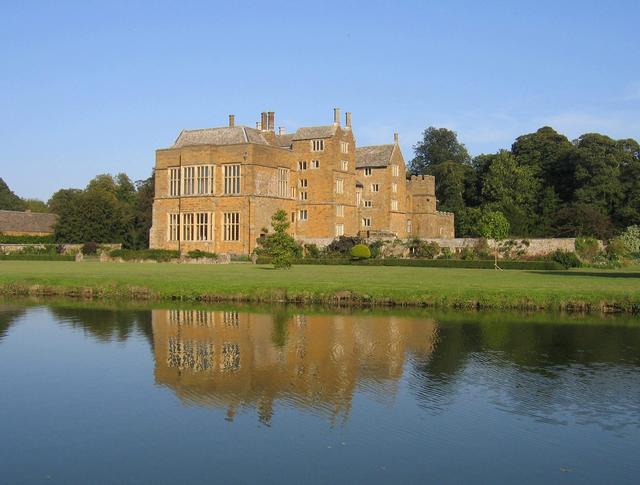
It is the home of the Fiennes (in full Twisleton-Wykeham-Fiennes) family, Barons Saye and Sele. The castle sits on an artificial island in pastureland and is surrounded by a wide moat. Across the small bridge lies the parish church of St Mary the Virgin, surrounded by its historic cemetery. A Grade I listed building, it opens to the public during the summer.
In 2021, Time Team excavated a Roman villa on the site, recently discovered by metal detectorist and amateur archaeologist, Keith Westcott. Previously, a lead-lined sarcophagus containing the burial of a wealthy Romano-British woman was discovered and partly investigated in the 1960s.
Geophysical surveys indicated a large winged or courtyard villa rustica comparable with that nearby at North Leigh. Limited excavations by Time Team showed at least two wings existed. The villa was occupied and developed from the 1st to the 4th c. AD. Large adjoining terraced ponds were used to manage water flows.
Found material, including mosaic tesserae and hypocaust flue tiles, as well as the sarcophagus, suggested a villa of high status on this site.
The castle was built as a manor house by Sir John de Broughton in 1300 at a location where the confluence of three streams created a natural site for a moated manor. The house was sold in 1377 to William of Wykeham, Bishop of Winchester, and has remained in the same family since that time. The original house was crenellated in 1406 by Sir Thomas Wykeham. In 1451, it passed by inheritance to the Fiennes family, Barons Saye and Sele. Beginning in 1550, Richard Fiennes transformed the medieval manor into a house in the Tudor style, significantly expanding the building. James I stayed at Broughton Castle on several occasions.
In the 17th century, The 1st Viscount Saye and Sele, known as "Old Subtlety", was one of the leading activists against Charles I. As a result, the castle was used by Parliamentarian sympathisers, such as John Pym and John Hampden, as a meeting place in the decade leading up to the Civil War. The 1st Viscount raised troops to fight against the king at the inconclusive Battle of Edgehill in 1642. In the following days, Royalist troops besieged the castle, quickly overcoming the defenders and occupying the castle for a time. Following the end of hostilities, reconstruction work needed to be undertaken to repair damage inflicted by Royalist cannon. Lord Saye and Sele had evaded signing Charles I's Death Warrant and was able to make his peace with the Crown after the English Restoration.
Broughton fell into decay in the 19th century, but was eventually rescued by The Ven. Frederick Fiennes, 16th Baron Saye and Sele, who served as Archdeacon of Hereford, and who brought in the prominent Victorian architect Sir George Gilbert Scott. At the turn of the century, the house was rented by the Edwardian socialite Lady Algernon Gordon-Lennox, who transformed the gardens and hosted Edward VII at the castle. It was the childhood home of Ivy Cavendish-Bentinck, Duchess of Portland.
Hub AI
Broughton Castle AI simulator
(@Broughton Castle_simulator)
Broughton Castle
Broughton Castle is a medieval fortified manor house in the village of Broughton, which is about two miles (3 km) southwest of Banbury in Oxfordshire, England, on the B4035 road (grid reference SP418382).
It is the home of the Fiennes (in full Twisleton-Wykeham-Fiennes) family, Barons Saye and Sele. The castle sits on an artificial island in pastureland and is surrounded by a wide moat. Across the small bridge lies the parish church of St Mary the Virgin, surrounded by its historic cemetery. A Grade I listed building, it opens to the public during the summer.
In 2021, Time Team excavated a Roman villa on the site, recently discovered by metal detectorist and amateur archaeologist, Keith Westcott. Previously, a lead-lined sarcophagus containing the burial of a wealthy Romano-British woman was discovered and partly investigated in the 1960s.
Geophysical surveys indicated a large winged or courtyard villa rustica comparable with that nearby at North Leigh. Limited excavations by Time Team showed at least two wings existed. The villa was occupied and developed from the 1st to the 4th c. AD. Large adjoining terraced ponds were used to manage water flows.
Found material, including mosaic tesserae and hypocaust flue tiles, as well as the sarcophagus, suggested a villa of high status on this site.
The castle was built as a manor house by Sir John de Broughton in 1300 at a location where the confluence of three streams created a natural site for a moated manor. The house was sold in 1377 to William of Wykeham, Bishop of Winchester, and has remained in the same family since that time. The original house was crenellated in 1406 by Sir Thomas Wykeham. In 1451, it passed by inheritance to the Fiennes family, Barons Saye and Sele. Beginning in 1550, Richard Fiennes transformed the medieval manor into a house in the Tudor style, significantly expanding the building. James I stayed at Broughton Castle on several occasions.
In the 17th century, The 1st Viscount Saye and Sele, known as "Old Subtlety", was one of the leading activists against Charles I. As a result, the castle was used by Parliamentarian sympathisers, such as John Pym and John Hampden, as a meeting place in the decade leading up to the Civil War. The 1st Viscount raised troops to fight against the king at the inconclusive Battle of Edgehill in 1642. In the following days, Royalist troops besieged the castle, quickly overcoming the defenders and occupying the castle for a time. Following the end of hostilities, reconstruction work needed to be undertaken to repair damage inflicted by Royalist cannon. Lord Saye and Sele had evaded signing Charles I's Death Warrant and was able to make his peace with the Crown after the English Restoration.
Broughton fell into decay in the 19th century, but was eventually rescued by The Ven. Frederick Fiennes, 16th Baron Saye and Sele, who served as Archdeacon of Hereford, and who brought in the prominent Victorian architect Sir George Gilbert Scott. At the turn of the century, the house was rented by the Edwardian socialite Lady Algernon Gordon-Lennox, who transformed the gardens and hosted Edward VII at the castle. It was the childhood home of Ivy Cavendish-Bentinck, Duchess of Portland.
Recent media