Recent from talks
Nothing was collected or created yet.
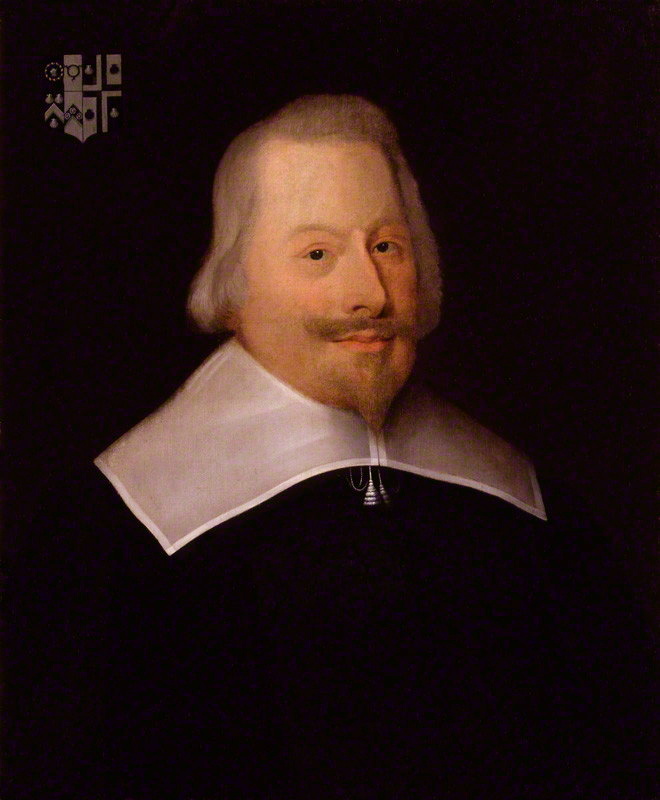
John Pym
View on Wikipedia
John Pym (20 May 1584 – 8 December 1643) was a politician from Somerset who played a key role in establishing the modern English Parliamentary system. One of the Five Members whose attempted arrest in January 1642 was a major step in sparking the First English Civil War, his use of procedure to outmanoeuvre opponents was unusual for the period. Though this meant he was respected by contemporaries rather than admired, in 1895 historian Goldwin Smith described him as "the greatest member of Parliament that ever lived".[1]
Key Information
Pym's father died when he was seven months old, and he was raised by his stepfather Sir Anthony Rous, from whom he inherited his Puritan views and deep opposition to Archbishop Laud's reforms. He was also a leading member of the Providence Island Company, which attempted to establish a Puritan colony in Central America.
Described as 'a true revolutionary', he led the opposition to arbitrary rule first under James I, then Charles I. His leadership in the early stages of the war was essential to the Parliamentarian cause, particularly his role in negotiating the Solemn League and Covenant with the Scots Covenanters; his death from cancer in December 1643 was considered a major blow.[2]
Originally buried in Westminster Abbey,[3] after the Stuart Restoration in 1660, his body was dumped in a pit at nearby St Margaret's, Westminster along with those of other Parliamentary leaders.[4] Though his reputation later suffered in comparison to less complex figures like John Hampden and Viscount Falkland, he is now viewed as an astute politician and effective speaker. Many of his ideas were adopted by Patriots during the American Revolution and 19th-century American liberals.[5]
Personal details
[edit]His father, Alexander Pym (1547–1585), was a member of the minor gentry from Brymore in Somerset, and a successful lawyer in London, where John was born in 1584. Alexander died seven months later and his mother, Philippa Colles (died 1620), married a wealthy Cornish landowner, Sir Anthony Rous.[6] A close friend and executor of Sir Francis Drake, Sir Anthony instilled in his stepson[7] a strong dislike of Spain, a zealous Puritanism, and opposition to both the Catholic Church, and the rival Protestant theology of Arminianism.[8]
The Rous were a large and close-knit family, often wedding relatives and friends. In May 1604, Pym married Anne Hooke, a daughter of Barbara Rous and John Hooke, and aunt of the scientist Robert Hooke. Before her death in 1620, they had seven children, of whom four survived into adulthood; Philippa (1604–1654), Charles (1615–1671), Dorothy (1617–1661), and Catherine.[9]
Career
[edit]Pym was educated at Pembroke College, Oxford, then known as Broadgates and famous for 'advanced Protestantism'.[10] Since legal knowledge was considered part of an education, he subsequently attended the Middle Temple in 1602; while he does not appear to have formally graduated from either, he made a number of lifelong friends, the most important of which being William Whitaker.[11]
In June 1605, he was appointed collector of taxes for the Exchequer in Hampshire, Gloucestershire, and Wiltshire; this gave him a broader range of connections than many contemporaries, who were often confined to family or county networks. Whitaker's father had been Member of Parliament for Westbury, Wiltshire, and in 1621, Pym was elected for the nearby seat of Calne.[12]
Forced Loan and Petition of Right
[edit]Pym's diary shows he viewed Parliamentary legislation as a whole, not just issues of interest to himself; combined with an ability to explain them clearly, it led to his appointment to numerous committees. Since direct criticism of the king was considered treason, the only way to express opposition was by attacking his advisors, using the process of impeachment. Pym argued it was for the Commons to decide guilt or innocence, leaving the Lords only to determine the penalty; this would become significant in his future Parliamentary career.[12]

Even in an era when it was common, he was notable for his anti-Catholicism, and opposition to alleged Catholic practices in the Church of England. One reason for this was the close links in the 17th-century between religion and politics, with alterations in one viewed as implying alterations in the other. Many contemporaries fought in the Thirty Years' War and were concerned at the apparent failure of James to defend Frederick the elector of Palatine, his own son-in-law, and so Protestant Europe as a whole.[13]
Following the dissolution of Parliament in 1621, Pym was arrested, and brought before the Privy Council, but released in August 1622. In 1624, he was elected for Tavistock, a seat controlled by Earl of Bedford, which he retained for the rest of his career.[12] In 1626, he led an attempt to impeach the Duke of Buckingham, an action which led to Parliament being dissolved. Only Buckingham's assassination in August 1628 prevented a second attempt, while Pym supported the presentation of the Petition of Right to Charles I in 1628.[12]
Pym, his stepbrother Francis Rous, and John Hampden, also led the Parliamentary attack on Roger Maynwaring and Robert Sibthorpe, two clergymen who published sermons supporting the Caroline precepts of the divine right of kings, and passive obedience. Though censured by Parliament for preaching against the established English constitution, Charles pardoned them, and dissolved Parliament, initiating the period of Personal Rule that continued until 1640.[14]
Pym became treasurer of the Providence Island Company in 1630, a role that increasingly consumed his time, and he relinquished his Exchequer position in 1639. Participation in the colonial movement was common among Puritan leaders, while company meetings later provided cover for co-ordinating political opposition. Many of these became leaders of the Parliamentary opposition in 1642, among them Hampden, Rous, Henry Darley, Lord Saye, William Waller, and Lord Brooke.[15]
Leader of the opposition; 1640 to 1641
[edit]
Following defeat in the first of the Bishops Wars, Charles recalled Parliament in April 1640. When the Short Parliament refused to vote him taxes without political concessions, he dissolved it after only three weeks. When the Treaty of Ripon imposed by the Scots after a second defeat forced him to hold fresh elections in November, Pym became the unofficial leader of the opposition.[16]
Historians like Tim Harris argue that, with the exception of a few extremists, by 1640 there was general consensus attempts to rule without Parliament had gone too far. This changed after the Grand Remonstrance in November 1641, when constitutional monarchists like Clarendon switched sides, arguing Parliament now wanted too much.[17]
Where Pym differed from Clarendon, and many of his own colleagues, was recognising Charles would not keep commitments he felt had been forced from him. Even during negotiations with Parliament, he and Henrietta Maria openly told foreign ambassadors any concessions were temporary, and would be retrieved by force if needed. These suspicions increased after October 1641, when Irish Catholic rebels claimed his approval for their actions. Many believed them, given previous attempts by Charles to use Irish troops against the Scots, and his initial refusal to condemn the rebellion.[18]
However, Pym was hampered by the fact Charles was essential to a stable government and society. Regardless of religion or political belief, in 1642 the vast majority believed a 'well-ordered' monarchy was divinely mandated; where they disagreed was what 'well-ordered' meant, and who held ultimate authority in clerical affairs. Royalists generally supported a Church of England governed by bishops, appointed by, and answerable to, the king; Parliamentarians were often more more friendly to Puritanism which tended to hold that church leaders should be appointed either by their congregations or assemblies of elders.[19]
Puritan was a term for anyone who wanted to reform, or 'purify', the Church of England, and contained many different sects. Presbyterians were the most prominent, and included leaders like Pym and John Hampden, but there were many others, such as Congregationalists, often grouped together as Independents. Close links between religion and politics added further complexity; one reason for opposition to bishops was their presence in the House of Lords, where they often blocked Parliamentary legislation. Their removal by the Clergy Act 1640 was a major step along the road to war.[20]
Most Presbyterians were political conservatives, who believed in a limited electorate, and wanted to keep the Church of England, but as a reformed, Presbyterian body, similar to the Church of Scotland. In general, England was a structured, socially conservative, and largely peaceful society, while the devastation caused by the Thirty Years' War meant many wanted to avoid conflict at any cost. Pym was one of the few who believed only military defeat would force Charles into agreeing meaningful reforms.[21]
Road to war; 1641 to 1643
[edit]Shortly after the Long Parliament assembled, it was presented with the Root and Branch petition; signed by 15,000 Londoners, it demanded England follow the Scots, and expel bishops.[22] This reflected widespread concerns about 'Catholic practices', or Arminianism in the Church of England, given weight by Charles' apparent willingness to make war on the Protestant Scots, but not assist his nephew Charles Louis regain his hereditary lands.[a] Many feared Charles was about to sign an alliance with Spain, a view shared by experienced diplomatic observers like Venice, and even France.[23]

This meant ending Charles' arbitrary rule was not only important for England, but the Protestant cause in general. Since respect for the institution of monarchy prevented direct attacks on Charles, the traditional route was to prosecute his 'evil counsellors.' Doing so made it clear that although the king was above the law, his subordinates were not, and he could not protect them; the intention was to make others think twice about their actions. Archbishop William Laud was impeached in December 1640 and held in the Tower of London until his execution in 1645; Strafford, former Lord Deputy of Ireland and organiser of the 1640 Bishops War, was attainted and executed in May 1641.[12] Although it's disputed, Pym's appearance at the trial may have been the origin of the word Roundhead. According to Richard Baxter Queen Henrietta Maria at the trial of Thomas Wentworth, 1st Earl of Strafford in 1641 asking about Pym asked who the roundheaded man was.[24]
The Commons also passed a series of constitutional reforms, including the Triennial Acts, abolition of the Star Chamber, and an end to levying taxes without Parliament's consent. Voting as a block, the bishops ensured all these were rejected by the Lords.[25] In June 1641, Pym secured passage of the Clergy Act in the Commons; one of its key provisions was to remove bishops from the Lords, which therefore rejected it. The growing political tension was brought to head in October with the outbreak of the Irish Rebellion. both Charles and Parliament supported raising troops to suppress it, but neither trusted the other with their control, fearing any army would be used against them first.[26]
Pym helped draft the Grand Remonstrance, presented to Charles on 1 December 1641; unrest culminated in 23 to 29 December with widespread riots in Westminster, led by the London apprentices. Suggestions Pym and other Parliamentary leaders helped organise these have not been proved, but as a result, bishops stopped attending the Lords.[27] On 30 December, John Williams, Archbishop of York and eleven other bishops, signed a complaint, disputing the legality of any laws passed by the Lords during their exclusion. Viewed by the Commons as inviting Charles to dissolve Parliament, all twelve were imprisoned for treason.[28]

In response to the growing unrest, on 4 January Charles made an unsuccessful attempt to arrest the Five Members, one of whom was Pym. Having failed to do so, he left London accompanied by many Royalist MPs and his supporters in the Lords, a major tactical mistake as it gave the opposition majorities in both houses.[29] When the First English Civil War began in August, Pym headed the Committee of Safety; his reputation for integrity and ability to keep a diverse coalition of interests together was crucial to surviving the first 18 months of the conflict.[30]
By early August 1643, a series of Royalist victories combined with the death in June of the popular John Hampden in the Battle of Chalgrove Field meant the Parliamentarian cause seemed close to collapse. At this crucial point, it was saved by Pym's leadership and determination, which led to a renewed commitment to win the war.[31] He created the foundations of victory by ensuring Parliament had sufficient financial and military resources, one of his last acts being to negotiate the Solemn League and Covenant that secured Scottish support.[32] Amidst the escalating tensions, one particular step Pym took played a major role in consolidating Parliament's authority. He orchestrated the expulsion of Henry Marten, a fellow Parliamentarian known for his radical views and outspoken criticism of the monarchy. Marten had publicly advocated for the deposition of King Charles I, a stance deemed too extreme by many in Parliament. Pym seized upon this opportunity to remove Marten, demonstrating his commitment to maintaining a more moderate and unified Parliamentarian front. Historian David Como believes this manoeuvre underscores Pym's political acumen and his influence within Parliament during this critical period.[33]
He died, probably of cancer, at Derby House on 8 December 1643; Parliament agreed to pay off the debts he incurred as a result of neglecting his private business interests, although they were still being disputed in 1665.[2] Buried in Westminster Abbey, his remains were exhumed after the Stuart Restoration in 1660 and re-buried in a common pit at St Margaret's, Westminster.[4]
His chief opponent, the Earl of Clarendon, a senior advisor to Charles during the First English Civil War, later wrote; 'he had a very comely and grave way of expressing himself...and understood the temper and affections of the kingdom as well as any man'.[34] Pym's reputation suffered in comparison to less complex figures like Hampden and Viscount Falkland, especially during the Victorian era which romanticised the Royalist cause. One exception was the historian Goldwin Smith, who described him as "the greatest member of Parliament that ever lived".[1] He is now generally viewed as an astute politician who laid the foundations of modern Parliamentary democracy and effective speaker, whose ideas and language were adapted by Patriots during the American Revolution and 19th century American liberals.[5]
Footnotes
[edit]- ^ A perspective summarised by Pym's stepbrother Francis in 1641; "For Arminianism is the span of a Papist, and if you mark it well, you shall see an Arminian reaching to a Papist, a Papist to a Jesuit, a Jesuit to the Pope, and the other to the King of Spain. And having kindled fire in our neighbours, they now seek to set on flame this kingdom also."
References
[edit]- ^ a b MacDonald 1969, p. 38.
- ^ a b Royle 2004, p. 278.
- ^ Stanley, A.P., Historical Memorials of Westminster Abbey (London; John Murray; 1882), p. 204.
- ^ a b Stanley 1882, pp. 204–205.
- ^ a b Kuypers & Althouse 2009, pp. 225–245.
- ^ M. R. P., PYM, Alexander (c.1547-85), of Brymore, Som. in The History of Parliament: the House of Commons 1558-1603 (1981).
- ^ "ROUS, Anthony (bef.1560-1620), of Halton St. Dominick, Cornw". History of Parliament Trust. Retrieved 16 August 2025.
- ^ Russell 1990, p. 221.
- ^ MacDonald 1969, p. 43.
- ^ McGee 2004, p. 406.
- ^ MacDonald 1969, p. 42.
- ^ a b c d e Ferris & Hunneyball 2010.
- ^ MacDonald 1969, pp. 45–50.
- ^ Little 2008, p. 33.
- ^ Van Duinen 2007, p. 531.
- ^ Jessup 2013, p. 25.
- ^ Harris 2014, pp. 457–458.
- ^ Wedgwood 2001, pp. 26–27.
- ^ Craig 2008, p. 39.
- ^ Wedgwood 2001, p. 31.
- ^ Wedgwood 2001, p. 253.
- ^ Rees 2016, p. 2.
- ^ Wedgwood 1983, p. 248.
- ^ "Roundhead". Encyclopedia Britannica.
- ^ Rees 2016, pp. 7–8.
- ^ Hutton 2003, p. 4.
- ^ Smith 1979, pp. 315–317.
- ^ Rees 2016, pp. 9–10.
- ^ Manganiello 2004, p. 60.
- ^ MacDonald 1969, p. 37.
- ^ Johnson 2012, pp. 172–174.
- ^ Russell 2009.
- ^ Como 2018, p. 177.
- ^ Clarendon 2019, pp. 321–322.
Sources
[edit]- Clarendon, Earl of (2019) [1704]. The History of the Rebellion and Civil Wars in England; Volume III. Wentworth Press. ISBN 978-0469445765.
- Como, David (2018). Radical Parliamentarians and the English Civil War. Oxford University Press. ISBN 9780191017704.
- Ferris, John; Hunneyball, Paul (2010). PYM, John (1584-1643), of Westminster, Brymore, Som., Whitchurch and Wherwell, Hants; later of Holborn, Mdx. and Fawsley, Northants in The History of Parliament: the House of Commons 1604–1629. CUP. ISBN 978-1107002258.
- Harris, Tim (2014). Rebellion: Britain's First Stuart Kings, 1567-1642. OUP. ISBN 978-0199209002.
- Hutton, Ronald (2003). The Royalist War Effort 1642-1646. Routledge. ISBN 9780415305402.
- Jessup, Frank W. (2013). Background to the English Civil War: The Commonwealth and International Library: History Division. Elsevier. ISBN 9781483181073.
- Johnson, David (2012). Parliament in crisis; the disintegration of the Parliamentarian war effort during the summer of 1643 (PDF) (PHD). York University.
- Kuypers, Jim; Althouse, Mathew (2009). "John Pym, Ideographs, and the Rhetoric of Opposition to the English Crown". Rhetoric Review. 28 (3): 225–245. doi:10.1080/07350190902958677. JSTOR 25655957. S2CID 144891577.
- Little, Patrick (2008). Oliver Cromwell: New Perspectives. Palgrave Macmillan. ISBN 9781137018854.
- MacDonald, William W (1969). "John Pym: Parliamentarian". Historical Magazine of the Protestant Episcopal Church. 38 (1).
- Macleod, Donald (Autumn 2009). "The influence of Calvinism on politics" (PDF). Theology in Scotland. XVI (2).
- Manganiello, Stephen (2004). The Concise Encyclopedia of the Revolutions and Wars of England, Scotland, and Ireland, 1639–1660. Scarecrow Press. ISBN 978-0810851009.
- McGee, Sears J (2004). "Francis Rous and "scabby or itchy children": The Problem of Toleration in 1645". Huntington Library Quarterly. 67 (3): 401–422. JSTOR 10.1525/hlq.2004.67.3.401.
- Rees, John (2016). The Leveller Revolution. Verso. ISBN 978-1784783907.
- Royle, Trevor (2004). Civil War: The Wars of the Three Kingdoms 1638–1660 (2006 ed.). Abacus. ISBN 978-0-349-11564-1.
- Russell, Conrad (1990). Unrevolutionary England, 1603-1642. Bloomsbury. ISBN 9780826425669.
- Russell, Conrad (2009). "Pym, John". Oxford Dictionary of National Biography (online ed.). Oxford University Press. doi:10.1093/ref:odnb/22926. (Subscription, Wikipedia Library access or UK public library membership required.)
- Smith, Steven (1979). "Almost Revolutionaries: The London Apprentices during the Civil Wars". Huntington Library Quarterly. 42 (4): 313–328. doi:10.2307/3817210. JSTOR 3817210.
- Stanley, Arthur P (1882). Historical Memorials of Westminster Abbey. John Murray.
- Van Duinen, Jared (2007). "Prosopography and the Providence Island Company: The Nature of Puritan Opposition in 1630s England". Prosopography Approaches and Applications: A Handbook. University of Oxford. pp. 527–540. ISBN 978-1900934121.
- Wedgwood, CV (2001) [1958]. The King's War, 1641–1647. Penguin Classics. ISBN 978-0141390727.
- Wedgwood, CV (1983) [1955]. The King's Peace, 1637-1641. Penguin Classics. ISBN 978-0140069907.
Further reading
[edit]- Craig, John (2008), "The Growth of English Puritanism", in Coffey, John; Lim, Paul C. H. (eds.), The Cambridge Companion to Puritanism, Cambridge Companions to Religion, Cambridge University Press, pp. 34–47, ISBN 978-0-521-67800-1
- Glow, Lotte (1964). "Pym and Parliament: The Methods of Moderation". Journal of Modern History. 36 (4): 373–397. doi:10.1086/239490. JSTOR 1875246. S2CID 153405066.
- Hexter, Jack H (1974). The Reign of King Pym. Harvard UP. ISBN 978-0674754010.
- MacDonald, William W (1981). The making of an English revolutionary: the early parliamentary career of John Pym. Fairleigh Dickinson. ISBN 978-0838630181.
- Plant, David. "John Pym". British Civil Wars Project. Retrieved 30 July 2025.
- Scott, David (2003). "The Outbreak of the English Civil War: August 1642 – September 1643". Politics and War in the Three Stuart Kingdoms, 1637–49. Palgrave. ISBN 978-0333658734.
- Yorke, Philip Chesney (1911). . In Chisholm, Hugh (ed.). Encyclopædia Britannica. Vol. 22 (11th ed.). Cambridge University Press. pp. 680–682.
John Pym
View on GrokipediaEarly Life and Background
Family and Upbringing
John Pym was born on 20 May 1584 at Brymore House in Cannington, Somerset, to Alexander Pym, a member of the local gentry whose family had held estates in the region since at least the reign of Edward I, and his wife Philippa Colles.[3][4] Alexander Pym, who served as a justice of the peace and sheriff in Somerset, died suddenly in late 1584 or early 1585, when John was less than a year old, leaving the infant as heir to the family's modest Brymore estate and other properties.[3][5] Philippa Colles remarried soon after to Sir Anthony Rous, a Cornish landowner and client of the Earl of Bedford, relocating the family to Halton in Cornwall, where Pym spent much of his early childhood.[6][7] Rous, known for his puritan sympathies and opposition to Catholic influences in England, provided Pym with a formative environment steeped in conservative Protestantism, including exposure to anti-Catholic sentiments that would later shape his worldview.[5][6] This gentry upbringing amid rural Somerset and Cornish estates instilled in Pym an awareness of local administrative roles and the tensions between crown authority and provincial interests, though his immediate family circle emphasized religious nonconformity over overt political engagement.[3]Education and Early Career
Pym matriculated at Broadgates Hall (later Pembroke College), Oxford, on 18 May 1599 at the age of fifteen, studying there until approximately 1602 without obtaining a degree. The institution was noted for its association with advanced Protestant thought, though Pym's time there primarily provided a broad scholarly foundation rather than specialized training. Following Oxford, he was admitted to the Middle Temple in London in 1602 to pursue legal studies, acquiring practical knowledge of common law and administrative procedures, but he was never called to the bar.[8] This legal exposure equipped him with skills in governance and estate management essential for his subsequent roles. In his early professional life, Pym entered royal service as Receiver-General of the Exchequer for Gloucestershire, Hampshire, and Wiltshire in 1606, a post he retained until 1639, overseeing revenue collection and fiscal accountability that sharpened his organizational and financial acumen.[8] He also held positions in the households of Queen Anne of Denmark from 1606 to 1619, Prince Henry from 1610 to 1612, and the future Charles I from 1616 to 1625, involving duties in court administration and patronage networks. Additionally, as a commissioner for disafforestation in Wiltshire's Blackmore, Pewsham, and Braydon forests between 1618 and the mid-1620s, he managed land reallocations and resolved disputes over royal domains, further developing expertise in public finance and territorial oversight.[8] Pym inherited seven manors in Somerset, centered on the family seat at Brymore, following his father's death in 1585, and maintained estates in both Somerset and Hampshire, including Wherwell.[8] Managing these properties involved navigating local tenancies, agricultural yields, and county affiliations, fostering connections among Somerset gentry that proved instrumental in his administrative proficiency. His involvement in early colonial enterprises, such as auditing roles within the Virginia Company, extended his experience to overseas ventures, emphasizing logistical planning and investment oversight before his parliamentary debut.[9]Entry into Parliament
First Elections and Initial Roles
John Pym first entered Parliament in 1621 as the member for Calne, Wiltshire, a constituency linked to his prior administrative dealings as a receiver for the Duchy of Cornwall.[1] This election marked his initial parliamentary role amid growing tensions over royal finances and patents, though he had no recorded prior service in the 1614 Addled Parliament.[1] In the 1621 Parliament, Pym demonstrated diligence through extensive involvement, delivering 41 recorded speeches and serving on 18 committees, while also maintaining a personal diary of proceedings.[1] His appointments centered on scrutinizing grievances, including select committees on Sir Giles Mompesson's patent (27 February), concealments patents (6 March), inns and alehouses (24 April), the monopolies petition (16 May), and Chancery reform (25 and 27 April).[1] These roles highlighted his focus on administrative abuses and financial irregularities, positioning him as a methodical investigator rather than a prominent orator at this stage. Pym contributed to supply debates by urging a balance between redressing grievances and providing royal funding, as on 12 March when he contended that anti-grievance legislation should not obstruct the subsidy bill's progress.[1] He also endorsed procedural innovations like impeachment processes (20 April) and anti-Catholic enforcement, including recusancy laws (28 November).[1] Such consistent engagement in finance-related committees and grievance inquiries laid the groundwork for his emerging expertise in parliamentary oversight, though the session yielded limited legislative outcomes before prorogation and eventual dissolution in 1622.[1]Involvement in Early Stuart Parliaments (1614-1626)
Pym entered Parliament during the Addled Parliament of 1614, representing Calne in Wiltshire, a session marked by obstructionism and royal frustration that yielded no substantive legislation or recorded contributions from him.[10] His activity increased markedly in the Parliament of 1621, again for Calne, where he delivered 41 speeches and secured appointment to 18 committees addressing monopolies, concealments, and other grievances. On 16 February, Pym spoke in support of a Sabbath observance bill, reflecting his puritan inclinations, while on 20 April he clarified the Commons' procedural role in impeachment processes. These interventions highlighted his emerging expertise in parliamentary procedure amid debates over royal foreign policy and domestic abuses.[10] Elected for Tavistock in the 1624 Parliament, Pym maintained a diary of Commons proceedings and was nominated to 43 committees, including those on privileges and grievances; he spoke 31 times, advocating on 19 March for subsidies to fund the planned war against Spain while critiquing prior administrative failures. On 12 May, he proposed mechanisms to ensure accountability from war treasurers, emphasizing fiscal oversight without outright opposition to the supply grants orchestrated by the duke of Buckingham and Prince Charles. This balanced approach underscored his procedural acumen in navigating royal initiatives toward war financing.[10][11] In the brief 1625 Parliament, Pym returned for Tavistock, serving on 14 committees such as the subsidy bill and delivering six speeches, including one on 4 July concerning recusancy laws; the Commons granted tonnage and poundage customs duties for only one year, diverging from tradition and signaling parliamentary wariness over unchecked royal revenue, though Pym's direct role centered on committee work rather than leading debates.[10] Pym's prominence peaked in the 1626 Parliament, where he again represented Tavistock, earning nearly 50 committee appointments—including on religion (10 February) and the duke of Buckingham's impeachment (3 May)—and delivering 65 speeches that showcased his oratorical skill. On 14 February, he urged caution in asserting parliamentary privileges to avoid escalation with the crown; on 17 March, he criticized Buckingham's accumulation of offices; and on 10 May, he led impeachment charges against the duke. Regarding tonnage and poundage, Pym on 24 May advocated incorporating pretermitted customs into the bill and favored resolving its legal status through settlement rather than confrontational strategies pursued by figures like John Eliot, aiming to reform revenue practices without immediate rupture.[10][8]Opposition to Royal Policies (1626-1629)
Impeachment Efforts and Petition of Right
In the Parliament of 1626, Pym played a prominent role in investigations targeting perceived royal favoritism and religious deviations, particularly against George Villiers, 1st Duke of Buckingham. On 6 March, he was appointed to the committee examining Richard Montagu's Arminian writings, Appello Caesarem and Immediate Address to God Alone, reporting on 17 April that Montagu's doctrines contradicted the Thirty-Nine Articles and merited impeachment, though the Commons ultimately rejected this course.[1] On 20 March, Pym joined the committee probing Buckingham's administrative mismanagement, presenting evidence of Crown land grants to the duke's relatives as evidence of corruption.[1] Appointed on 3 May to draft formal impeachment articles against Buckingham, Pym delivered a key speech on 10 May detailing the duke's profiteering from royal estates, framing these abuses as undermining parliamentary trust in royal governance.[1] These efforts contributed to Buckingham's impeachment proceedings but faltered amid royal intervention and parliamentary dissolution on 15 June 1626. Pym's activities highlighted early parliamentary resistance to court influence, linking administrative corruption to broader threats against established religious orthodoxy, as Arminian tendencies were viewed by critics like Pym as eroding Calvinist foundations and inviting popish innovations.[1] In the 1628 Parliament, Pym shifted focus to constitutional safeguards, becoming instrumental in formulating the Petition of Right as a remedial declaration of liberties. Appointed on 6 May to the drafting committee, he advocated framing the petition to affirm existing laws against arbitrary imprisonment, forced billeting, martial law in peacetime, and extraparliamentary taxation, invoking the king's coronation oath to uphold Magna Carta and statutes like 28 Edward III.[1] During the 6 May debate in committee of the whole House, Pym argued that verbal royal assurances were insufficient against recurrent abuses, insisting on enforceable rules to prevent future violations and tying overreach to existential risks for Protestant England, including unchecked religious heterodoxy.[1][12] He reviewed the fair copy on 8 May, and later opposed Lords' amendments on 20 May that diluted the petition's direct attribution of grievances to royal warrants, helping secure its passage on 7 June after Commons linkage to supply votes.[1] The king's reluctant assent on 18 June marked a temporary parliamentary victory, though Pym's emphasis on legal precedents underscored skepticism toward prerogative claims unbound by statute.[1]Response to Forced Loans and Dissolution
In late 1626, Charles I imposed the Forced Loan to fund military expeditions without parliamentary consent, prompting widespread resistance among MPs and gentry who viewed it as an illegal levy infringing on traditional rights. John Pym, appointed to the Hampshire commission for collecting the loan, initially refused to contribute, aligning with critics who deemed it coercive and unconstitutional. To evade detection and potential repercussions, his brother-in-law arranged a surreptitious payment of £10 on his behalf.[1] During the Third Parliament of 1628-9, Pym emerged as a vocal opponent of perceived royal deviations in religion and finance, linking them to the king's extraparliamentary measures. As the first MP to explicitly raise the threat of Arminianism—which he and fellow Puritans saw as doctrinally innovative and conducive to absolutism—he served as chairman of the committee for religion and on 17 April 1628 reported to the House on charges against cleric Richard Montagu for promoting Arminian views in print. Pym also advanced efforts against Catholic recusants, securing on 24 May 1628 a petition to the Lords condemning recusant Walter Brooke for converting Protestant children to Catholicism, reflecting broader parliamentary demands for stricter enforcement amid fears of royal leniency toward Catholics.[1] These activities intensified confrontations, culminating in the Three Resolutions passed by the Commons on 2 March 1629, which declared anyone innovating in religion (targeting Arminians), paying unparliamentary taxes like tonnage and poundage, or advising dissolution as enemies of the kingdom—resolutions Pym supported through committee work and debate. Charles responded by dissolving Parliament that day, arresting several members for seditious speeches in the final session, including allies like Sir John Eliot and John Selden. Pym faced scrutiny for his parliamentary rhetoric but avoided prolonged imprisonment, though the episode marked his deepening rift with the crown and exclusion from royal circles during the ensuing personal rule.[1]The Eleven Years' Tyranny and Political Absence
Activities Outside Parliament
During Charles I's personal rule from 1629 to 1640, John Pym concentrated on estate management and administrative duties, maintaining households at Brymore in Somerset and Wherwell in Hampshire.[1] He continued serving as Receiver-General of the Exchequer for Gloucestershire, Hampshire, and Wiltshire, a role involving the collection and oversight of crown revenues in those counties until his resignation in 1639.[13] Pym also participated in local governance through royal commissions, acting as a commissioner for sewers on the Isle of Wight in 1631, for depopulation in Gloucestershire in 1632 and Wiltshire in 1635, and for encroachments on the River Thames in 1636.[1] Pym engaged in colonial ventures aligned with Puritan interests, becoming treasurer of the Providence Island Company in 1630—a joint-stock enterprise led by figures like the 2nd Earl of Warwick to establish trade and settlement on Providence Island in the Caribbean—and advancing to deputy governor by 1640.[1] He was additionally a grantee of the Saybrook colony in Connecticut in 1632, fostering ties to transatlantic Puritan networks including Warwick and Lord Brooke.[1] These activities allowed Pym to sustain influence among moderate opponents of the court without provoking royal reprisals, as evidenced by his retention of Exchequer responsibilities amid widespread Puritan discontent.[1]Building Alliances and Puritan Networks
During the period of Charles I's personal rule from 1629 to 1640, John Pym maintained a low public profile while strategically engaging in ventures that strengthened ties among Puritan-leaning gentry and nobles opposed to royal ecclesiastical and foreign policies. As treasurer of the Providence Island Company starting in 1630, Pym managed finances for a joint-stock enterprise chartered to colonize Providence Island (modern-day Santa Catalina) off the Nicaraguan coast, with aims of establishing trade routes to Spanish America and authorizing privateering against Spanish shipping if peaceful commerce failed.[14][10] This role connected him to influential Puritan patrons such as the 2nd Earl of Warwick, Lord Brooke, and Lords Saye and Sele, who viewed the colony as a bulwark for Protestant expansion and a potential base for anti-Catholic operations amid fears of Spanish influence at court.[10][15] The Providence Island Company's pursuits, which included fortifying the settlement against Spanish assaults—such as the failed 1635 invasion—fostered a network of investors and administrators sharing anti-Spanish sentiments and commitments to Puritan ideals of religious discipline and colonial autonomy.[14] Pym's oversight extended to related endeavors, including his selection as a grantee for the Saybrook colony in Connecticut in 1632, linking him to New England Puritan settlers and broadening his influence among those dissatisfied with Archbishop Laud's enforcement of ceremonial uniformity in England.[10] These activities, conducted outside parliamentary channels, built financial and personal alliances that anticipated a crisis over royal authority, emphasizing practical opposition through economic and exploratory initiatives rather than overt political agitation.[10] By the late 1630s, Pym had risen to deputy governor of the Providence Company, a position reflecting his growing stature within these circles, where he exerted significant direction over operations despite the venture's ultimate failure to Spanish conquest in 1641.[10] This discreet networking, rooted in shared colonial ambitions and resistance to perceived popish tendencies, positioned Pym as a respected elder figure among potential parliamentary allies by 1640, enabling coordinated action against the crown's policies without provoking dissolution or reprisal during the tyranny.[14][10]Revival of Parliament (1640)
Short Parliament Leadership
John Pym, a veteran parliamentarian with experience from prior sessions, secured election to represent Tavistock in the Short Parliament, summoned by writs issued in February 1640 and assembled on 13 April.[16] This body, the first in eleven years, faced King Charles I's urgent demand for subsidies to fund a campaign against Scottish Covenanters amid the Bishops' Wars.[16] Pym rapidly positioned himself as the principal Commons spokesman against royal overtures, aligning with sympathetic members including John Hampden, whose resistance to Ship Money had symbolized broader opposition to extralegal taxation.[16] On 17 April 1640, he presented a comprehensive two-hour address enumerating national grievances under categories such as encroachments on religion, justice, supply, and counsel, asserting that Parliament must redress these before voting funds.[16] [17] Central to Pym's demands was the immediate abolition of Ship Money, the crown's controversial naval levy imposed without consent since 1634, which had provoked widespread defiance exemplified by Hampden's 1637 legal challenge.[16] Charles countered by pledging to end the levy but insisted on twelve subsidies upfront; MPs, led by Pym, rebuffed this as insufficient without binding reforms and accountability for past abuses.[16] After protracted debates yielding no supply, Charles dissolved Parliament on 5 May 1640, just three weeks into its session, highlighting the monarchy's acute financial straits and inability to coerce cooperation without addressing parliamentary preconditions.[16] This impasse deprived the king of resources for his northern expedition, exposing vulnerabilities that intensified following Scottish victories later that year.[16]Long Parliament: Consolidation of Power
The Long Parliament assembled on November 3, 1640, following the failure of Charles I's campaigns against the Scots, with John Pym elected as member for Tavistock and quickly asserting influence in the Commons.[13] Pym orchestrated the impeachment of key royal advisors, beginning with Thomas Wentworth, Earl of Strafford, accused on November 11, 1640, of high treason for his role in Irish governance and military policies; Strafford was imprisoned upon arrival in London on November 23 and his trial commenced in March 1641, culminating in Pym's pivotal closing speech on April 12 detailing 28 articles of charge.[13] [18] Simultaneously, Archbishop William Laud faced impeachment on December 18, 1640, for alleged innovations in church policy and suppression of Puritan dissent, leading to his sequestration and imprisonment in the Tower of London.[13] These proceedings targeted the perceived architects of royal absolutism, weakening the king's advisory circle and bolstering parliamentary authority.[19] Pym's leadership facilitated rapid legislative reforms to curb royal prerogatives, including the Triennial Act passed by the Commons on February 15, 1641, and receiving royal assent on February 16, which mandated parliamentary sessions at least every three years and prohibited dissolution without parliamentary consent, directly challenging the king's control over legislative timing.[20] The abolition of the Court of Star Chamber followed on July 5, 1641, through an act dismantling the prerogative court notorious for arbitrary judgments and enforcement of royal policies, such as prosecutions under the Laudian regime.[21] These measures, alongside preliminary efforts toward parliamentary oversight of the militia through petitions and bills in early 1641, marked initial steps toward securing legislative dominance without immediate armed confrontation.[22] By mid-1641, Pym had solidified his position as the de facto leader of the Commons through the "Junto," an informal alliance with figures like John Hampden, Denzil Holles, Oliver St. John, and Nathaniel Fiennes, coordinating opposition strategy and committee assignments to prioritize constitutional grievances over royal overtures.[23] This coalition, rooted in shared Puritan sympathies and resistance to personal rule, enabled Pym to navigate internal divisions and external pressures, such as the king's attempts at reconciliation, ensuring sustained momentum for purges and reforms.[24] The executions and imprisonments of Strafford on May 12, 1641, and Laud's prolonged detention underscored the Junto's effectiveness in executive purges, though Pym's methods, including reliance on attainder for Strafford, highlighted a willingness to bypass traditional judicial norms to achieve political ends.[19]Leadership in the Long Parliament (1640-1641)
Grand Remonstrance and Constitutional Challenges
The Grand Remonstrance, drafted under John Pym's leadership in the House of Commons during late 1641, consisted of 204 articles enumerating parliamentary grievances against Charles I's rule, particularly the "Eleven Years' Tyranny" from 1629 to 1640.[25] It portrayed the era's abuses—such as forced loans, arbitrary imprisonment, and ecclesiastical innovations—as stemming from the infiltration of "popery" (Catholic influences) and "evil counselors" who had misled the king into subverting traditional English liberties and Protestantism.[2] Pym, as a key architect alongside figures like John Hampden, framed these charges to justify parliamentary supremacy in redressing royal misgovernment without directly indicting the king's person.[25] On 22 November 1641, after protracted debates extending into the night, the Remonstrance passed the Commons by a narrow margin of 159 votes to 148, reflecting sharp factional splits between Pym's Puritan allies and royalist sympathizers.[25] [2] The document bypassed formal submission to the Lords and was presented directly to Charles I on 1 December 1641, who rejected it, escalating tensions.[2] Its approval, despite opposition from moderates wary of overreaching, solidified Pym's control over the parliamentary majority and prompted moves to print and publicize the text for broader dissemination. Constitutionally, the Remonstrance mounted a direct assault on royal prerogative by insisting that the king dismiss existing advisors tainted by "popish" leanings and appoint successors only with parliamentary approbation, thereby subordinating crown patronage to legislative oversight.[26] This demand implicitly curtailed the monarch's independent authority in governance and religion, advocating a mixed constitution where Parliament advised on policy to prevent future "arbitrary" rule.[27] Passage of the measure galvanized extraparliamentary support, including London demonstrations in late December 1641 that backed Pym's faction against royalist backlash.[28]Alliance with Scottish Covenanters
Following the Long Parliament's assembly on 3 November 1640, John Pym, as a leading figure in the Commons, advocated for upholding the Treaty of Ripon—signed on 26 October 1640 between Charles I and Scottish commissioners—which stationed approximately 20,000 Covenanter troops in northern England pending resolution of the Bishops' Wars. Pym supported parliamentary committees that secured funding for the Scots, including a Commons vote on 15 February 1641 to disburse £200,000 immediately and ongoing subsidies at £850 per diem, framing this as essential to prevent royal dissolution of Parliament and to maintain leverage against the king's forces.[22] The Irish Rebellion, erupting on 23 October 1641 with coordinated Catholic uprisings that killed thousands of Protestant settlers, amplified Pym's arguments for deepened Scottish ties; he portrayed the Covenanters' Presbyterian resistance to perceived popish innovations as a model for English defense, warning that royal reliance on Irish recruits—evidenced by Charles's earlier plans for an Irish expeditionary force—threatened Protestant England unless bolstered by Scottish military presence.[14] This stance justified retaining the Scottish army south of the border, effectively trading fiscal support for their role as a deterrent amid escalating constitutional tensions. In the Grand Remonstrance, presented to the king on 1 December 1641 and largely authored by Pym, Parliament lauded the Scots' National Covenant of 1638 for rejecting episcopacy and royal religious impositions, signaling willingness to pursue "uniformity in Church government" akin to Scotland's Presbyterian framework—a concession that critics later decried as Pym's bid to import foreign ecclesiastical control. Royalists, including historian Edward Hyde, condemned this orientation as subordinating English sovereignty to "Scottish presbyters," accusing Pym of exploiting the alliance to erode monarchical authority under the guise of anti-Catholic solidarity.Path to Civil War (1641-1643)
The Five Members Incident
On 3 January 1642, King Charles I directed his Attorney-General to prepare articles of impeachment for high treason against five prominent members of the House of Commons: John Pym, John Hampden, Denzil Holles, Arthur Haselrig, and William Strode.[29] Charles accused them of conspiring with Scottish Covenanters to undermine royal authority, including plots to subvert the king's government and military preparations against him.[30] From the royal perspective, Pym and his associates represented a faction of agitators whose actions, such as the Grand Remonstrance and alliances with external forces, constituted treasonous subversion of monarchical prerogative.[31] The following day, 4 January 1642, Charles personally led an armed guard of approximately 400 soldiers into the House of Commons chamber to effect the arrests, marking a direct breach of parliamentary privilege.[32] Forewarned of the impending action, Pym and the other four members had already fled the chamber and sought refuge in the City of London.[33] Upon arrival, Charles demanded their whereabouts from Speaker William Lenthall, who replied that he served the House and could neither see nor speak save as directed by it, refusing to comply.[32] Frustrated, Charles declared the "birds had flown" and withdrew, but the spectacle inflamed London's populace against him.[34] The incident rapidly militarized the capital, as City Trained Bands and apprentices armed in defense of Parliament, viewing the king's move as an assault on legislative independence.[2] This erosion of Charles's support in London forced his departure to York on 10 January, while Pym emerged as a symbol of parliamentary resistance, having evaded capture and rallied opposition to what was portrayed as royal overreach.[35] Royalists, however, contended that the evasion confirmed the members' guilt, justifying the attempt to curb a seditious cabal led by Pym that threatened national stability.[30]Militia Ordinance and War Preparations
In early 1642, following King Charles I's failed attempt to arrest opposition leaders including John Pym, Parliament under Pym's leadership accelerated efforts to secure control over military forces amid escalating tensions. On 15 March 1642, the House of Commons, with Pym as a principal architect, passed the Militia Ordinance, which asserted Parliament's authority to appoint lords lieutenant and deputy lieutenants for raising, training, and commanding the trained bands—the kingdom's primary militia—without royal commission or assent.[36][2] This measure bypassed the traditional royal prerogative over the militia, enabling Parliament to organize defenses independently and marking a decisive step toward armed confrontation, as it effectively armed parliamentary supporters while denying the king unilateral control.[37] The ordinance authorized the levy of forces, execution of martial law, and suppression of "malignants"—perceived royalist threats—prompting widespread compliance in London and eastern counties but division elsewhere, as local officials weighed allegiance to Parliament or the crown.[38] Pym, coordinating with allies like the Earl of Essex, leveraged this to fortify London's defenses, including entrenchments and volunteer trainings, while rejecting royal counter-proposals that would have restored crown oversight.[39] By June 1642, Parliament issued the Nineteen Propositions, demanding oversight of the militia, royal counselors, and foreign policy, which Charles rejected on 18 June, framing it as an infringement on his divine rights and escalating to open war preparations.[40][41] In response, Pym drove ordinances for raising funds via excise taxes and loans, commissioning the Earl of Essex as Captain-General of parliamentary forces on 12 July with 15,000 foot and 3,000 horse, and coordinating supply lines from Puritan-leaning regions.[42] These efforts sustained Parliament's mobilization after Charles raised his standard at Nottingham on 22 August, culminating in defensive strategies during the Battle of Edgehill on 23 October, where parliamentary armies under Essex held against royalist advances despite tactical stalemate, preserving London from immediate threat.[43][44]Death and Succession
Final Months and Illness
By mid-1643, John Pym's health had severely declined due to chronic ailments exacerbated by a probable abdominal cancer, which a post-mortem revealed as a fist-sized growth interfering with his digestion.[8] This condition, combined with longstanding frailty, limited his physical participation in parliamentary proceedings, though he persisted in advising key committees on fiscal and military matters.[13] His final contributions included urging the House of Commons to secure adequate supplies for the ongoing conflict against royalist forces, reflecting his unwavering commitment to parliamentary finances amid the escalating civil war.[8] Pym succumbed to his illness on 8 December 1643 at Derby House in Westminster.[8] In recognition of his service, the Commons resolved to accord him a state funeral, and he was interred in Westminster Abbey shortly thereafter.[7][8]Immediate Political Aftermath
Pym's death on 8 December 1643 created an immediate leadership vacuum in the House of Commons, depriving Parliament of its primary architect of wartime strategy and inter-factional compromise. As the key figure who had orchestrated the Solemn League and Covenant earlier that year, binding English Parliamentarians with Scottish Covenanters, his absence left no equivalent unifier capable of bridging divides. Scottish observer Robert Baillie lamented in his correspondence that "since Pym died, not a state head among us, all things drooping," reflecting the swift erosion of morale and organizational momentum amid ongoing hostilities.[45] Without Pym's brokerage, succession disputes intensified between the dominant Presbyterian faction, increasingly led by Denzil Holles, and the Independent minority, fostering early signs of weakened cohesion that hampered unified war preparations. Oliver St. John endeavored to steer remnants of Pym's "middle group" alliance, but underlying tensions over church settlement and negotiation with the king precluded a seamless transition, leading to faltering coordination in the Committee of Both Kingdoms. Royalist commentators, drawing from court intelligence, exploited these fissures in propaganda, portraying Parliament as rudderless and prone to internal collapse to bolster Charles I's negotiating leverage and erode opponent resolve.[46][47]Ideology and Motivations
Religious Puritanism and Anti-Catholicism
John Pym maintained a steadfast adherence to Calvinist doctrines, rooted in his early upbringing under the influence of his stepfather, Alexander Pym, a committed Puritan and associate of Sir Francis Drake, who emphasized scriptural purity and opposition to perceived corruptions in the Church of England.[48] This formation positioned Pym within the broader Puritan movement, which empirically prioritized doctrinal rigor over ceremonialism, interpreting Arminian tendencies—promoted under figures like William Laud—as a theological concession that eroded predestinarian orthodoxy and facilitated Catholic infiltration.[49] Pym's Calvinism thus framed religious deviations not as abstract disputes but as causal precursors to national apostasy, compelling his parliamentary efforts to safeguard Protestant hegemony. As the preeminent Puritan voice in the Long Parliament convening on 3 November 1640, Pym prioritized ecclesiastical overhaul through the Root and Branch petition, submitted on 11 December 1640 by London apprentices and citizens numbering around 15,000 signatories, demanding the eradication of the episcopal structure "root and branch" to purge bishops and their perceived popish hierarchies from governance.[50] Pym's leadership amplified this initiative, steering debates toward the Root and Branch Bill of 27 May 1641, which sought legislative abolition of bishops' temporal powers and presbyterian reconfiguration, reflecting his empirical conviction that episcopacy perpetuated Arminian innovations antithetical to Calvinist discipline.[23] These measures empirically stemmed from Puritan anxieties over Laudian altars and ceremonies, enacted between 1633 and 1640, which Pym decried as fostering recusant tolerance. Pym's anti-Catholicism manifested as a visceral response to perceived existential perils, viewing Romanism as an active conspiracy undermining England's confessional state; in parliamentary proceedings from 1626 onward, he collaborated in committees to enforce recusancy fines and expose Jesuit networks, interpreting Charles I's Irish policies as molding a popish monarchy.[51] His 7 November 1640 opening speech to the Commons explicitly linked courtly Arminianism to Irish rebellions and continental Catholic alliances, positing religious laxity as the root cause of political instability rather than incidental grievance. This causal realism—prioritizing faith as the driver of policy—propelled statutes like the 1641 disabling of Catholic officeholders, yet engendered intolerance toward moderate conformists, as Pym's zeal marginalized episcopal defenders, fracturing potential consensus on church governance.[8]Views on Monarchy, Parliament, and Limited Government
John Pym championed the English constitution as a mixed monarchy, in which the king, House of Lords, and House of Commons each exercised distinct powers that mutually restrained one another to avert dominance by any single element.[52] This framework, rooted in classical and medieval precedents, positioned the monarch as a pivotal yet limited authority, dependent on parliamentary counsel for effective governance rather than unchecked prerogative.[53] Pym articulated this in parliamentary debates, arguing that deviations from this balance—such as Charles I's reliance on advisors unaccountable to Parliament—undermined the realm's stability and invited tyranny.[54] Central to Pym's rejection of absolutism was the principle that taxation required the explicit consent of Parliament, a cornerstone he invoked against royal impositions like ship money levied without legislative approval during the 1630s.[55] In a speech on June 4, 1641, he emphasized that English law exempted subjects from taxes or loans absent common consent in Parliament, framing such arbitrary levies as violations of fundamental liberties rather than legitimate exercises of sovereignty.[55] Through instruments like the Grand Remonstrance, drafted under his influence and passed on November 22, 1641, Pym sought to institutionalize these restraints by demanding parliamentary veto over ministerial appointments and ecclesiastical policies, thereby subordinating royal discretion to collective deliberation without eliminating the crown's executive role.[50] Pym positioned himself as a moderate constitutionalist against parliamentary radicals advocating republicanism, explicitly favoring a monarchy circumscribed by parliamentary oversight over outright abolition of the throne.[56] He clashed with figures like Henry Marten, whose outspoken anti-monarchical sentiments led to Marten's brief imprisonment in 1643 on Pym's motion for seditious criticism of the House, underscoring Pym's commitment to preserving hierarchical order under limited government rather than yielding to egalitarian upheavals.[57] This stance aligned with his vision of sovereignty diffused across estates, where the king's authority derived legitimacy from adherence to law and counsel, not personal will.[58]Controversies and Criticisms
Royalist Perspectives on Pym's Ambitions
Royalist propagandists depicted John Pym as the central figure in a clandestine cabal, often termed "Pym's Junto," orchestrating seditious plots to undermine the monarchy and seize power for personal and factional ends. In pamphlets such as Pyms juncto published in 1643, Pym was accused of scheming to "blast the honour of the King" through coordinated efforts with Puritan allies, likened to a shadowy conspiracy akin to Jesuit intrigue in its secretive and subversive nature.[59] Early scribal satires from 1642 derisively styled him "King Pym," portraying his leadership in the Long Parliament as a bid to usurp Charles I's authority, with verses urging the king to "change places" and don Pym's "grave gowne" as a symbol of inverted hierarchies.[59] These libels emphasized Pym's ambitions as self-serving, alleging he profited from wartime taxation schemes introduced in 1642 to fund parliamentary forces, prioritizing enrichment over national reconciliation.[59] Critics from the royalist camp further charged Pym with hypocrisy, presenting him as a false Puritan whose zeal masked opportunistic warmongering. A February 1643 pamphlet accused him of accepting bribes from Papists while decrying Catholic influence, thus betraying his anti-popish rhetoric for political advantage and supporting radical sectaries who sowed discord.[59] Royalist observers, including those in Mercurius Aulicus from September 1643, amplified personal slanders, tracing spurious origins to his mother in terms of bestiality to discredit his moral authority and portray his rise as illegitimate.[59] Such attacks framed Pym's intransigence—evident in his orchestration of the Grand Remonstrance in late 1641 and rejection of royal overtures—as deliberate escalation, fostering divisions that precluded compromise and propelled the realm toward open conflict by October 1642.[59] From the royalist vantage, Pym's alliances exacerbated these ambitions, particularly his advocacy for the Solemn League and Covenant in 1643, which bound Parliament to Scottish Presbyterians in a manner viewed as subordinating English sovereignty to foreign covenanters and contravening traditional constitutional balances.[59] A March 1643 royal declaration explicitly blamed Pym for the "distractions" of war, attributing the refusal of reconciliation to his unyielding demands that prioritized factional dominance over monarchical prerogative.[59] Empirical consequences underscored these critiques: Pym's policies contributed causally to the English Civil Wars, resulting in over 200,000 deaths from combat, disease, and indirect effects across England, Wales, and Scotland, alongside widespread economic devastation from disrupted trade and plundered estates, all without securing a decisive parliamentary triumph by his death in December 1643.[60][59]Internal Divisions and Expulsion of Radicals
In 1643, amid escalating tensions in the Long Parliament, John Pym took decisive action against radical voices threatening internal cohesion. Henry Marten, a Berkshire MP noted for his outspoken republicanism, was expelled from the Commons in July after remarks during a debate implying that the kingdom's security outweighed considerations for the royal family, which were deemed seditious and tantamount to endorsing regicide. Pym directly denounced Marten, leveraging his influence to secure the expulsion and subsequent imprisonment in the Tower of London, thereby curbing rhetoric that could alienate moderate allies and undermine the war effort's focus on constitutional reform rather than outright abolition of monarchy.[56] Pym's strategy emphasized preserving a broad Presbyterian consensus to sustain the alliance with Scottish Covenanters, who demanded a uniform national church structure in exchange for military support. He opposed the Independents, led by figures like Oliver Cromwell and Sir Henry Vane the Younger, whose push for congregational autonomy and broader religious toleration risked fracturing this unity by accommodating sects and potentially weakening discipline against perceived Catholic threats. By prioritizing Presbyterian uniformity—evident in his backing of the Westminster Assembly's proceedings starting in 1643—Pym sidelined Independent proposals, viewing toleration as a gateway to anarchy that could erode parliamentary resolve.[8][61] This approach highlighted Pym's conservatism, as he defended established property qualifications for political participation and resisted early radical agitations that challenged socioeconomic hierarchies, even as proto-Leveller ideas began surfacing in petitions emphasizing natural rights yet hinting at expanded franchises. Some contemporaries and historians have observed that Pym's enforcement was selective, rigorously applied to ideological outliers like Marten while advancing his Presbyterian coalition's coercive ecclesiastical measures, which imposed national uniformity without equivalent scrutiny.[62]Legacy and Historiographical Debates
Short-Term Impact on the Civil Wars
Pym's leadership was instrumental in initially unifying Parliament's disparate factions to mount a coordinated war effort following the outbreak of hostilities in August 1642. As head of the Committee of Safety, established on 5 July 1642, he oversaw the creation of administrative structures for finance, military recruitment, and local governance, preventing early fragmentation among Parliamentarians.[10][63] His connections in the City of London enabled the securing of critical loans to fund the nascent army, while he played a key role in enacting the Militia Ordinance of March 1642, which asserted Parliament's control over local trained bands and bypassed royal authority.[10][2] These measures sustained Parliament's resistance after the inconclusive Battle of Edgehill on 23 October 1642, where royalist forces advanced toward London but failed to capitalize, allowing Pym to rally defenses and avert immediate capitulation.[10] However, Pym's efforts revealed shortcomings in military organization during the war's early phase. Post-Edgehill disarray hampered Parliament's forces, with coordination challenges persisting despite committee oversight, as rivalries between commanders like the Earl of Essex and internal debates delayed effective field operations.[10] Pym's staunch opposition to compromise in peace negotiations, such as those at Oxford in late 1642 and early 1643, stemmed from demands for royal concessions on religion, militia control, and counsel that the king deemed unacceptable, thereby prolonging the conflict rather than seeking tactical pauses.[64][10] Pym's death from illness on 8 December 1643 exacerbated these vulnerabilities, leaving Parliament without a unifying figure and contributing to a leadership vacuum that intensified factionalism and stalled momentum until the formation of the New Model Army in 1645.[10] While his financial and administrative innovations prevented collapse, the absence of prepared succession underscored reliance on his personal authority, hindering short-term strategic coherence.[65]Long-Term Assessments: Architect of Parliament or Instigator of Chaos
Historiographical assessments of John Pym's long-term impact have shifted from celebratory portrayals in the 19th-century Whig tradition, which depicted him as a foundational architect of parliamentary liberty against royal absolutism, to more critical revisionist analyses emphasizing his role in precipitating unnecessary conflict. Victorian historians like S.R. Gardiner praised Pym's foresight in constitutional matters, viewing him as a precursor to parliamentary dominance that preserved English liberties, with his leadership in the Long Parliament seen as a deliberate counter to Charles I's perceived tyranny.[66][67] This perspective aligned with broader Whig narratives that framed the Civil Wars as an inevitable progress toward limited government, attributing to Pym the unification of Commons factions and innovations in fiscal and procedural controls that endured beyond the Stuart era.[68] Revisionist scholars, notably Conrad Russell and John Morrill in the late 20th century, challenged this teleological optimism by applying causal analysis to the war's origins, arguing that Pym's aggressive tactics—such as the Grand Remonstrance of 1641 and orchestration of Strafford's execution—represented political miscalculations that escalated avoidable tensions rather than inevitable clashes. Russell's examination of parliamentary dynamics portrayed Pym not as an omnipotent innovator but as a persistent manager whose "unweariableness" in bridging Lords and Commons masked deeper factional fragilities, ultimately failing to avert breakdown.[69] Morrill similarly downplayed Pym's centrality, suggesting his strategies deepened divisions without securing stable reform, paving the way for post-1643 anarchy under radical independents and military rule. Empirically, while Pym bolstered the Commons' procedural authority, his escalation contributed to the wars' catastrophic toll: approximately 200,000 deaths, equating to 4.5% of England's population, alongside widespread economic disruption from sieges, taxation, and trade collapse.[70][71] Royalist historiography, both contemporary and echoed in modern critiques, cast Pym as a demagogic instigator who subverted legitimate monarchical order through libelous agitation and puritanical conspiracy. Libels dubbed him "King Pym," accusing him of treasonous ambitions to usurp the crown and dismantle church and state, with verses decrying his efforts to "belch'd out most horrid treasons against Gods Anointed" and overthrow established hierarchies.[59] This view posits Pym's mobilization of anti-Catholic fears and procedural maneuvers not as liberty's defense but as calculated subversion, unleashing factional chaos that culminated in regicide and Cromwell's dictatorship—outcomes that empirically undermined the very parliamentary stability he professed to champion, as evidenced by the expulsion of moderates and military dominance by 1648. Such assessments prioritize the wars' causal chain from parliamentary intransigence to societal rupture over Whig progress narratives.[59]References
- https://en.wikisource.org/wiki/Dictionary_of_National_Biography%2C_1885-1900/Pym%2C_John
