



Community hub
Recent from talks
Knowledge base stats:
Talk channels stats:
Members stats:
Burn
A burn is an injury to skin, or other tissues, caused by heat, electricity, chemicals, friction, or ionizing radiation (such as sunburn, caused by ultraviolet radiation). Most burns are due to heat from hot fluids (called scalding), solids, or fire. Burns occur mainly in the home or the workplace. In the home, risks are associated with domestic kitchens, including stoves, flames, and hot liquids. In the workplace, risks are associated with fire and chemical and electric burns. Alcoholism and smoking are other risk factors. Burns can also occur as a result of self-harm or violence between people (assault).
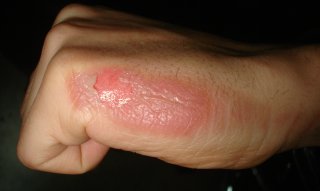
Burns that affect only the superficial skin layers are known as superficial or first-degree burns. They appear red without blisters, and pain typically lasts around three days. When the injury extends into some of the underlying skin layer, it is a partial-thickness or second-degree burn. Blisters are frequently present and they are often very painful. Healing can require up to eight weeks and scarring may occur. In a full-thickness or third-degree burn, the injury extends to all layers of the skin. Often there is no pain and the burnt area is stiff. Healing typically does not occur on its own. A fourth-degree burn additionally involves injury to deeper tissues, such as muscle, tendons, or bone. The burn is often black and frequently leads to loss of the burned part.
Burns are generally preventable. Treatment depends on the severity of the burn. Superficial burns may be managed with little more than simple pain medication, while major burns may require prolonged treatment in specialized burn centers. Cooling with tap water may help pain and decrease damage; however, prolonged cooling may result in low body temperature. Partial-thickness burns may require cleaning with soap and water, followed by dressings. It is not clear how to manage blisters, but it is probably reasonable to leave them intact if small and drain them if large. Full-thickness burns usually require surgical treatments, such as skin grafting. Extensive burns often require large amounts of intravenous fluid, due to capillary fluid leakage and tissue swelling. The most common complications of burns involve infection. Tetanus toxoid should be given if not up to date.
In 2015, fire and heat resulted in 67 million injuries. This resulted in about 2.9 million hospitalizations and 176,000 deaths. Among women in much of the world, burns are most commonly related to the use of open cooking fires or unsafe cook stoves. Among men, they are more likely a result of unsafe workplace conditions. Most deaths due to burns occur in the developing world, particularly in Southeast Asia. While large burns can be fatal, treatments developed since 1960 have improved outcomes, especially in children and young adults. In the United States, approximately 96% of those admitted to a burn center survive their injuries. The long-term outcome is related to the size of burn and the age of the person affected.
The characteristics of a burn depend upon its depth. Superficial burns cause pain lasting two or three days, followed by peeling of the skin over the next few days. Individuals with more severe burns may indicate discomfort or complain of feeling pressure rather than pain. Full-thickness burns may be entirely insensitive to light touch or puncture. While superficial burns are typically red in color, severe burns may be pink, white or black. Burns around the mouth or singed hair inside the nose may indicate that burns to the airways have occurred, but these findings are not definitive. More worrisome signs include: shortness of breath, hoarseness, and stridor or wheezing. Itchiness is common during the healing process, occurring in up to 90% of adults and nearly all children. Numbness or tingling may persist for a prolonged period of time after an electrical injury. Burns may also produce emotional and psychological distress.
Burns are caused by a variety of external sources classified as thermal (heat-related), chemical, electrical, and radiation. In the United States, the most common causes of burns are: fire or flame (44%), scalds (33%), hot objects (9%), electricity (4%), and chemicals (3%). Most (69%) burn injuries occur at home or at work (9%), and most are accidental, with 2% due to assault by another, and 1–2% resulting from a suicide attempt. These sources can cause inhalation injury to the airway and/or lungs, occurring in about 6%.
Burn injuries occur more commonly among the poor. Smoking and alcoholism are other risk factors. Fire-related burns are generally more common in colder climates. Specific risk factors in the developing world include cooking with open fires or on the floor as well as developmental disabilities in children and chronic diseases in adults.
In the United States, fire and hot liquids are the most common causes of burns. Of house fires that result in death, smoking causes 25% and heating devices cause 22%. Almost half of injuries are due to efforts to fight a fire. Scalding is caused by hot liquids or gases and most commonly occurs from exposure to hot drinks, high temperature tap water in baths or showers, hot cooking oil, or steam. Scald injuries are most common in children under the age of five and, in the United States and Australia, this population makes up about two-thirds of all burns. Contact with hot objects is the cause of about 20–30% of burns in children. Generally, scalds are first- or second-degree burns, but third-degree burns may also result, especially with prolonged contact. Fireworks are a common cause of burns during holiday seasons in many countries. This is a particular risk for adolescent males. In the United States, for non-fatal burn injuries to children, white males under the age of 6 comprise most cases. Thermal burns from grabbing/touching and spilling/splashing were the most common type of burn and mechanism, while the bodily areas most impacted were hands and fingers followed by head/neck.
Hub AI
Burn AI simulator
(@Burn_simulator)
Burn
A burn is an injury to skin, or other tissues, caused by heat, electricity, chemicals, friction, or ionizing radiation (such as sunburn, caused by ultraviolet radiation). Most burns are due to heat from hot fluids (called scalding), solids, or fire. Burns occur mainly in the home or the workplace. In the home, risks are associated with domestic kitchens, including stoves, flames, and hot liquids. In the workplace, risks are associated with fire and chemical and electric burns. Alcoholism and smoking are other risk factors. Burns can also occur as a result of self-harm or violence between people (assault).
Burns that affect only the superficial skin layers are known as superficial or first-degree burns. They appear red without blisters, and pain typically lasts around three days. When the injury extends into some of the underlying skin layer, it is a partial-thickness or second-degree burn. Blisters are frequently present and they are often very painful. Healing can require up to eight weeks and scarring may occur. In a full-thickness or third-degree burn, the injury extends to all layers of the skin. Often there is no pain and the burnt area is stiff. Healing typically does not occur on its own. A fourth-degree burn additionally involves injury to deeper tissues, such as muscle, tendons, or bone. The burn is often black and frequently leads to loss of the burned part.
Burns are generally preventable. Treatment depends on the severity of the burn. Superficial burns may be managed with little more than simple pain medication, while major burns may require prolonged treatment in specialized burn centers. Cooling with tap water may help pain and decrease damage; however, prolonged cooling may result in low body temperature. Partial-thickness burns may require cleaning with soap and water, followed by dressings. It is not clear how to manage blisters, but it is probably reasonable to leave them intact if small and drain them if large. Full-thickness burns usually require surgical treatments, such as skin grafting. Extensive burns often require large amounts of intravenous fluid, due to capillary fluid leakage and tissue swelling. The most common complications of burns involve infection. Tetanus toxoid should be given if not up to date.
In 2015, fire and heat resulted in 67 million injuries. This resulted in about 2.9 million hospitalizations and 176,000 deaths. Among women in much of the world, burns are most commonly related to the use of open cooking fires or unsafe cook stoves. Among men, they are more likely a result of unsafe workplace conditions. Most deaths due to burns occur in the developing world, particularly in Southeast Asia. While large burns can be fatal, treatments developed since 1960 have improved outcomes, especially in children and young adults. In the United States, approximately 96% of those admitted to a burn center survive their injuries. The long-term outcome is related to the size of burn and the age of the person affected.
The characteristics of a burn depend upon its depth. Superficial burns cause pain lasting two or three days, followed by peeling of the skin over the next few days. Individuals with more severe burns may indicate discomfort or complain of feeling pressure rather than pain. Full-thickness burns may be entirely insensitive to light touch or puncture. While superficial burns are typically red in color, severe burns may be pink, white or black. Burns around the mouth or singed hair inside the nose may indicate that burns to the airways have occurred, but these findings are not definitive. More worrisome signs include: shortness of breath, hoarseness, and stridor or wheezing. Itchiness is common during the healing process, occurring in up to 90% of adults and nearly all children. Numbness or tingling may persist for a prolonged period of time after an electrical injury. Burns may also produce emotional and psychological distress.
Burns are caused by a variety of external sources classified as thermal (heat-related), chemical, electrical, and radiation. In the United States, the most common causes of burns are: fire or flame (44%), scalds (33%), hot objects (9%), electricity (4%), and chemicals (3%). Most (69%) burn injuries occur at home or at work (9%), and most are accidental, with 2% due to assault by another, and 1–2% resulting from a suicide attempt. These sources can cause inhalation injury to the airway and/or lungs, occurring in about 6%.
Burn injuries occur more commonly among the poor. Smoking and alcoholism are other risk factors. Fire-related burns are generally more common in colder climates. Specific risk factors in the developing world include cooking with open fires or on the floor as well as developmental disabilities in children and chronic diseases in adults.
In the United States, fire and hot liquids are the most common causes of burns. Of house fires that result in death, smoking causes 25% and heating devices cause 22%. Almost half of injuries are due to efforts to fight a fire. Scalding is caused by hot liquids or gases and most commonly occurs from exposure to hot drinks, high temperature tap water in baths or showers, hot cooking oil, or steam. Scald injuries are most common in children under the age of five and, in the United States and Australia, this population makes up about two-thirds of all burns. Contact with hot objects is the cause of about 20–30% of burns in children. Generally, scalds are first- or second-degree burns, but third-degree burns may also result, especially with prolonged contact. Fireworks are a common cause of burns during holiday seasons in many countries. This is a particular risk for adolescent males. In the United States, for non-fatal burn injuries to children, white males under the age of 6 comprise most cases. Thermal burns from grabbing/touching and spilling/splashing were the most common type of burn and mechanism, while the bodily areas most impacted were hands and fingers followed by head/neck.