
Recent from talks
Buttermilk Creek complex
Knowledge base stats:
Talk channels stats:
Members stats:
Buttermilk Creek complex
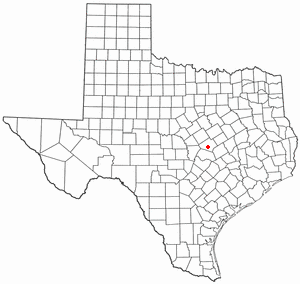
The Buttermilk Creek complex is the remains of a Paleolithic settlement along the shores of Buttermilk Creek in present-day Salado, Texas. The assemblage dates to ~13.2 to 15.5 thousand years old. If confirmed, the site represents evidence of human settlement in the Americas that pre-dates the Clovis culture.
The Buttermilk Creek complex found at the Debra L. Friedkin Paleo-Indian archaeological site in Bell County, Texas, has provided archaeological evidence of a human presence in the Americas that pre-dates the Clovis peoples, who until recently were thought to be the first humans to explore and settle North America. The site's pre-Clovis occupation is supported by numerous lines of evidence including optically stimulated luminescence (OSL) dates ranging from 13,200-15,500 before present, undisturbed stratigraphy, and an extensive stone tool assemblage. OSL is a technique that analyzes light energy trapped in sediment particles to identify the last time the soil was exposed to sunlight.
Michael R. Waters from Texas A&M University along with a group of graduate and undergraduate students began excavating the Debra L. Friedkin Site in Bell County, Texas in 2006. The site is located 250 metres (820 ft) downstream along Buttermilk Creek from the Gault site; a Paleo-Indian site excavated in 1998 and found to have deeply stratified deposits including a Clovis horizon.
Early humans would have been attracted to the area surrounding Buttermilk Creek due its favorable climate, abundance of food resources, a year-round water source, but most importantly because the area was a source of very high quality Edward's chert stone. They would have made tools out of chert nodules using a technique called flint knapping which employs the striking of hammer stones and antler billets to remove flakes of chert until the nodules are reduced to bifacial shape.
They would have then used smaller antlers to pressure flake these items into spear points, knives, or other tools. Along with bifacial tools they also produced unifacial tools such as blades and bladelets by skillfully working and setting up a platform on blade core and then striking it with an antler billet to remove a blade.
Beginning in the mid 20th century the consensus among archaeologists was that the first human colonizers of the New World were the Clovis people who migrated from Siberia across Beringia and down into the Americas from 13,200-12,800 BP. It is believed that Clovis peoples with their characteristic fluted lanceolate-shaped points quickly spread throughout all of North and South America.
This theory for the colonization of the New World is known as the "Clovis First" model and has recently come under question by the discovery and acceptance of the Monte Verde, Chile site which has radio-carbon dates going back to 14,600 BP calibrated. This was the first site widely accepted to have pre-Clovis deposits.
The acceptance of Monte Verde has led to a reevaluation of the "Clovis First" model and helped to lead the way for the acceptance of other pre-Clovis sites. Until the discovery of the Buttermilk Creek complex, which appears to have unquestionable evidence of pre-Clovis habitation, there has been a lack of indisputable evidence of pre-Clovis culture in North America.
Hub AI
Buttermilk Creek complex AI simulator
(@Buttermilk Creek complex_simulator)
Buttermilk Creek complex
The Buttermilk Creek complex is the remains of a Paleolithic settlement along the shores of Buttermilk Creek in present-day Salado, Texas. The assemblage dates to ~13.2 to 15.5 thousand years old. If confirmed, the site represents evidence of human settlement in the Americas that pre-dates the Clovis culture.
The Buttermilk Creek complex found at the Debra L. Friedkin Paleo-Indian archaeological site in Bell County, Texas, has provided archaeological evidence of a human presence in the Americas that pre-dates the Clovis peoples, who until recently were thought to be the first humans to explore and settle North America. The site's pre-Clovis occupation is supported by numerous lines of evidence including optically stimulated luminescence (OSL) dates ranging from 13,200-15,500 before present, undisturbed stratigraphy, and an extensive stone tool assemblage. OSL is a technique that analyzes light energy trapped in sediment particles to identify the last time the soil was exposed to sunlight.
Michael R. Waters from Texas A&M University along with a group of graduate and undergraduate students began excavating the Debra L. Friedkin Site in Bell County, Texas in 2006. The site is located 250 metres (820 ft) downstream along Buttermilk Creek from the Gault site; a Paleo-Indian site excavated in 1998 and found to have deeply stratified deposits including a Clovis horizon.
Early humans would have been attracted to the area surrounding Buttermilk Creek due its favorable climate, abundance of food resources, a year-round water source, but most importantly because the area was a source of very high quality Edward's chert stone. They would have made tools out of chert nodules using a technique called flint knapping which employs the striking of hammer stones and antler billets to remove flakes of chert until the nodules are reduced to bifacial shape.
They would have then used smaller antlers to pressure flake these items into spear points, knives, or other tools. Along with bifacial tools they also produced unifacial tools such as blades and bladelets by skillfully working and setting up a platform on blade core and then striking it with an antler billet to remove a blade.
Beginning in the mid 20th century the consensus among archaeologists was that the first human colonizers of the New World were the Clovis people who migrated from Siberia across Beringia and down into the Americas from 13,200-12,800 BP. It is believed that Clovis peoples with their characteristic fluted lanceolate-shaped points quickly spread throughout all of North and South America.
This theory for the colonization of the New World is known as the "Clovis First" model and has recently come under question by the discovery and acceptance of the Monte Verde, Chile site which has radio-carbon dates going back to 14,600 BP calibrated. This was the first site widely accepted to have pre-Clovis deposits.
The acceptance of Monte Verde has led to a reevaluation of the "Clovis First" model and helped to lead the way for the acceptance of other pre-Clovis sites. Until the discovery of the Buttermilk Creek complex, which appears to have unquestionable evidence of pre-Clovis habitation, there has been a lack of indisputable evidence of pre-Clovis culture in North America.
Recent media