Hubbry Logo
CAS Registry NumberCAS Registry NumberMain
Open search
CAS Registry Number
Community hub
CAS Registry Number
logo
8 pages, 0 posts
0 subscribers
Be the first to start a discussion here.
CAS Registry Number
CAS Registry Number
from Wikipedia

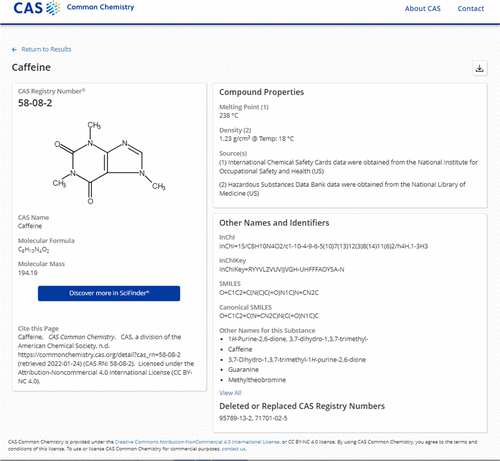
Screenshot of the CAS Common Chemistry database with information about caffeine (58-08-2).

A CAS Registry Number[1] (also referred to as CAS RN[2] or informally CAS Number) is a unique identification number, assigned by the Chemical Abstracts Service (CAS) in the US to every chemical substance described in the open scientific literature, in order to index the substance in the CAS Registry. This registry includes all substances described since 1957, plus some substances from as far back as the early 1800s.[3] It is a chemical database that includes organic and inorganic compounds, minerals, isotopes, alloys, mixtures, and nonstructurable materials (UVCBs - substances of unknown or variable composition, complex reaction products, or biological origin).[4] CAS RNs are generally serial numbers (with a check digit), so they do not contain any information about the structures themselves the way SMILES and InChI strings do.

The CAS Registry is an authoritative collection of disclosed chemical substance information. It identifies more than 204 million unique organic and inorganic substances and 69 million protein and DNA sequences,[3] plus additional information about each substance. It is updated with around 15,000 additional new substances daily.[5] A collection of almost 500 thousand CAS registry numbers is made available under a CC BY-NC license at ACS Commons Chemistry.[6]

History and use

[edit]

Historically, chemicals have been identified by a wide variety of synonyms and properties. One of the biggest challenges in the early development of substance indexing, a task undertaken by the Chemical Abstracts Service, was in identifying if a substance in literature was new or if it had been previously discovered. Well-known chemicals may be known via multiple generic, historical, commercial, and/or (black)-market names, and even systematic nomenclature based on structure alone was not universally useful. An algorithm was developed to translate the structural formula of a chemical into a computer-searchable table, which provided a basis for the service that listed each chemical with its CAS Registry Number, the CAS Chemical Registry System, which became operational in 1965.[7]

CAS Registry Numbers (CAS RN) are simple and regular, convenient for database searches. They offer a reliable, common and international link to every specific substance across the various nomenclatures and disciplines used by branches of science, industry, and regulatory bodies. Almost all molecule databases today allow searching by CAS Registry Number, and it is used as a global standard.[8]

Format

[edit]

A CAS Registry Number has no inherent meaning, but is assigned in sequential, increasing order when the substance is identified by CAS scientists for inclusion in the CAS Registry database.

A CAS RN is separated by hyphens into three parts, the first consisting from two up to seven digits,[9] the second consisting of two digits, and the third consisting of a single digit serving as a check digit. This format gives CAS a maximum capacity of 1,000,000,000 unique numbers.

The check digit is found by taking the last digit times 1, the preceding digit times 2, the preceding digit times 3 etc., adding all these up and computing the sum modulo 10. For example, the CAS number of water is 7732-18-5: the checksum 5 is calculated as (8×1 + 1×2 + 2×3 + 3×4 + 7×5 + 7×6) = 105; 105 mod 10 = 5.

Granularity

[edit]
  • Stereoisomers and racemic mixtures are assigned discrete CAS Registry Numbers: L-epinephrine has 51-43-4, D-epinephrine has 150-05-0, and racemic DL-epinephrine has 329-65-7
  • Different phases do not receive different CAS RNs (liquid water and ice both have 7732-18-5), but different crystal structures do (carbon in general is 7440-44-0, graphite is 7782-42-5 and diamond is 7782-40-3)
  • Commonly encountered mixtures of known or unknown composition may receive a CAS RN; examples are Leishman stain (12627-53-1) and mustard oil (8007-40-7).
  • Some chemical elements are discerned by their oxidation state, e.g. the element chromium has 7440-47-3, the trivalent Cr(III) has 16065-83-1 and the hexavalent Cr(VI) species have 18540-29-9.
  • Occasionally whole classes of molecules receive a single CAS RN: the class of enzymes known as alcohol dehydrogenases has 9031-72-5.

Search engines

[edit]

See also

[edit]

References

[edit]
[edit]
Revisions and contributorsEdit on WikipediaRead on Wikipedia
from Grokipedia
The CAS Registry Number (CAS RN) is a unique numeric identifier assigned by the , a division of the , to every described in scientific publications and patents. Introduced in 1965 as part of the CAS REGISTRY database, it provides an unambiguous way to distinguish substances regardless of varying names, synonyms, or structural representations, thereby preventing errors in chemical communication. The format consists of up to 10 digits separated by hyphens into three segments—the first with 2 to 7 digits, the second with 2 digits, and the final single digit as a for validation—ensuring accuracy in data handling. CAS RNs form the foundation of the CAS REGISTRY, the world's largest database of disclosed chemical substances, which includes over 204 million organic and inorganic substances (as of 2024), encompassing everything from simple molecules like (CAS RN 7732-18-5) to complex polymers, alloys, and biomolecules. This system originated from efforts in the to manage the growing volume of chemical literature indexed by CAS, which began as Chemical Abstracts in , evolving into a computerized registry to link substances across global research. Today, CAS RNs are universally adopted by scientists, regulators, industries, and databases for tasks such as filings, toxicological assessments, , and compliance with international standards like REACH and TSCA. Their proprietary yet widely licensed nature supports innovation while maintaining rigorous curation by CAS experts to verify novelty and structural integrity upon registration.

Overview

Definition and Purpose

A CAS Registry Number (CASRN), often simply called a CAS number, is a unique, irreversible numeric identifier assigned by the , a division of the , to every described in the or patented inventions. This identifier ensures that each substance, whether organic, inorganic, or biological, receives a single, distinct designation regardless of how it is named or represented in various sources. CASRNs are assigned systematically upon the first encounter of a substance in processed literature, making them a cornerstone of chemical documentation worldwide. The primary purpose of the CASRN is to provide unambiguous identification of chemical substances, eliminating confusion arising from synonymous names, varying structural depictions, or differences in across languages, databases, and regulatory frameworks. By standardizing reference to chemicals through a simple numerical code, CASRNs facilitate precise indexing, efficient retrieval of information from vast scientific repositories, and seamless integration in global databases. This system supports critical applications, including for assessments, filings, and , where accurate substance identification is essential to avoid errors in handling hazardous materials or misinterpreting research data. Introduced in 1965, the CAS Registry System was developed to cope with the explosive growth in chemical literature following , when the volume of published research surged beyond manual indexing capabilities. As of 2025, the CAS REGISTRY database encompasses over 290 million unique substances, with millions added annually to reflect ongoing discoveries and innovations in chemistry.

Significance in Chemical Identification

The CAS Registry Number (CASRN) serves as a standardized identifier that resolves ambiguities arising from the multiplicity of chemical names, including systematic , common names, trade names, and regional variations, thereby enabling precise communication across scientific, industrial, and regulatory contexts. This uniqueness facilitates seamless cross-referencing with complementary identification systems such as the (InChI) and Simplified Molecular Input Line Entry System (SMILES), which further enhance in chemical and literature searches. By providing a single, authoritative reference point, CASRNs mitigate errors in substance identification that could otherwise lead to miscommunication in . In practical applications, CASRNs are indispensable for ensuring accuracy and safety in various processes, including the preparation of safety data sheets (SDS), where they are explicitly required to identify hazardous ingredients under the Globally Harmonized System (GHS). They play a critical role in reporting by linking substances to reliable and exposure data, in filings to distinctly claim novel compounds, and in to track materials without confusion, ultimately reducing risks of errors in manufacturing and procurement. Globally, CASRNs have achieved widespread adoption, with regulatory frameworks mandating their use to promote consistency and compliance; for instance, they are integral to the European Union's REACH regulation for substance registrations, the U.S. Toxic Substances Control Act (TSCA) inventory listings, and GHS-compliant SDS worldwide. These identifiers are relied upon by scientists, industries, and government agencies across more than 190 countries, supporting , , and initiatives. A key advantage of CASRNs over alternatives like molecular formulas is their ability to differentiate isomers and stereoisomers, which share the same empirical composition but exhibit distinct properties and risks. Additionally, the assignment process is irreversible, with numbers issued sequentially and permanently retained, which avoids disruptions from revisions and maintains historical continuity in chemical records.

History

Origins of CAS

The (CAS) was founded in 1907 by the (ACS) with the launch of Chemical Abstracts, a publication dedicated to indexing and abstracting chemical literature from journals worldwide. The inaugural issue, edited by William A. Noyes Sr., contained fewer than 12,000 abstracts drawn from approximately 400 journals, reflecting the society's commitment to organizing the growing body of chemical knowledge. In 1909, Chemical Abstracts was formally established as a division of the ACS, marking its institutionalization and expansion of operations, initially based in , before relocating to . This founding responded to the need for a centralized English-language resource amid the proliferation of international chemical research. By the and , the rapid growth of chemical publications posed significant challenges to CAS's manual operations. Annual chemical literature outputs exceeded 100,000 documents by the late 1950s, resulting in an overwhelming volume of abstracts—reaching about 100,000 per year across roughly 10,000 pages—that strained indexing capacity. Compounding this overload were nomenclature inconsistencies, as the same chemical substances were often indexed multiple times with varying names provided by authors or differing from prior entries, leading to duplication and retrieval difficulties. These issues underscored the limitations of relying on human indexers, who manually copied molecular structures and assigned identifiers, highlighting the urgent need for more systematic approaches to manage the exploding information landscape. To address these early hurdles, CAS developed and refined manual abstracting and indexing systems throughout the to . These involved teams of chemists and editors systematically reviewing global journals, extracting key data, and compiling annual and decennial indexes with subject, author, and formula entries. Such efforts, while labor-intensive, built a foundational framework for chemical and increasingly revealed the impracticality of purely manual methods as publication volumes doubled roughly every 15 years. This recognition paved the way for , culminating in the exploration of computerized solutions to enhance accuracy and speed. In the , CAS introduced pre-registry tools such as punched-card systems to facilitate substance tracking and preliminary data organization. These mechanized aids allowed for rudimentary machine sorting of chemical records based on encoded notations, bridging manual processes and emerging digital technologies. By encoding chemical structures and names onto cards for automated retrieval, CAS began alleviating some indexing burdens, setting the stage for more advanced registry innovations while maintaining comprehensive coverage of the .

Development of the Registry System

The CAS Registry System was conceptualized in as a pioneering computerized database designed to automate the identification and recognition of chemical substances, addressing the growing volume of chemical that overwhelmed manual indexing methods. This system introduced the use of connection tables—computer-readable representations of molecular structures that capture atoms and their bonds—to enable unique and unambiguous substance identification, marking a shift from traditional name-based indexing to structure-based . The initiative stemmed from the need for a standardized way to handle the exponential increase in reported chemicals, allowing scientists to reference substances consistently across publications. Key innovations in the system's development were led by CAS scientists, including G. Malcolm Dyson, who was hired in 1959 to spearhead efforts and built on his earlier work in chemical notation systems. A breakthrough came with Harry Morgan's in the early 1960s, which generated unique two-dimensional records of chemical structures for efficient searching and matching. The first prototype, an experimental version of the Chemical Registry System, became operational in late 1964, incorporating algorithmic structure searching to process and store substance data. These advancements laid the foundation for integrating structural data directly with bibliographic records, enhancing accuracy in chemical documentation. The official rollout occurred in 1965, when the system transitioned from experimental to production use, assigning the first CAS Registry Numbers (CASRNs) to newly indexed substances and retroactively registering those from prior Chemical Abstracts volumes. This launch integrated the Registry seamlessly with Chemical Abstracts indexing, ensuring that every substance entry included a linked to its , name, and references. Early implementation relied on contemporary technology, such as the IBM 7090 mainframe, to handle , matching, and generation of registry entries. By 1970, the system had expanded to store and match over 1 million unique substances, demonstrating its scalability and critical role in managing the burgeoning field of chemical information.

Key Milestones and Growth

In the 1970s and 1980s, the CAS Registry expanded its accessibility through integration with emerging online systems, notably the launch of STN International in by CAS and FIZ Karlsruhe, which provided global access to CAS databases including the Registry. By 1990, the Registry had reached 10 million registered substances, reflecting steady growth driven by increasing chemical literature and patent disclosures. The 1990s and 2000s marked further technological advancements and rapid expansion, with the introduction of SciFinder in 1995 offering scientists an intuitive interface to search Registry data. In September 2009, the Registry surpassed 50 million substances, a milestone achieved just nine months after reaching 40 million, underscoring accelerating discovery rates. That same year, CAS launched Common Chemistry in May 2009, providing free public access to basic substance information for nearly 500,000 commonly used chemicals by 2021. The adoption of XML formats during this period facilitated standardized data exchange with external systems, enhancing interoperability. Entering the 2010s and , the Registry continued , hitting 60 million substances in 2010, 70 million in 2012, 75 million in 2013, and 100 million in 2014 to commemorate its 50th anniversary. By 2020, it exceeded 159 million unique organic and inorganic substances, along with millions of biological sequences. This period saw expanded coverage to include biologics and polymers, with the 2024 launch of the CAS BioFinder Discovery Platform to support life sciences research. AI enhancements were integrated into related tools like SciFinder in 2025, improving substance registration and search efficiency through for data curation and analysis. As of 2025, the Registry contains over 290 million substances, having grown from approximately 200 million in recent years through ongoing curation. This expansion is fueled by annual additions of 10-20 million new substances sourced from scientific literature, patents, and regulatory filings, enabling comprehensive tracking of emerging materials like . Ongoing interoperability efforts, such as mapping CAS Registry Numbers to entries, support seamless data sharing across databases.

Format and Validation

Structure of the CAS Number

The CAS Registry Number (CASRN) is structured as a numeric sequence of up to 10 digits, divided by hyphens into three distinct parts without any encoded chemical significance in the segments themselves. The first part, ranging from 2 to 7 digits, represents the core identifier; the second part consists of exactly 2 digits; and the third part is a single digit serving as a check digit for validation. This format ensures uniqueness and readability, with numbers assigned sequentially upon the registration of a new substance in the CAS REGISTRY database. Originally introduced in , the CASRN format began with shorter lengths, typically 6 to 7 digits during the and , reflecting the initial scale of the registry. The length of the first segment has increased over time from typically 2 to 4 digits in the to up to 7 digits as the database has grown, allowing the total number to reach 10 digits while using the same format, with the registry containing over 290 million substances as of 2025. This variable-length design maintains while supporting ongoing expansion. CASRNs follow specific conventions, including no leading zeros in the first segment and sequential assignment without regard to or . Distinct CASRNs are issued for salts, solvates, and mixtures, treating them as separate entities. Examples include 7732-18-5 for , 67-56-1 for , and 50-00-0 for , demonstrating the non-systematic, registry-order basis of the numbering.

Check Digit and Verification

The check digit, which forms the final single-digit part of a CAS Registry Number (CASRN), serves to validate the accuracy of the preceding digits and detect common transcription or typing errors, such as single-digit substitutions or transpositions. This digit is computed using a modulo-10 arithmetic algorithm that ensures the entire number's integrity without relying on the semantic meaning of the substance it identifies. By incorporating this self-checking mechanism, the CASRN format minimizes the risk of erroneous data propagation in chemical databases, literature, and regulatory filings. The algorithm for generating or verifying the check digit begins by removing the hyphens from the CASRN to obtain a sequence of digits, excluding the check digit itself. These digits are then weighted from right to left, with the rightmost digit multiplied by 1, the next by 2, the next by 3, and so on, up to the leftmost digit. The products are summed, and the result modulo 10 yields the check digit. Mathematically, for a digit sequence dndn1d1d_n d_{n-1} \dots d_1 (where d1d_1 is the rightmost before the check digit), the check digit cc is given by: c=(i=1ndii)mod10c = \left( \sum_{i=1}^{n} d_i \cdot i \right) \mod 10 For instance, consider the CASRN 50-00-0 for formaldehyde. The digits preceding the check digit are 5, 0, 0, 0. Weighting from the right gives 0×1+0×2+0×3+5×4=200 \times 1 + 0 \times 2 + 0 \times 3 + 5 \times 4 = 20, and 20mod10=020 \mod 10 = 0, confirming the check digit. Another example is 7732-18-5 for water: digits 7, 7, 3, 2, 1, 8 yield 8×1+1×2+2×3+3×4+7×5+7×6=1058 \times 1 + 1 \times 2 + 2 \times 3 + 3 \times 4 + 7 \times 5 + 7 \times 6 = 105, and 105mod10=5105 \mod 10 = 5, matching the provided check digit. This method effectively catches about 90% of single-digit errors and many adjacent transpositions. Verification of a CASRN involves recalculating the using the above and comparing it to the original. If the computed value matches, the number is transcriptionally valid; a discrepancy indicates an error, such as a mistyped digit or incorrect placement, which can disrupt the digit sequence despite hyphens being ignored in the calculation. CAS provides and tools for this manual or automated process, allowing users to confirm authenticity before use in scientific or regulatory contexts. While the does not verify whether the number corresponds to an actual registered substance, it ensures basic numerical reliability.

Scope and Granularity

Substances Covered

The CAS Registry assigns unique identifiers to a broad array of chemical entities, encompassing organic and inorganic compounds, elements, isotopes, ions, coordination compounds, and salts. These core substances are sourced from peer-reviewed , patents, and commercial catalogs, ensuring comprehensive representation of known chemistry. Over time, the registry has expanded to include polymers to accommodate complex macromolecular structures. Biologics, such as proteins, DNA, and RNA sequences, receive CAS Registry Numbers, supporting identification in biopharmaceutical contexts through sequence data and structural details. Nanomaterials and alloys are also eligible when characterized with specific compositions or structures, broadening the registry's utility for advanced materials. Proprietary trade secrets remain excluded unless publicly disclosed in qualifying sources. Assignment of a CAS Registry Number occurs upon the first documented description of a substance in eligible sources, such as journal articles or disclosures. Retrospective assignments are applied to historical substances identified in older literature, maintaining completeness across time. Certain entities are ineligible for unique identifiers, including pure mixtures lacking a defined or unique composition, which are instead referenced by component substances. Theoretical or unrealized structures without experimental verification or data are also excluded from registration.

Specificity and Isomers

The CAS Registry System assigns distinct Registry Numbers (RNs) to chemical substances based on their structural specificity, ensuring precise identification of variants such as stereoisomers. Each stereoisomer, including enantiomers and diastereomers, receives a unique RN to differentiate it from other forms of the same compound, while the unlabeled parent structure is assigned a single RN unless is explicitly specified. Tautomers are similarly treated with separate RNs when their distinct structures are reported, though interconvertible forms without specified localization may share the parent RN. Conformers, being transient structural arrangements, are generally not assigned individual RNs unless fixed by specific conditions or notations that define them as unique entities. Isotopically labeled compounds are granted unique RNs to reflect substitutions such as for or for , distinguishing them from their unlabeled counterparts for applications in and tracing studies. This approach allows for unambiguous tracking of isotopic variants, with each specified labeling pattern—whether specific sites or general enrichment—warranting a separate identifier. The system's handling of isotopes underscores its role in supporting research requiring isotopic precision, as seen in the registration of variants for analytical standards. For complex substances like , CAS RNs typically employ generic representations based on monomeric units and overall composition, without differentiation for variations in chain length, molecular weight, or ratios unless those parameters are explicitly defined as integral to the structure. Specific polymer variants with precisely characterized chain lengths or sequences may receive distinct RNs if structural is established through detailed arrangements or reaction specifics. In biologics, such as proteins or nucleic acids, RN assignment relies on sequence-based , incorporating or orders, post-translational modifications, and codon translations to ensure differentiation among variants like isoforms or mutants. A key limitation of the CAS Registry is that undefined mixtures—those lacking specified components, ratios, or compositions—do not receive RNs, as registration requires defined structural or compositional details for uniqueness. This maintains the system's integrity by excluding ambiguous entities that cannot be precisely identified.

Applications

Use in Scientific and Regulatory Contexts

In scientific literature, CAS Registry Numbers (CAS RNs) serve as essential identifiers for chemical substances, facilitating precise indexing and retrieval. Publications from the (ACS), such as the Journal of Chemical & Engineering Data, require authors to include CAS RNs or equivalent structural representations for described compounds to ensure unambiguous identification. This practice, aligned with ACS style guidelines, extends to references from databases, where CAS RNs are cited alongside chemical names to support reproducibility in experimental data. In academic theses and technical reports, CAS RNs enable cross-referencing across disciplines, reducing ambiguity in citing reagents and intermediates, as recommended in comprehensive chemistry style manuals. Regulatory frameworks worldwide mandate or strongly encourage the use of CAS RNs for inventory listing and compliance, enhancing traceability of chemicals. In the United States, the Toxic Substances Control Act (TSCA) Inventory lists non-confidential substances identified by CAS RNs and CA Index Names, as maintained by the Environmental Protection Agency (EPA) under 40 CFR Part 710. The European Union's REACH regulation (EC No. 1907/2006) incorporates CAS RNs in annexes for substance registration and the Candidate List of substances of very high concern, aiding in and authorization processes. Under the UN's Prior Informed Consent (PIC) procedure via the , chemicals in Annex III are specified with CAS RNs to regulate international trade of hazardous substances, requiring export notifications and consents. For hazardous material transport, the UN Globally Harmonized System (GHS) requires CAS RNs in Safety Data Sheets (SDSs) and labels to identify ingredients, supporting uniform classification and communication of dangers during shipping. In industrial settings, CAS RNs underpin supplier catalogs, , and management by providing a standardized . Chemical suppliers leverage CAS Commercial Sources to aggregate catalog data, linking products to CAS RNs for accurate sourcing and procurement. For , the unique identifiers minimize misidentification risks in manufacturing processes, ensuring consistency in batch testing and compliance audits. In , platforms like CAS STNext® integrate CAS RNs into searches, enabling precise tracking of chemical innovations and avoiding infringement. In pharmaceutical development, CAS RNs are critical for active pharmaceutical ingredient () tracking, as seen in regulatory submissions where they verify substance identity from synthesis to formulation. CAS RNs have played a pivotal role in case studies involving public health and commerce, demonstrating their utility in verification and risk mitigation. During the (2020–2023), CAS compiled ingredient lists for U.S.-approved , assigning CAS RNs to components like and buffers to facilitate verification of formulations and address public concerns over transparency. For instance, mRNA from Pfizer-BioNTech and included excipients such as 2-[(polyethylene glycol (PEG))-2000]-N,N-ditetradecylacetamide (CAS 1849616-42-7), verified via CAS RNs in official disclosures. In global trade, CAS RNs reduce errors by standardizing chemical identification for customs declarations, harmonizing with (HS) codes to prevent misclassification, delays, and penalties in international shipments. This has streamlined compliance for exporters, minimizing disputes and supporting efficient cross-border exchanges of over 290 million registered substances.

Integration with Databases and Tools

CAS Registry Numbers (CASRNs) are extensively linked to other chemical identifiers across major databases, enabling seamless in chemical . For instance, 's Identifier Exchange Service facilitates the mapping of CASRNs to PubChem Compound Identifiers (CIDs), InChIKeys, and SMILES strings, allowing users to convert between these formats for comprehensive substance data access. Similarly, integrates CASRNs with its unique ChemSpider IDs through web services and open-source tools like the webchem, which retrieves ChemSpider IDs directly from CASRN inputs to support cross-database queries. These mappings to InChIKeys, the IUPAC-standardized condensed identifiers, further enhance compatibility, as CASRNs can be resolved to InChI representations for structure-based comparisons. Integration with CAS's own SciFinder platform, introduced in the mid-1990s, has provided bidirectional access to Registry data since its inception, allowing researchers to sync substance records between the core Registry and SciFinder's search interface for real-time updates and literature linkages. This longstanding synchronization ensures that CASRNs serve as a central hub for pulling in related bibliographic and experimental data without manual reconciliation. In cheminformatics software, CASRNs are incorporated via APIs and libraries for automated processing. The RDKit toolkit, a widely used open-source cheminformatics platform, supports CASRN resolution to molecular structures through name-to-structure conversion, enabling workflows for property prediction and when integrated with tools like for data analytics. 's RDKit nodes further extend this by allowing CASRN-based filtering and transformation in pipeline workflows, streamlining batch processing of chemical datasets. Additionally, CASRNs are embedded in electronic lab notebooks (ELNs) for management, where systems like Labstep use them to track reagents, automate stock alerts, and ensure by linking to substance safety profiles. CASRNs adhere to IUPAC guidelines for substance identification, complementing standards like InChI while providing unique registry-based uniqueness, and CAS supports bulk data exports in structured formats such as XML and via its APIs for integration into custom databases or analytical tools. These exports facilitate programmatic access to Registry records, including substance details and cross-references, for developers building compliant chemical management systems. Recent advancements in the have introduced AI-driven methods for CASRN matching, particularly for handling incomplete or ambiguous data in large-scale databases. For example, CAS SciFinder's SearchSense AI interprets queries involving partial identifiers to retrieve relevant CASRNs with high accuracy, reducing manual effort in substance resolution. By 2025, CASRNs achieve extensive coverage in global databases, with over 290 million substances in the CAS Registry mirrored across platforms like (exceeding 100 million linked compounds) and , ensuring near-universal representation for disclosed chemicals. This broad supports regulatory requirements, such as those in hazard communication standards, by standardizing substance tracking.

Access and Search Methods

Official CAS Resources

The primary platforms for accessing and utilizing CAS Registry Numbers (CASRNs) are SciFinder-n and STN International, both provided by the Chemical Abstracts Service (CAS). SciFinder-n, a web-based discovery platform launched in 2017, enables comprehensive substance and structure searching, including by CASRN, with tools tailored for chemists and researchers. It operates on a subscription basis, typically licensed to academic, corporate, or government institutions to support broad user access within those organizations. STN International, through its web interface STNext, specializes in advanced structure and substance searching across scientific, technical, and intellectual property databases, also requiring institutional subscriptions for access. These platforms integrate the CAS REGISTRY database, which contains full substance profiles for over 290 million organic and inorganic substances, including chemical structures, systematic names, molecular formulas, and associated properties. CAS offers dedicated services for managing CASRNs, notably through CAS Registry Services, which handles requests for assigning new CASRNs to previously unregistered substances. This fee-based service, initiated in the to support systematic identification, charges approximately $70 USD per substance for basic lookups or assignments, with options for expedited processing and consultation. Users submit chemical structures or details via the CAS Customer Center, where experts verify novelty against the REGISTRY database and issue unique identifiers if warranted. The REGISTRY database itself receives real-time updates, adding thousands of new substances daily from , patents, and other sources to maintain its comprehensiveness. CAS also provides CAS Common Chemistry, a free public resource offering access to nearly 500,000 chemical substances from the CAS REGISTRY, including names, structures, and basic properties, for non-subscribers. Key features within these platforms enhance CASRN utilization, such as similarity searching, which identifies structurally related substances or reactions based on user-defined criteria like atom adjacency in reaction centers. Reaction mapping tools in SciFinder-n allow visualization of synthetic pathways, grouping results into schemes or transformations with filters for yield, conditions, and reagents to aid retrosynthesis planning. Recent enhancements, including expanded support for biologics as of 2022, enable more precise searching and mapping of complex biomolecules alongside small molecules. Access to these resources is governed by licensing policies that prioritize institutional subscriptions, ensuring controlled distribution, while individual researchers can seek verification or limited services directly through the CAS Customer Center.

Third-Party and Open Access Tools

PubChem, maintained by the National Institutes of Health (NIH) since its launch in 2004, serves as a major open-access resource for chemical data, including linkages to CAS Registry Numbers (CASRNs) across its collection of more than 322 million substances. This free database allows users to search by CASRN, name, or structure, integrating data from various contributors to provide identifiers, properties, and safety information without subscription fees. The (ECHA) operates the ECHA CHEM database, launched in 2024, which offers public access to REACH registration data for thousands of substances, including their associated CASRNs to support compliance and hazard assessment. This resource covers phase-in substances from the EC Inventory and regulatory lists, enabling free searches for environmental and health-related chemical information under mandates. ChemSpider, provided by the Royal Society of Chemistry, is a free aggregator database containing over 130 million chemical structures with identifiers like CASRNs, allowing text and structure-based searches across hundreds of data sources. Similarly, indexes millions of patent documents worldwide, where CASRNs are frequently cited in chemical inventions, facilitating open searches for intellectual property linked to specific substances. Open-source tools such as (Open Parser for Systematic IUPAC Nomenclature) enable conversion of chemical names to structures and, through integration with databases, to identifiers including CASRNs, supporting automated workflows in research. Community-driven platforms, like those using standardized infoboxes for chemical entries, further promote by embedding CASRNs in collaborative knowledge bases. Despite these resources, coverage remains partial, excluding proprietary or unpublished data from the full CAS Registry. In 2025, EU revisions to REACH and the Data Act have mandated enhanced open data sharing for chemicals, expanding platforms like ECHA CHEM to include more comprehensive, publicly available CASRN-linked information.

References

Add your contribution
Related Hubs
User Avatar
No comments yet.