Hubbry Logo
Cabin boyCabin boyMain
Open search
Cabin boy
Community hub
Cabin boy
logo
8 pages, 0 posts
0 subscribers
Be the first to start a discussion here.
Cabin boy
Cabin boy
from Wikipedia
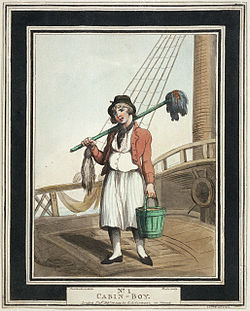
1799 illustration of a Royal Navy cabin boy by Thomas Rowlandson

A cabin boy or ship's boy is a boy or young man who waits on the officers and passengers of a ship,[1] especially running errands for the captain. The modern merchant navy successor to the cabin boy is the steward's assistant.

Duties

[edit]

Cabin boys were usually 13–16 years old, but sometimes as young as 8,[2] and also helped the cook in the ship's kitchen and carried buckets of food from the ship's kitchen to the forecastle where the ordinary seamen ate. They would have to scramble up the rigging into the yards whenever the sails had to be trimmed. They would occasionally stand watch like other crewmen or act as helmsman in good weather, holding the wheel to keep the ship steady on her course. They could be found on pirate ships sometimes.

Royal Navy officers

[edit]

Several prominent British Royal Navy officers began their career as cabin boys. The list includes officers that achieved an admiralty rank before 1801.

Notable American cabin boys

[edit]
[edit]
  • Cori, de Scheepsjongen ("Cori the Cabin Boy"), a comics series by Belgian artist Bob de Moor about a cabin boy working for the Verenigde Oostindische Compagnie in the 16th century.
  • Cabin Boy, a 1994 film.
  • "Cabin Boy" a song by Tom Robinson from the 1984/1997 Castaway Northwest CNWVP006 album War Baby.
  • Captain Pugwash, a British television children's animated series about a hapless captain and his crew; Tom, the cabin boy, is depicted as the most intelligent member of the crew.
  • Treasure Island, where the main character Jim serves as a cabin boy on the board the ship the Hispaniola.
  • "Cabin Boy", a short story by Damon Knight.
  • In The Terror AMC, the first season of the show showcased four fictionalised versions of the real ship boys of the Franklin Expedition. Thomas Evans, Robert Golding, David Young and George Chambers.
  • Renaissance Festival, The Cabin Boys, Pirate Fire Comedy act from Minnesota.
  • In One Piece, a couple of famous figures started their career as pirate cabin boys who would later grow into prominence after leaving their old crews. The Roger Pirates, the crew of the Pirate King Gol D. Roger, had two cabin boys who would later become two of the current Four Emperors, "Red-Hair" Shanks and "Genius Jester" Buggy. Their fellow emperor Marshall D. Teach (a.k.a. "Blackbeard") was a cabin boy of the Whitebeard Pirates, the rival crew of the Roger Pirates. The dethroned emperor "King of the Beasts" Kaidou was a cabin boy of the legendary Rocks Pirates. "Surgeon of Death" Trafalgar D. Water Law joined the Donquixote Family as a cabin boy where he would hang out with fellow cabin boy and cabin girl Buffalo and Baby 5 until Law was taken away from the crew by Donquixote Rosinante ("Corazon") for his own safety. SWORD officer "Red Flag" X. Drake was forced to be a cabin boy of his father's pirate crew, the Barrels Pirates, until the day of their destruction from which he escaped. Fellow SWORD officer Koby "the Hero" was abducted and forced to be a cabin boy for the Aldiva Pirates until he escaped and then joined the Marines shortly after.

References

[edit]
Revisions and contributorsEdit on WikipediaRead on Wikipedia
from Grokipedia
Cabin Boy is a 1994 American fantasy comedy film directed by Adam Resnick and co-produced by and , starring in the lead role as a spoiled prep-school graduate named Nathaniel Mayweather who mistakenly boards a rundown fishing vessel en route to , only to face adventures and the ire of the superstitious crew who deem him a . The film follows Mayweather, a naive and arrogant young man fresh from finishing school, as he embarks on what he believes will be a luxurious cruise but instead ends up as the titular cabin boy on the fishing boat Filthy Goose, commanded by the gruff Captain Greybar (Ritch Brinkley). Accompanied by a colorful ensemble cast including James Gammon as the elderly Paps, Brian Doyle-Murray as the sneaky Skunk, Brion James as the imposing Big Teddy, and Melora Walters as the ethereal island girl Trina, the story blends absurdist humor with fantastical elements, such as encounters with an enchanted figurehead (Ricki Lake) and a magical kingdom. Written by Resnick and Elliott, who drew inspiration from classic seafaring tales like Captains Courageous while infusing it with offbeat, dreamlike sequences reminiscent of Terry Gilliam's style, Cabin Boy was produced by Touchstone Pictures under Walt Disney Studios. Released on , 1994, in 593 theaters, the film had a budget of approximately $9 million but grossed only $3.7 million at the North American , marking it as a commercial disappointment. Critically, it received mixed to negative reviews, earning a 52% approval rating on based on 27 critic scores and a Metascore of 21 on , with detractors citing its uneven tone and over-the-top absurdity as flaws, though it later garnered a for Elliott's performance and the film's quirky charm. Despite the initial backlash, which even led to Elliott's nomination for a Golden Raspberry Award for Worst New Star, Cabin Boy has endured as a beloved oddity among fans of eccentric .

Synopsis and cast

Plot

Cabin Boy is an 80-minute fantasy comedy that parodies adventure tales such as Captains Courageous, following the transformation of a pampered young man through a series of absurd maritime misadventures. Nathaniel Mayweather, a snobbish and entitled graduate of the "Fancy Lads" finishing school, sets out from his elite upbringing to join his wealthy father in Hawaii aboard what he believes is the luxury liner Queen Catherine. Mistakenly directed by a quirky dockside vendor, he boards the dilapidated fishing vessel Filthy Whore instead, captained by the gruff Captain Greybar and crewed by rough fishermen including the dim-witted original cabin boy Kenny, the burly Mulligan, the superstitious Paps, and the cynical Skunk. The crew immediately resents Nathaniel's effete demeanor and fancy attire, dubbing him bad luck and assigning him menial chores like gutting fish, which he bungles comically—such as using a silver spoon or fainting at the sight of blood—leading to escalating tensions and "fancy lad" mishaps that parody class clashes at sea. As the ship enters the mysterious "Hell's Bucket" region, a storm ravages the vessel, washing overboard to his death and forcing into the full role of . Adrift on a for nine days, endures hallucinatory trials, including a sunburn from slathering on and from drinking , culminating in a surreal encounter with Chocki, a half-shark, half-man creature who saves him and imparts cryptic wisdom. Rescued and returned to the ship, 's journey intensifies with dream sequences featuring bizarre visions, such as a giant floating that spits . The docks at a remote for repairs, where faces further absurdity: he navigates a romantic subplot with , a tough swimmer initially repelled by his weakness but drawn to him after his ordeals; encounters a massive, dim-witted giant version of member Mulligan, whom he outwits using Chocki's advice and a giant ; and has a fantastical sexual awakening with Calli, a blue-skinned, six-armed siren-like figure. These island adventures highlight the film's surreal, stop-motion-infused style, blending live-action with whimsical fantasy elements. Upon reaching , rejects his father's offer of a cushy life, having matured through the trials into a resilient "Cabin Man." He reconciles with the crew, who now accept him, and sails off with and the Filthy Whore for further adventures, resolving his arc from spoiled elite to sea-hardened in a triumphant, if nonsensical, comedic denouement.

Cast

The principal cast of Cabin Boy features comedian in the lead role of Nathaniel Mayweather, a snobbish and spoiled young man from a wealthy family who aspires to a life of luxury and ease. plays Captain Greybar, the gruff and authoritarian leader of a rough fishing crew. portrays Skunk, the unkempt and odorous ship's cook among the crew. appears as Paps, the weathered and no-nonsense elderly sailor. is cast as Big Teddy, a hulking and intimidating crew member known for his brute strength. performs as Chocki, a half-man, half-shark creature who rescues and advises Nathaniel during his ordeal at sea. stars as Trina, a kind-hearted and down-to-earth young woman from the fishing village. plays Calli, a quirky island resident with multiple arms. has a supporting role as the , the carved wooden ornament on the ship's bow. appears as Kenny, the dim-witted original cabin boy. Mike Starr is cast as Mulligan, a burly and superstitious crew member. The film includes notable cameos by as an old salt in the fishing village and by Bob Elliott, Chris Elliott's real-life father, as William Mayweather, Nathaniel's affluent father. Adam Resnick, who co-wrote the screenplay with and made his directorial debut on the film, contributed to its surreal comedic tone through his collaboration with the lead actor, a longtime friend from their time on .

Production

Development

The screenplay for Cabin Boy originated from sketches in the television series Get a Life, co-created by Adam Resnick and , evolving into a parody of the 1937 adventure film with surreal, mythical elements added to suit a whimsical tone. In 1992, following the cancellation of Get a Life, —impressed by Elliott's performance—approached the duo to develop the project as a follow-up in the vein of his 1985 film , initially intending to direct it himself. Burton contributed as , influencing early creative decisions like incorporating fantastical visuals, such as a floating design. Burton departed the directorial role in 1993 to pursue , handing the reins to Resnick for his feature debut despite Resnick's initial reluctance, as the script had been tailored to Burton's vision. This shift necessitated adjustments, including scaling back ambitious elements originally planned for a larger production. , a division of , acquired the project that year, approving a $10 million and prompting script revisions to heighten the surreal comedy while fitting the more modest scope. Pre-production commenced in late 1992, with calls underway; Elliott was selected for the lead role Nathaniel Mayweather due to his established collaboration with Resnick on Get a Life. Location scouting emphasized nautical sets, primarily soundstages to evoke a shipboard environment.

Filming

for Cabin Boy took place from March 10 to May 19, 1993, spanning approximately ten weeks in the area. The production utilized a mix of practical locations and studio facilities, including exteriors at the and San Pedro Harbor to capture authentic maritime environments for the fishing boat sequences. Interiors for the Stephenwood School scenes were shot at Greystone Park & Mansion in , providing an elegant backdrop that contrasted with the film's later gritty shipboard settings. Much of the filming occurred on soundstages, including the Harbor Star Stage in San Pedro, where the central vessel, the Filthy Whore, was constructed as a detailed practical set to facilitate the crew's interactions and surreal comedic elements. Sea scenes, such as Nathaniel's raft ordeal, were filmed in a large within a , creating a controlled yet challenging aquatic environment that mimicked open ocean conditions. The production incorporated real fishing boats for exterior shots to enhance realism, while surreal sequences relied on practical effects, including a custom costume transforming actor into the half-man, half-shark creature Chocki, crafted by effects artist Tony Gardner's team. The low $10 million budget imposed significant constraints, leading to improvised that contributed to the film's intentionally chintzy, whimsical aesthetic parodying classic adventure tales. Water-based shoots proved particularly arduous, with stagnant tank water requiring multiple takes and visible seams in the backdrop compromising some shots, as director Adam Resnick later recounted. Resnick, a first-time feature director, navigated crew misunderstandings of the project's offbeat vision, fostering a tense on-set atmosphere amid these logistical hurdles. Cameos were handled efficiently to manage the tight schedule; David Letterman's brief appearance as the monkey-selling sailor was filmed in a single day as a favor to Resnick, his former colleague. Cinematographer Steve Yaconelli employed vibrant, exaggerated lighting and compositions to underscore the film's fantastical tone, blending live-action with miniature effects for ship movements and dreamlike sequences like the giant . This approach, influenced by Resnick's directorial takeover from initial producer , emphasized a playful, low-fi over polished realism.

Release

Box office

Cabin Boy was released theatrically in the United States on January 7, 1994, by through its Buena Vista Distribution arm, opening on 593 screens nationwide. The film carried a of approximately $9 million. It earned $1.51 million during its opening weekend, placing 13th at the behind holdover hits such as , which grossed $11.5 million in its eighth weekend. Over its entire domestic run, the film accumulated approximately $3.7 million, failing to recoup its costs and marking it as a commercial disappointment. The picture's underwhelming performance was exacerbated by stiff competition from family-oriented comedies and poor word-of-mouth stemming from mixed critical reception, leading to a sharp decline in attendance after its debut. International distribution was limited, generating negligible additional revenue and resulting in a worldwide gross equivalent to its domestic total.

Home media

The film was first made available on home video with a VHS release on July 27, 1994, distributed by Touchstone Home Video, which became a popular rental title in video stores despite its theatrical underperformance. A DVD edition followed on September 3, 2002, released by Touchstone Home Entertainment in a standard format without special features. In recognition of its 25th anniversary, issued a Blu-ray (alongside a DVD version) on September 18, 2018, featuring an audio commentary track with star and director Adam Resnick moderated by writer Mike Sacks, an on-camera interview with Elliott and Resnick, deleted scenes, a , and a collection of trailers and TV spots. The film has been available for streaming on platforms including as of 2025. Home media sales have been steady, driven by the film's cult status, generating approximately $156,108 in domestic video as of reported figures, helping to offset a portion of the production costs after its disappointment. By November 2025, no major physical re-releases had occurred following the 2018 edition, though the film's 30th anniversary in 2024 saw special theater screenings at venues such as the Paris Theater in New York and the Egyptian Theatre in , highlighting ongoing fan interest.

Reception

Critical response

Upon its release, Cabin Boy received mixed reviews from critics, with a general consensus highlighting its ambitious but uneven attempt at surreal . On , the film holds a 52% approval rating based on 27 reviews, with the consensus noting its quirky style but limited appeal. Similarly, assigns it a score of 21 out of 100 based on 10 critic reviews, indicating widespread disapproval. Some reviewers praised the film's surreal humor and Chris Elliott's lead performance as the spoiled protagonist Nathaniel Mayweather. Variety commended Elliott's "bug-eyed, prissy characterization" as the primary element holding the production together, appreciating its bold take on parodying old-fashioned sea adventures. The New York Times described the narrative as a whimsical voyage among "oddballs," crediting the script's inspiration from Tim Burton's style—Burton served as a —for infusing a sense of profound weirdness into the fantasy elements. However, negative critiques dominated, often citing the film's pointless plot and failure to deliver consistent laughs. Variety labeled it "obnoxious, snide and pointless," criticizing its crude and over-the-top execution as an ill-fated spoof that lacked cohesion. The faulted the uneven pacing and underdeveloped gags, observing that director Adam Resnick's script felt like "a first draft rushed into production before most of the gags got penned in," resulting in a style that blended vintage adventure tropes with stop-motion fantasy but without sufficient edge or humor. Common complaints across reviews included the overreliance on absurd, lowbrow antics that alienated mainstream audiences. This poor critical reception was underscored by Elliott's nomination for Worst New Star at the .

Accolades

Cabin Boy garnered attention primarily through nominations for negative achievements, reflecting its critical and commercial reception. At the 15th Golden Raspberry Awards in 1995, honoring films from 1994, Chris Elliott received a nomination for Worst New Star for his lead role as Nathaniel Mayweather. The film itself was not nominated in any category at the ceremony. The film was also nominated for Worst Picture at the 1994 Stinkers Bad Movie Awards, an early parody awards show focused on cinematic failures, with producer Tim Burton sharing the nomination as one of the film's key executives. No wins resulted from this nomination. In year-end critiques, was included on multiple lists of the worst films of 1994, such as a compilation by film enthusiast Vestmon, who ranked it alongside In the Army Now as emblematic of unfunny comedies featuring mismatched protagonists in rugged environments. The film and its contributors, including director Adam Resnick and producer , received no positive formal awards or nominations tied directly to this project, such as at the for fantasy elements. While later retrospective screenings at events like the Off-Centered Film Fest and Indie Memphis provided minor nods to its cult appeal, these did not include any competitive accolades.

Legacy

Cult following

Despite its initial box office failure, Cabin Boy gradually developed a dedicated in the late , particularly among enthusiasts who discovered the film through VHS rentals and late-night cable airings. The movie's offbeat humor, surreal elements, and Chris Elliott's exaggerated performance resonated with fans of alternative , transforming its commercial disappointment into a badge of ironic appreciation. Fan communities have sustained the film's popularity through online forums and discussions, where enthusiasts share memorable quotes like "fancy lad" and create memes that highlight the movie's quotable absurdity. Annual watch parties and virtual screenings organized by groups further foster this devotion, allowing fans to revisit the film's whimsical chaos collectively. Chris Elliott has reflected on the film's cult status in numerous interviews, noting how its failure paradoxically deepened its appeal among niche audiences who value its unapologetic weirdness. He has described the experience as a career-defining oddity that continues to draw loyal supporters, even as he embraces its legacy with humor. In 2019, the film's 25th anniversary was marked by special screenings, including a Q&A event with Elliott and director Adam Resnick at PhilaMOCA in Philadelphia, alongside a restored Blu-ray release by Kino Lorber. More recently, 2024 saw the 30th anniversary celebrated through podcasts like The Pick on Mildly Pleased, which analyzed its enduring charm. By 2025, steady viewership on streaming platforms such as Hoopla has kept the film accessible to new generations of fans.

Cultural impact

The film's distinctive dialogue and surreal elements have influenced music, particularly in hip-hop, where scenes like the "Half Man, Half Shark" sequence were sampled in Kool Keith's 1996 track "Halfsharkalligatorhalfman" from the album Dr. Octagon, highlighting its quirky appeal to underground artists. Other samples from the movie appear in experimental hip-hop tracks, contributing to its niche recognition in sampling culture. In broader media, Cabin Boy has been referenced in retrospectives and discussions of alternative comedy, such as The Ringer's 2018 article marking its 25th anniversary, which portrayed it as an "inspirational disaster" that captured the era's offbeat humor. It has also featured in podcasts, including the Nitehawk Cinema's 2018 episode with stars and director Adam Resnick, exploring its enduring weirdness. The movie's commercial and critical flop significantly impacted the careers of Elliott and Resnick, stalling their mainstream momentum and earning them a reputation as Hollywood pariahs in the years following its 1994 release, though it later bolstered their status in niche circles. Tim Burton's role as producer had minimal repercussions on his trajectory, given his established success with projects like . As of 2025, recent commentary continues to celebrate as an enduring example of absurd comedy, with Nathan Rabin's Substack post in May designating it a "Joy of Positivity" pick for its unapologetic strangeness and cult charm. In January 2025, a podcast episode featured a breakdown of the film's by effects artist , further highlighting its quirky production elements. discussions and essays in 2025 have sustained this discourse, analyzing its influence on modern weird humor without prompting major revivals. This ongoing appreciation amplifies its modest , positioning the film as a touchstone for fans of eccentric cinema.

References

Add your contribution
Related Hubs
User Avatar
No comments yet.