Hubbry Logo
search
logo
2092856

Calvin Graham

logo
Community Hub0 Subscribers
Read side by side
from Wikipedia

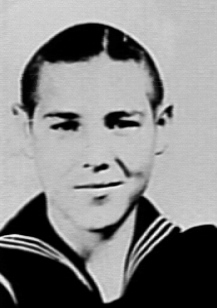
Calvin Leon Graham (April 3, 1930 – November 6, 1992) was the youngest U.S. serviceman to serve and fight during World War II and was one of the few known child soldiers to fight on behalf of the United States in the conflict.[2] Following the attack on Pearl Harbor, he enlisted in the United States Navy from Houston, Texas on August 15, 1942, at the age of 12.[3] His case was similar to that of Jack W. Hill, another child soldier who covertly enlisted during the U.S. involvement in WW2.

Key Information

Early life

[edit]

Graham was born in Canton, Texas, and was attending elementary school in Houston before he decided to join the Navy, after his father had died and his mother had remarried.[4]

US Navy, World War II

[edit]

Graham enlisted in the Navy on August 15, 1942. He went through boot camp in San Diego, California for six weeks. He was deployed to the USS South Dakota, at Pearl Harbor in Oahu, Hawaii.

USS South Dakota

[edit]

On October 26, 1942, he saw action in the Battle of the Santa Cruz. The South Dakota and her crew received a Navy Unit Commendation for their service. On the night of November 14–15, 1942, Graham was wounded during the Naval Battle of Guadalcanal. He served as a loader for a 40 mm anti-aircraft gun and was hit by shrapnel while taking a hand message to an officer.[5][6] Though he received fragmentation wounds, he helped in rescue duty by aiding and pulling the wounded aboard ship to safety.[5] He was awarded the Bronze Star Medal and the Purple Heart, and he and his crew mates were awarded another Navy Unit Commendation.

The South Dakota returned to the East Coast on December 18, 1942, for an overhaul and battle damage repairs (she had taken 42 hits from at least three enemy ships) in New York City, and since then, was named "Battleship X" in order to make the Japanese think she had been sunk. Graham's mother revealed his age after he traveled to his grandmother's funeral in Texas (he arrived a day late) without permission from the Navy, for which he spent three months in a Texas brig. He was released after his sister threatened to contact the newspapers. Although he had tried to return to his ship, he was discharged from the Navy on April 1, 1943, and his awards were revoked.[3][5][7] The South Dakota's gunnery officer who was involved in handling his case was Sargent Shriver.

He then worked in a Houston shipyard as a welder after dropping out of school.[6][4] At age 14 he married and became a father the following year. At age 17 he was divorced when he enlisted in the Marine Corps.[6]

US Marine Corps, 1948–1951

[edit]

Graham joined the United States Marine Corps in 1948 at age 17. His enlistment in the Marines also ended early when he fell from a pier and broke his back in 1951 during the Korean War.[8] Although serving in the Marine Corps qualified him as a veteran, he would spend the rest of his life fighting for full medical benefits and clearing his military service record.

Post military service

[edit]

In 1978, Graham was finally given an honorable discharge for his service in the Navy, and after writing to Congress and with the approval of President Jimmy Carter, all medals except his Purple Heart were reinstated. His story came to public attention in 1988, when his story was told in the TV movie, Too Young the Hero starring Rick Schroder.[9]

In 1988, Graham received disability benefits and back pay for his service in the Navy after President Ronald Reagan signed legislation that granted Graham full disability benefits, increased his back pay to $4,917 and allowed him $18,000 for past medical bills, contingent on receipts for the medical services.[9][10] By this time, some of the doctors who treated him had died and many medical bills were lost. He received only $2,100 of the possible $18,000. While the money for the rights to his story for the movie, Too Young The Hero amounted to $50,000, 50% went to two agents and 20% went to a writer of an unpublished book about Graham. He and his wife received just $15,000 before taxes.[3]

Death

[edit]

Graham died of heart failure in 1992 at the age of 62. His Purple Heart was finally reinstated, and presented to his widow, Mary, on June 21, 1994, by Secretary of the Navy John Dalton in Arlington, Texas, nearly two years after his death.[3][8] He was buried at Laurel Land Memorial Park in Fort Worth, Texas.[11]

Military awards

[edit]

References

[edit]
[edit]
Revisions and contributorsEdit on WikipediaRead on Wikipedia
from Grokipedia
Calvin Leon Graham (April 3, 1930 – November 6, 1992) was an American Navy veteran recognized as the youngest U.S. serviceman to engage in combat during World War II after enlisting at age 12 by misrepresenting his birthdate.[1][2] Assigned to the battleship USS South Dakota as a 40mm anti-aircraft gun loader, Graham participated in the intense surface actions of the Naval Battle of Guadalcanal on November 14–15, 1942, sustaining shrapnel wounds, a concussion, and the loss of two front teeth while continuing to man his station amid heavy Japanese fire.[1][2] For his valor in aiding the defense that repelled superior enemy forces, he was awarded the Bronze Star Medal with Combat "V" and Purple Heart, though these decorations were revoked upon his honorable discharge in April 1943 after his mother identified him in a news photograph, prompting revelation of his underage status.[1][3] Graham later reenlisted in the United States Marine Corps at age 17, achieving the rank of corporal and serving in Korea, where he earned additional campaign medals before a non-combat medical discharge in 1951 due to injuries from his earlier service.[3][4] His medals were reinstated by congressional action in 1988, acknowledging the legitimacy of his wartime contributions despite the circumstances of his enlistment.[5] Postwar, Graham faced personal hardships including family estrangement and health issues stemming from combat wounds, yet his story exemplifies youthful determination amid national crisis, though it also highlights administrative rigidities in military age verification during wartime exigency.[6]

Early Life

Childhood in Texas

Calvin Leon Graham was born on April 3, 1930, in Canton, Van Zandt County, Texas, to Lee Wesley Graham, aged 34, and Nora Gentry Graham.[7][8] He was the youngest of seven children in a poor farming family amid the Great Depression, with the household relying on subsistence agriculture in rural East Texas.[3][9] The family relocated to Crockett, Houston County, Texas, where Graham spent much of his early years and attended school through the sixth grade.[10][1] His father died during his childhood, after which his mother remarried, introducing a stepfather whose reported physical abuse toward Graham exacerbated family tensions.[6][2] By 1941, at age 11, Graham and a brother had been placed in a Texas boarding home due to the abusive home environment, reflecting the instability of his upbringing.[2] He remained in elementary school in the region until the Japanese attack on Pearl Harbor in December 1941 prompted his decision to seek escape through military service the following year.[6]

Family Dynamics and Abuse

Calvin Graham was born on April 3, 1930, in Canton, Texas, into a large impoverished family as the youngest of seven children from a rural farm background near Crockett.[11][6] His biological father, Lee Graham, died during Calvin's early childhood, after which his mother remarried, introducing a stepfather into the household.[6][12] The family dynamics were marked by hardship and tension, with the stepfather exerting physical and emotional control in a environment of poverty and limited resources. Multiple accounts describe the stepfather as abusive and alcoholic, creating an untenable home life that contributed to Graham's decision to seek independence.[13][14][15] In 1941, at age 11, Graham and his older brother left the family home to escape this abuse, relocating to a inexpensive rooming house in Crockett where Calvin sustained himself by selling newspapers on the streets.[12][16] His mother occasionally visited but did not intervene to bring him back, reflecting the strained familial bonds.[16] This early autonomy amid neglect and mistreatment foreshadowed Graham's enlistment in the Navy shortly after the Pearl Harbor attack on December 7, 1941.[11]

Enlistment and World War II Navy Service

Deception and Induction into the US Navy

Calvin Graham, residing in Texas amid a turbulent home life marked by familial abuse after his father's death, was galvanized to serve following the Japanese attack on Pearl Harbor on December 7, 1941. At 11 years old initially, he resolved to enlist in the U.S. military, departing home without consent and heading to a recruitment office in Houston. The Navy required enlistees to be at least 17 with parental approval or 19 otherwise, prompting Graham to fabricate consent by forging his mother's signature on the necessary forms.[2][17] To complete the deception, Graham illicitly obtained and used a notary stamp to validate the forged document, enabling him to bypass verification checks during the enlistment process. This act of fraudulence succeeded partly due to the expedited wartime recruitment standards, which prioritized volume over stringent scrutiny, allowing his pre-pubescent appearance to evade detection despite a physical examination.[2][17][14] On August 15, 1942—his twelfth birthday having passed that April—Graham was sworn in as a seaman recruit, marking him as the youngest documented U.S. service member to enter active duty during World War II. Assigned initially for basic training, his induction reflected the broader phenomenon of underage enlistments amid national urgency, though his case stood out for its audacity and youth.[2][6]

Assignment to USS South Dakota

Following completion of recruit training at San Diego, California, Graham underwent specialized instruction as an anti-aircraft gunner before being assigned to the USS South Dakota (BB-57), a fast battleship operating in the Pacific theater.[2][1][18] At 5 feet 2 inches tall and weighing 125 pounds, he served as a Seaman Second Class (S2c) manning one of the ship's 40 mm anti-aircraft guns.[19][3] The assignment occurred in fall 1942, with Graham joining the vessel as part of Task Force 16 at Pearl Harbor, Oahu, Hawaii, shortly after its shakedown operations.[6][20] The USS South Dakota, under Captain Leigh Noyes, had been commissioned on March 20, 1942, and was tasked with providing heavy gunfire support and carrier escort duties amid escalating naval engagements in the Solomon Islands campaign.[3]

Combat Experiences and Injuries

Graham served as a loader on a 40mm anti-aircraft gun aboard the USS South Dakota during its initial combat engagement in the Battle of the Santa Cruz Islands on October 26, 1942, southeast of Guadalcanal, where the battleship contributed to shooting down 26 Japanese aircraft.[14][20] The ship's most intense action occurred during the Naval Battle of Guadalcanal on the night of November 14–15, 1942, when South Dakota exchanged fire with a Japanese fleet, sustaining at least 26 hits from enemy shells and bombs that caused multiple fires, power failures, and over 100 casualties among the crew.[1][2] Graham remained at his gun station amid the chaos, but shrapnel struck his face, tearing through his jaw and mouth; a subsequent blast knocked him unconscious, causing him to fall through three decks before he regained awareness.[1][2] Despite his wounds, which included facial lacerations and dental damage requiring multiple teeth extractions, Graham assisted in aiding other injured sailors by dragging them to safety and helping to extinguish fires, actions that demonstrated resolve under fire.[2][20] For his conduct in this engagement, he received the Bronze Star Medal with Combat "V" for valor and the Purple Heart for his injuries, alongside the Navy Unit Commendation awarded to the ship.[1][2]

Discharge from the Navy

Revelation of True Age

Following the Naval Battle of Guadalcanal on November 14–15, 1942, aboard the USS South Dakota, Graham sustained shrapnel wounds to his face and gums, lost two front teeth, and fell through three decks after being knocked unconscious, requiring hospitalization.[2][1] Upon recovery, while Graham was on leave in Texas, his mother recognized him in newsreel footage depicting wounded sailors from the battle and contacted the U.S. Navy to report his true age of 12 at enlistment.[6][1] Navy investigators confirmed Graham's birth date as April 3, 1930, via birth records and family statements, verifying he had forged documents and lied about being 17 years old when enlisting on August 15, 1942.[4][21] This revelation invalidated his service under enlistment regulations requiring a minimum age of 17 with parental consent or 19 without, prompting the Navy to detain him briefly in the brig before initiating discharge proceedings in early 1943.[2][21] Following the revelation of his true age by his mother in mid-December 1942, Graham was removed from the USS South Dakota during repairs at the Brooklyn Navy Yard and transported to a naval brig in Corpus Christi, Texas, where he was confined for nearly three months.[11][6] During this period, he faced interrogation regarding his fraudulent enlistment but was not subjected to formal court-martial proceedings.[14] On April 1, 1943, the Navy issued Graham an undesirable discharge—characterized in some accounts as dishonorable—for lying about his age to enlist, thereby revoking all military honors, including his Bronze Star Medal with "V" device and Purple Heart, as well as any associated disability benefits for his shrapnel wounds sustained in combat.[14][11][6] This administrative action reflected the Navy's policy against underage enlistment fraud during wartime, prioritizing the invalidation of service records over recognition of contributions from minors.[11] Graham received no back pay beyond a small sum and civilian clothing upon release, leaving him without veteran status or support at age 12.[14][6]

Marine Corps Service

Re-enlistment and Training

In 1948, facing conscription amid the post-World War II draft, Calvin Graham enlisted in the United States Marine Corps at age 17.[14][1] This marked his return to military service following his Navy discharge, with enlistment occurring voluntarily as an alternative to being drafted into another branch.[6] Graham completed Marine Corps recruit training, a standard regimen for all enlistees involving physical conditioning, marksmanship, combat skills, and discipline indoctrination, typically lasting eight to twelve weeks at one of the recruit depots.[1] Specific details of his training experience, such as location or incidents, are not extensively documented in primary accounts, but successful completion enabled his progression to active duty and promotion to corporal.[1][6]

Active Duty and Separation

Graham enlisted in the United States Marine Corps on November 6, 1950, entering active duty during the Korean War at the age of 20.[4] He advanced to the rank of corporal (E-4) while serving.[20] His active duty period involved standard Marine operations amid the ongoing conflict, though specific combat engagements for Graham are not documented in available records.[6] Graham's service ended prematurely due to a severe injury sustained in a non-combat accident. On an unspecified date in 1951, he fell from a pier, fracturing his back.[1] The injury rendered him unfit for continued duty, leading to a medical separation from the Marines on August 1, 1951, after 8 months and 29 days of service.[4] He was awarded a 20% disability rating by the Veterans Administration for the spinal injury, reflecting its long-term impact on his mobility and health.[22] Unlike his Navy tenure, this enlistment was lawful with no age-related discrepancies, allowing for honorable discharge terms tied to the medical condition rather than administrative revocation.[23]

Post-Military Life

Marriage, Family, and Employment

Following his discharge from the U.S. Navy in 1943, Graham secured employment as a welder in a Houston shipyard.[1] At age 14, he married and fathered a child the following year.[1][14] The marriage dissolved in divorce by the time he was 17.[2] Graham remarried Mary Louise Winfield on January 7, 1968, in Texas.[7] She was his wife at the time of his death in 1992.[24]

Health Consequences of Service

During the Naval Battle of Guadalcanal on November 14–15, 1942, Graham sustained shrapnel wounds to his face, jaw, and mouth while manning a gun aboard the USS South Dakota; the injuries knocked out his front teeth and were severe enough to qualify him for the Purple Heart, though he continued aiding wounded crewmates despite the trauma.[1][2] An explosion also hurled him down three decks, exacerbating his injuries amid the ship's 42 enemy hits, which resulted in 38 deaths and over 60 wounded overall.[25] These combat wounds were later classified as a permanent service-connected disability.[2] The facial and arm injuries from Guadalcanal persisted into adulthood, causing ongoing pain and complications that Graham cited in his campaigns for restored benefits and honorable discharge status.[14] In his Marine Corps service, Graham incurred an additional back injury on August 1, 1951, after falling from a pier, which resulted in a 20 percent service-connected disability rating upon his separation.[26] These cumulative effects contributed to his lifelong pursuit of medical and disability compensation, culminating in 1988 legislation signed by President Ronald Reagan that granted him Navy back pay and benefits for the Guadalcanal wounds.[2] Graham died of heart failure on November 6, 1992, at age 62, with no direct causal link established between his service injuries and the cause of death in available records.[1]

Advocacy and Recognition Efforts

Campaign to Restore Benefits and Medals

Following his undesirable discharge from the U.S. Navy in 1943, Calvin Graham persistently advocated for the restoration of his military honors, benefits, and recognition of his service aboard the USS South Dakota. Graham's efforts spanned decades, involving petitions to government officials and legislative action, as he sought to rectify the revocation of his medals—including the Purple Heart for shrapnel wounds sustained during the Battle of Guadalcanal—and to secure an honorable discharge along with associated disability payments for injuries incurred in combat.[3][2] In 1976, Graham formally petitioned the White House for official recognition of his wartime contributions, prompting a review that culminated in 1978 when President Jimmy Carter personally approved an upgrade to an honorable discharge and reinstated most of Graham's decorations, excluding the Purple Heart; this action also entitled him to disability benefits for his service-related injuries.[27][3] Despite these partial restorations, Graham continued pressing for full reinstatement, including back pay owed for disabilities stemming from his Navy service.[2] Further progress occurred in 1988, when President Ronald Reagan signed legislation—enacted through congressional efforts—that granted Graham additional veterans' benefits and compensated him for accrued disability payments withheld since his discharge.[3][2] The Purple Heart, however, remained withheld during Graham's lifetime, with the Navy citing regulations barring awards to underage enlistees despite his verified combat injuries; it was finally restored posthumously on May 25, 1994, by Navy Secretary John H. Dalton, acknowledging Graham's valor as a 12-year-old gunner.[27][6] These restorations highlighted the challenges of bureaucratic resistance to recognizing underage volunteers, requiring sustained personal and legislative campaigns to affirm Graham's contributions to World War II efforts.[9]

Later Honors and Public Acknowledgment

In 1980s, President Ronald Reagan restored Graham's disability benefits, recognizing the long-term health impacts from his wartime injuries.[3] Graham died on November 6, 1992, at age 62 in Fort Worth, Texas, from heart failure exacerbated by his service-related conditions.[28][3] On May 26, 1994, the U.S. Navy announced the restoration of his Purple Heart, the final medal withheld since his 1943 discharge; it was formally presented to his widow, Mary Graham, by Navy Secretary John H. Dalton on June 21, 1994, in a ceremony acknowledging his heroism at age 12 during the Battle of Guadalcanal.[27][2] Graham's story gained broader public recognition posthumously, including designation as the Department of Veterans Affairs' "Veteran of the Day" on September 27, 2022, highlighting his status as the youngest U.S. service member in World War II and his contributions aboard the USS South Dakota.[3]

Death and Legacy

Final Years and Passing

Calvin Graham resided in Fort Worth, Texas, during his later years, where he continued to grapple with the long-term effects of his wartime injuries, including the loss of teeth from a shipboard incident and subsequent health complications.[6] The 1988 television film Too Young the Hero, which dramatized his story and starred Ricky Schroder, provided Graham with some financial relief shortly before his death.[14] Graham died of heart failure on November 6, 1992, at his home in Fort Worth at the age of 62.[1][21] His stepson, Ronnie O'Donley, confirmed the cause of death as heart failure.[20] He was buried at Laurel Land Memorial Park in Fort Worth.[21] Nearly two years later, on June 21, 1994, the U.S. Navy posthumously reinstated his Purple Heart medal, which was presented to his widow.[19]

Historical Significance and Debates

Calvin Graham's service underscores the broader historical pattern of underage enlistment during World War II, where an estimated 200,000 American youths, motivated by post-Depression economic pressures, family hardships, and fervent patriotism following Pearl Harbor, falsified their ages to join the military amid urgent manpower needs.[29] Recruiters, facing overwhelming volunteerism, often conducted superficial verifications, allowing boys as young as 12—like Graham, who enlisted on August 15, 1942—to serve in combat roles, contributing to key operations such as the Naval Battle of Guadalcanal.[11] His wounding aboard the USS South Dakota on November 14, 1942, and subsequent awards of the Bronze Star for valor and Purple Heart exemplified the sacrifices of these "baby vets," many of whom faced death or injury before reaching voting age, thereby amplifying narratives of youthful resolve in sustaining the Allied effort.[29] By 1991, over 1,200 such cases were documented, highlighting systemic laxity in age enforcement during wartime exigency.[11] Graham's post-discovery treatment—dishonorable discharge in April 1943, three months' imprisonment, and revocation of medals and pay after his mother's report—exposed tensions in military policy between wartime pragmatism and peacetime administrative rigor, where fraudulent enlistment overshadowed combat merit.[11] His decades-long advocacy, culminating in an honorable discharge and partial benefits restoration under President Carter in 1978 and further honors under Reagan in 1988, influenced retrospective recognition for other underage veterans, prompting policy shifts toward granting G.I. Bill access and honorable statuses despite initial deceptions.[29] This trajectory illustrates how individual cases illuminated the human cost of rigid bureaucracy on proven contributors, fostering greater appreciation for voluntary service amid flawed enlistment processes. Debates surrounding Graham center on the ethical balance between honoring demonstrated bravery and penalizing age falsification, with critics arguing that revocations like his undermined morale and ignored the context of recruiter complicity in overlooked discrepancies.[29] While frequently dubbed the youngest U.S. WWII combatant, records suggest he was among the youngest documented to fight and receive decorations, though undocumented or lesser-known cases may predate or rival his age of 12, tempering absolute claims amid incomplete historical data.[11] His story thus fuels discussions on verifying "firsts" in veteran lore versus substantive impact, emphasizing causal factors like family abuse driving enlistment over glorified myths of singular youth.[29]

References

User Avatar
No comments yet.