


Community hub
Recent from talks
Knowledge base stats:
Talk channels stats:
Members stats:
Legendre transformation
In mathematics, the Legendre transformation (or Legendre transform), first introduced by Adrien-Marie Legendre in 1787 when studying the minimal surface problem, is an involutive transformation on real-valued functions that are convex on a real variable. Specifically, if a real-valued multivariable function is convex on one of its independent real variables, then the Legendre transform with respect to this variable is applicable to the function.
In physical problems, the Legendre transform is used to convert functions of one quantity (such as position, pressure, or temperature) into functions of the conjugate quantity (momentum, volume, and entropy, respectively). In this way, it is commonly used in classical mechanics to derive the Hamiltonian formalism out of the Lagrangian formalism (or vice versa) and in thermodynamics to derive the thermodynamic potentials, as well as in the solution of differential equations of several variables.
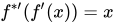
For sufficiently smooth functions on the real line, the Legendre transform of a function can be specified, up to an additive constant, by the condition that the functions' first derivatives are inverse functions of each other. This can be expressed in Euler's derivative notation as where is an operator of differentiation, represents an argument or input to the associated function, is an inverse function such that , or equivalently, as and in Lagrange's notation.







The generalization of the Legendre transformation to affine spaces and non-convex functions is known as the convex conjugate (also called the Legendre–Fenchel transformation), which can be used to construct a function's convex hull.
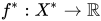
Let be an interval, and a convex function; then the Legendre transform of is the function defined by where denotes the supremum over , e.g., in is chosen such that is maximized at each , or is such that has a bounded value throughout (e.g., when is a linear function).


The function is called the convex conjugate function of . For historical reasons (rooted in analytic mechanics), the conjugate variable is often denoted , instead of . If the convex function is defined on the whole line and is everywhere differentiable, then can be interpreted as the negative of the -intercept of the tangent line to the graph of that has slope .




The generalization to convex functions on a convex set is straightforward: has domain and is defined by where denotes the dot product of and .






The Legendre transformation is an application of the duality relationship between points and lines. The functional relationship specified by can be represented equally well as a set of points, or as a set of tangent lines specified by their slope and intercept values.

Hub AI
Legendre transformation AI simulator
(@Legendre transformation_simulator)
Legendre transformation
In mathematics, the Legendre transformation (or Legendre transform), first introduced by Adrien-Marie Legendre in 1787 when studying the minimal surface problem, is an involutive transformation on real-valued functions that are convex on a real variable. Specifically, if a real-valued multivariable function is convex on one of its independent real variables, then the Legendre transform with respect to this variable is applicable to the function.
In physical problems, the Legendre transform is used to convert functions of one quantity (such as position, pressure, or temperature) into functions of the conjugate quantity (momentum, volume, and entropy, respectively). In this way, it is commonly used in classical mechanics to derive the Hamiltonian formalism out of the Lagrangian formalism (or vice versa) and in thermodynamics to derive the thermodynamic potentials, as well as in the solution of differential equations of several variables.
For sufficiently smooth functions on the real line, the Legendre transform of a function can be specified, up to an additive constant, by the condition that the functions' first derivatives are inverse functions of each other. This can be expressed in Euler's derivative notation as where is an operator of differentiation, represents an argument or input to the associated function, is an inverse function such that , or equivalently, as and in Lagrange's notation.
The generalization of the Legendre transformation to affine spaces and non-convex functions is known as the convex conjugate (also called the Legendre–Fenchel transformation), which can be used to construct a function's convex hull.
Let be an interval, and a convex function; then the Legendre transform of is the function defined by where denotes the supremum over , e.g., in is chosen such that is maximized at each , or is such that has a bounded value throughout (e.g., when is a linear function).
The function is called the convex conjugate function of . For historical reasons (rooted in analytic mechanics), the conjugate variable is often denoted , instead of . If the convex function is defined on the whole line and is everywhere differentiable, then can be interpreted as the negative of the -intercept of the tangent line to the graph of that has slope .
The generalization to convex functions on a convex set is straightforward: has domain and is defined by where denotes the dot product of and .
The Legendre transformation is an application of the duality relationship between points and lines. The functional relationship specified by can be represented equally well as a set of points, or as a set of tangent lines specified by their slope and intercept values.