Hubbry Logo
Cao RenCao RenMain
Open search
Cao Ren
Community hub
Cao Ren
logo
8 pages, 0 posts
0 subscribers
Be the first to start a discussion here.
Cao Ren
Cao Ren
from Wikipedia

Key Information

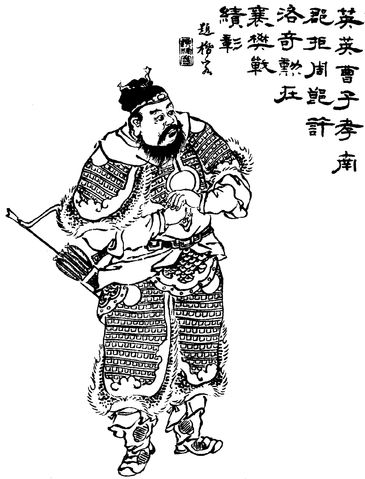
Cao Ren (pronunciation) (168 – 6 May 223),[a][4] courtesy name Zixiao, was a military general serving during the late Eastern Han dynasty of China under the warlord Cao Cao, who was also his older second cousin.[5] He continued serving in the state of Cao Wei – founded by Cao Cao's son and successor, Cao Pi – during the Three Kingdoms period. He played a significant part in assisting Cao Cao in the civil wars leading to the end of the Han dynasty. He was appointed as the Grand Marshal (大司馬) when Cao Pi ascended the throne, and was also credited by the latter for the establishment of Wei. However, Cao Ren was also once derided as a mediocre commander by Zhu Huan, a general from Wei's rival state Eastern Wu.[6]

Early life

[edit]

Cao Ren was a younger second cousin of Cao Cao.[7] His grandfather Cao Bao (曹襃) and father Cao Chi (曹熾) served in the government of the Eastern Han dynasty.[8] He had a younger full brother, Cao Chun. As their father died when they were still young, Cao Ren and Cao Chun lived with another family. They inherited their family fortune when they became older. They were known for being wealthy and having hundreds of servants and retainers.[9]

As a youth, Cao Ren was fond of horse-riding, archery and hunting. When chaos broke out in China towards the end of the Han dynasty, Cao Ren rallied a militia of over 1,000 men and they wandered around the region near the Huai and Si rivers. Cao Ren and his followers eventually joined Cao Cao around 190 when the latter was raising an army to join the campaign against Dong Zhuo. Cao Ren held the rank of a Major of Separate Command (別部司馬) under Cao Cao but he was actually an acting Sharp Edge Colonel (厲鋒校尉).[10]

Campaigns in central China

[edit]

Throughout the 190s, Cao Ren followed Cao Cao on various campaigns against rival warlords in central China. He made great contributions in the campaign against Yuan Shu between 197 and 199. When Cao Cao invaded Xu Province from 193–194 to attack the provincial governor Tao Qian, Cao Ren was in charge of the cavalry and he led the vanguard. He defeated Tao Qian's general Lü You (呂由) and led his force to rendezvous with Cao Cao's main army at Pengcheng (彭城; present-day Xuzhou, Jiangsu), where they scored a major victory over Tao Qian's forces. Cao Ren and his cavalry later defeated Tao Qian's subordinates in various battles at the counties in Xu Province.[11] During the conflict between Cao Cao and Lü Bu, Cao Ren attacked Lü Bu's subordinate Liu He (劉何) at Gouyang (勾陽) and captured the enemy commander alive.[12]

After Cao Cao had defeated the Yellow Turban rebels, he received Emperor Xian (who had escaped from the clutches of Li Jue and Guo Si) and set up the new capital at Xu (許; present-day Xuchang, Henan) in 196. Cao Ren was appointed as the Administrator (太守) of Guangyang Commandery (廣陽郡) for his achievements. However, Cao Ren never exercised governorship over his jurisdiction because Cao Cao appreciated his military skills and kept him by his side in Xu. Cao Ren was still in charge of the cavalry even though he held the position of a civil official as a Consultant (議郎).[13]

The following year, Cao Ren followed Cao Cao on a campaign against the warlord Zhang Xiu, and was authorised to lead a separate force to raid the counties around Zhang Xiu's base in Wan (宛; or Wancheng, present-day Wancheng District, Nanyang, Henan) and he captured over 3,000 civilians. Zhang Xiu surrendered to Cao Cao initially, but rebelled later and launched a surprise attack, which led to the Battle of Wancheng. Cao Cao was defeated and he retreated after his forces succeeded in repelling further attacks by Zhang Xiu. However, as they were withdrawing, Zhang Xiu attacked again and Cao Cao's men were unable to drive the enemy away. The morale of Cao Cao's army started falling but Cao Ren helped to raise the soldiers' spirits by encouraging and inspiring them. Cao Cao was very impressed with Cao Ren, and he managed to defeat Zhang Xiu later in a counterattack.[14]

Campaign against Yuan Shao

[edit]

In 200, when the forces of Cao Cao and Yuan Shao were locked in a stalemate at the Battle of Guandu, Yuan sent Liu Bei with an army to support the rebellions against Cao Cao in Yinjiang (㶏疆; southwest of present-day Xuchang, Henan), roughly 8.3 km south of the capital. Cao Cao became worried about such developments in the territories under his control, so he sent Cao Ren to suppress the uprisings. Cao Ren observed that the rebels dared to create trouble because they had Liu Bei's support, but the men under Liu were newly recruited and inexperienced, so it was not difficult to defeat them. Cao Ren targeted the rebel chief Liu Pi and killed him in battle, and subsequently defeated Liu Bei as well. Yuan Shao attempted to cut off Cao Cao's route to the west by sending Han Meng (韓猛)[15] southwest. Cao Ren responded to the threat by defeating Han Meng at Jiluo Hill (雞洛山; located 50 li northeast of present-day Xinmi, Henan). Yuan Shao became afraid and did not dare to send out his troops. Cao Ren and Shi Huan (史渙) later led a force to attack a convoy transporting supplies to Yuan Shao's camp and destroyed the food supplies.[16]

After Cao Cao's victory at Guandu, Cao Ren continued to join Cao Cao in his campaigns against Yuan Shao's heirs in the early 3rd century. During one battle near Hu Pass (壺關; present-day Huguan County, Shanxi), Cao Cao gave orders that all the enemy troops would be buried alive after the city fell. However, after several days of siege, Cao Cao's forces were unable to capture the city. Cao Ren then told Cao Cao, "When we besiege a city, we must leave the defenders with a final option of surrendering. Now, as you've already said that the defenders would be slaughtered after the city is taken, all of them would definitely put up fierce resistance. Besides, the city's fortifications are strong and the defenders have much supplies, so our forces would suffer heavy casualties if we attack, and we will be held up here if we switch to a defensive stance. It's not a wise choice to besiege a city whose defenders are willing to fight to the death." Cao Cao heeded Cao Ren's advice, and the enemy surrendered later. After the campaign, Cao Ren received the title of a "Marquis of a Chief Village" (都亭侯) for his contributions.[17]

Battle of Jiangling, and campaigns in northwest China

[edit]

In 208, after losing to Sun Quan and Liu Bei at the Battle of Red Cliffs, Cao Cao retreated north and left Cao Ren and Xu Huang to defend the strategic Jiangling Commandery (江陵郡; in present-day Jingzhou, Hubei) from the advances of Sun Quan's forces, which were led by Zhou Yu. Cao Ren was serving as acting General Who Attacks the South (征南將軍) then. Zhou Yu despatched a several thousand-strong vanguard to challenge Cao Cao's forces at Jiangling. Cao Ren was aware that his army's morale was low, since they were recently defeated at Red Cliffs, so he ordered his subordinate Niu Jin to lead 300 volunteer soldiers into battle, in the hope that they would display bravery and boost his men's morale. Niu Jin and his men were heavily outnumbered and surrounded by the enemy. Cao Ren's Chief Clerk (長史), Chen Jiao (陳矯), turned pale when he saw the situation from the top of the city walls. However, unlike what everyone thought, Niu Jin managed to create havoc around the Wu's army with just 100 men left by then. Cao Ren experienced a surge of fury and courage after watching how Niu Jin with so little men could make the entire Wu army three times the strength get so tired battling just 300 of his own men, so he ordered every troop in the city to be prepared to go into battle. Chen Jiao and the others attempted to dissuade him from braving danger, but Cao Ren ignored them and every soldiers in his command was ordered to charged into the enemy formation. Cao Ren successfully rescued Niu Jin and his surviving men and even turned back to save his remaining soldiers who were still trapped in the enemy formation. Sun Quan's forces retreated. When Cao Ren returned, his subordinates exclaimed, "General, you're truly a man from Heaven!" The troops were awed by Cao Ren's bravery, and Cao Cao was very impressed when he heard about this incident. Cao Ren's marquis title was changed to "Marquis of Anping Village" (安平亭侯).[18]

Around 211, Cao Ren participated in Cao Cao's campaigns against a coalition of northwestern warlords led by Ma Chao and Han Sui, which led to the Battle of Tong Pass. Cao Ren held the appointment of acting General Who Stabilises the West (安西將軍) and commanded the defence at Tong Pass (潼關; present-day Tongguan County, Weinan, Shaanxi) before Cao Cao reached the frontline.[19]

When Su Bo (蘇伯) and Tian Yin (田銀) rebelled in 212,[20] Cao Ren was appointed acting General of Valiant Cavalry (驍騎將軍) and he led seven armies to attack the rebels and defeated them.[21]

Battle of Fancheng

[edit]

Cao Ren was reappointed acting General Who Attacks the South (征南將軍) was ordered to garrison at Fan (樊; also called Fancheng, in present-day Fancheng District, Xiangfan, Hubei) and oversee Cao Cao's forces in Jing Province. Cao Ren suppressed a rebellion led by Hou Yin (侯音) before massacring the population of Wan (宛; present-day Wancheng District, Nanyang, Henan) between late 218 and early 219,[22][23] he was then officially commissioned as General Who Attacks the South and he continued to garrison at Fan.[24]

In the autumn of 219, Liu Bei's general Guan Yu, who was in charge of Liu's territories in southern Jing Province, led an army north to attack Fan. Cao Cao sent the general Yu Jin to lead seven armies to resist Guan Yu, but the armies were destroyed in a flood when the Han River overflowed due to heavy rains. Yu Jin surrendered to Guan Yu while his subordinate Pang De refused and was executed by Guan. Cao Ren was left with a few thousand troops to defend Fan. Guan Yu and his forces sailed towards Fan on boats and besieged the fortress. By then, Cao Ren and his troops had been completely isolated inside Fan as they had lost contact with outside, while their supplies were running out and there were no reinforcements in sight. Cao Ren encouraged his men to fight to the death and they were very inspired by his words. By the time reinforcements led by Xu Huang arrived, the water level had subsided slightly. While Xu Huang was attacking Guan Yu, Cao Ren seized the opportunity to counterattack and break the siege. Guan Yu failed to conquer Fan so he retreated.[25]

Service under Cao Pi

[edit]

Although Cao Ren behaved brashly and had no regard for laws when he was young, but after he joined the Cao Cao's Army, he started following rules and regulations strictly and he went by the book in everything he did. Once, when Cao Cao's son Cao Zhang was on away on a campaign against the Wuhuan, his brother Cao Pi wrote to him, "Shouldn't you follow rules and regulations in the same way Cao Ren does?"[26]

Cao Cao died in 220 and was succeeded as King of Wei by Cao Pi. Later that year, Cao Pi, with the support of all the officials, made Emperor Xian to pass the throne to him, finally putting an end to the crumbling Han dynasty, and established the state of Cao Wei, the strongest of the three Kingdoms. Cao Ren was appointed as General of Chariots and Cavalry (車騎將軍) and was placed in charge of military affairs in Jing, Yang and Yi provinces. He also received the title "Marquis of Chen" (陳侯) and was given 2,000 more taxable households in his marquisate, making it a total of 3,500 households.[27]

Cao Ren moved to Wan (宛; present-day Wancheng District, Nanyang, Henan) in northern Jing Province and garrisoned there. Later, when Sun Quan sent Chen Shao (陳邵) to attack Xiangyang, Emperor Wen(Cao pi) ordered Cao Ren to lead an army to Xiangyang to resist Sun Quan's forces. Cao Ren and Xu Huang defeated Chen Shao and their forces entered Xiangyang. Cao Ren had the general Gao Qian (高遷) oversee the relocation of civilians from the southern bank of the Han River to the north. Emperor Wen appointed Cao Ren as General-in-Chief (大將軍). Later, Emperor Wen ordered Cao Ren to move to Linying (臨潁) and promoted him to Grand Marshal (大司馬). Cao Ren was placed in charge of the armies along the Wu River (烏江) and he garrisoned at Hefei.[28] In 222, Cao Ren led several tens of thousands men to assail Sun Quan's garrison at Ruxu (濡須; north of present-day Wuwei County, Anhui), where the defending general, Zhu Huan, had only 5,000 troops remaining inside the city walls.[29] However, Cao Ren was deemed only as an inferior commander by Zhu Huan and his colleagues, so the defenders put up a staunch defence. Even though Cao Ren had a complete numerical advantage, the battle concluded with Zhu Huan as the victor – Cao Ren lost not only over 1,000 men, but also two of his subordinates, Chang Diao (常雕) and Wang Shuang.[30]

Death

[edit]

Cao Ren died on 6 May 223[a][31] at the age of 56 (by East Asian age reckoning).[32] He was posthumously granted the title "Marquis Zhong" (忠侯), which literally means "loyal marquis". He was best remembered for his bravery and courage, which placed him above Zhang Liao among all of Cao Cao's generals.[33]

Family

[edit]

Cao Ren's grandfather Cao Bao (曹褒) served as the Administrator (太守) of Yingchuan Commandery (潁川郡) in the Eastern Han dynasty. Cao Ren's father Cao Chi (曹熾) also served as a Palace Attendant and Changshui Colonel (長水校尉) in the Eastern Han dynasty, and was posthumously awarded the title "Marquis Mu of Chen" (陳穆侯) by Cao Pi.[34] Cao Ren's younger brother Cao Chun was also a general under Cao Cao.

Cao Ren's titles were inherited by his son Cao Tai (曹泰), who served as General Who Guards the East (鎮東將軍) and later had his marquis title changed to "Marquis of Ningling" (寗陵侯). Cao Tai was succeeded by his son Cao Chu (曹初). Cao Ren's other sons (Cao Tai's younger brothers) Cao Kai (曹楷) and Cao Fan (曹範) also received marquis titles.[35]

[edit]

Cao Ren is featured as a playable character in Koei's Dynasty Warriors and Warriors Orochi video game series.

In the collectible card game Magic: The Gathering there is a card named "Cao Ren, Wei Commander" in the Portal Three Kingdoms set.

See also

[edit]

Notes

[edit]

References

[edit]
Revisions and contributorsEdit on WikipediaRead on Wikipedia
from Grokipedia
Cao Ren (Chinese: 曹仁; courtesy name Zixiao; 167–223) was a military general who served under his cousin, the warlord Cao Cao, during the late Eastern Han dynasty and into the early Three Kingdoms period in China. Born into a prominent family from Qiao Commandery in Pei State, with his grandfather having served as Grand Administrator of Yingchuan and his father as a palace attendant, Cao Ren rose through the ranks by demonstrating valor and loyalty in Cao Cao's campaigns against rivals such as Yuan Shu, Tao Qian, Lü Bu, and Zhang Xiu. He achieved notable successes in battles including the defeat of at Yinjiang, the routing of Yuan Shao's forces at Guandu and Mount Jiluo, and the suppression of rebellions by figures like Su Bo, Tian Yin, and Hou Yin. Cao Ren earned acclaim for his defensive strategies, particularly during the defense of Jing Province where he rescued the officer Niu Jin from Zhou Yu's army and withstood Guan Yu's prolonged siege at Fancheng in 219, preventing a major loss for Cao Cao's forces despite flooding and numerical disadvantage. Later stationed at , he repelled multiple incursions by armies, solidifying his reputation as a steadfast who prioritized tactical ingenuity over aggressive pursuits. Appointed to high ranks such as and under , Cao Ren died in 223 at age 56 while at and was posthumously honored as Marquis of Loyalty.

Early Life

Birth and Family Background

Cao Ren was born in 168 AD in Qiao County, Pei Commandery, which corresponds to modern-day in Province. His was Zixiao. As a member of the Cao clan, Ren was Cao Cao's younger second cousin through their paternal lineage, with both descending from the same in Qiao. The Cao family held minor noble status as local yeomen with intermittent official roles in the late Eastern Han bureaucracy, lacking the prestige of great aristocratic houses but benefiting from kinship networks that facilitated amid dynastic decline. This clannish loyalty, rooted in Han-era customs where familial ties often determined command appointments over merit alone, positioned Ren for early integration into Cao Cao's forces, underscoring the causal influence of in regional power consolidation during the era's turmoil.

Youth and Initial Military Inclinations

Cao Ren, Zixiao, was born in 168 in Qiao County, Pei Commandery (modern-day , ), as a paternal cousin of the warlord ; his father, Cao Chi, was a relative of Cao Teng, the who had adopted Cao Cao's father. In his , Cao Ren displayed a strong inclination toward martial pursuits, particularly excelling in horse-riding and , while also engaging in and birding activities that highlighted his physical prowess but also an undisciplined and unruly temperament. These interests aligned with the era's emphasis on equestrian and skills as foundational to military capability, though his early behavior suggested a lack of formal structure rather than scholarly or administrative leanings. Amid the turmoil following Dong Zhuo's seizure of power in 189 and the subsequent fragmentation into warlord factions, Cao Ren secretly assembled over a thousand young followers and roamed the regions between the Huai and Si rivers, demonstrating nascent leadership and a proactive response to the instability. By around 190, as Cao Cao mobilized forces against Dong Zhuo's regime, Cao Ren offered his service and integrated his group into Cao Cao's emerging army, marking his formal entry into organized military service. This decision reflected a strategic alignment with his cousin's rising influence during the coalition against Dong Zhuo, transitioning from independent adventurism to structured command. Upon joining, Cao Ren received appointments as Major with Separate Command (Biebu Sima) and Who Spreads Sharpness to the Four Corners (Lifeng Xiaowei), roles that leveraged his expertise in initial operations against local threats, including elements tied to rebels like those under Zhang Miao's early orbit. His adherence to Cao Cao's directives in these formative suppressions evidenced a maturation from youthful waywardness, as he subordinated personal inclinations to hierarchical discipline, laying the groundwork for sustained loyalty within the Cao clan's military framework. This period underscored Cao Ren's physical capabilities and adaptability, though primary accounts emphasize his reliability over tactical innovation at this stage.

Military Service under Cao Cao

Early Campaigns in Central China

Cao Ren participated in 's efforts to suppress remnants of the in around 192–193 AD, contributing to the stabilization of Yan Province after widespread uprisings disrupted Han authority. As a capable leader, he helped secure early gains for 's forces amid fragmented resistance in the region. In the campaigns to consolidate Xu Province between 193 and 195 AD, Cao Ren commanded vanguard mounted troops against Tao Qian's defenders, routing General Lü You and disrupting enemy reinforcements effectively through mobile strikes. He rejoined the main army to defeat Tao Qian's forces at Pengcheng, demonstrating tactical reliance on maneuvers to exploit and avoid prolonged engagements. Following Tao Qian's death and Lü Bu's seizure of Xu territory, Cao Ren captured Lü Bu's subordinate Liu He at Juyang, aiding Cao Cao's recapture of key positions and preventing further incursions into core territories. These actions emphasized logistical support and rapid redeployments, bolstering Cao Cao's hold on central bases against opportunistic warlords. During the 197 AD expedition against Zhang Xiu in Nanyang, Cao Ren led raids into enemy prefectures, capturing over 3,000 prisoners and weakening local resistance through aggressive foraging and disruption. When Zhang Xiu counterattacked and pursued Cao Cao's retreating forces after the at Wancheng, Cao Ren rallied his troops, restoring morale and facilitating a successful counteroffensive that forced Xiu's temporary withdrawal. His emphasis on disciplined cavalry operations and timely reinforcements highlighted an early preference for over direct assaults in defending against Jing Province border threats.

Northern Campaigns against Yuan Shao

In 200 AD, during the , Cao Ren played a critical role in securing Cao Cao's rear lines against incursions orchestrated by . dispatched , allied with the rebel leader Liu Pi, to stir uprisings in Runan and threaten Cao Cao's base, prompting Cao Ren to lead elite cavalry forces to counter the threat; he decisively defeated 's army, killed Liu Pi, and forced to flee southward. Concurrently, when attempted to outflank Cao Cao by sending Han Meng westward to disrupt supply routes, Cao Ren mobilized to rout Han Meng's forces, preventing further division of Cao Cao's attention and bolstering the defense at . These actions stabilized Cao Cao's position, enabling the main force to exploit weaknesses in 's logistics, such as the burning of supplies at Wuchao, which contributed to 's eventual retreat. Following the Guandu victory in late 200 AD, Cao Ren joined Cao Cao's subsequent offensives into to pursue Yuan Shao's remnants and dismantle his power base. As a vanguard general, he participated in operations that targeted Yuan Shao's divided heirs, Yuan Tan and Yuan Shang, including engagements around key northern territories. In coordination with officers like Shi Huan, Cao Ren routed elements of Yuan forces responsible for , burning their food supplies and accelerating the collapse of resistance north of the . By 204 AD, these efforts aided in the capture of Ye, Yuan Shao's former capital, and the broader pacification of through 205 AD, where Cao Ren's repeated personal leadership in charges demonstrated resolve amid prolonged coalition warfare against entrenched local loyalties. His contributions underscored the effectiveness of targeted disruptions in eroding superior numerical advantages held by Yuan's coalition.

Defense of Southern Territories and Battle of Fancheng

Following the defeat at Red Cliffs in the winter of 208 AD, Cao Ren assumed command of the residual Wei forces in Jing Province, primarily at Jiangling, as retreated northward across the . Zhou Yu's fleet initiated a of Jiangling in late 208, compounded by Liu Bei's land advances, subjecting the city to continuous assaults through early 209. Cao Ren's defenses repelled multiple attacks, sustaining heavy mutual casualties over six months, but with isolated supplies and no viable reinforcements, he ordered a calculated evacuation north of the river in spring 209, preserving his core troops from encirclement and destruction. Amid broader Wei stabilization efforts, Cao Ren contributed to northwestern border security during Cao Cao's 211 AD campaign against the Ma Chao-Han Sui coalition, participating in maneuvers around Tong Pass that fragmented the rebels and secured Liang Province frontiers by 214 AD. In summer 219 AD, Guan Yu's offensive targeted Wei outposts in northern Jing Province, besieging Fancheng—under Cao Ren's direct command—and Xiangyang. With approximately 10,000 defenders, Cao Ren reinforced the walls and repulsed initial probes, but Guan Yu's forces overran surrounding detachments. Cao Cao dispatched Yu Jin's 30,000-man relief army, which suffered near-total loss to Han River floods in autumn 219, prompting Yu Jin's surrender; yet Cao Ren adapted by shifting his garrison to elevated positions within the city, rejecting capitulation demands and sustaining morale despite inundation and isolation. Xu Huang's timely arrival with fresh troops in late 219 disrupted Guan Yu's lines, forcing the siege's end and Guan Yu's withdrawal, thereby blocking Shu consolidation of the Huabei plain and preserving Wei's southern flank against potential Wu-Shu alignment.

Later Career and Death

Service under Cao Pi

Following Cao Cao's death in March 220 AD, ascended as emperor of the newly established dynasty and appointed Cao Ren as General of the Chariots and Cavalry (車騎將軍), tasking him with oversight of military affairs across Jing, Yang, and Yi provinces to maintain defensive postures against southern threats. further enfeoffed him as Marquis of Chen (陳侯), expanding his fief to 3,500 households in recognition of prior services and to secure familial loyalty amid the imperial transition. These roles emphasized continuity in Wei's southern fortifications, adapting to the tripartite stalemate by prioritizing border stability over expansive offensives. In Huangchu 3 (222 AD), Cao Ren led a force of several tens of thousands from Ruxu against territories under , coordinating with multi-front Wei advances including those by and others, but encountered staunch resistance from Wu general Zhu Huan's defenses at Ruxu fortress. Despite numerical superiority, heavy rains disrupted operations, leading to Wei withdrawal after sustaining over 1,000 casualties and the loss of two subordinate generals, marking a tactical repulsion without territorial gains. Cao Ren's command adhered to strict troop discipline, executing deserters and malingerers to uphold morale, which aligned with Wei's centralization under by enforcing accountability in prolonged frontier duties. Subsequently, Cao Pi promoted Cao Ren to (大司馬) and relocated his garrison to Wan, reinforcing northern approaches while suppressing potential internal unrest through population relocations from recaptured border areas like , where he had earlier collaborated with to evict Wu forces and resettle civilians north of the Han River for loyalty assurance. These measures reflected pragmatic defensive consolidation, fortifying Wei's heartland against Wu incursions and dissent amid the dynasty's formative years.

Final Appointments and Demise

In 220 AD, following Cao Pi's ascension as Emperor Wen of Wei, Cao Ren was appointed as Grand Commandant (taiwei), recognizing his longstanding service and kinship within the Cao clan. He was subsequently elevated to (dasi ma), the highest military honorific rank, and enfeoffed as Marquis of Anping with an estate of 2,000 households, reflecting the regime's strategy to consolidate loyalty among core relatives through prestigious titles and administrative roles. By early 223 AD, during the Huangchu reign period, Cao Ren commanded defenses at , a key frontier fortress against Wu incursions, amid ongoing tensions post the Ruxu campaign of the prior year where Wei forces had withdrawn due to heavy rains, outbreaks, and logistical strains. He succumbed to illness on 6 May 223 AD at age 55, with contemporary accounts attributing his death to ailments exacerbated by the rigors of prolonged campaigning. Posthumously, Cao Ren received the title Marquis Zhong (Loyal Marquis), honoring his unwavering fidelity to the Cao regime from its origins through state foundation; this designation underscored Wei's emphasis on clan cohesion, as his marquisate and military responsibilities were promptly transferred to sons Cao Fan and Cao Lin, who inherited noble ranks and auxiliary commands to perpetuate family influence in border defenses.

Family and Succession

Immediate Family

Cao Ren was born to Cao Chi, a minor official in Qiao Commandery (modern , ), and was the grandson of Cao Bao, both of whom held local administrative posts during the Eastern . As the younger second cousin of the warlord —sharing descent through the extended Cao clan—this relation positioned Cao Ren's immediate family within the core networks of loyalty that underpinned Cao Cao's rise and the subsequent Wei state's aristocratic military cadre. His siblings included the elder brother Cao Hong, who similarly pursued a military career under and inherited family estates, and the younger brother Cao Anmin, noted in records for his role in early campaigns before perishing in 197 while defending at Wan Castle. These fraternal ties exemplified the clan's internal cohesion, channeling multiple kin into 's inner circle without documented conflicts or breaches of hierarchical norms. Historical annals do not name Cao Ren's , though his unions adhered to prevailing practices of allying with compatible lineages to bolster status. He had three recorded sons: the eldest, Cao Tai, enfeoffed as Marquis of Anxiang Village under ; and the younger Cao Kai and Cao Fan, each granted secondary marquisates reflecting entry into Wei's bureaucratic and honorific systems. This progeny integrated into the regime's administrative framework, underscoring as a stabilizing mechanism in Wei's command structures, with no primary sources attesting to familial scandals or nonconformity to Confucian standards of conduct.

Descendants and Legacy in Wei

Cao Ren's eldest son, Cao Tai (曹泰), inherited his father's titles as heir and served as General Who Guards the East (東護軍), participating in key campaigns such as the 222–223 offensive against Wu at Ruxu. Cao Tai also held the marquisate of Ningling (寧陵侯). His younger brothers, Cao Kai (曹凱) and Cao Fan (曹範), were enfeoffed as marquises, reflecting the clan's sustained noble status under the newly established Wei regime. Cao Tai's son, Cao Chu (曹楚), succeeded to the Ningling marquisate, extending the lineage's elite continuity into subsequent generations. These appointments to generalships and marquisates during the reigns of (r. 220–226) and (r. 226–239) maintained the family's military and administrative roles, providing empirical evidence of inherited influence within Wei's power structure. The clan's proximity as a collateral branch of the imperial Cao house—stemming from Cao Ren's status as Cao Cao's second cousin—facilitated this perpetuation, embedding proven kin loyalty into Wei's foundational elite networks. This lineage's persistence bolstered Wei's dynastic legitimacy by exemplifying unwavering familial allegiance amid pressures from Shu and Wu, as the retention of such positions underscored institutional stability derived from Cao Cao's original cadre. However, following Wei's collapse in 265 CE with the Sima clan's usurpation and establishment of Jin, the Cao Ren branch, like other Cao collaterals, experienced sharp decline, its titles and influence extinguished under the new regime.

Historical Appraisal

Achievements and Strategic Contributions

Cao Ren demonstrated exceptional defensive capabilities throughout his career, particularly in sustaining garrisons despite numerical inferiority, which preserved Wei's in critical southern regions. His most notable success came during the prolonged defense of Fancheng in 219 AD, where, commanding fewer than 10,000 troops against Guan Yu's much larger Shu-Han forces, he fortified the city, repelled assaults, and endured a devastating unleashed by the Han River, holding out until reinforcements under arrived to relieve the pressure and ultimately force Guan Yu's retreat. This resilience not only averted the capture of a strategic stronghold but also prevented a potential collapse of Wei's southern flank, enabling Cao Cao's successors to maintain offensive momentum elsewhere. Ren's expertise in cavalry operations further enhanced Wei's strategic flexibility amid multi-front conflicts. Early in his service, while stationed in Xu as an imperial consultant, he trained specialized cavalry units proficient in mounted archery and rapid maneuvers, skills derived from his personal proficiency in riding and shooting. These forces proved instrumental in swift interventions, such as his 208 AD relief of Niu Jin's besieged army at Jiangling, where Ren's cavalry repelled Zhou Yu's Eastern Wu assault, securing the position and disrupting enemy advances into Wei-held territories. By stabilizing such fronts, Ren's mobile reserves allowed Cao Cao to allocate resources toward northern campaigns against Yuan Shao, contributing causally to Wei's consolidation of central China. Overall, Ren's consistent territorial holdings—through both static defenses and dynamic responses—underpinned Wei's survival against concurrent threats from Shu, Wu, and internal rebels, providing the operational breathing room necessary for Cao Cao's unification drives. His loyalty in maintaining these positions, even under extreme duress, exemplified a defensive strategy that prioritized endurance over aggressive expansion, thereby sustaining Wei's logistical base and enabling counteroffensives that shifted regional balances in their favor.

Criticisms and Military Shortcomings

Cao Ren's military record includes documented losses in Jing Province, where defensive postures failed against coordinated enemy offensives. In the wake of Cao Cao's retreat after the in late 208 CE, Zhou Yu's campaign forced Cao Ren to abandon positions in southern Jing, including areas around Jiangxia commandery, despite initial fortifications and troop deployments; this retreat enabled Wu forces to consolidate control over Nanjun and adjacent territories. Such outcomes highlighted a pattern of yielding ground when facing amphibious and rapid advances, prioritizing preservation over aggressive reclamation. A similar shortfall occurred in 211 CE, when Liu Bei's forces exploited Cao Cao's preoccupation in the northwest to overrun Jingnan regions under Cao Ren's oversight. Despite Wei's superior numbers and in the area, Cao Ren was driven from Nan Commandery and Jiangxia, suffering expulsions that ceded strategic riverine positions without decisive counteraction. These reversals, recorded in primary histories, suggest limitations in tactical adaptability, as static garrisons proved insufficient against mobile incursions that disrupted supply lines and isolated outposts. Chen Shou's appraises Cao Ren's strict enforcement of military law as a strength for but implies rigidity in application, potentially constraining amid fluctuating campaigns. This disciplinarian approach, while curbing desertions, contributed to inflexibility in scenarios demanding bold maneuvers, as evidenced by repeated territorial concessions where proactive strikes might have mitigated defeats. Historical analyses attribute these shortcomings to an emphasis on endurance over opportunistic offense, allowing adversaries like to seize initiative in fluid southern theaters.

Depiction in Primary Sources versus Fictional Accounts

In the Records of the Three Kingdoms (Sanguozhi), compiled by in the , Cao Ren is portrayed as a pragmatic emphasizing defensive operations, strict adherence to , and unwavering to , though not without human limitations such as early indiscipline and occasional tactical setbacks. For instance, during the defense of Jiangling against Zhou Yu's forces in 209, Cao Ren held the city with only 1,000 men, personally leading a charge to rescue trapped subordinates but suffering losses that resulted in a temporary demotion by . His successful repulsion of Guan Yu's assault on Fancheng in 219 is attributed to resilient garrisoning with limited troops amid flooding, awaiting reinforcements from , rather than individual heroics or invincibility; the account underscores collective endurance and strategic restraint over personal valor. These depictions highlight Cao Ren's role as a reliable guardian of Wei territories, marked by calculated risks and loyalty, yet tempered by realistic vulnerabilities like territorial pressures and the need for external aid. By contrast, Luo Guanzhong's 14th-century novel amplifies Cao Ren's Fancheng defense into a tableau of exaggerated heroism, incorporating dramatic flourishes absent from primary records, such as his defiant stand atop the submerged city walls symbolizing unyielding resolve amid apocalyptic floods, which elevates him to a near-mythic of Wei loyalty. The narrative introduces elements of personal confrontation and moral invincibility, aligning with the novel's pattern of glorifying Wei figures through literary devices like heightened stakes and symbolic endurance, diverging from the Sanguozhi's focus on logistical defense and troop management. Scholars observe that such embellishments in the Romance serve narrative imperatives, prioritizing archetypal heroism and dramatic causality over the empirical contingencies detailed in Chen Shou's annals, thereby distorting historical portrayals to fit moral and literary frameworks rather than verifiable sequences of events. This transformation underscores the novel's departure from primary sources, where Cao Ren's achievements, while commendable, reflect pragmatic generalship constrained by resource limitations and occasional errors, not romanticized infallibility.
Add your contribution
Related Hubs
User Avatar
No comments yet.