



Community hub
Recent from talks
Knowledge base stats:
Talk channels stats:
Members stats:
Cape Hatteras Lighthouse
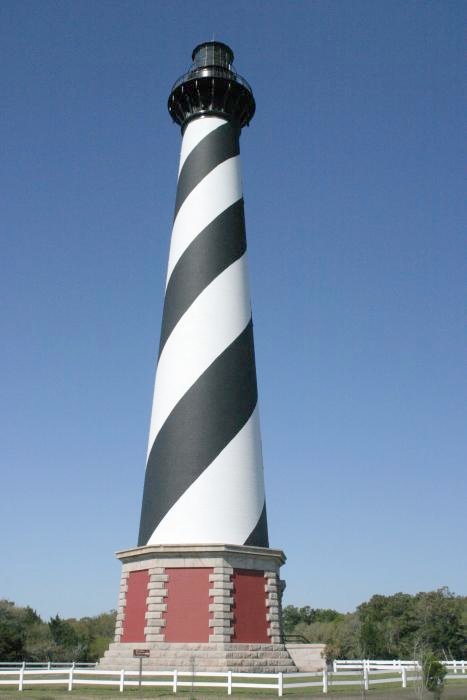
Cape Hatteras Light is a lighthouse located on Hatteras Island in the Outer Banks in the town of Buxton, North Carolina and is part of the Cape Hatteras National Seashore. It is the tallest lighthouse in the U.S. from base to tip at 210 feet. The lighthouse's semi-unique pattern makes it easy to recognize and famous. It is often ranked high on lists of most beautiful, and famous lighthouses in the US.
The Outer Banks are a group of barrier islands on the North Carolina coast that separate the Atlantic Ocean from the coastal sounds and inlets. Atlantic currents in this area made for excellent travel for ships, except in the area of Diamond Shoals, just offshore at Cape Hatteras. Nearby, the warm Gulf Stream ocean current collides with the colder Labrador Current, creating ideal conditions for powerful ocean storms and sea swells. The large number of ships that ran aground because of these shifting sandbars gave this area the nickname "Graveyard of the Atlantic." It also led the U.S. Congress to authorize the construction of the Cape Hatteras Light. Its 198-foot height makes it the tallest brick lighthouse structure in the United States and 2nd in the world. Since its base is almost at sea level, it is only the 15th highest light in the United States, the first 14 being built on higher ground.
Adjacent to the Cape Hatteras Light is the Hatteras Island Visitor Center and Museum of the Sea, operated by the National Park Service, which is located in the historic Cape Hatteras Lighthouse Double Keepers' Quarters. Exhibits include the history, maritime heritage and natural history of the Outer Banks and the lighthouse. The visitor center offers information about the Cape Hatteras National Seashore, ranger programs and a bookstore.
On July 10, 1794, after Secretary of Treasury Alexander Hamilton requested that they make a lighthouse on this location after his ship almost crashed and sank on its to way to The New World, giving it the nickname "Hamilton's light." Congress appropriated $44,000 "for erecting a lighthouse on the headland of Cape Hatteras and a lighted beacon on Shell Castle Island, in the harbor of Ocracoke in the State of North Carolina." The Cape Hatteras Lighthouse was constructed in 1802.
The Cape Hatteras light marked very dangerous shoals that extend from the cape for a distance of 10 nautical miles (19 km). The original tower was built of dark sandstone and retained its natural color. The original light consisted of 18 lamps; with 14-inch (360 mm) reflectors, and was 112 feet (34 m) above sea level. It was visible in clear weather for a distance of 18 miles (29 km).
In July 1851, Lt. David D. Porter, USN, reported as follows:
"Hatteras light, the most important on our coast is, without doubt, the worst light in the world. Cape Hatteras is the point made by all vessels going to the south, and also coming from that direction; the current of the Gulf Stream runs so close to the outer point of the shoals that vessels double as close round the breakers as possible, to avoid its influence. The only guide they have is the light, to tell them when up with the shoals; but I have always had so little confidence in it, that I have been guided by the lead, without the use of which no vessel should pass Hatteras. The first nine trips I made I never saw Hatteras light at all, though frequently passing in sight of the breakers, and when I did see it, I could not tell it from a steamer's light, excepting that the steamer's lights are much brighter. It has improved much latterly but is still a wretched light. It is all-important that Hatteras should be provided with a revolving light of great intensity, and that the light is raised 15 feet (4.6 m) higher than at present. Twenty-four steamship's lights, of great brilliancy, pass this point in one month, nearly at the rate of one every night (they all pass at night) and it can be seen how easily a vessel may be deceived by taking a steamer's light for a light onshore."
The improvement in the light referred to had begun in 1845 when the reflectors were changed from 14 to 15-inch (380 mm). In 1848 the 18 lamps were changed to 15 lamps with 21-inch (530 mm) reflectors and the light had become visible in clear weather at a distance of 20 miles (32 km). In 1854 a first-order Fresnel lens with flashing white light was substituted for the old reflecting apparatus, and the tower was raised to 150 feet (46 m).
Hub AI
Cape Hatteras Lighthouse AI simulator
(@Cape Hatteras Lighthouse_simulator)
Cape Hatteras Lighthouse
Cape Hatteras Light is a lighthouse located on Hatteras Island in the Outer Banks in the town of Buxton, North Carolina and is part of the Cape Hatteras National Seashore. It is the tallest lighthouse in the U.S. from base to tip at 210 feet. The lighthouse's semi-unique pattern makes it easy to recognize and famous. It is often ranked high on lists of most beautiful, and famous lighthouses in the US.
The Outer Banks are a group of barrier islands on the North Carolina coast that separate the Atlantic Ocean from the coastal sounds and inlets. Atlantic currents in this area made for excellent travel for ships, except in the area of Diamond Shoals, just offshore at Cape Hatteras. Nearby, the warm Gulf Stream ocean current collides with the colder Labrador Current, creating ideal conditions for powerful ocean storms and sea swells. The large number of ships that ran aground because of these shifting sandbars gave this area the nickname "Graveyard of the Atlantic." It also led the U.S. Congress to authorize the construction of the Cape Hatteras Light. Its 198-foot height makes it the tallest brick lighthouse structure in the United States and 2nd in the world. Since its base is almost at sea level, it is only the 15th highest light in the United States, the first 14 being built on higher ground.
Adjacent to the Cape Hatteras Light is the Hatteras Island Visitor Center and Museum of the Sea, operated by the National Park Service, which is located in the historic Cape Hatteras Lighthouse Double Keepers' Quarters. Exhibits include the history, maritime heritage and natural history of the Outer Banks and the lighthouse. The visitor center offers information about the Cape Hatteras National Seashore, ranger programs and a bookstore.
On July 10, 1794, after Secretary of Treasury Alexander Hamilton requested that they make a lighthouse on this location after his ship almost crashed and sank on its to way to The New World, giving it the nickname "Hamilton's light." Congress appropriated $44,000 "for erecting a lighthouse on the headland of Cape Hatteras and a lighted beacon on Shell Castle Island, in the harbor of Ocracoke in the State of North Carolina." The Cape Hatteras Lighthouse was constructed in 1802.
The Cape Hatteras light marked very dangerous shoals that extend from the cape for a distance of 10 nautical miles (19 km). The original tower was built of dark sandstone and retained its natural color. The original light consisted of 18 lamps; with 14-inch (360 mm) reflectors, and was 112 feet (34 m) above sea level. It was visible in clear weather for a distance of 18 miles (29 km).
In July 1851, Lt. David D. Porter, USN, reported as follows:
"Hatteras light, the most important on our coast is, without doubt, the worst light in the world. Cape Hatteras is the point made by all vessels going to the south, and also coming from that direction; the current of the Gulf Stream runs so close to the outer point of the shoals that vessels double as close round the breakers as possible, to avoid its influence. The only guide they have is the light, to tell them when up with the shoals; but I have always had so little confidence in it, that I have been guided by the lead, without the use of which no vessel should pass Hatteras. The first nine trips I made I never saw Hatteras light at all, though frequently passing in sight of the breakers, and when I did see it, I could not tell it from a steamer's light, excepting that the steamer's lights are much brighter. It has improved much latterly but is still a wretched light. It is all-important that Hatteras should be provided with a revolving light of great intensity, and that the light is raised 15 feet (4.6 m) higher than at present. Twenty-four steamship's lights, of great brilliancy, pass this point in one month, nearly at the rate of one every night (they all pass at night) and it can be seen how easily a vessel may be deceived by taking a steamer's light for a light onshore."
The improvement in the light referred to had begun in 1845 when the reflectors were changed from 14 to 15-inch (380 mm). In 1848 the 18 lamps were changed to 15 lamps with 21-inch (530 mm) reflectors and the light had become visible in clear weather at a distance of 20 miles (32 km). In 1854 a first-order Fresnel lens with flashing white light was substituted for the old reflecting apparatus, and the tower was raised to 150 feet (46 m).