



Community hub
Recent from talks
Knowledge base stats:
Talk channels stats:
Members stats:
Captive orcas
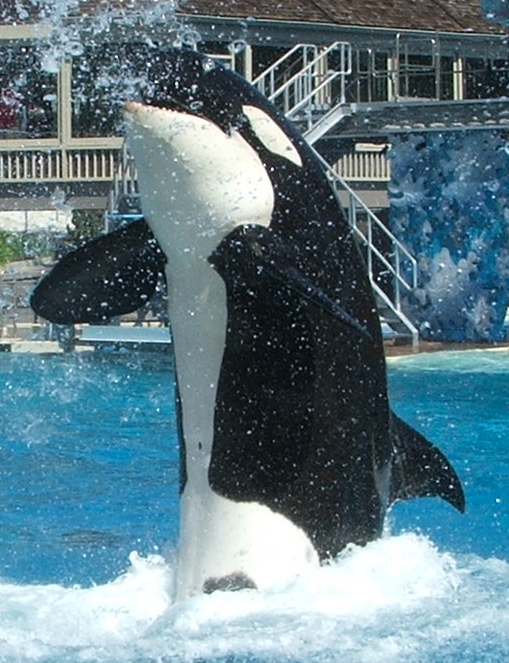
Dozens of orcas are held in captivity for breeding or performance purposes. The practice of capturing and displaying orcas in exhibitions began in the 1960s, and they soon became popular attractions at public aquariums and aquatic theme parks due to their intelligence, trainability, striking appearance, playfulness, and sheer size. As of 24 March 2024, around 55 orcas are in captivity worldwide, 33 of which were captive-born. At that time, there were 18 orcas in the SeaWorld parks.
The practice of keeping orcas in captivity is controversial, due to their separation from their familial pod during capture, and their living conditions and health in captivity. Additionally, concerns have been raised regarding the safety of animal trainers entering the water to work with captive orcas, which have been responsible for numerous attacks on humans—some fatal. In contrast, wild orcas are not known to have ever killed a human, and physical interactions with humans in the wild are extremely rare and typically non-aggressive.
Orcas are large, active and intelligent. Males range from 6 to 9.7 m (20 to 32 ft) and can weigh over 8 tonnes (8.8 tons), while females range from 5 to 7 m (16 to 23 ft) and weigh 3 to 5 tonnes (3.3 to 5.5 tons). The orca is the largest species of the dolphin family. The species is found in all the world's oceans, from the frigid Arctic and Antarctic regions to warm, tropical seas. Orcas are intelligent, versatile and opportunistic predators. Some populations feed entirely on fish, while others hunt marine mammals, including sea lions, elephant seals, seals, walruses, porpoises, dolphins, large whales and some species of shark, including great whites. The species is an apex predator, as no other animal predates on orcas. There are up to five distinct orca types, some of which may be separate races, subspecies or species. Orcas are highly social, and some populations are composed of matrilineal family groups that are the most stable of any animal species. The sophisticated social behaviour, hunting techniques, and vocal behaviour of orcas have been described as manifestations of animal culture.
Although the orca is not an endangered species, some populations are threatened or endangered due to bioaccumulation of persistent organic pollutants, depletion of prey populations, captures for marine mammal parks, conflicts with fishing activities, acoustic pollution, shipping vessels, stress from whale-watching boats, and habitat loss.
The first capture in the North Eastern Pacific occurred in November 1961. An orca of the Pacific offshore ecotype, suspected to be ailing by Marineland of the Pacific officials, was netted by its collecting crew when swimming alone near Newport Beach, California. They took the 5.2 m (17 ft) orca to a tank at the aquarium. She became known as Wanda, but convulsed and died two days later after "swimming at high speed around the tank, striking her body repeatedly", recalled Marineland's Frank Brocato. The next orca captured, Moby Doll, was harpooned in 1964 but survived for nearly three months in captivity when taken to Vancouver, British Columbia, by the Vancouver Aquarium. He was a member of J Pod of the Southern Resident Killer Whales, the population of killer whales most damaged by subsequent captures.
The third capture for display occurred in June 1965 when a fisherman found a 22-foot (6.7 m) male orca in his floating salmon net that had drifted close to shore near Namu, British Columbia. The orca was sold for $8,000 to Ted Griffin, a Seattle public aquarium owner. Named after his place of capture, Namu was the subject of a film that changed some people's attitudes toward orcas.
A few months later, Griffin procured a companion for Namu: a very young, 14 foot (4.25 m), 2000 lb (900 kg) orca captured off Whidbey Island, Puget Sound, Washington. Shamu means 'Friend of Namu' (alternately 'She-Namu'). However, Shamu did not get along with Namu and so was sold to SeaWorld in San Diego in December 1965.
The Yukon Harbor operation was the first planned, deliberate capture of multiple orcas. After a long and dramatic 17-day operation in February and March 1967, five southern resident orcas were taken into captivity, while three others died entangled in nets.
Hub AI
Captive orcas AI simulator
(@Captive orcas_simulator)
Captive orcas
Dozens of orcas are held in captivity for breeding or performance purposes. The practice of capturing and displaying orcas in exhibitions began in the 1960s, and they soon became popular attractions at public aquariums and aquatic theme parks due to their intelligence, trainability, striking appearance, playfulness, and sheer size. As of 24 March 2024, around 55 orcas are in captivity worldwide, 33 of which were captive-born. At that time, there were 18 orcas in the SeaWorld parks.
The practice of keeping orcas in captivity is controversial, due to their separation from their familial pod during capture, and their living conditions and health in captivity. Additionally, concerns have been raised regarding the safety of animal trainers entering the water to work with captive orcas, which have been responsible for numerous attacks on humans—some fatal. In contrast, wild orcas are not known to have ever killed a human, and physical interactions with humans in the wild are extremely rare and typically non-aggressive.
Orcas are large, active and intelligent. Males range from 6 to 9.7 m (20 to 32 ft) and can weigh over 8 tonnes (8.8 tons), while females range from 5 to 7 m (16 to 23 ft) and weigh 3 to 5 tonnes (3.3 to 5.5 tons). The orca is the largest species of the dolphin family. The species is found in all the world's oceans, from the frigid Arctic and Antarctic regions to warm, tropical seas. Orcas are intelligent, versatile and opportunistic predators. Some populations feed entirely on fish, while others hunt marine mammals, including sea lions, elephant seals, seals, walruses, porpoises, dolphins, large whales and some species of shark, including great whites. The species is an apex predator, as no other animal predates on orcas. There are up to five distinct orca types, some of which may be separate races, subspecies or species. Orcas are highly social, and some populations are composed of matrilineal family groups that are the most stable of any animal species. The sophisticated social behaviour, hunting techniques, and vocal behaviour of orcas have been described as manifestations of animal culture.
Although the orca is not an endangered species, some populations are threatened or endangered due to bioaccumulation of persistent organic pollutants, depletion of prey populations, captures for marine mammal parks, conflicts with fishing activities, acoustic pollution, shipping vessels, stress from whale-watching boats, and habitat loss.
The first capture in the North Eastern Pacific occurred in November 1961. An orca of the Pacific offshore ecotype, suspected to be ailing by Marineland of the Pacific officials, was netted by its collecting crew when swimming alone near Newport Beach, California. They took the 5.2 m (17 ft) orca to a tank at the aquarium. She became known as Wanda, but convulsed and died two days later after "swimming at high speed around the tank, striking her body repeatedly", recalled Marineland's Frank Brocato. The next orca captured, Moby Doll, was harpooned in 1964 but survived for nearly three months in captivity when taken to Vancouver, British Columbia, by the Vancouver Aquarium. He was a member of J Pod of the Southern Resident Killer Whales, the population of killer whales most damaged by subsequent captures.
The third capture for display occurred in June 1965 when a fisherman found a 22-foot (6.7 m) male orca in his floating salmon net that had drifted close to shore near Namu, British Columbia. The orca was sold for $8,000 to Ted Griffin, a Seattle public aquarium owner. Named after his place of capture, Namu was the subject of a film that changed some people's attitudes toward orcas.
A few months later, Griffin procured a companion for Namu: a very young, 14 foot (4.25 m), 2000 lb (900 kg) orca captured off Whidbey Island, Puget Sound, Washington. Shamu means 'Friend of Namu' (alternately 'She-Namu'). However, Shamu did not get along with Namu and so was sold to SeaWorld in San Diego in December 1965.
The Yukon Harbor operation was the first planned, deliberate capture of multiple orcas. After a long and dramatic 17-day operation in February and March 1967, five southern resident orcas were taken into captivity, while three others died entangled in nets.