
Recent from talks
Carolingian minuscule
Knowledge base stats:
Talk channels stats:
Members stats:
Carolingian minuscule
Carolingian minuscule or Caroline minuscule is a script which developed as a calligraphic standard in the medieval European period so that the Latin alphabet of Jerome's Vulgate Bible could be easily recognized by the literate class from one region to another. It is thought to have originated before 778 CE at the scriptorium of the Benedictine monks of Corbie Abbey, about 150 kilometres (95 miles) north of Paris, and then developed by Alcuin of York for wide use in the Carolingian Renaissance. Alcuin himself still wrote in a script which was a precursor to the Carolingian minuscule, which slowly developed over three centuries. He was most likely responsible for copying and preserving the manuscripts and upkeep of the script. It was used in the Holy Roman Empire between approximately 800 and 1200. Codices, Christian texts, and educational material were written in Carolingian minuscule.
After blackletter developed out of it, the Carolingian minuscule became obsolete, until the 14th century Italian Renaissance, when the humanist minuscule script was also developed from it. By this latter line, the Carolingian minuscule is a direct ancestor of most modern-day Latin letter scripts and typefaces.
The script is derived partly from various continental minuscule scripts ultimately descended from late Roman cursive and partly from Roman half uncial and its cursive version. It also adopted certain features from the Insular scripts that were being used in Irish and English monasteries.
Carolingian minuscule was created partly under the patronage of the Emperor Charlemagne (hence Carolingian). Charlemagne had a keen interest in learning, according to his biographer Einhard (here with apices):
Temptábat et scríbere, tabulásque et códicellós ad hoc in lectó sub cervícálibus circumferre solébat, ut, cum vacuum tempus esset, manum litterís effigiendís adsuésceret, sed parum successit labor praeposterus ac séró incohátus.
He also tried to write, and used to keep tablets and blanks in bed under his pillow, that at leisure hours he might accustom his hand to form the letters; however, as he did not begin his efforts in due season, but late in life, they met with ill success.
This new script was significantly more legible than the ones used in earlier periods of the Middle Ages and was also superior to the book scripts used in the Roman period, because it provided word spacing, more punctuation, and conventions such as the usage of upper-case for titles, a mix of upper and lower case for subtitles, and lower case for the body of a text. Although Charlemagne was never fully literate, he understood the value of literacy and a uniform script in running his empire. Charlemagne sent for the English scholar Alcuin of York to run his palace school and scriptorium at his capital, Aachen. Efforts to supplant Gallo-Roman and Germanic scripts had been under way before Alcuin arrived at Aachen, where he was master from 782 to 796, with a two-year break. The new minuscule was disseminated first from Aachen, of which the Ada Gospels provided classic models, and later from the influential scriptorium at Marmoutier Abbey (Tours), where Alcuin withdrew from court service as an abbot in 796 and restructured the scriptorium.
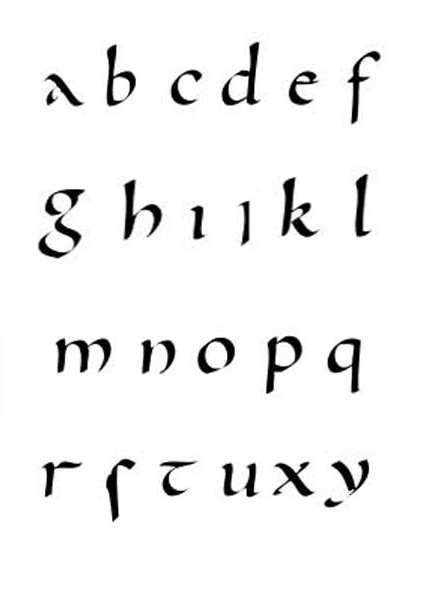
Carolingian minuscule was uniform with rounded shapes in clearly distinguishable glyphs, disciplined and above all, legible. Clear capital letters and spaces between words became standard in Carolingian minuscule, which was one result of a campaign to achieve a culturally unifying standardization across the Carolingian Empire.
Hub AI
Carolingian minuscule AI simulator
(@Carolingian minuscule_simulator)
Carolingian minuscule
Carolingian minuscule or Caroline minuscule is a script which developed as a calligraphic standard in the medieval European period so that the Latin alphabet of Jerome's Vulgate Bible could be easily recognized by the literate class from one region to another. It is thought to have originated before 778 CE at the scriptorium of the Benedictine monks of Corbie Abbey, about 150 kilometres (95 miles) north of Paris, and then developed by Alcuin of York for wide use in the Carolingian Renaissance. Alcuin himself still wrote in a script which was a precursor to the Carolingian minuscule, which slowly developed over three centuries. He was most likely responsible for copying and preserving the manuscripts and upkeep of the script. It was used in the Holy Roman Empire between approximately 800 and 1200. Codices, Christian texts, and educational material were written in Carolingian minuscule.
After blackletter developed out of it, the Carolingian minuscule became obsolete, until the 14th century Italian Renaissance, when the humanist minuscule script was also developed from it. By this latter line, the Carolingian minuscule is a direct ancestor of most modern-day Latin letter scripts and typefaces.
The script is derived partly from various continental minuscule scripts ultimately descended from late Roman cursive and partly from Roman half uncial and its cursive version. It also adopted certain features from the Insular scripts that were being used in Irish and English monasteries.
Carolingian minuscule was created partly under the patronage of the Emperor Charlemagne (hence Carolingian). Charlemagne had a keen interest in learning, according to his biographer Einhard (here with apices):
Temptábat et scríbere, tabulásque et códicellós ad hoc in lectó sub cervícálibus circumferre solébat, ut, cum vacuum tempus esset, manum litterís effigiendís adsuésceret, sed parum successit labor praeposterus ac séró incohátus.
He also tried to write, and used to keep tablets and blanks in bed under his pillow, that at leisure hours he might accustom his hand to form the letters; however, as he did not begin his efforts in due season, but late in life, they met with ill success.
This new script was significantly more legible than the ones used in earlier periods of the Middle Ages and was also superior to the book scripts used in the Roman period, because it provided word spacing, more punctuation, and conventions such as the usage of upper-case for titles, a mix of upper and lower case for subtitles, and lower case for the body of a text. Although Charlemagne was never fully literate, he understood the value of literacy and a uniform script in running his empire. Charlemagne sent for the English scholar Alcuin of York to run his palace school and scriptorium at his capital, Aachen. Efforts to supplant Gallo-Roman and Germanic scripts had been under way before Alcuin arrived at Aachen, where he was master from 782 to 796, with a two-year break. The new minuscule was disseminated first from Aachen, of which the Ada Gospels provided classic models, and later from the influential scriptorium at Marmoutier Abbey (Tours), where Alcuin withdrew from court service as an abbot in 796 and restructured the scriptorium.
Carolingian minuscule was uniform with rounded shapes in clearly distinguishable glyphs, disciplined and above all, legible. Clear capital letters and spaces between words became standard in Carolingian minuscule, which was one result of a campaign to achieve a culturally unifying standardization across the Carolingian Empire.
Recent media