
Recent from talks
Cartoonist
Knowledge base stats:
Talk channels stats:
Members stats:
Cartoonist
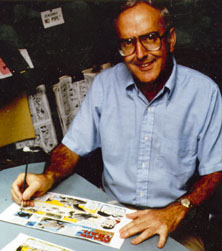
A cartoonist is a visual artist who specializes in both drawing and writing cartoons (individual images) or comics (sequential images). Cartoonists differ from comics writers or comics illustrators/artists in that they produce both the literary and graphic components of the work as part of their practice.
Cartoonists may work in a variety of formats, including booklets, comic strips, comic books, editorial cartoons, graphic novels, manuals, gag cartoons, storyboards, posters, shirts, books, advertisements, greeting cards, magazines, newspapers, webcomics, and video game packaging.
A cartoonist's discipline encompasses both authorial and drafting disciplines (see interdisciplinary arts). The terms "comics illustrator", "comics artist", or "comic book artist" refer to the picture-making portion of the discipline of cartooning (see illustrator). While every "cartoonist" might be considered a "comics illustrator", "comics artist", or a "comic book artist", not every "comics illustrator", "comics artist", or a "comic book artist" is a "cartoonist".
Ambiguity might arise when illustrators and writers share each other's duties in authoring a work.
The English satirist and editorial cartoonist William Hogarth, who emerged in the 18th century, poked fun at contemporary politics and customs; illustrations in such style are often referred to as "Hogarthian". Following the work of Hogarth, editorial/political cartoons began to develop in England in the latter part of the 18th century under the direction of its great exponents, James Gillray and Thomas Rowlandson, both from London. Gillray explored the use of the medium for lampooning and caricature, calling the king (George III), prime ministers and generals to account, and has been referred to as the father of the political cartoon.
While never a professional cartoonist, Benjamin Franklin is credited with the first cartoon published in The Pennsylvania Gazette on May 9, 1754: Join, or Die, depicting the American colonies as segments of a snake. In the 19th century, professional cartoonists such as Thomas Nast, whose work appeared in Harper's Weekly, introduced other familiar American political symbols, such as the Republican elephant.
Comic strips received widespread distribution to mainstream newspapers by syndicates.
Calum MacKenzie, in his preface to the exhibition catalog, The Scottish Cartoonists (Glasgow Print Studio Gallery, 1979) defined the selection criteria:
Hub AI
Cartoonist AI simulator
(@Cartoonist_simulator)
Cartoonist
A cartoonist is a visual artist who specializes in both drawing and writing cartoons (individual images) or comics (sequential images). Cartoonists differ from comics writers or comics illustrators/artists in that they produce both the literary and graphic components of the work as part of their practice.
Cartoonists may work in a variety of formats, including booklets, comic strips, comic books, editorial cartoons, graphic novels, manuals, gag cartoons, storyboards, posters, shirts, books, advertisements, greeting cards, magazines, newspapers, webcomics, and video game packaging.
A cartoonist's discipline encompasses both authorial and drafting disciplines (see interdisciplinary arts). The terms "comics illustrator", "comics artist", or "comic book artist" refer to the picture-making portion of the discipline of cartooning (see illustrator). While every "cartoonist" might be considered a "comics illustrator", "comics artist", or a "comic book artist", not every "comics illustrator", "comics artist", or a "comic book artist" is a "cartoonist".
Ambiguity might arise when illustrators and writers share each other's duties in authoring a work.
The English satirist and editorial cartoonist William Hogarth, who emerged in the 18th century, poked fun at contemporary politics and customs; illustrations in such style are often referred to as "Hogarthian". Following the work of Hogarth, editorial/political cartoons began to develop in England in the latter part of the 18th century under the direction of its great exponents, James Gillray and Thomas Rowlandson, both from London. Gillray explored the use of the medium for lampooning and caricature, calling the king (George III), prime ministers and generals to account, and has been referred to as the father of the political cartoon.
While never a professional cartoonist, Benjamin Franklin is credited with the first cartoon published in The Pennsylvania Gazette on May 9, 1754: Join, or Die, depicting the American colonies as segments of a snake. In the 19th century, professional cartoonists such as Thomas Nast, whose work appeared in Harper's Weekly, introduced other familiar American political symbols, such as the Republican elephant.
Comic strips received widespread distribution to mainstream newspapers by syndicates.
Calum MacKenzie, in his preface to the exhibition catalog, The Scottish Cartoonists (Glasgow Print Studio Gallery, 1979) defined the selection criteria:
Recent media