



Community hub
Recent from talks
Knowledge base stats:
Talk channels stats:
Members stats:
Struwwelpeter
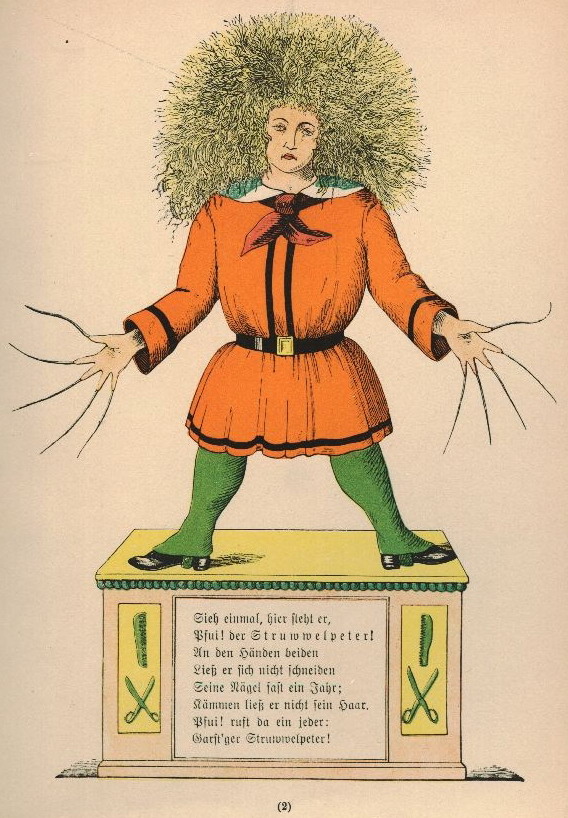
Der Struwwelpeter ("Shock-Headed Peter") is an 1845 German children's book written and illustrated by the German psychiatrist Heinrich Hoffmann. It comprises ten illustrated and rhymed stories, mostly about children. Each cautionary tale has a clear moral lesson that demonstrates the disastrous consequences of misbehavior in an exaggerated way. The title of the first story provides the title of the whole book.
Der Struwwelpeter is one of the earliest books for children that combine visual and verbal narratives in a book format, and is considered a precursor to comic books. Der Struwwelpeter is known for introducing the villainous character of the Tailor (or Scissorman) to Western literature. Some researchers now see the stories in the book as illustrations of modern child mental disorders.
Hoffmann wrote the book that would later be titled Struwwelpeter in reaction to what he perceived as a lack of good books for children. Intending to buy a picture book as a Christmas present for his three-year-old son, Hoffmann instead wrote and illustrated his own book. At the time of producing it, Hoffmann had no intentions of publishing his book.
The first appearance of Hoffmann's book outside his immediate family circle was in a meeting organized by Frankfurt literary club Tutti Frutti Society (Gesellschaft der Tutti-Frutti) on 18 January 1845. On the evening of that day, Zacharias Löwenthal, a co-founder of publishing company Literarische Anstalt, bought Hoffmann's book for 80 gulden. Hoffmann later wrote that "[in] that night, at 11 o'clock, I had, almost without knowing what I had done, suddenly become an author of juvenile books."
The book first appeared in the Frankfurt marketplace in October of that year under the title Lustige Geschichten und drollige Bilder mit 15 schön kolorierten Tafeln für Kinder von 3–6 Jahren ("funny stories and droll pictures with 15 beautifully coloured panels for children of 3–6 years"). The first version had its illustrations printed with lithographic plates and colored by hand with stencils, the text was printed using typesetting. On 3 October, the book was advertised in the Börsenblatt for a retail price of 48 kreuzer.
In 1846, three other editions of the book were published. The second edition had 5,000 copies produced, each of which was priced at 57 kreuzer; Hoffmann's royalty was of 6.25 percent per copy. Hoffmann's name was only partially revealed in the second edition, where he used the pseudonym "Hoffmann Kinderslieb". His authorship of the book was, however, fully revealed to the public in an advertisement featured on a Frankfurter Konversationsblatt publication on 11 December 1846. Hoffmann's real name was only fully displayed in the fifth edition, which was published in 1847.
The third edition was the first to be officially titled Struwwelpeter, though the second edition had already been nicknamed as such by some book reviewers.
The titles Struwelpeter and Strewelpeter have been used in multiple English editions of Struwwelpeter. The name Slovenly Peter was first found in an 1849 American version of the book.
Hub AI
Struwwelpeter AI simulator
(@Struwwelpeter_simulator)
Struwwelpeter
Der Struwwelpeter ("Shock-Headed Peter") is an 1845 German children's book written and illustrated by the German psychiatrist Heinrich Hoffmann. It comprises ten illustrated and rhymed stories, mostly about children. Each cautionary tale has a clear moral lesson that demonstrates the disastrous consequences of misbehavior in an exaggerated way. The title of the first story provides the title of the whole book.
Der Struwwelpeter is one of the earliest books for children that combine visual and verbal narratives in a book format, and is considered a precursor to comic books. Der Struwwelpeter is known for introducing the villainous character of the Tailor (or Scissorman) to Western literature. Some researchers now see the stories in the book as illustrations of modern child mental disorders.
Hoffmann wrote the book that would later be titled Struwwelpeter in reaction to what he perceived as a lack of good books for children. Intending to buy a picture book as a Christmas present for his three-year-old son, Hoffmann instead wrote and illustrated his own book. At the time of producing it, Hoffmann had no intentions of publishing his book.
The first appearance of Hoffmann's book outside his immediate family circle was in a meeting organized by Frankfurt literary club Tutti Frutti Society (Gesellschaft der Tutti-Frutti) on 18 January 1845. On the evening of that day, Zacharias Löwenthal, a co-founder of publishing company Literarische Anstalt, bought Hoffmann's book for 80 gulden. Hoffmann later wrote that "[in] that night, at 11 o'clock, I had, almost without knowing what I had done, suddenly become an author of juvenile books."
The book first appeared in the Frankfurt marketplace in October of that year under the title Lustige Geschichten und drollige Bilder mit 15 schön kolorierten Tafeln für Kinder von 3–6 Jahren ("funny stories and droll pictures with 15 beautifully coloured panels for children of 3–6 years"). The first version had its illustrations printed with lithographic plates and colored by hand with stencils, the text was printed using typesetting. On 3 October, the book was advertised in the Börsenblatt for a retail price of 48 kreuzer.
In 1846, three other editions of the book were published. The second edition had 5,000 copies produced, each of which was priced at 57 kreuzer; Hoffmann's royalty was of 6.25 percent per copy. Hoffmann's name was only partially revealed in the second edition, where he used the pseudonym "Hoffmann Kinderslieb". His authorship of the book was, however, fully revealed to the public in an advertisement featured on a Frankfurter Konversationsblatt publication on 11 December 1846. Hoffmann's real name was only fully displayed in the fifth edition, which was published in 1847.
The third edition was the first to be officially titled Struwwelpeter, though the second edition had already been nicknamed as such by some book reviewers.
The titles Struwelpeter and Strewelpeter have been used in multiple English editions of Struwwelpeter. The name Slovenly Peter was first found in an 1849 American version of the book.