Hubbry Logo
Gymnosporangium juniperi-virginianaeGymnosporangium juniperi-virginianaeMain
Open search
Gymnosporangium juniperi-virginianae
Community hub
Gymnosporangium juniperi-virginianae
logo
8 pages, 0 posts
0 subscribers
Be the first to start a discussion here.
Gymnosporangium juniperi-virginianae
from Wikipedia

Gymnosporangium juniperi-virginianae
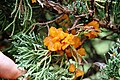
Galls of cedar-apple rust on eastern red cedar
Scientific classification Edit this classification
Kingdom: Fungi
Division: Basidiomycota
Class: Pucciniomycetes
Order: Pucciniales
Family: Gymnosporangiaceae
Genus: Gymnosporangium
Species:
G. juniperi-virginianae
Binomial name
Gymnosporangium juniperi-virginianae
Schwein. (1822)

Gymnosporangium juniperi-virginianae is a plant pathogen that causes cedar-apple rust.[1] In virtually any location where apples or crabapples (Malus) and eastern red cedar (Juniperus virginiana) coexist, cedar apple rust can be a destructive or disfiguring disease on both the apples and cedars. Apples, crabapples, and eastern red cedar are the most common hosts for this disease.[2] Similar diseases can be found on quince and hawthorn[3] and many species of juniper can substitute for the eastern red cedars.[2]

Symptoms

[edit]

On the apple tree, the infections occur on leaves, fruit and young twigs.[4] The brightly colored spots produced on the leaves make it easy to identify. Small, yellow-orange spots appear on the upper surfaces of the leaves, anytime from April to June.[5] These spots gradually enlarge and turn orange or red and may show concentric rings of color. Drops of orange liquid may be visible on the spots. Later in the season, black dots appear on the orange spots on the upper leaf surface. In late summer, tube-like structures develop on the undersurface of the apple leaf. Infected leaves sometimes drop prematurely, particularly during drought conditions or when the tree is under additional stress. Infections on fruit are usually near the blossom end and are somewhat similar to the leaf lesions.

On the eastern red cedar host, the fungus produces reddish-brown galls from 14 to 2 inches (6 to 50 mm).[3][6] After reaching a diameter of about 12 inch (13 mm), the galls show many small circular depressions. In the center of each depression is a small, pimple-like structure. In the spring these structures absorb water during rainy periods and elongate into orange gelatinous telial horns that are 10–20 mm long.[3] The wind carries the microscopic spores to infect apple leaves, blossoms, fruit and young twigs on trees within a radius of several miles of the infected tree.

On other species of juniper more common in landscaping and bonsai, the sizes of the infections are reduced. Early in the infection, the galls are small bumps on the woody portions of the plant. They maintain the orange gelatinous form after the first warm rains of spring but generally on a greatly reduced scale.

Disease cycle

[edit]
Depiction of the life cycle of cedar apple rust

Cedar apple rust is caused by the fungi Gymnosporangium or more specifically Gymnosporangium juniperi-virginianae that spend part of their life cycles on Eastern Red Cedars growing near orchards. The complex disease cycle of cedar apple rust, alternating between two host plants, was first delineated by Anders Sandøe Ørsted.[7]

When exposed to the first warm rain of spring, the small bumps on the galls absorb water, swell, and produce telial horns –gelatinous masses that produce teliospores.[3] When swollen, teliospores will germinate and produce basidiospores which are forcibly discharged and travel along air currents to infect apple trees and other alternate hosts.[8] The telial horns will dry out once the rain passes and will lose their gelatinous appearance, instead resembling dark brown threads.[8] When the rain returns, the horns will swell again. This process can repeat eight to ten times during the spring.[8] It can take as little as four hours for basidiospores to form inside the telial horns under optimal conditions.[8]

Gall on eastern red cedar (Juniperus virginiana) before rain.

Wind[3] carries the spores to apple leaves at about the time that apple buds are in the pink or early blossom stage.[5] Upon reaching apple buds or leaves covered by films of water,[8] the spores attach themselves to the young leaves, germinate, and enter the leaf or fruit tissues. Light infection can take place in as little as two hours under favorable conditions.[8] Heavy infections take at least four hours to develop.[8] Lower temperatures delay infection.[8] Yellow-orange lesions develop on the upper sides of leaves or on fruit one to two weeks following infection. These lesions contain pycnia and pycniospores.[8] These lesions will produce a sticky honeydew like substance to attract insects that assist in the transport of the pycniospores to different lesions, allowing for sexual recombination.[9]

One to two months later, in July and August, orange-yellow aecia are produced in concentric rings on the bottom of the apple leaves or surrounding the pycnia on the fruit.[3] The aecia produce aeciospores. The wind carries the spores back to eastern red cedars, completing the infectious cycle. The spores land on cedar needle bases or in cracks or crevices of twigs. There, they germinate and produce small, green-brown swellings about the size of a pea. Galls do not produce spores until the second spring. However, mature galls usually are present every year. This fungus produces four out of five of the spores known to be produced by the class Urediniomycetes during its life cycle. (These include teliospores, basidiospores, spermatia (also called pycniospores), and aeciospores. The type of spore it does not produce is urediniospores.) Rust fungi have a complicated life-cycle with up to five types of spores (each borne on a different type of structure) in its life cycle and often an alternate host, and an "alternate alternate host" as well. Basidiomycetes that have all 5 spore stages and those with less are said to be "macrocyclic" or "microcyclic" respectively.

Control

[edit]

Because apples are an economically important crop, control is usually focused there. Interruption of the disease cycle is the only effective method for control of the cedar apple rust. Removing as many cedar trees within close proximity of an apple orchard will reduce potential sources of inoculum. The closer the tree to the orchard the greater impact removal will have. Removing all junipers within the 4–5 miles (6.5–8 km) would provide complete control of the disease.[10] Additionally, pruning and disposing of galls from infected cedar trees would reduce sources of inoculum for infection of apple trees, however this would likely be time consuming and uneconomical.[6] For those doing bonsai, it is common to have the trees within feet of each other and on the central eastern seaboard of the United States, eastern red cedar is a common first-growth conifer along roadsides.

There are differences in the susceptibility of various apple varieties. 'Jonathan', 'Rome Beauty', 'Wealthy', 'Stayman', 'Jonafree' and 'York Imperial' are susceptible.[11] 'Grimes Golden', 'Red Delicious', 'Winesap', 'Redfree', 'McIntosh', 'Liberty', and 'Priscilla' are resistant.[11] Crabapples are generally more susceptible than apples. Resistant crabapples include 'Adams', 'Beverly', 'Candied Apple', 'Dolgo', 'Donald Wyman', 'Eleyi', 'Inglis', 'Indian Summer', 'Liset', 'Mt. Arbor', M. persicifolia, 'Red Jewel', 'Robinson', 'Robusta', 'Royalty', M. sargentii, 'Tina', 'Snowdrift', and 'Special Radiant'. Resistant Crataegus (Hawthorn) include C. crus-galli, series Intricatae, C. laevigata, 'Autumn Glory', C. phaenopyrum, C. pruinosa, C. viridis, and 'Winter King'. The resistant varieties are less susceptible to attack, but that does not mean that they are free from an aggressive attack.

Fungicide sprays applied in a timely manner are highly effective against the rust diseases during the apple cycle.[12] Most protective fungicide sprays are applied four times at 7- to 10-day intervals, starting with pink bud on crabapples. These applications are to protect the apples from spores being released from the cedar host in mid-spring. If cedar apple rust disease is diagnosed on apple fruits and leaves it is far too late to spray. Although curative fungicides also exist for cedar apple rust, they must still be applied before trees begin to develop symptoms.[13] Systemic fungicides are available as well, which require fewer sprays during the season.[14] However, there are no fungicides available to home gardeners that can be used on trees that produce fruit which will be eaten by people.[2]

[edit]

References

[edit]
[edit]
Revisions and contributorsEdit on WikipediaRead on Wikipedia
from Grokipedia
Gymnosporangium juniperi-virginianae is a heteroecious rust fungus in the family Pucciniaceae that requires alternation between two host plant families to complete its life cycle: the Cupressaceae (primarily eastern red cedar, Juniperus virginiana, and other junipers) as the primary host, and the Rosaceae (such as apple, Malus spp., crabapple, hawthorn, Crataegus spp., and quince, Cydonia oblonga) as the alternate host. It causes cedar-apple rust, a common disease characterized by the production of gelatinous, orange telial horns on juniper galls and yellow-orange spots or aecia on rosaceous leaves and fruits, leading to potential defoliation, fruit deformation, and reduced yields in susceptible orchard crops. The life cycle of G. juniperi-virginianae is complex and spans two years, beginning with overwintering teliospores embedded in woody on junipers. In spring, under wet conditions and temperatures around 56–61°F (13–16°C), these produce horn-like structures that release basidiospores, which are wind-dispersed up to 1–3 miles to infect young leaves or fruits of rosaceous hosts. On the alternate host, infections develop into aecia that release aeciospores in early to mid-summer, which then reinfect nearby junipers to form new that mature over the following season. As an obligate biotroph, the fungus cannot survive without living plant tissue and produces four spore types: basidiospores, teliospores, aeciospores, and spermatia. This pathogen is widespread across eastern and central , from rural areas alternating between farmland and forest to disturbed sites, and is particularly prevalent where both host types coexist within close proximity. While it rarely causes significant damage to junipers—often appearing as ornamental, holiday-like growths on —it can weaken apple and crabapple trees, causing significant yield loss in unmanaged orchards and predisposing plants to secondary infections. Management typically involves cultural practices like removing nearby junipers, planting resistant varieties, and applying fungicides during susceptible periods.

Taxonomy and nomenclature

Taxonomic classification

Gymnosporangium juniperi-virginianae belongs to the kingdom Fungi, phylum , class Pucciniomycetes, order Pucciniales, family Gymnosporangiaceae, genus , and species G. juniperi-virginianae. In 2020, the genus Gymnosporangium was placed in the newly established family Gymnosporangiaceae based on molecular phylogenetic analyses. The genus Gymnosporangium comprises approximately 70 species of rust fungi, which primarily alternate between hosts in the genus Juniperus (Cupressaceae) and members of the Rosaceae family, such as Malus and Crataegus. This species is classified as a heteroecious rust fungus, requiring two unrelated host plants to complete its life cycle, in contrast to autoecious rusts that develop on a single host; it exhibits four spore stages typical of demicyclic heteroecious rusts, lacking urediniospores. A key diagnostic feature is its teliospores, which are two-celled and borne on pedicels that contribute to a gelatinous matrix upon wetting, aiding in spore dispersal.

Etymology and synonyms

The genus name Gymnosporangium is derived from the Greek words gymnos (γυμνός), meaning "naked", and sporangium (σποράγγιον), meaning "spore vessel", alluding to the exposed teliospores that characterize species in this genus. The specific epithet juniperi-virginianae is the genitive form of Juniperus virginiana, denoting the primary host, the eastern red cedar. Gymnosporangium juniperi-virginianae was first described in 1822 by the American mycologist Lewis David de Schweinitz in the journal Schriften der Naturforschenden Gesellschaft zu Leipzig, based on specimens collected on branches of Juniperus virginiana in North Carolina. A neotype was later designated from material collected in North Carolina in 1977 to stabilize the nomenclature. Historical synonyms reflect the piecemeal description of the fungus's heteroecious life cycle across different stages and genera, including Gymnosporangium Link (1825) for the telial stage and Roestelia pyrata (Schwein.) for the aecial stage on rosaceous hosts. Other junior synonyms include Caeoma pyratum (Schwein.), Gymnosporangium virginianum Farl., and Podisoma juniperi-virginianae Arthur.

Hosts and geography

Host plants

Gymnosporangium juniperi-virginianae is a heteroecious rust fungus, meaning it requires alternation between two distinct host types to complete its life cycle: a telial host in the Cupressaceae family and an aecial host in the Rosaceae family. This specificity ensures that the pathogen cannot persist without both host groups in proximity. The primary hosts, where teliospores are produced, are species of Juniperus within the Cupressaceae. The most common and widespread primary host is eastern red cedar (Juniperus virginiana), which serves as the main reservoir for the fungus in natural settings. Other susceptible junipers include Rocky Mountain juniper (J. scopulorum), creeping juniper (J. horizontalis), and various ornamental varieties such as J. chinensis, J. communis, and J. sabina. Alternate hosts, where aecia form, belong to the Rosaceae family and include a range of woody plants. The primary alternate hosts are apples (Malus domestica) and crabapples (Malus spp.), which are economically significant due to their role in fruit production. Additional susceptible genera include hawthorns (Crataegus spp.), serviceberries (Amelanchier spp.), mountain ashes (Sorbus spp.), and photinias (Photinia spp.). Over 40 cultivars of Malus are affected to varying degrees, with susceptibility differing based on genetic resistance; for example, cultivars like 'Golden Delicious' and 'Jonathan' show high vulnerability, while others such as 'Liberty' exhibit greater tolerance.

Distribution and habitat

Gymnosporangium juniperi-virginianae is native to eastern and central , with its geographic range extending from and southward to and westward to , , and . This distribution closely follows that of its primary host, eastern redcedar (Juniperus virginiana), which is widespread across these regions. The fungus has been sporadically introduced to , particularly in central areas, through the importation of ornamental junipers, though it remains regulated as a pest and has not established broadly. The fungus prefers temperate regions characterized by mixed farmland-forest interfaces, where both and rosaceous hosts are commonly found in proximity. It thrives in environments with humid, rainy springs that facilitate germination and infection, typically in rural or disturbed areas such as pastures, trails, and orchards. Elevations range from near up to approximately 1,500 m, aligning with the habitat tolerances of its hosts. Gymnosporangium juniperi-virginianae has been widespread in its native range since pre-colonial times, predating European settlement and co-occurring with indigenous junipers and crabapples. As of 2025, no major recent expansions have been documented, with its presence remaining stable within the established host distributions.

Symptoms and diagnosis

Symptoms on junipers

Infection by on junipers typically begins in early summer following exposure to aeciospores from alternate hosts, manifesting as small, greenish-brown swellings on twigs and branches where needle-like leaves are attached. These initial swellings, often less than 2 mm in diameter, enlarge gradually through the season and turn brownish as the host tissue responds to fungal colonization. Over winter, these swellings develop into characteristic brownish galls, ranging from 6 to 50 mm in diameter, with a lumpy surface featuring small circular dimples. The , often kidney-shaped or spherical, become more evident in late winter or early spring, remaining dormant until moisture triggers further development. During wet spring weather, typically in or May, the swell and produce orange, gelatinous, horn-like telial projections, measuring 10-20 mm in length, that emerge from the dimples. These horn-like structures, with a jelly-like texture, release basidiospores that initiate the next phase of the fungus's life cycle by infecting the alternate host. The projections maintain their bright color for 2-3 weeks before drying and withering, though they may rehydrate and produce additional spores during subsequent rainy periods. The persist for two or more years after spore production ceases, gradually hardening and remaining attached to branches, which weakens the affected twigs and can lead to dieback in severe cases. Heavy infections may cause tip and overall branch decline, though the disease rarely kills mature junipers.

Symptoms on rosaceous plants

On rosaceous hosts, particularly apple (Malus domestica) and crabapple (Malus spp.), infections by Gymnosporangium juniperi-virginianae manifest primarily on leaves and fruit during the growing season. Initial symptoms appear as small, bright orange-yellow spots, approximately 3 mm in diameter, on the upper surfaces in spring, often developing a red border as they enlarge to about 13 mm. These spots result from infections on young leaves, with visible signs emerging 10-14 days post-infection under favorable wet conditions. On the lower leaf surfaces, cup-shaped aecia (0.5-1 mm in diameter) form, releasing aeciospores that appear as orange, finger-like structures up to 3 mm long. Fruit infections typically occur near the calyx end of developing apples, producing rusty-brown lesions that expand and cause deformation or of the . These lesions, often larger than those on leaves (up to 19 mm in diameter), disrupt normal growth, leading to cracked, undersized, or dropped , particularly in susceptible varieties. Twig infections, though less common than on leaves or , result in spindle-shaped swellings that can girdle and kill young branches. Severe infections during April to June can lead to 20-50% defoliation in heavily affected trees, reducing photosynthetic capacity and predisposing plants to or secondary pests. This ephemeral damage on rosaceous hosts contrasts with persistent effects on junipers, emphasizing the disease's heteroecious . Diagnostic confirmation involves microscopic examination of aeciospores, which exhibit characteristic wall ornamentation.

Identification methods

Identification of Gymnosporangium juniperi-virginianae relies on a combination of field observations, microscopic examination, molecular techniques, and limited laboratory culturing methods, as the fungus is an obligate parasite requiring confirmation beyond visual symptoms. In the field, diagnosis often begins with characteristic signs such as orange, cup-shaped aecia on the undersides of apple (Malus spp.) leaves or gelatinous telial horns emerging from galls on juniper (Juniperus spp.) branches during wet spring conditions. These features help distinguish G. juniperi-virginianae from similar rusts like G. clavariiforme, which typically infects hawthorn (Crataegus spp.) and produces differently shaped telia or infects different hosts; spore morphology and host specificity provide key differentiation. Microscopic examination confirms the presence of diagnostic spores. Teliospores are two-celled, dikaryotic, and measure 45–65 × 15–21 μm, forming in telia on galls. Aeciospores are globose to subglobose, 21–31 × 13–26 μm, with thick, echinulate walls, produced in aecia on rosaceous hosts. Basidiospores, produced from germinating teliospores, are , , and approximately 10–15 × 5–8 μm, though they are short-lived and less commonly observed directly. These characteristics are viewed under a light microscope after mounting samples in lactophenol or similar media. Molecular diagnosis employs PCR assays targeting the (ITS) region of for species-specific identification. DNA is extracted from infected tissue or spores, amplified using universal primers like ITS1 and ITS4, and sequenced or compared to reference databases; phylogenetic analysis of ITS and large subunit (LSU) rDNA sequences distinguishes G. juniperi-virginianae from closely related species, often combined with morphological for accuracy. This method is particularly useful for ambiguous field samples or detections. Laboratory culturing is challenging due to the fungus's parasitic nature, preventing growth on alone. Instead, screening uses detached leaves or shoot cultures of susceptible hosts like apple to inoculate with basidiospores or aeciospores, observing development under controlled conditions to confirm pathogenicity; success rates vary, but this approach aids resistance testing without full axenic culture.

Life cycle and ecology

Overview of life cycle

Gymnosporangium juniperi-virginianae is a heteroecious rust fungus that requires alternation between two host types to complete its macrocyclic life cycle: junipers (or other Cupressaceae) as the primary host and rosaceous plants, such as apple or hawthorn, as the alternate host. This two-year cycle involves four distinct spore stages, beginning with teliospores overwintering on juniper galls and culminating in the production of new galls on the primary host. The pathogen cannot complete its development on a single host, making host proximity a key factor in disease epidemiology. The cycle initiates in spring when moist conditions trigger the germination of teliospores within telia on mature juniper galls, producing basidiospores which are wind-dispersed to infect young leaves or of rosaceous hosts. Infections occur optimally at temperatures between 15–20°C (59–68°F) under prolonged leaf wetness of at least 4–6 hours, leading to the formation of pycnia and subsequently aecia on the alternate host within weeks. Aeciospores produced in these aecia are then dispersed in summer to infect juniper twigs, initiating development that requires 18–20 months to mature. On the alternate host, the infectious phase lasts only 4–6 months, primarily during the . Environmental factors, particularly rainfall and humidity, are critical for spore germination and host penetration throughout the cycle, with dry conditions suppressing events. The overall duration spans approximately two years, synchronizing with seasonal host to ensure transmission between junipers and rosaceous trees.

Spore stages and dispersal

Gymnosporangium juniperi-virginianae exhibits a complex life cycle involving four distinct stages typical of heteroecious fungi, with teliospores, basidiospores, pycniospores, and aeciospores serving as key propagules for host alternation between junipers and rosaceous plants. These stages facilitate and long-distance spread, with morphology adapted to specific environmental cues for germination and dispersal. Teliospores form within woody galls on juniper twigs, appearing as dikaryotic, two-celled structures embedded in gelatinous, orange telial horns that emerge in spring following rain-induced swelling of overwintered . These spores, measuring approximately 20-30 μm in length, germinate in place to produce erect basidia without independent dispersal, initiating the infectious phase on the primary host. Basidiospores are haploid, oblong to cylindrical spores (about 10-15 μm long) borne on basidia arising from germination, released in massive quantities during moist spring conditions. They are primarily wind-dispersed, traveling up to 5-10 km but most effectively within 1-2 km, landing on and infecting young leaves of apple and other rosaceous hosts to establish systemic infection. Pycniospores, also known as spermatia, are small (3-5 μm), haploid male gametes produced in flask-shaped pycnia on the upper surface of infected apple leaves, emerging 2-3 weeks after infection. These sticky spores exude in a nectar-like from ostioles, enabling local dispersal via rain splash (up to a few meters) or inadvertent transfer by foraging on the lesions, which promotes and dikaryotization essential for aecial development. Aeciospores develop in chain-like clusters within cup- or tube-shaped aecia on the undersides of apple leaves or , featuring cylindrical to morphology (15-25 μm long) with thick walls for durability. Formed in to early summer after pycniospore fusion, these dikaryotic spores are forcibly ejected and wind-dispersed over distances of several kilometers, typically infecting nearby twigs to complete the cycle by forming new . Overall, dispersal relies heavily on abiotic factors: drives basidiospores and aeciospores for regional spread, while pycniospores remain localized through or minor activity, with no significant role for other vectors in long-distance transmission. Wet enhances telial horn extrusion and spore release across stages, underscoring the pathogen's dependence on meteorological conditions for potential.

Impact and management

Disease impact

Gymnosporangium juniperi-virginianae, commonly known as cedar-apple rust, imposes notable economic burdens on the apple industry through reduced fruit quality and yield in susceptible cultivars. In untreated orchards, severe infections lead to premature defoliation, smaller fruit size, and blemishes that diminish market value, resulting in serious yield losses, particularly in young orchards or nurseries. The disease also affects ornamental junipers by producing conspicuous galls that degrade their aesthetic appeal, impacting landscape and nursery sectors. Ecologically, cedar-apple rust has a limited role in natural ecosystems, where it primarily causes localized weakening of host trees without widespread disruption. On wild junipers, recurrent infections can reduce vigor, increasing vulnerability to secondary pests and environmental stresses, though the rarely leads to mortality. In mixed habitats alternating between forests and farmlands, the pathogen's presence influences host dynamics but does not significantly alter overall . Historically, the rust emerged as a major concern in the late , coinciding with the expansion of commercial apple orchards in the , where proximity to eastern red cedar exacerbated infections. As of 2025, no major outbreaks have been reported since 2020, reflecting effective regional management practices. Susceptibility and impact vary regionally, with higher disease pressure in the Midwest U.S., such as and , due to the close coexistence of and rosaceous hosts that facilitates spore dispersal.

Control strategies

Cultural methods form the foundation of cedar-apple rust management by reducing inoculum sources from the primary host. Removing infected junipers or eastern red cedars within 500 meters of apple orchards significantly limits dispersal to rosaceous hosts, though complete eradication over larger distances is often impractical due to the fungus's windborne spores traveling several miles. and destroying on junipers before spring rains trigger telial horn formation prevents spore release, with this practice most effective when performed in late fall or winter on accessible trees. Additionally, spacing plantings to maintain at least a few hundred yards between junipers and susceptible rosaceous species like apples minimizes infection risk without relying on chemical interventions. Chemical control targets the secondary host during vulnerable growth stages, primarily through protectant and systemic fungicides applied to apples and crabapples. Triazole fungicides such as myclobutanil (e.g., Rally or Eagle) are highly effective, with 4-6 applications from pink bud stage through petal fall providing substantial disease suppression when timed to coincide with ascospore release periods. Other options include copper-based or sulfur products for organic systems, though they offer lower efficacy (around 50-70%) and require more frequent applications every 7-14 days during wet conditions. Fungicide use on junipers is generally not recommended due to minimal aesthetic impact on the primary host and the labor involved. Selecting resistant varieties offers a sustainable, low-input approach to long-term control. For apples, cultivars like 'Liberty', 'Enterprise', and 'Red Delicious' exhibit strong resistance to cedar-apple rust, reducing the need for sprays in orchards. In contrast, 'Golden Delicious' is highly susceptible and should be avoided in rust-prone areas. On the juniper side, selections such as 'Skyrocket' (Juniperus virginiana 'Skyrocket') show high resistance to gall formation, making them suitable for landscapes near fruit plantings. Integrated management combines these tactics for optimal efficacy, particularly in commercial settings. Sanitation through gall pruning and host removal pairs with resistant cultivars to lower baseline inoculum, while monitoring tools like rainfall-based forecasting models (e.g., NEWA system) predict infection risks by tracking wetting hours and temperature during spring rains, enabling targeted fungicide timing. Biological controls remain limited, with few effective antagonists identified for this heteroecious rust. This multifaceted strategy can substantially reduce disease incidence in integrated orchards compared to single-method approaches.

References

Add your contribution
Related Hubs
User Avatar
No comments yet.