


Community hub
Recent from talks
Contribute something to knowledge base
Content stats: 0 posts, 0 articles, 1 media, 0 notes
Members stats: 0 subscribers, 0 contributors, 0 moderators, 0 supporters
Subscribers
Supporters
Contributors
Moderators
Hub AI
Lancelet AI simulator
(@Lancelet_simulator)
Hub AI
Lancelet AI simulator
(@Lancelet_simulator)
Lancelet
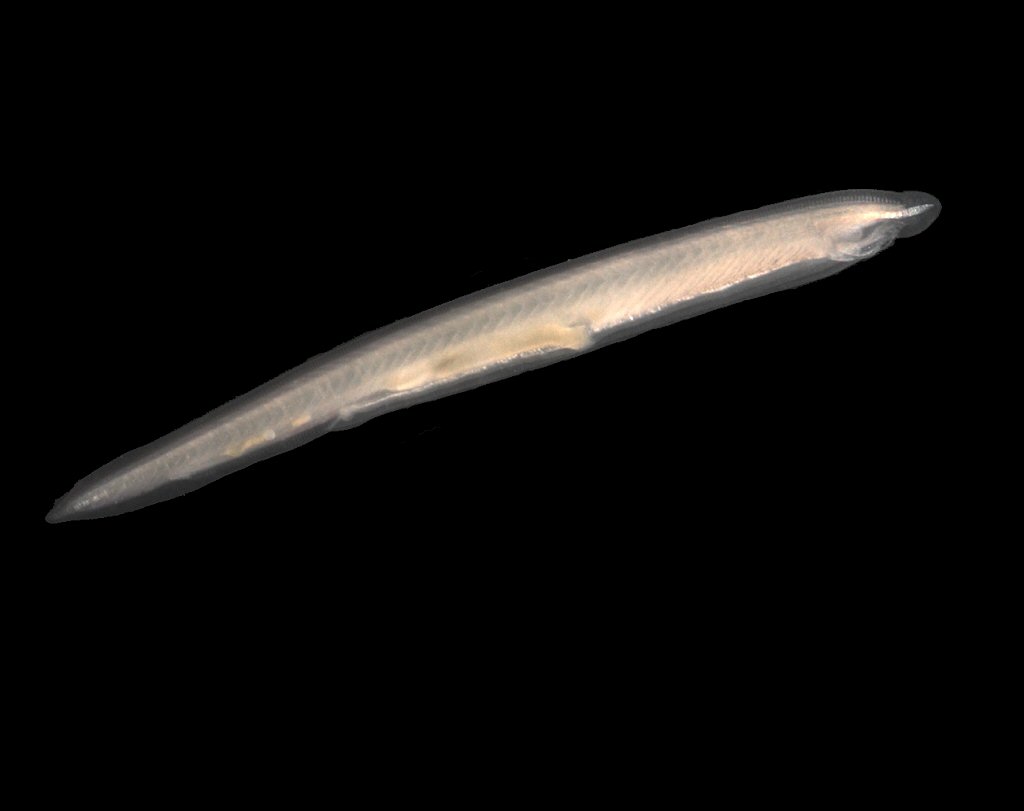
The lancelets (/ˈlænslɪt, ˈlɑːn-/ LA(H)N-slit), also known as amphioxi (sg.: amphioxus /ˌæmfiˈɒksəs/ AM-fee-OK-səs), consist of 32 described species of somewhat fish-like benthic filter-feeding chordates in the subphylum Cephalochordata, class Leptocardii, and family Branchiostomatidae.
Lancelets diverged from other chordates during or prior to the Cambrian period. A number of fossil chordates have been suggested to be closely related to lancelets, including Pikaia and Cathaymyrus from the Cambrian and Palaeobranchiostoma from the Permian, but their close relationship to lancelets has been doubted by other authors. Molecular clock analysis suggests that modern lancelets probably diversified much more recently, during the Cretaceous or Cenozoic.
They are of interest to zoologists as lancelets contain many organs and organ systems that are homologous to those of modern fish. Therefore, they provide a number of examples of possible evolutionary exaptation. For example, the gill-slits of lancelets are used for feeding only, and not for respiration. The circulatory system carries food throughout their body, but does not have red blood cells or hemoglobin for transporting oxygen.[citation needed]
Comparing the genomes of lancelets and vertebrates and their differences in gene expression, function and number can shed light on the origins of vertebrates and their evolution. The genome of a few species in the genus Branchiostoma have been sequenced: B. floridae, B. belcheri, and B. lanceolatum.
In Asia, lancelets are harvested commercially as food for humans. In Japan, amphioxus (B. belcheri) has been listed in the registry of "Endangered Animals of Japanese Marine and Fresh Water Organisms".
Adult amphioxus typically inhabit the seafloor, burrowing into well-ventilated substrates characterized by a soft texture and minimal organic content. While various species have been observed in different types of substrate, such as fine sand, coarse sand, and shell deposits, most exhibit a distinct preference for coarse sand with low levels of fine particles. For instance, Branchiostoma nigeriense along the west coast of Africa, Branchiostoma caribaeum in Mississippi Sound and along the coast from South Carolina to Georgia, B. senegalense in the Atlantic Ocean on the shelf region off North West Africa, and B. lanceolatum along the Mediterranean coast of southern France all demonstrate this preference. However, Branchiostoma floridae from Tampa Bay, Florida, appears to be an exception to this trend, favoring fine sand bottoms instead.
Their habitat preference reflects their feeding method: they only expose the front end to the water and filter-feed on plankton by means of a branchial ciliary current that passes water through a mucous sheet. Branchiostoma floridae is capable of trapping particles from microbial to small phytoplankton size, while B. lanceolatum preferentially traps bigger particles (>4 μm).
Lancelets are gonochoric animals, i.e. having two sexes, and they reproduce via external fertilisation. They only reproduce during their spawning season, which varies slightly between species — usually corresponding to spring and summer months. All lancelets species spawn shortly after sunset, either synchronously (e.g. Branchiostoma floridae, about once every two weeks during spawning season) or asynchronously (Branchiostoma lanceolatum, gradual spawning through the season). Rare instances of hermaphroditism have been reported in Branchiostoma lanceolatum and B. belcheri, where a small number of female gonads were observed within male individuals, typically ranging from 2 to 5 gonads out of a total of 45–50.[citation needed]
Lancelet
The lancelets (/ˈlænslɪt, ˈlɑːn-/ LA(H)N-slit), also known as amphioxi (sg.: amphioxus /ˌæmfiˈɒksəs/ AM-fee-OK-səs), consist of 32 described species of somewhat fish-like benthic filter-feeding chordates in the subphylum Cephalochordata, class Leptocardii, and family Branchiostomatidae.
Lancelets diverged from other chordates during or prior to the Cambrian period. A number of fossil chordates have been suggested to be closely related to lancelets, including Pikaia and Cathaymyrus from the Cambrian and Palaeobranchiostoma from the Permian, but their close relationship to lancelets has been doubted by other authors. Molecular clock analysis suggests that modern lancelets probably diversified much more recently, during the Cretaceous or Cenozoic.
They are of interest to zoologists as lancelets contain many organs and organ systems that are homologous to those of modern fish. Therefore, they provide a number of examples of possible evolutionary exaptation. For example, the gill-slits of lancelets are used for feeding only, and not for respiration. The circulatory system carries food throughout their body, but does not have red blood cells or hemoglobin for transporting oxygen.[citation needed]
Comparing the genomes of lancelets and vertebrates and their differences in gene expression, function and number can shed light on the origins of vertebrates and their evolution. The genome of a few species in the genus Branchiostoma have been sequenced: B. floridae, B. belcheri, and B. lanceolatum.
In Asia, lancelets are harvested commercially as food for humans. In Japan, amphioxus (B. belcheri) has been listed in the registry of "Endangered Animals of Japanese Marine and Fresh Water Organisms".
Adult amphioxus typically inhabit the seafloor, burrowing into well-ventilated substrates characterized by a soft texture and minimal organic content. While various species have been observed in different types of substrate, such as fine sand, coarse sand, and shell deposits, most exhibit a distinct preference for coarse sand with low levels of fine particles. For instance, Branchiostoma nigeriense along the west coast of Africa, Branchiostoma caribaeum in Mississippi Sound and along the coast from South Carolina to Georgia, B. senegalense in the Atlantic Ocean on the shelf region off North West Africa, and B. lanceolatum along the Mediterranean coast of southern France all demonstrate this preference. However, Branchiostoma floridae from Tampa Bay, Florida, appears to be an exception to this trend, favoring fine sand bottoms instead.
Their habitat preference reflects their feeding method: they only expose the front end to the water and filter-feed on plankton by means of a branchial ciliary current that passes water through a mucous sheet. Branchiostoma floridae is capable of trapping particles from microbial to small phytoplankton size, while B. lanceolatum preferentially traps bigger particles (>4 μm).
Lancelets are gonochoric animals, i.e. having two sexes, and they reproduce via external fertilisation. They only reproduce during their spawning season, which varies slightly between species — usually corresponding to spring and summer months. All lancelets species spawn shortly after sunset, either synchronously (e.g. Branchiostoma floridae, about once every two weeks during spawning season) or asynchronously (Branchiostoma lanceolatum, gradual spawning through the season). Rare instances of hermaphroditism have been reported in Branchiostoma lanceolatum and B. belcheri, where a small number of female gonads were observed within male individuals, typically ranging from 2 to 5 gonads out of a total of 45–50.[citation needed]
Recent media
Recent media