



Community hub
Recent from talks
Contribute something
Nothing was collected or created yet.
Chagan (nuclear test)
View on Wikipedia| Chagan | |
|---|---|
 | |
 | |
| Information | |
| Country | Soviet Union |
| Test site | Semipalatinsk Test Site |
| Date | January 15, 1965 |
| Number of tests | 124 |
| Test type | Underground test |
| Device type | Thermonuclear |
| Max. yield | Total yield 140 kilotons of TNT (590 TJ) |
| Test chronology | |
Chagan (Чага́н) was a Soviet underground nuclear test conducted at the Semipalatinsk Test Site on January 15, 1965.
Description
[edit]Chagan was the first and largest of the 124 detonations in the Nuclear Explosions for the National Economy program, designed to produce peaceful nuclear explosions (PNEs) for earth-moving purposes. The concept of using PNEs to create artificial lakes, harbors and canals was modeled after a United States program, Project Plowshare, which conducted the first peaceful nuclear explosion (the 104 kt Sedan shallow cratering test) at the Nevada Test Site in July 1962.
Described as a "near clone" of the Sedan shot, Chagan's yield was the equivalent of 140 kilotons of TNT and sought to produce a large conical crater suitable for a lake. The site was a dry bed of the Chagan River (tributary of Irtysh River) at the edge of the Semipalatinsk Test Site, and was chosen such that the lip of the crater would dam the river during its high spring flow. The resultant lake has a diameter of 408 m (1,339 ft) and is 100 m (330 ft) deep.
Shallow subsurface (open) cratering explosions such as Sedan or Chagan release a great deal of steam and pulverized rock along with approximately 20% of the device's fission products into the atmosphere. Although the vast majority of this fallout was deposited in the general area of the test, it also produced a small but measurable radioactive plume, which in Chagan's case was detected over Japan and initially prompted complaints from the US that the Soviets were violating the provisions of the October 1963 Limited Test Ban Treaty, which banned atmospheric tests and any vented (or "open") subsurface detonation which caused "radioactive debris to be present outside the territorial limits of the State under whose jurisdiction or control such explosion is conducted".[1]
The device itself was a low fission-fraction design,[2] meaning it produced only a small portion of its yield from fission and hence produced less fallout than a military device generally designed for low weight and/or size, and not fallout considerations.[3] The device had a primary (fission) stage of 5 to 7 kilotonnes of TNT (21 to 29 TJ) and a purely thermonuclear secondary stage.[2]
The photo of the Chagan shot is occasionally confused with that of the Soviet Joe 1 test. The correct image shows a squat, ground-level cloud similar to the Sedan shot rather than the tall mushroom cloud of the tower-detonated Joe-1.[4][5]

Lake Chagan
[edit]Lake Chagan or Lake Shagan,[6] also known as Balapan, is a lake created at the confluence of rivers Shagan and Ashchysu by the Chagan nuclear test roughly 10,000,000 m3 (8,100 acre⋅ft) in size, is still radioactive, and has been called the "Atomic Lake". As at the Trinity site of the first United States nuclear weapon test in Alamogordo, New Mexico, the exposed rock and sand was melted into a glassy substance called trinitite.
See also
[edit]- Sedan (nuclear test) – an American cratering detonation
References
[edit]- ^ "Library: Treaties: Partial Test Ban Treaty, October 10, 1963". Nuclear Files. 1963-10-10. Archived from the original on 2015-04-04. Retrieved 2014-06-01.
- ^ a b M. D. Nordyke (26 July 2000). The Soviet Program for Peaceful Uses of Nuclear Explosions (Report). Lawrence Livermore National Lab. p. 14. OSTI 793554. UCRL-ID-124410-Rev-2.
The nuclear explosive used for the Chagan test was reported to be a low-fission design, which had a pure thermonuclear secondary driven by a fission primary with a yield of about 5–7 kt.
- ^ Sublette, Carey. "Thermonuclear Weapon Designs - 4.5.4 Minimum Residual Radiation (MRR or "Clean") Designs". Nuclear Weapon Archive. Retrieved 9 February 2022.
- ^ Rhodes, Richard (1 August 1995), Dark Sun: The Making of the Hydrogen Bomb, OCLC 456652278, OL 2617721W, Wikidata Q105755363 – via Internet Archive
- ^ Holloway, David (1994). Stalin and the Bomb: The Soviet Union and Atomic Energy, 1939-1956 (1st ed.). Yale University Press. ISBN 978-0300060560. OCLC 470165274. OL 1084400M.
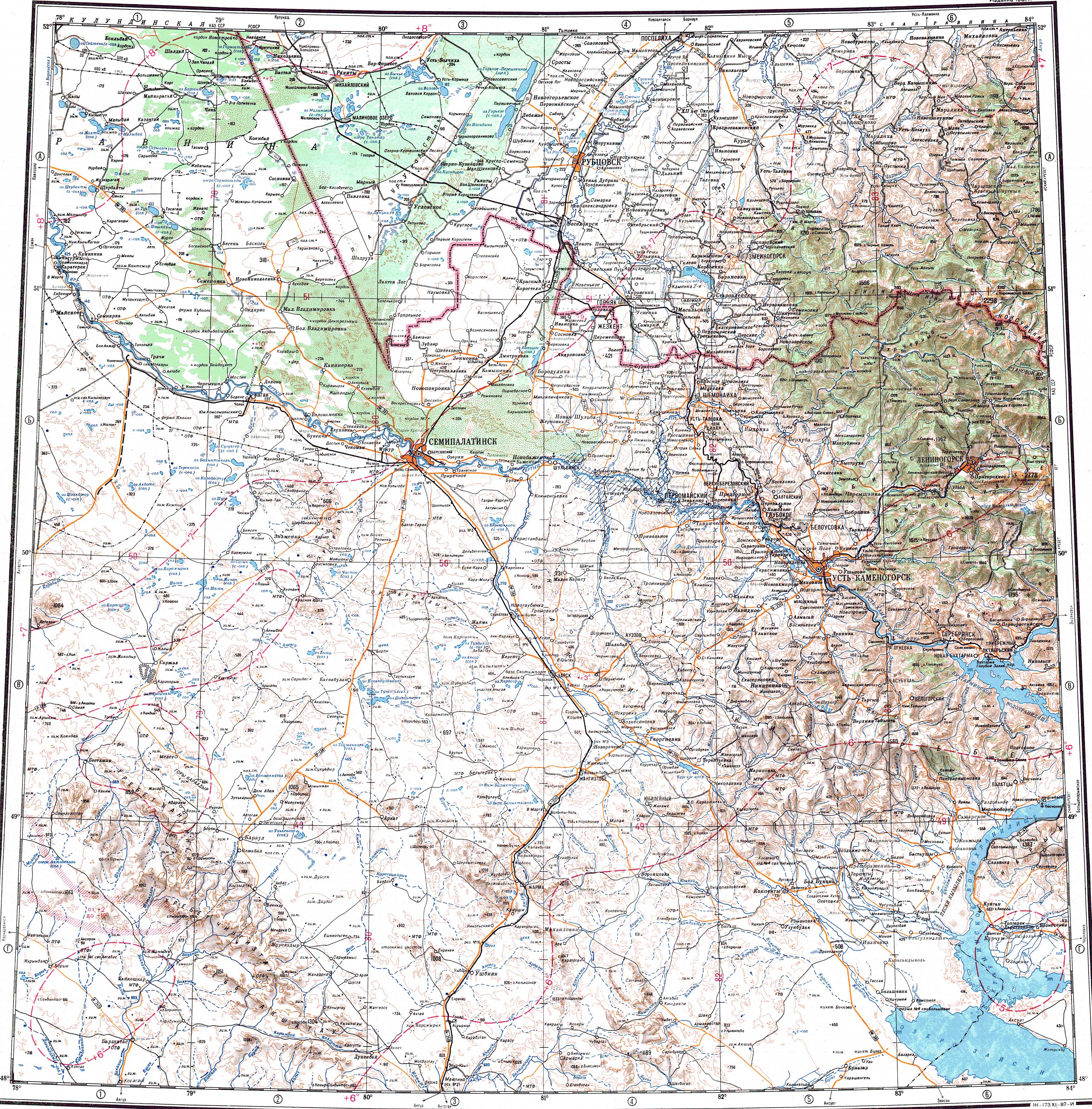
- ^ "M-44 Topographic Chart (in Russian)". Retrieved 4 October 2022.
External links
[edit]Chagan (nuclear test)
View on GrokipediaHistorical and Programmatic Context
Soviet Nuclear Explosions for the National Economy Program
The Soviet Nuclear Explosions for the National Economy (NEE) program, designated as Program No. 7, represented a systematic effort to repurpose nuclear explosives for civilian infrastructure projects, formally commencing in 1965.[6] This initiative drew inspiration from analogous U.S. efforts like Project Plowshare but expanded more aggressively, conducting 124 such explosions by 1988 to address industrial challenges including excavation, seismic stimulation, and hydrological engineering.[2][7] The program's core rationale centered on harnessing the immense energy release of nuclear devices—far exceeding conventional explosives—to execute feats unattainable otherwise, such as rapid earthmoving in vast, underdeveloped territories.[8] Key applications targeted resource constraints in arid and steppe regions, where traditional methods proved inefficient for large-scale water management and extraction.[9] In Kazakhstan's semi-desert landscapes, acute freshwater deficits prompted investigations into nuclear-induced cratering to form artificial basins, aiming to bolster irrigation and livestock support amid sparse natural hydrology.[10] Broader economic imperatives included canal construction for navigation and irrigation diversion, as well as fracturing rock formations to enhance oil, gas, and mineral recovery, reflecting a pragmatic calculus of nuclear yields against infrastructural bottlenecks in the Soviet periphery.[11] Early program phases emphasized empirical validation of explosion dynamics for containment and utility, with initial tests establishing baselines for yield-depth configurations suited to geological variability.[8] These precedents underscored the potential for controlled venting and fracturing to yield functional landforms, paving the way for specialized experiments like Chagan, which prioritized data on subsurface permeability and retention for sustained water impoundment in scarcity-prone areas.[2] Despite ambitions, the program's outputs often yielded mixed results due to unpredictable radioactivity dispersal and geological inconsistencies, though it amassed extensive datasets on explosion-induced modifications to aquifers and terrains.[11]Planning and Site Selection for Chagan
The site for the Chagan test was selected in 1964 at the Balapan sub-site of the Semipalatinsk Test Site, Kazakhstan, specifically in the dry bed of the Chagan River near its confluence with the Ashchysu River, owing to the area's flat topography, low population density, and geological composition of sand-clay sediments overlying tuffaceous sandstones and flinty siltstones, which provided stability for crater formation and water retention.[2][12] These sedimentary layers, with thicknesses of 3 to 100 meters, were assessed as conducive to excavating a contained depression that could impound seasonal river floods for irrigation under the Nuclear Explosions for the National Economy program.[12][1] Geological surveys, including borehole analyses of rock properties and gas content (4.5-18% in surrounding formations), informed the choice to prioritize hydraulic engineering outcomes over risks associated with atmospheric testing bans, aiming to demonstrate nuclear methods for reservoir creation in arid regions.[12] Pre-detonation modeling projected a crater approximately 400 meters wide and 100 meters deep, with a rim height of 20-38 meters sufficient to form a 10 million cubic meter reservoir by damming high-flow periods.[2] Preparation phases commenced with drilling a vertical shaft to 178 meters depth into the riverbed alluvium to ensure optimal energy coupling for ejection while attempting containment.[2][12] The nuclear device was then emplaced in this shaft, with stemming materials applied to mitigate venting, reflecting calculations based on empirical data from prior Soviet underground tests adapted for peaceful excavation goals.[12]Technical Specifications
Nuclear Device Design and Yield
The nuclear device detonated in the Chagan test was a two-stage thermonuclear weapon with a total explosive yield of 140 kilotons TNT equivalent.[9][8] This yield was achieved through a low-fission primary stage producing approximately 5 kilotons, which served to trigger a predominantly fusion-based secondary stage designed to minimize fission byproducts and associated radioactive fallout.[9] The fusion secondary was engineered as a "clean" component, relying on high-temperature compression and neutron flux from the primary to sustain deuterium-tritium reactions, thereby deriving the majority of the energy release from fusion processes rather than fission chain reactions.[9] This low-fission fraction represented an adaptation of Soviet thermonuclear technology tailored for non-military applications under the Peaceful Nuclear Explosions (PNE) program, contrasting with contemporary arsenal weapons that often incorporated higher fission contributions for enhanced neutron and blast effects in warfighting scenarios.[8] The design prioritized efficient energy coupling to the surrounding geology for excavation purposes, with internal tamping and structural optimizations to direct shock waves outward and upward, facilitating large-scale material displacement while curtailing deep penetration that could lead to containment failures.[9] Such features enabled the device's potential reuse in scalable infrastructure initiatives, like canal or reservoir formation, by reducing residual radioactivity that might otherwise limit post-detonation site usability.[8] Yield calibration for the Chagan device drew from prior Soviet testing data, ensuring the 140-kiloton output balanced excavation efficiency against geological constraints at the Semipalatinsk site, without relying on boosted fission primaries common in tactical yields.[9] Declassified assessments indicate the primary's implosion-type fissile core, likely plutonium-based, was minimized to the 5-kiloton threshold sufficient for secondary ignition, underscoring a deliberate engineering shift toward fusion-dominant profiles in PNE contexts.[8]Detonation Configuration and Parameters
The nuclear device for the Chagan test was emplaced in a vertical shaft drilled to a depth of 178 meters (584 feet) into sedimentary formations comprising stiff clay layers overlying sandstone at the Balapan sub-site of the Semipalatinsk Test Site.[13][8] This burial depth corresponded to a scaled depth-of-burial of approximately 42 meters per kiloton to the power of 1/3.4, intentionally shallow to ensure the detonation cavity would breach the surface and generate a large ejecta mound rather than a fully contained subsurface cavity.[8] The shaft was backfilled with overburden material and stemmed near the surface using compacted earth and possibly cement plugs to initially direct shock energy downward and laterally before allowing venting, thereby enhancing crater dimensions over cavity-dominated collapse.[12] Pre-test hydrodynamic simulations projected that roughly 50% of the detonation energy would contribute to rock vaporization, melting, and fracturing within the near-field zone, producing a vitrified glass layer and compacted rubble capable of forming a low-permeability barrier to support post-explosion water retention in the crater.[14] These models accounted for the site's geophysical inputs, including the clay's plasticity for absorbing shear and the sandstone's compressive strength for fracturing propagation, with the remaining energy partitioned into ejecta throw-out, seismic waves, and thermal effects to achieve the desired excavation profile for reservoir creation. To capture subsurface dynamics and verify predictive models, an instrumentation array including seismic accelerometers, pressure transducers in adjacent boreholes, and remote seismic stations was positioned at varying distances from ground zero, enabling real-time data on wave propagation, cavity pressure buildup, and energy coupling to the geology for refinement of scaling laws in subsequent nuclear excavation efforts.[12][15]Execution and Geological Outcomes
The January 15, 1965, Detonation
The Chagan nuclear detonation took place at 09:00 local time on January 15, 1965, in borehole 1004 beneath the dry bed of the Shagan River at the Semipalatinsk Test Site in Kazakhstan.[14] The event registered a seismic magnitude of approximately 6.0, detectable up to 4,300 kilometers away, with regional monitoring via the Borovoye Observatory capturing P-wave velocities and aftershocks extending 650–1,400 meters per kiloton to the one-third power from the epicenter.[14] Surface rupture occurred rapidly, ejecting approximately 10 million cubic meters of soil and debris to heights of up to 4.8 kilometers, forming an ejecta blanket 20–35 meters high within a 2-kilometer radius.[14] Initial ground surface velocity reached 100 meters per second, accelerating to an uplift velocity of 140 meters per second after 2.5 seconds, with maximum uplift height attaining 960 meters.[14] Gas venting commenced 2.5–5.5 seconds post-detonation, contributing to the dynamic expulsion of material.[14] Seismic and visual records documented the formation of an initial crater roughly 400–430 meters in diameter and 100 meters deep within seconds to tens of minutes, resulting from cavity expansion, collapse, and venting in the water-saturated sandstone and alluvium.[14][9] Extensive fracturing radiated outward, with intense zones extending 50–120 meters per kiloton to the one-third power and damage zones reaching 2–3 times the cavity radius vertically and 3–6 times the crater radius horizontally, along pre-existing discontinuities.[14] This fracturing enhanced hydraulic conductivity up to 1,000 times and permeability to 25–30 meters per day, directing pathways toward the adjacent riverbed and indicating preliminary alignment with objectives for reservoir creation via natural infilling from seasonal river flow.[14][1]Crater Formation and Initial Venting Effects
The Chagan detonation, conducted at a burial depth of 178 meters in sedimentary rock, generated a subsurface cavity through rapid expansion of high-pressure gases and vaporization of surrounding materials, leading to surface breaching and crater formation via gravitational collapse of the overlying strata. This process ejected approximately 10 million cubic meters of rubble, forming a crater with a diameter of 408 meters and an initial depth of 100 meters, rimmed by a mound of fragmented ejecta resulting from upward migration of vaporized rock. The mechanics mirrored those of comparable cratering experiments, where the explosion's energy fractured the overburden, causing subsidence and radial fracturing that confined major ejecta deposition locally. [16] A partial breach in the crater wall due to overburden instability facilitated hydraulic connection to the adjacent Shagan River, enabling subsequent infilling but altering the intended isolated reservoir morphology. This failure stemmed from the explosion's scaled depth-of-burial—approximately 90 meters per kiloton^(1/3)—being marginal for full containment in the heterogeneous geology, resulting in unintended venting through fracture networks and the open crater chimney. [9] The venting episode released an estimated 20% of produced fission products briefly into the atmosphere, violating expectations of underground containment despite the device's design emphasizing fusion over fission to minimize radioactive output. [9] Post-detonation cavity temperatures at ground zero surpassed 1,000°C, sustaining thermal effects that limited immediate ejecta dispersal, with fallout patterns indicating primary deposition within a 5-kilometer radius around the site. [16]Lake Chagan Development
Hydrological and Morphological Features
Following the January 1965 detonation, Lake Chagan filled rapidly through snowmelt accumulation and directed inflow from the Chagan River via a connecting channel, reaching a stabilized volume of approximately 10 million cubic meters by 1966. The lake's hydrological dynamics reflect episodic seasonal replenishment in the semi-arid steppe environment, with retention supported by the intact crater rim despite initial subsurface fracturing from the explosion.
Morphologically, the basin exhibits a near-circular form roughly 400 meters in diameter, with maximum water depths approaching 100 meters near the center, tapering toward the periphery. Natural sedimentation has progressively sealed explosion-induced fractures in the subsurface, contributing to the basin's long-term stability as a contained water body, even amid minor rim erosion from weathering and freeze-thaw cycles.[17]
The water body displays elevated salinity, with salt concentrations increasing over time due to high evaporation rates exceeding precipitation in the region, incorporating minerals from underlying evaporite-bearing strata. This renders the lake unsuitable for drinking but potentially applicable for non-potable purposes such as limited irrigation experiments, as assessed in post-formation evaluations.[17]
Engineering Performance Assessment
The Chagan test successfully created a reservoir with a total capacity of 10 million cubic meters, comprising 6.4 million cubic meters in the primary crater lake and additional storage behind the crater lip, fulfilling the Nuclear Explosions for the National Economy (NEE) program's objective of large-scale water impoundment in arid regions.[16] This outcome demonstrated nuclear cratering's high excavation efficiency in water-saturated siltstone, where the 140-kiloton device at 178 meters burial depth produced a crater 408 meters in diameter and 100 meters deep, displacing material far beyond conventional mechanical methods' capabilities in similar hard rock formations.[16] Initial crater volume exceeded predictions of 3-5 million cubic meters, validating energy coupling models for underground explosions in porous media.[16] Post-detonation subsidence reduced the reservoir's effective capacity by approximately 25%, highlighting limitations in predicting long-term structural stability of crater rims under gravitational settling and hydrological loading.[16] A rim breach facilitated unintended water flow but also enabled scalable fracturing patterns observable in the ejecta, providing empirical data for designing linear canal systems via row-cratering techniques in subsequent NEE experiments.[16] The test's scaled burial depth of 42 meters per kiloton to the power of 1/3.4 resulted in 20% venting of radioactive products, yet the overall geological disruption confirmed nuclear methods' superiority for rapid, large-volume earthmoving compared to conventional excavation, which would require years and immense resources for equivalent displacement.[9] These results informed refinements in later tests, such as adjusted depths in Sary-Uzen, establishing feasibility for replicable reservoir and canal projects despite containment challenges.[16]Radiation and Environmental Effects
Contamination Profiles and Measurement Data
The primary radionuclides associated with the Chagan test contamination are cesium-137 (¹³⁷Cs) and strontium-90 (⁹⁰Sr) in lake sediments and surrounding soils, alongside plutonium isotopes from incomplete containment during the January 15, 1965, detonation. Soil samples collected near Lake Chagan (also known as Atomic Lake) revealed ¹³⁷Cs activities ranging from 6.8 to 4500 Bq/kg, reflecting localized deposition from the surface outburst of radioactive ejecta. Plutonium concentrations in lake sediments reached up to 20 kBq/kg, with higher activities (up to 10⁶ Bq/kg) observed in vitrified or breccia-like materials ("Chaganite") formed by the explosion.[18][19][19] Hot particles, predominantly containing plutonium and other fission products, were identified within a 1-2 km radius of the crater, consistent with the camouflet design's partial containment that restricted aerosol dispersal beyond the immediate Balapan sub-site. These particles contributed to heterogeneous isotopic distributions, with gamma-emitting nuclides in ejecta exceeding 375 Bq/g, dominated by europium-152 alongside ¹³⁷Cs. Wide-area fallout was minimal, as confirmed by sediment core analyses showing bound residuals rather than uniform dispersion.[19][20] Soviet monitoring programs conducted annual sampling of soils, sediments, and water from the 1960s through the 1980s, documenting initial post-test dose rates at the crater rim of 200-300 mSv/h, which decayed over time due to weathering and radioactive half-lives. Post-independence Kazakh efforts, aligned with IAEA evaluations in the 1990s and 2000s, reported tritium activities in lake and groundwater exceeding 10 Bq/L in some samples, with ¹³⁷Cs in sediments projected to fall below Kazakhstan's maximum permissible soil activity (10 kBq/kg) within 20 years of early 2000s measurements. No acute elevation spikes were recorded after 2000, with IAEA site-wide assessments indicating localized hotspots at Balapan but near-background levels elsewhere.[21][22][23][24]| Radionuclide | Medium | Measured Activity Range | Source Period |
|---|---|---|---|
| ¹³⁷Cs | Soil near lake | 6.8–4500 Bq/kg | Post-1990s |
| Pu isotopes | Sediments | Up to 20 kBq/kg | 1960s–2000s |
| Tritium | Lake water | >10 Bq/L | 2000s |