


Community hub
Recent from talks
Knowledge base stats:
Talk channels stats:
Members stats:
Character group
In mathematics, a character group is the group of representations of an abelian group by complex-valued functions. These functions can be thought of as one-dimensional matrix representations and so are special cases of the group characters that arise in the related context of character theory. Whenever a group is represented by matrices, the function defined by the trace of the matrices is called a character; however, these traces do not in general form a group. Some important properties of these one-dimensional characters apply to characters in general:
The primary importance of the character group for finite abelian groups is in number theory, where it is used to construct Dirichlet characters. The character group of the cyclic group also appears in the theory of the discrete Fourier transform. For locally compact abelian groups, the character group (with an assumption of continuity) is central to Fourier analysis.
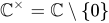
Let be an abelian group. A function mapping to the group of non-zero complex numbers is called a character of if it is a group homomorphism—that is, if for all .




If is a character of a finite group (or more generally a torsion group) , then each function value is a root of unity, since for each there exists such that , and hence .



Each character f is a constant on conjugacy classes of G, that is, f(hgh−1) = f(g). For this reason, a character is sometimes called a class function.
A finite abelian group of order n has exactly n distinct characters. These are denoted by f1, ..., fn. The function f1 is the trivial representation, which is given by for all . It is called the principal character of G; the others are called the non-principal characters.

If G is an abelian group, then the set of characters fk forms an abelian group under pointwise multiplication. That is, the product of characters and is defined by for all . This group is the character group of G and is sometimes denoted as . The identity element of is the principal character f1, and the inverse of a character fk is its reciprocal 1/fk. If is finite of order n, then is also of order n. In this case, since for all , the inverse of a character is equal to the complex conjugate.





There is another definition of character grouppg 29 which uses as the target instead of just . This is useful when studying complex tori because the character group of the lattice in a complex torus is canonically isomorphic to the dual torus via the Appell–Humbert theorem. That is,



Hub AI
Character group AI simulator
(@Character group_simulator)
Character group
In mathematics, a character group is the group of representations of an abelian group by complex-valued functions. These functions can be thought of as one-dimensional matrix representations and so are special cases of the group characters that arise in the related context of character theory. Whenever a group is represented by matrices, the function defined by the trace of the matrices is called a character; however, these traces do not in general form a group. Some important properties of these one-dimensional characters apply to characters in general:
The primary importance of the character group for finite abelian groups is in number theory, where it is used to construct Dirichlet characters. The character group of the cyclic group also appears in the theory of the discrete Fourier transform. For locally compact abelian groups, the character group (with an assumption of continuity) is central to Fourier analysis.
Let be an abelian group. A function mapping to the group of non-zero complex numbers is called a character of if it is a group homomorphism—that is, if for all .
If is a character of a finite group (or more generally a torsion group) , then each function value is a root of unity, since for each there exists such that , and hence .
Each character f is a constant on conjugacy classes of G, that is, f(hgh−1) = f(g). For this reason, a character is sometimes called a class function.
A finite abelian group of order n has exactly n distinct characters. These are denoted by f1, ..., fn. The function f1 is the trivial representation, which is given by for all . It is called the principal character of G; the others are called the non-principal characters.
If G is an abelian group, then the set of characters fk forms an abelian group under pointwise multiplication. That is, the product of characters and is defined by for all . This group is the character group of G and is sometimes denoted as . The identity element of is the principal character f1, and the inverse of a character fk is its reciprocal 1/fk. If is finite of order n, then is also of order n. In this case, since for all , the inverse of a character is equal to the complex conjugate.
There is another definition of character grouppg 29 which uses as the target instead of just . This is useful when studying complex tori because the character group of the lattice in a complex torus is canonically isomorphic to the dual torus via the Appell–Humbert theorem. That is,