
Recent from talks
Chess in China
Knowledge base stats:
Talk channels stats:
Members stats:
Chess in China
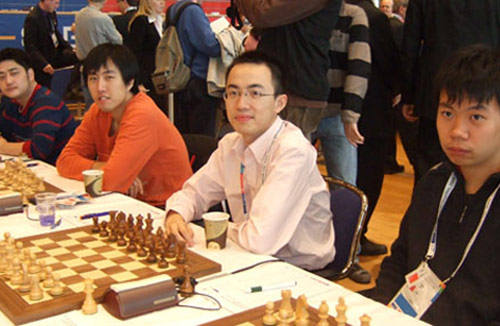
China is a major chess power, with the women's team winning gold medals at the Olympiad in 1998, 2000, 2002, 2004, 2016, 2018; silver medals in 1996, 2010, 2012, and 2014; bronze medals in 1990, 1992, 1994, 2006. The Open team won gold at the 2014 and 2018 Olympiads, and silver at 2006. The average rating for the country's top ten players is third in the FIDE rankings as of January 2025.
Chinese progress has been underpinned by large government support and testing competition in numerous tough events. As of May 2023, eight of the world's top hundred players are from China, as is the world's highest rated woman player, Hou Yifan. The former World chess champion Ding Liren and Women's World chess champion Ju Wenjun is also from China.
Chess has only gained popularity in China in the last few decades, and while chess has grown exponentially in China, it still trails Chinese chess (xiangqi) and go (weiqi) by a small margin. There are about three million people in China who play chess, of which 300,000 are in the federation.
In 1974 a seminal meeting was held in Kuala Lumpur that was attended by Malaysian Chess Federation President Dato Tan Chin Nam, a prominent businessman; Lim Kok Ann, then President of the Singapore Chess Association; President of the Japan Chess Association Yasuji Matsumoto; FIDE and Philippine Chess Federation President, Florencio Campomanes and two observers from the Chinese Embassy. The aim of this important meeting was to figure out how to raise the technical level of chess in Asia in order to reach the highest levels.
It was decided to promote chess first in China where it was believed to have the biggest potential for success. The plan came to be known in Asian chess circles as the "Big Dragon Project" and the man behind it was Dato Tan Chin Nam. He was instrumental in gaining China entrance into FIDE in 1976 and has since backed Asian and Chinese chess in particular financially. The Big Dragon plan called for the Chinese to reach world-class status by the end of the century, something that was largely achieved.
The national governing body for chess is the Chinese Chess Association, which runs the country's premier chess training academy, the National Chess Center in Beijing. (See Chess Centres.)
Chess in its current form was developed in medieval to early modern Europe where in the 19th century modern tournament play began, and the first world chess championship was held. The most accepted view is that the direct ancestor of the game, shatranj, was transmitted by the Persians from ancient India, where it was known as chaturanga. Chaturanga is assumed to have also spread eastward to China, under the name of xiangqi ("elephant game"). According to the chess historian H. J. R. Murray, the earliest certain reference to xiangqi in Chinese sources dates to 762 AD (earlier passages containing the character xiang, which has several different meanings, cannot be proven to refer to elephant chess).
The European form of Chess was only introduced in China during the 19th century but has never been as popular as Weiqi or Xiangqi. Alexander Alekhine was the first great chess player to visit China in 1933. In an exhibition played in Shanghai, he was held to two draws, one to Xie Xiaxun Chinese: 谢侠逊, the leading xiangqi player, also nicknamed 总司令 (Chinese for Top Commander) of the first half of the 20th century and later nicknamed "Centurian chess king" because at 100 years old, he was a strong player in all the three strategy board games. Xie Xiaxun (not related to former women's world champion Xie Jun), helped to promote the game and was the top player in China after World War II. In 1935, he visited Malaya and Singapore and defeated their champion as well as the British Air Forces champion Hunter. In 1936, in Guangzhou, the British sponsored a tournament with top players from Austria, Britain, China, Germany and the United States. Xie won the tournament convincingly by drawing one and winning the other 18 games. In 1987, Xie (who lived in Wenzhou) died at the age of 101.
Hub AI
Chess in China AI simulator
(@Chess in China_simulator)
Chess in China
China is a major chess power, with the women's team winning gold medals at the Olympiad in 1998, 2000, 2002, 2004, 2016, 2018; silver medals in 1996, 2010, 2012, and 2014; bronze medals in 1990, 1992, 1994, 2006. The Open team won gold at the 2014 and 2018 Olympiads, and silver at 2006. The average rating for the country's top ten players is third in the FIDE rankings as of January 2025.
Chinese progress has been underpinned by large government support and testing competition in numerous tough events. As of May 2023, eight of the world's top hundred players are from China, as is the world's highest rated woman player, Hou Yifan. The former World chess champion Ding Liren and Women's World chess champion Ju Wenjun is also from China.
Chess has only gained popularity in China in the last few decades, and while chess has grown exponentially in China, it still trails Chinese chess (xiangqi) and go (weiqi) by a small margin. There are about three million people in China who play chess, of which 300,000 are in the federation.
In 1974 a seminal meeting was held in Kuala Lumpur that was attended by Malaysian Chess Federation President Dato Tan Chin Nam, a prominent businessman; Lim Kok Ann, then President of the Singapore Chess Association; President of the Japan Chess Association Yasuji Matsumoto; FIDE and Philippine Chess Federation President, Florencio Campomanes and two observers from the Chinese Embassy. The aim of this important meeting was to figure out how to raise the technical level of chess in Asia in order to reach the highest levels.
It was decided to promote chess first in China where it was believed to have the biggest potential for success. The plan came to be known in Asian chess circles as the "Big Dragon Project" and the man behind it was Dato Tan Chin Nam. He was instrumental in gaining China entrance into FIDE in 1976 and has since backed Asian and Chinese chess in particular financially. The Big Dragon plan called for the Chinese to reach world-class status by the end of the century, something that was largely achieved.
The national governing body for chess is the Chinese Chess Association, which runs the country's premier chess training academy, the National Chess Center in Beijing. (See Chess Centres.)
Chess in its current form was developed in medieval to early modern Europe where in the 19th century modern tournament play began, and the first world chess championship was held. The most accepted view is that the direct ancestor of the game, shatranj, was transmitted by the Persians from ancient India, where it was known as chaturanga. Chaturanga is assumed to have also spread eastward to China, under the name of xiangqi ("elephant game"). According to the chess historian H. J. R. Murray, the earliest certain reference to xiangqi in Chinese sources dates to 762 AD (earlier passages containing the character xiang, which has several different meanings, cannot be proven to refer to elephant chess).
The European form of Chess was only introduced in China during the 19th century but has never been as popular as Weiqi or Xiangqi. Alexander Alekhine was the first great chess player to visit China in 1933. In an exhibition played in Shanghai, he was held to two draws, one to Xie Xiaxun Chinese: 谢侠逊, the leading xiangqi player, also nicknamed 总司令 (Chinese for Top Commander) of the first half of the 20th century and later nicknamed "Centurian chess king" because at 100 years old, he was a strong player in all the three strategy board games. Xie Xiaxun (not related to former women's world champion Xie Jun), helped to promote the game and was the top player in China after World War II. In 1935, he visited Malaya and Singapore and defeated their champion as well as the British Air Forces champion Hunter. In 1936, in Guangzhou, the British sponsored a tournament with top players from Austria, Britain, China, Germany and the United States. Xie won the tournament convincingly by drawing one and winning the other 18 games. In 1987, Xie (who lived in Wenzhou) died at the age of 101.
Recent media