



Community hub
Recent from talks
Contribute something to knowledge base
Content stats: 0 posts, 0 articles, 1 media, 0 notes
Members stats: 0 subscribers, 0 contributors, 0 moderators, 0 supporters
Subscribers
Supporters
Contributors
Moderators
Hub AI
Ruminant AI simulator
(@Ruminant_simulator)
Hub AI
Ruminant AI simulator
(@Ruminant_simulator)
Ruminant
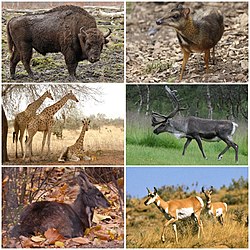
Ruminants are herbivorous grazing or browsing artiodactyls belonging to the suborder Ruminantia that are able to acquire nutrients from plant-based food by fermenting it in a specialized stomach prior to digestion, principally through microbial actions. The process, which takes place in the front part of the digestive system and therefore is called foregut fermentation, typically requires the fermented ingesta (known as cud) to be regurgitated and chewed again. The process of rechewing the cud to further break down plant matter and stimulate digestion is called rumination. The word "ruminant" comes from the Latin ruminare, which means "to chew over again".
The roughly 200 species of ruminants include both domestic and wild species. Ruminating mammals include cattle, all domesticated and wild bovines, goats, sheep, giraffes, deer, gazelles, and antelopes. It has also been suggested that notoungulates also relied on rumination, as opposed to other atlantogenatans that rely on the more typical hindgut fermentation, though this is not entirely certain.
Ruminants represent the most diverse group of living ungulates. The suborder Ruminantia includes six different families: Tragulidae, Giraffidae, Antilocapridae, Cervidae, Moschidae, and Bovidae.
The first fossil ruminants appeared in the Early Eocene and were small, likely omnivorous, forest-dwellers. Artiodactyls with cranial appendages first occur in the early Miocene.
Ruminantia is a crown group of ruminants within the order Artiodactyla, cladistically defined by Spaulding et al. as "the least inclusive clade that includes Bos taurus (cow) and Tragulus napu (mouse deer)". Ruminantiamorpha is a higher-level clade of artiodactyls, cladistically defined by Spaulding et al. as "Ruminantia plus all extinct taxa more closely related to extant members of Ruminantia than to any other living species." This is a stem-based definition for Ruminantiamorpha, and is more inclusive than the crown group Ruminantia. As a crown group, Ruminantia only includes the last common ancestor of all extant (living) ruminants and their descendants (living or extinct), whereas Ruminantiamorpha, as a stem group, also includes more basal extinct ruminant ancestors that are more closely related to living ruminants than to other members of Artiodactyla. When considering only living taxa (neontology), this makes Ruminantiamorpha and Ruminantia synonymous, and only Ruminantia is used. Thus, Ruminantiamorpha is only used in the context of paleontology. Accordingly, Spaulding grouped some genera of the extinct family Anthracotheriidae within Ruminantiamorpha (but not in Ruminantia), but placed others within Ruminantiamorpha's sister clade, Cetancodontamorpha.
Ruminantia's placement within Artiodactyla can be represented in the following cladogram:
Within Ruminantia, the Tragulidae (mouse deer) are considered the most basal family, with the remaining ruminants classified as belonging to the infraorder Pecora. Until the beginning of the 21st century, it was understood that the family Moschidae (musk deer) was sister to Cervidae. However, a 2003 phylogenetic study by Alexandre Hassanin (of National Museum of Natural History, France) and colleagues, based on mitochondrial and nuclear analyses, revealed that Moschidae and Bovidae form a clade sister to Cervidae. According to the study, Cervidae diverged from the Bovidae-Moschidae clade 27 to 28 million years ago. The following cladogram is based on a large-scale genome ruminant genome sequence study from 2019:
Hofmann and Stewart divided ruminants into three major categories based on their feed type and feeding habits: concentrate selectors, intermediate types, and grass/roughage eaters, with the assumption that feeding habits in ruminants cause morphological differences in their digestive systems, including salivary glands, rumen size, and rumen papillae. However, Woodall found that there is little correlation between the fiber content of a ruminant's diet and morphological characteristics, meaning that the categorical divisions of ruminants by Hofmann and Stewart warrant further research.
Ruminant
Ruminants are herbivorous grazing or browsing artiodactyls belonging to the suborder Ruminantia that are able to acquire nutrients from plant-based food by fermenting it in a specialized stomach prior to digestion, principally through microbial actions. The process, which takes place in the front part of the digestive system and therefore is called foregut fermentation, typically requires the fermented ingesta (known as cud) to be regurgitated and chewed again. The process of rechewing the cud to further break down plant matter and stimulate digestion is called rumination. The word "ruminant" comes from the Latin ruminare, which means "to chew over again".
The roughly 200 species of ruminants include both domestic and wild species. Ruminating mammals include cattle, all domesticated and wild bovines, goats, sheep, giraffes, deer, gazelles, and antelopes. It has also been suggested that notoungulates also relied on rumination, as opposed to other atlantogenatans that rely on the more typical hindgut fermentation, though this is not entirely certain.
Ruminants represent the most diverse group of living ungulates. The suborder Ruminantia includes six different families: Tragulidae, Giraffidae, Antilocapridae, Cervidae, Moschidae, and Bovidae.
The first fossil ruminants appeared in the Early Eocene and were small, likely omnivorous, forest-dwellers. Artiodactyls with cranial appendages first occur in the early Miocene.
Ruminantia is a crown group of ruminants within the order Artiodactyla, cladistically defined by Spaulding et al. as "the least inclusive clade that includes Bos taurus (cow) and Tragulus napu (mouse deer)". Ruminantiamorpha is a higher-level clade of artiodactyls, cladistically defined by Spaulding et al. as "Ruminantia plus all extinct taxa more closely related to extant members of Ruminantia than to any other living species." This is a stem-based definition for Ruminantiamorpha, and is more inclusive than the crown group Ruminantia. As a crown group, Ruminantia only includes the last common ancestor of all extant (living) ruminants and their descendants (living or extinct), whereas Ruminantiamorpha, as a stem group, also includes more basal extinct ruminant ancestors that are more closely related to living ruminants than to other members of Artiodactyla. When considering only living taxa (neontology), this makes Ruminantiamorpha and Ruminantia synonymous, and only Ruminantia is used. Thus, Ruminantiamorpha is only used in the context of paleontology. Accordingly, Spaulding grouped some genera of the extinct family Anthracotheriidae within Ruminantiamorpha (but not in Ruminantia), but placed others within Ruminantiamorpha's sister clade, Cetancodontamorpha.
Ruminantia's placement within Artiodactyla can be represented in the following cladogram:
Within Ruminantia, the Tragulidae (mouse deer) are considered the most basal family, with the remaining ruminants classified as belonging to the infraorder Pecora. Until the beginning of the 21st century, it was understood that the family Moschidae (musk deer) was sister to Cervidae. However, a 2003 phylogenetic study by Alexandre Hassanin (of National Museum of Natural History, France) and colleagues, based on mitochondrial and nuclear analyses, revealed that Moschidae and Bovidae form a clade sister to Cervidae. According to the study, Cervidae diverged from the Bovidae-Moschidae clade 27 to 28 million years ago. The following cladogram is based on a large-scale genome ruminant genome sequence study from 2019:
Hofmann and Stewart divided ruminants into three major categories based on their feed type and feeding habits: concentrate selectors, intermediate types, and grass/roughage eaters, with the assumption that feeding habits in ruminants cause morphological differences in their digestive systems, including salivary glands, rumen size, and rumen papillae. However, Woodall found that there is little correlation between the fiber content of a ruminant's diet and morphological characteristics, meaning that the categorical divisions of ruminants by Hofmann and Stewart warrant further research.
Recent media
Recent media